6 month backend development internship in Jalandhar
Explore 6 Month Backend Development Internship in Jalandhar at Techcadd. Learn server-side programming, APIs, databases, authentication and practical projects.
On this page
- Go Behind the Scenes of Modern Applications
- Learn to Think Like a Backend Developer
- Choose a Programming Language and Build Your Foundation
- Create Server-Side Features With Backend Frameworks
- Understand How APIs Allow Applications to Communicate
- Organise Information With Database Management
- Add User Accounts and Authentication
- Handle Errors and Keep Applications Reliable
- Connect the Different Parts of an Application
- Work on Projects That Demonstrate Backend Skills
- Get Introduced to Deployment and Application Maintenance
- Who Can Consider This Internship?
- Explore Career Paths in Backend Development
- Take Your Next Step With Techcadd Jalandhar
Go Behind the Scenes of Modern Applications
When you log in to an app, place an online order or save information to your account, a lot happens behind the screen. The application needs to process your request, check the relevant information, communicate with a database and return the correct response. Backend development makes these operations possible.
The 6 Month Backend Development Internship in Jalandhar is intended for students, graduates and aspiring programmers who want to understand how the server-side of an application works. It offers a learning path for exploring programming logic, data handling, APIs and the systems that support modern websites and applications.
If you are considering this programme at Techcadd, ask about the available technologies, practical assignments, project work and whether the internship includes supervised industry experience or simulated training projects.
Learn to Think Like a Backend Developer
Backend development begins with understanding what an application needs to do. Before writing code, a developer must consider the information the system receives, the rules it follows and the response it should provide.
Imagine a college management system that stores student details. It must accept new records, check the submitted information, retrieve existing data and update details when required. Each operation needs clear logic and appropriate handling of errors.
Learners can practise breaking such requirements into smaller tasks and designing the steps needed to complete them. This develops a problem-solving approach that is useful when moving from simple programming exercises to more complex application features.
Choose a Programming Language and Build Your Foundation
A backend developer needs a programming language to define application behaviour. The language used depends on the type of application, the development environment and the project requirements.
Depending on the syllabus, learners may explore Python, Java, JavaScript with Node.js, PHP or another backend technology. Core programming concepts can include variables, data types, functions, conditional statements, loops, data structures and error handling.
Practical exercises help students understand how these concepts work together. They might write a program to process records, calculate totals, validate input or organise information before moving towards more advanced server-side tasks.
Create Server-Side Features With Backend Frameworks
Programming languages provide the foundation, while backend frameworks help organise application code and build common features more efficiently.
Depending on the chosen technology, a programme may introduce tools such as Node.js with Express, Django or Flask for Python, or a Java-based backend framework. Learners can explore how a server receives requests, processes them and sends responses to the application making the request.
They may also practise creating routes, separating application logic into manageable sections and returning suitable responses for different situations. The exact framework and depth of coverage should be confirmed from the current course syllabus.
Understand How APIs Allow Applications to Communicate
Many digital products rely on multiple systems working together. A website might request account information from a server, a mobile app may retrieve product details, or a dashboard could receive updated figures from another service.
APIs provide defined ways for applications to exchange information. Backend learners can explore how requests and responses work, how endpoints are organised and how data is commonly exchanged in formats such as JSON.
Depending on the programme, practical exercises may include building simple API endpoints, retrieving records and handling invalid requests. These activities help explain how a frontend or mobile application communicates with the backend.
Organise Information With Database Management
A useful application often needs to remember information between sessions. Customer profiles, product details, booking records and transaction histories must be stored in a way that makes them easy to retrieve and maintain.
Backend development introduces the connection between application logic and databases. Learners can explore database design, tables, records, relationships and queries. Depending on the technology stack, the course may include SQL databases such as MySQL or PostgreSQL, or NoSQL tools such as MongoDB.
Practical tasks can demonstrate how an application creates, reads, updates and deletes records. Students can also learn why organised data structures and appropriate database queries matter as applications become more complex.
Add User Accounts and Authentication
Many applications need to distinguish between users and control what each person can access. For example, an administrator may manage records, while a regular user can view only their own information.
Authentication helps establish who a user is, while authorisation determines which actions that user is permitted to perform. Learners can explore these concepts through login workflows, access rules and basic session or token-based authentication, depending on the syllabus.
Security should be considered from the beginning rather than added as an afterthought. Students can also learn about input validation, safe handling of credentials and the importance of protecting sensitive information.
Handle Errors and Keep Applications Reliable
A backend system must deal with more than successful requests. A user may submit incomplete information, a database may be temporarily unavailable or an API request may contain invalid data.
Learners can practise validating inputs, returning meaningful error responses, reading logs and investigating unexpected behaviour. They can also explore basic testing techniques to check whether functions and endpoints behave as intended.
Working through these situations helps students understand that dependable software requires careful checking, not just code that works in one ideal situation.
Connect the Different Parts of an Application
A complete application usually combines several components: the user interface, server-side logic, data storage and sometimes external services. Backend development involves making sure these parts exchange information correctly.
Through guided exercises, learners can explore how a request travels from a frontend interface to a server, how the server processes it and how the result is returned. They may also work with API testing tools, environment settings and configuration files, depending on the programme.
This broader view helps students understand where backend code fits within the complete software development process.
Work on Projects That Demonstrate Backend Skills
Projects give learners a chance to combine programming, databases, APIs and testing in one application. They also reveal how different decisions affect the way a system works.
Possible practice projects include a student record management system, an inventory API, an appointment booking backend, a task management service or a basic user registration system. The projects offered will depend on the actual syllabus and the learner's progress.
Students can practise documenting their endpoints, testing different inputs and explaining how the application stores and processes information. Where appropriate, they can use Git and GitHub to track code changes and maintain a record of their work.
Get Introduced to Deployment and Application Maintenance
An application that runs on a developer's computer may need additional configuration before other people can use it. Deployment involves preparing the application to run in a suitable environment and making it accessible to its intended users.
Depending on the programme, learners may be introduced to environment variables, configuration settings, hosting fundamentals, logs and basic deployment workflows. They can also explore why applications need updates and ongoing maintenance after their initial release.
These topics provide a starting point for understanding how backend development continues beyond writing and testing code.
Who Can Consider This Internship?
The 6 Month Backend Development Internship in Jalandhar may be suitable for:
B.Tech, BCA and MCA students interested in server-side programming
Computer science students who want to practise application logic
Graduates exploring backend development careers
Freshers building their programming foundation
Learners interested in APIs, databases and application architecture
Aspiring developers who want to create functional software projects
Prior programming experience may be helpful, depending on the technology stack. Beginners should confirm whether the programme starts with programming fundamentals or expects familiarity with a language.
Explore Career Paths in Backend Development
Backend development skills can support further learning towards roles such as junior backend developer, trainee software developer, API developer or server-side programmer. Some learners may later explore full-stack development, database engineering or cloud-based application development.
The technologies required vary between employers and projects. Building a portfolio, understanding the code you write, practising problem-solving and learning how to explain technical decisions can help you prepare for entry-level opportunities.
Completing a six-month programme does not guarantee employment or placement. Career outcomes depend on practical skills, experience, project quality, qualifications and employer requirements.
Take Your Next Step With Techcadd Jalandhar
If you are interested in what happens behind a website or application, backend development can be a valuable technical area to explore. Start with programming fundamentals, practise working with data and gradually learn how servers, APIs and databases work together.
If you are searching for a 6 Month Backend Development Internship in Jalandhar, contact Techcadd to discuss the current programme. Ask for the detailed syllabus, practical project requirements, internship format, mentor support and any assessment or certification details before enrolling.
A clear learning plan and consistent hands-on practice can help you build a stronger foundation in backend programming.
Build the Logic Behind Powerful Applications
Explore server-side programming, database management, API development, authentication and application testing through structured learning and practical software projects.
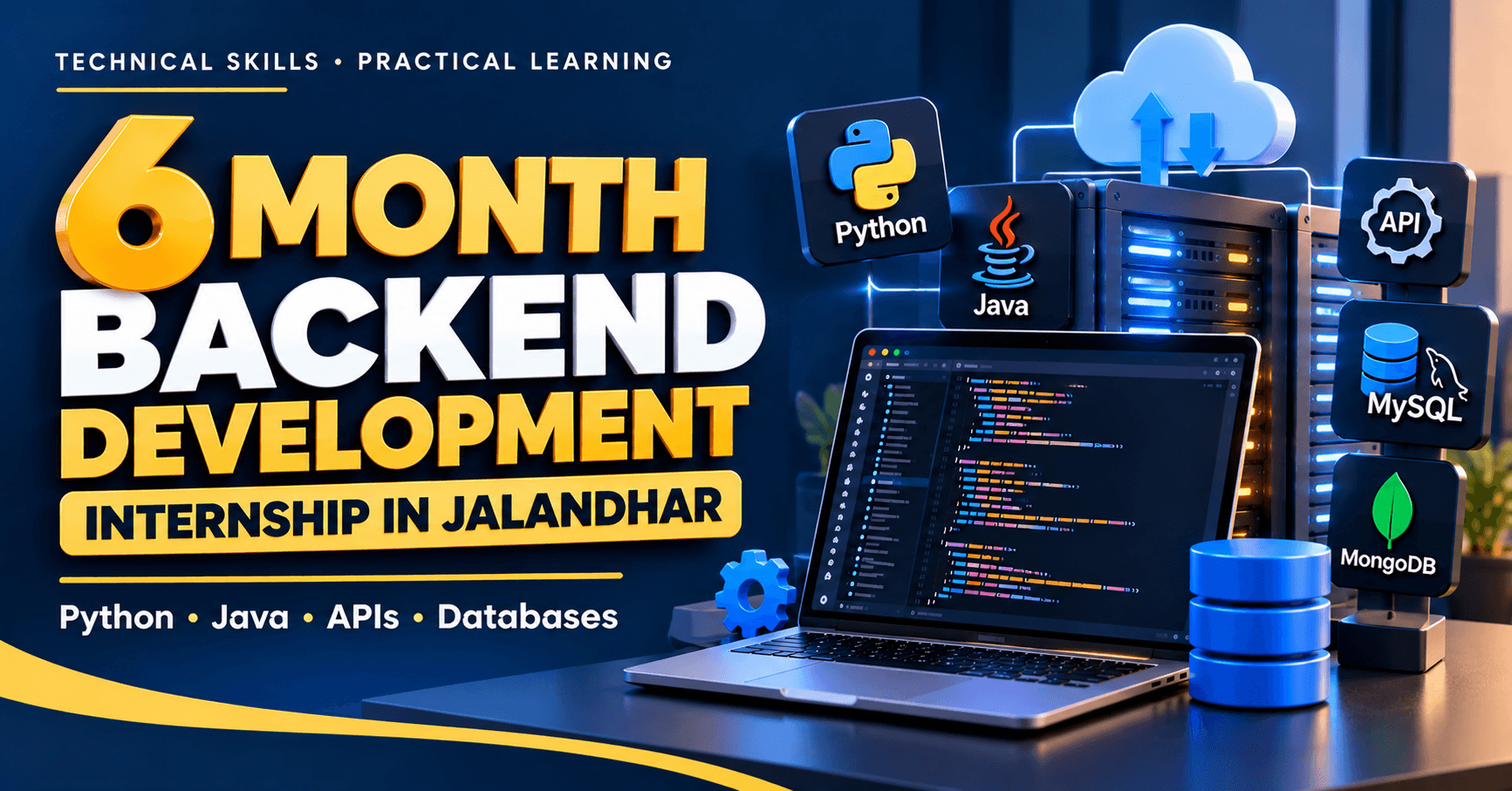
Learn how applications process data, communicate with servers and deliver reliable results through backend development practice.
Explore Backend DevelopmentHave a questionabout this?
Leave your number and a counsellor will call you back — about batch timings, fees, EMI options, placement record, or which track fits your degree.
- Free career counselling, no registration fee
- Weekday, evening, weekend or 1-on-1 batches
- Internship letter and placement support
Ready to get started?
Start building yourcareer today.
Talk to a counsellor today. One call is usually enough to know which track fits your degree, your schedule and the job you want.
- Free career counselling
- No registration fee
- Placement support included