Best After 12th 3-Month Agentic AI Program in Jalandhar
Thirteen weeks that take you from your first line of Python to an autonomous agent running in public, with citations, guardrails and a cost-per-conversation figure behind it. No programming experience assumed.
Agentic AI Program Course in Jalandhar
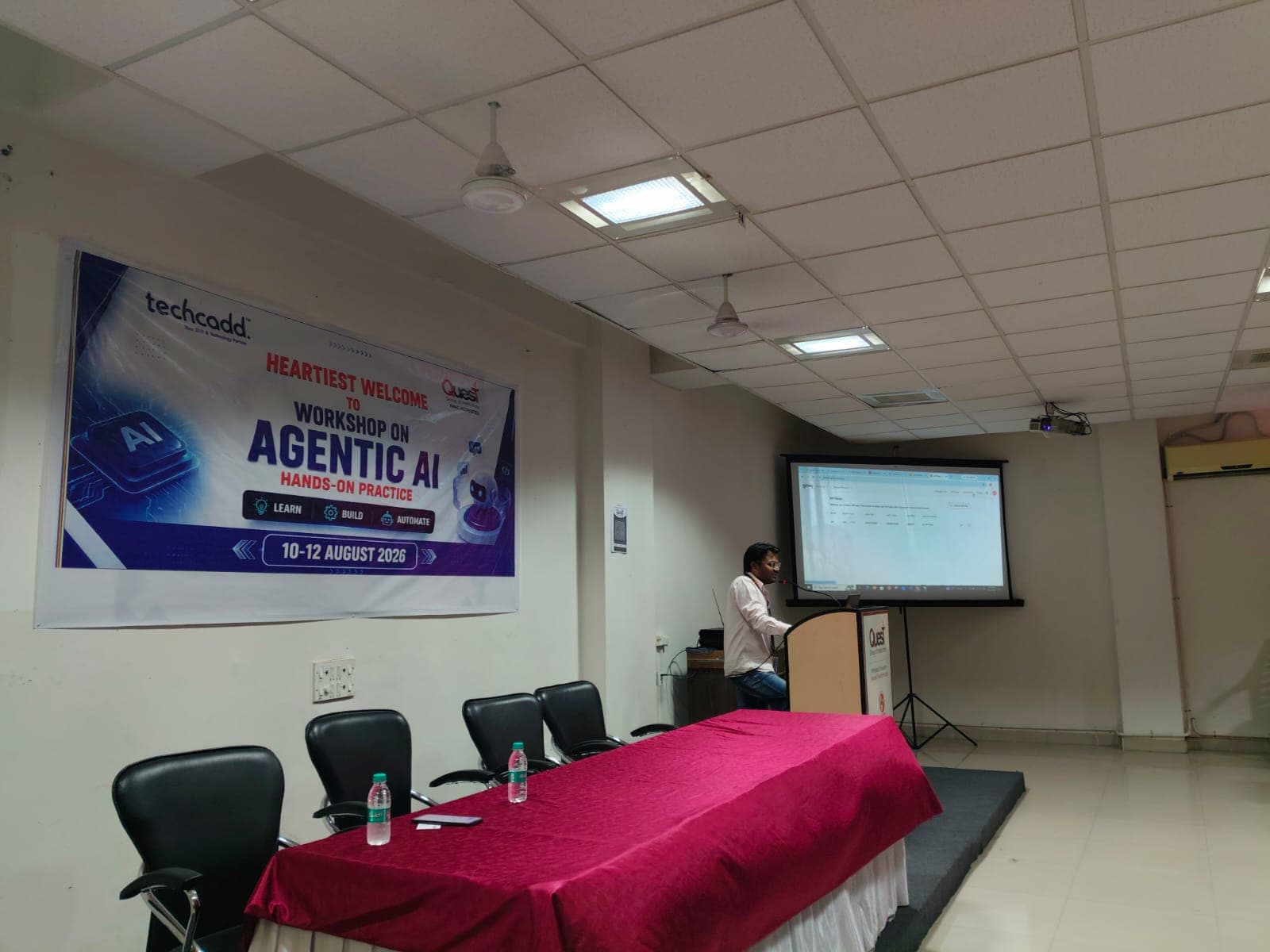
Enrol in the 3-Month Agentic AI Practitioner program after 12th at techcadd Jalandhar (4.9★, 556+ reviews). Seven modules from Python, Git and databases through tool calling, MCP servers, RAG with citations, memory, LangGraph orchestration and a deployed agent capstone. No programming background required.
Key Highlights :
- Duration: 3 Months
- Modules: 7
- Eligibility: 12th Pass, Any Stream
- Includes: Certificate + Placement Support
Course Overview
A language model answers. An agent decides. Give it a goal and it plans its own next step, calls a real tool, reads what came back, and goes again — until the goal is met, the budget runs out, or it asks a human. The three-month Practitioner track is Stage 1 of techcadd's agent ladder: seven modules that take that loop from an idea to something running in production.
Module 01 begins with Python, the command line, Git, HTTP and SQL taught from the ground up, which is what makes the programme open to career changers and to students straight out of 12th with no coding background. From Module 02 onward, every session is agent engineering. Progression is capability-gated — you advance when a deliverable passes review, not when the calendar says so — and every module specifies the same four things: the topics in teaching order, the named tool stack used in the labs, the commercial problem the pattern is bought to solve, and the artefact you keep.
What You'll Learn
Every module ends in something you have built and a trainer has reviewed, so the list below is work you will have done rather than topics you will have heard about.
- 01
Two weeks of programming, then agents
Python, Git, HTTP and SQL before a single prompt. From Module 02 onward every session is agent engineering, which is only possible because the foundation is real.
- 02
ReAct written by hand before any framework
Module 03 builds the reason-act-observe loop from scratch. When LangGraph arrives in Module 06 you can already read what it is doing for you.
- 03
Citations that a reviewer can check
The RAG module is graded on RAGAS faithfulness and context precision against a 50-question gold set, not on whether the answer sounded right.
- 04
A capstone that is publicly reachable
The final two weeks deploy the agent, gate it behind an eval suite in CI, and put a cost-per-conversation number next to it — the three things an interviewer actually asks about.
Course Curriculum
Seven modules in teaching order. Each one names its topics, the tool stack used in its labs, the commercial problem it solves and the artefact you finish it with.
Programming Foundations — From Absolute Zero — Weeks 1–2
- 1
Python from the first line: syntax, variables, data structures, loops, functions, modules, files and error handling; classes and objects; type hints and dataclasses; decorators.
- 2
Async and await, and why network-bound code needs it; virtual environments with uv and pip.
- 3
The command line: navigation, environment variables, permissions, processes and piping.
- 4
Git and GitHub: commits, branches, merges, conflicts, pull requests and .gitignore.
- 5
The web: HTTP verbs, status codes, headers, JSON, REST, webhooks, API keys and bearer tokens.
- 6
Databases: SQL SELECT and JOIN, primary keys and indexes; key-value stores. Reading documentation and debugging systematically.
- 7
Tool stack: Python · uv · VS Code · Git · GitHub · httpx · FastAPI · PostgreSQL · Redis · Postman · Docker · Jupyter
- 8
Real use: the engineer's starting kit — a small REST service reading and writing to Postgres, containerised and pushed to GitHub with tests running in CI.
- 9
Deliverable: containerised FastAPI service with a database, typed models, passing tests in GitHub Actions, and a README a stranger can follow.
Tools you will actually work in
Everything here is installed on the lab machines and used on live client work, not shown once in a slide and forgotten.
- GPTLLChFA
Who can do this course
Students straight after 12th
Join from any stream. There is no assumed technical knowledge and no programming prerequisite. Most students run the programme alongside a degree at a Jalandhar college using the weekday or weekend batch.
Graduates and final-year students
If you are finishing a BCA, B.Sc, BBA or B.Tech, this is the shortest route from degree to an AI automation role. You enter placement season with a deployed agent and an evaluation report instead of a blank CV.
Career changers
The weekend batch exists for people already earning. Thirteen weeks is enough to become interview-ready for AI Automation Engineer and Agentic AI Developer roles without leaving your current job.
Developers and analysts
If you already write code or work with data, the foundations module is revision and the pace picks up from Module 02. What changes your title is the part most self-taught developers skip — evaluation, guardrails and cost.
Why this programme is worth your year
Foundations before frameworks
Python, the command line, Git, HTTP and SQL occupy the first two weeks. Every agent pattern after that is something you can reason about rather than copy, because you already understand the request, the schema and the commit graph underneath it.
The loop, written by hand
Module 03 implements ReAct from scratch with no framework at all. Frameworks arrive in Module 06, by which point you can read what they are doing — which is the difference between using LangGraph and being trapped by it.
Evidence is the deliverable
Anyone can demo an agent that works once. Seven modules, seven graded artefacts — a labelled evaluation set, a measured before-and-after and a cost-per-task number are what get people hired.
A ladder, not a dead end
These seven modules are the permanent foundation of the six- and nine-month tracks. Nothing is removed when you extend later; Stage 2 begins exactly where this ends, so you never restart.
Automate. Assist. Achieve.
- An agent is defined by four properties: it is goal-directed, so you give it an outcome rather than a script; it uses tools, reaching outside the model to APIs, databases, browsers and code; it has memory, carrying state across steps and sessions; and it has autonomy, running its own loop within the budgets and approval gates you set.
- That is why the job exists. Someone has to decide which problems need an agent, wire the tools so they cannot be misused, ground the answers in real documents, and prove the whole thing works with numbers before it touches a customer.
Get certified in Agentic AI Program
Complete the course with a portfolio of live projects and receive an industry-recognised certificate, plus a documented internship letter accepted by Punjab universities.
 Computer Education · JalandharCertificateof Project ExcellenceThis is to certify thatStudent Name
has designed, built and deployed a live capstone project in Agentic AI Program, reviewed and graded under industry mentorship.
Computer Education · JalandharCertificateof Course CompletionThis is to certify thatStudent Namehas successfully completed the professional training programme in Agentic AI Program with a grade of A+.
Two certificates on completion — the course certificate and a separate capstone project certificate.
Where this course takes you
The roles this opens, what they pay in Punjab and beyond, and who is hiring for them — the same figures our free Salary Estimator publishes, not a brochure number.
Entry level, and the most common first destination from this stage. Interviews test whether you can wire tools reliably, handle failures gracefully and show a working deployed demo. Show: the MCP server, the cited RAG assistant and the deployed capstone.
Early career. Interviews test framework fluency, RAG quality debugging and human-in-the-loop design. Show: the approval-gated graph agent, the extraction engine and the eval CI gate.
The role that sits between the customer and the build. You demonstrate agents, scope what is feasible and prototype it — which is exactly the shape of the seven deliverables in this stage.
Day-two work on a live agent: reading traces, triaging failed tool calls, curating evaluation sets from real traffic and escalating what the guardrails caught. Every one of those is a module in this stage.
Hands-on projects you will ship
Containerised API Service
A FastAPI service backed by Postgres, typed and tested, shipped in Docker with CI running on every push.
Document Extraction Engine
Unstructured invoices and contracts converted into schema-valid JSON with under 2% validation failure across 100 documents.
Published MCP Server
Five or more scoped tools with full schema documentation, integration tests and a hand-written ReAct loop that uses them without a framework.
Cited Compliance Copilot
Hybrid-search RAG assistant with clause-level citations, scoring 0.85+ faithfulness on a 50-question gold set.
Human-in-the-Loop Approval Agent
A stateful graph agent that pauses for underwriter sign-off, streams every step, and resumes cleanly after a crash.
Deployed Support Agent
Publicly reachable capstone with CRM write-back, human escalation, a CI regression gate and a cost-per-conversation figure.
Learn it. Build it. Make it yours.
Every project moves through the same loop: understand the brief, build with guidance, then explain the decisions behind your work.
Understand
Break a real requirement into a clear plan and the right tools.
Containerised API ServiceBuild
Work hands-on with trainer feedback while the decisions are still easy to change.
Document Extraction EnginePresent
Turn the finished work into a portfolio story you can defend in an interview.
Published MCP ServerWhy students choose techcadd
Nine campuses across Punjab, 4.9★ from 556+ reviews, and a syllabus that is republished each year rather than reprinted.
Capability-gated, not calendar-gated
You advance when a deliverable passes review. A student who needs an extra week on retrieval gets it; nobody is moved on because the timetable says Week 8.
Real model APIs, with budgets
Labs run against live Claude, OpenAI and Gemini endpoints with per-student token budgets and cost dashboards — so the cost mental model in Module 02 is something you have felt, not read.
Trainers who still ship
The people teaching MCP servers and LangGraph checkpointing are the people writing them for client work, which is why the failure sections cover failures that actually happen.
A ladder you can extend
Finish here with a certificate and a deployed capstone, or continue into the six- and nine-month tracks later. Stage 2 starts where Stage 1 ended — you never repeat a module you have already passed.
Frequently asked questions
Find answers to the questions students ask before enrolling.
Thirteen weeks, covering the seven modules of Stage 1 of the Agentic AI ladder. Weekday, evening and weekend batches cover the same syllabus, and 1-on-1 training is available if you would rather set your own pace. Every class runs for 2 hours, whichever format you choose.
No. Module 01 begins with Python taught from the first line, alongside the command line, Git, HTTP and SQL, and the programme is explicitly built for career changers and for students joining straight after 12th from any stream. The only prerequisite is turning up consistently and finishing each module's deliverable.
A language model answers; an agent decides. A prompting course teaches you to ask better questions. This teaches you to build software that sets its own next step, calls real tools, reads what came back and repeats until the goal is met — then to evaluate, secure, deploy and cost it.
You deploy. The capstone in Modules 12 to 13 is a publicly reachable agent with a GitHub repository, an evaluation report with a CI regression gate, an architecture diagram, a five-minute demo video and a cost-per-conversation analysis.
Six portfolio projects: a containerised API service, a document extraction engine, a published MCP server, a cited compliance copilot, a human-in-the-loop approval agent and the deployed support agent capstone. Every one can be opened, run and defended in an interview.
AI Automation Engineer, Agentic AI Developer and Solutions Engineer are the roles this stage prepares you for. Those interviews test whether you can wire tools reliably, debug retrieval quality and show a working deployed demo — which is what the six projects are for.
A fresher with a deployed agent and an evaluation report typically starts around ₹20,000 – ₹40,000 per month in the Jalandhar and Ludhiana market, rising quickly with a second year of production experience. Agent work also carries more remote and freelance opportunity than most, since the systems are not in the room.
Yes, and nothing is repeated. The three tracks are nested rather than parallel — these seven modules remain the permanent foundation, Stage 2 begins at Module 08 and Stage 3 at Module 21. You never restart, and a module you have already passed is never re-taught.
No training provider can honestly guarantee a job, and you should be cautious of anyone in Jalandhar who claims one. techcadd guarantees placement support: CV reviews, mock interviews, portfolio preparation and repeated drives with hiring partners across Jalandhar and Ludhiana.
Yes. The stage ends in a documented final evaluation — capstone demonstration, technical viva and certification — and every student receives an industry-recognised certificate on completion alongside a documented internship letter based on live project work.
Ask about Agentic AI Program
Send your question and a counsellor will call you back about batch timings, fees, EMI options, placement record, or whether this course fits your degree.
- info@techcadd.com
- Phone
- +91 98881 22254
- Address
- 2nd Floor, Crystal Plaza, SCS 78, Opposite PIMS Hospital, Jalandhar, Punjab 144001
- Counselling hours
- Monday – Saturday, 9:00 AM – 7:00 PM
Not sure if Agentic AI Program is the right fit?
One call with a counsellor is usually enough to find out. Book a free demo class and see the lab before you decide.