Algorithms and Problem Solving: Techniques Every Developer Should Know
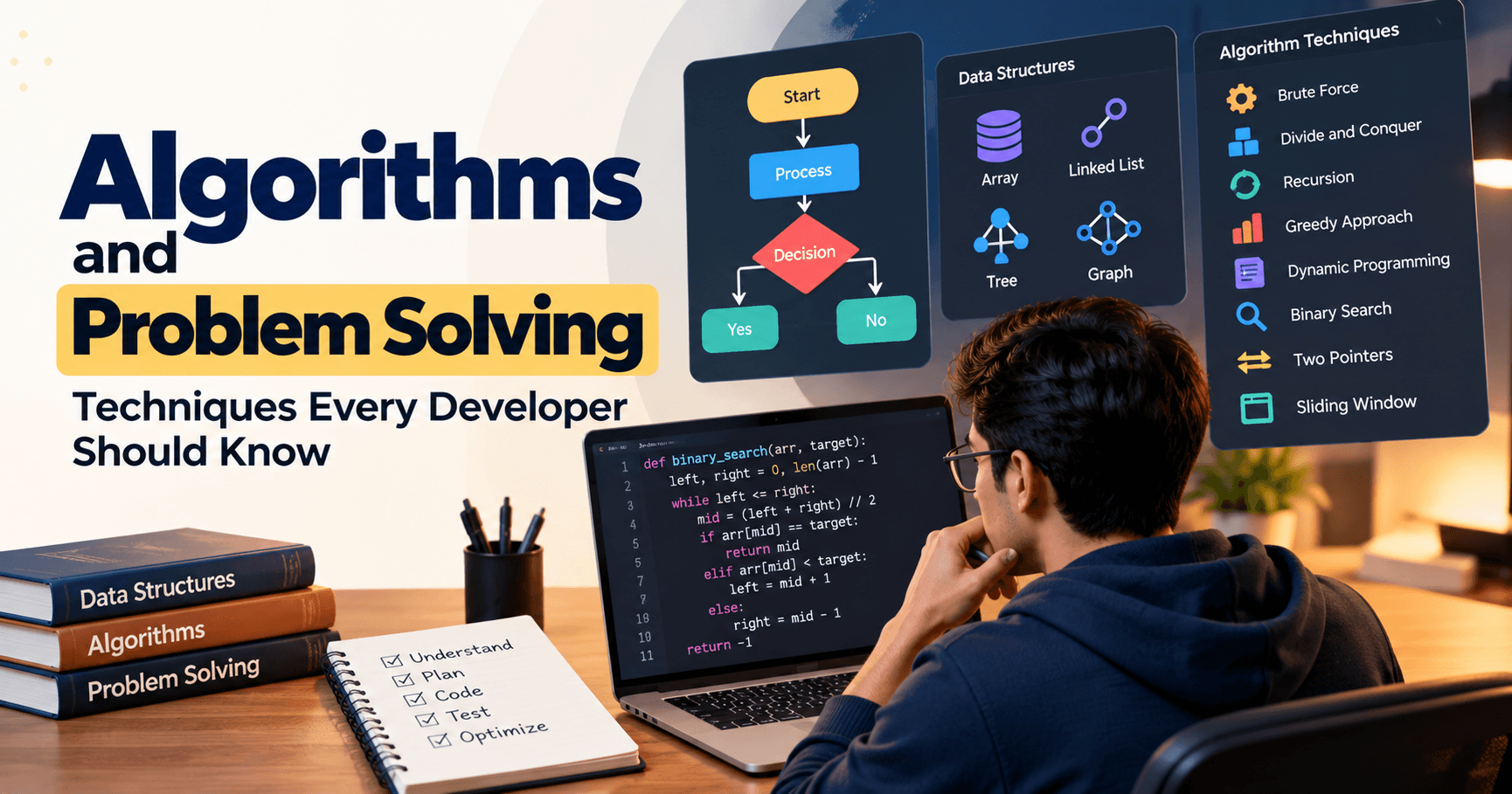
Explore essential algorithms and problem-solving techniques every developer should know, including recursion, binary search, and dynamic programming.
On this page
- Introduction to Algorithms and Problem Solving
- What Is an Algorithm?
- Why Problem-Solving Skills Matter for Developers
- Essential Algorithmic Techniques Every Developer Should Know
- 1. Brute Force Approach
- 2. Divide and Conquer
- 3. Recursion
- 4. Greedy Algorithms
- 5. Dynamic Programming
- 6. Backtracking
- 7. Binary Search
- 8. Two Pointers and Sliding Window
- Understand Data Structures Alongside Algorithms
- Learn Time and Space Complexity
- A Practical Framework for Solving Coding Problems
- Step 1: Understand the Problem
- Step 2: Break the Problem into Smaller Parts
- Step 3: Write Pseudocode
- Step 4: Choose a Suitable Algorithm and Data Structure
- Step 5: Implement the Solution
- Step 6: Test Different Cases
- Step 7: Analyze and Improve
- Common Problem-Solving Mistakes to Avoid
- How Beginners Can Practise Algorithms
- Build Strong Programming Foundations with Techcadd Jalandhar
Introduction to Algorithms and Problem Solving
Every software application begins with a problem that needs a solution. From calculating a customer's bill to processing thousands of records, developers use logical instructions to perform tasks accurately and efficiently. These instructions form an algorithm, which provides a step-by-step approach to solving a particular problem.
Problem solving is the process of understanding a requirement, identifying possible solutions, evaluating their strengths, and implementing the most suitable approach. When developers combine effective problem-solving methods with programming knowledge, they can build applications that are easier to maintain, test, and improve.
For students learning programming, algorithms provide a strong foundation for understanding how code works. At Techcadd Jalandhar, developing logical thinking and programming fundamentals can help learners approach coding challenges with greater confidence.
What Is an Algorithm?
An algorithm is a finite sequence of clearly defined steps designed to solve a problem or complete a task. It accepts inputs when required, processes information according to specific rules, and produces an output.
For example, an algorithm for finding the largest of three numbers involves accepting three values, comparing them, identifying the greatest value, and displaying the result. The same logical process can be implemented in Python, C, C++, Java, or another programming language.
A good algorithm should be clear, correct, finite, and efficient. It should solve the intended problem without unnecessary operations and handle the expected inputs appropriately.
Why Problem-Solving Skills Matter for Developers
Problem-solving skills help developers understand requirements before writing code. Instead of immediately starting to program, an effective developer identifies the expected outcome, considers possible edge cases, and plans a suitable solution.
Strong problem-solving abilities can help developers reduce coding errors, improve application performance, understand unfamiliar problems, and collaborate more effectively with other team members. These skills are also valuable during technical interviews, where candidates are often asked to explain their reasoning rather than simply provide a working answer.
Essential Algorithmic Techniques Every Developer Should Know
1. Brute Force Approach
Brute force is a straightforward technique that checks possible solutions until it finds one that satisfies the problem's requirements. It is often useful when learning a new concept or when the input size is small.
For example, a simple search algorithm may examine each element in a list until it finds the required value. Although this approach is easy to understand and implement, it may become inefficient when the amount of data increases.
Developers should learn brute force first because it provides a useful baseline against which more efficient solutions can be compared.
2. Divide and Conquer
Divide and conquer breaks a large problem into smaller subproblems, solves those subproblems, and combines their results when necessary. This technique can make complicated tasks easier to manage.
Merge sort is a common example. It divides a list into smaller sections, sorts those sections, and merges them into a sorted list. Binary search also uses a related halving strategy to narrow down the search area in sorted data.
Understanding this technique helps developers design efficient solutions for sorting, searching, and other computational problems.
3. Recursion
Recursion occurs when a function calls itself to solve a smaller version of the same problem. A recursive solution usually contains a base case that stops further calls and a recursive case that reduces the problem.
Factorial calculation is a familiar example. The factorial of a positive integer can be expressed in terms of the factorial of the preceding integer, with a defined base case.
Recursion is useful in tree traversal, certain searching algorithms, backtracking, and divide-and-conquer solutions. Developers should also understand call-stack usage and the risk of excessive recursion depth.
4. Greedy Algorithms
A greedy algorithm makes the best available local choice at each step, aiming to reach a suitable overall solution. Greedy approaches can be efficient, but they do not guarantee an optimal answer for every problem.
Examples include activity selection and certain minimum-spanning-tree algorithms. The key is to establish whether the problem has properties that make a greedy strategy valid.
Developers should learn to evaluate greedy solutions carefully rather than assuming that a sequence of locally attractive choices always produces the best final result.
5. Dynamic Programming
Dynamic programming is useful when a problem contains overlapping subproblems and optimal substructure. Instead of repeatedly solving the same smaller problems, the algorithm stores and reuses their results.
There are two common approaches: memoization, which caches results during recursive computation, and tabulation, which builds results iteratively.
Dynamic programming appears in problems involving Fibonacci numbers, knapsack optimization, sequence comparison, and shortest paths in suitable settings. Learning this technique can help developers reduce repeated computation and improve performance.
6. Backtracking
Backtracking explores possible choices and reverses a choice when it cannot lead to a valid solution. It is especially useful for problems involving combinations, constraints, and searching through possible arrangements.
Sudoku solving, maze exploration, and the N-Queens problem are common examples. A backtracking algorithm builds a candidate solution step by step, checks whether each choice remains valid, and abandons branches that violate the constraints.
This technique helps developers understand systematic search, constraint checking, and how to reduce unnecessary exploration.
7. Binary Search
Binary search efficiently finds a target value in a sorted collection by repeatedly comparing the target with the middle element. Depending on the comparison, it discards half of the remaining search range.
Its time complexity is O(log n), compared with O(n) for a basic linear search in the worst case. Binary search requires correctly sorted data and careful handling of index boundaries.
It is an important technique for programming interviews and for understanding how algorithms can reduce the number of operations needed to solve a problem.
8. Two Pointers and Sliding Window
The two-pointer technique uses two positions to process a collection, often reducing the need for nested loops. It can help solve problems involving sorted arrays, pairs of values, and reversing sequences.
The sliding-window technique maintains a changing section of an array or string while moving through the data. It is useful for finding a maximum sum over a fixed-size range or identifying the longest substring satisfying specific conditions.
These techniques are particularly valuable when working with arrays, strings, and contiguous sequences.
Understand Data Structures Alongside Algorithms
Algorithms work with data, so choosing an appropriate data structure is an important part of problem solving.
Arrays and lists store ordered collections. Linked lists connect elements through references. Stacks follow the last-in, first-out principle, while queues generally follow the first-in, first-out principle. Hash tables support efficient average-case lookups, and trees and graphs represent hierarchical or connected data.
Understanding how these structures behave helps developers choose appropriate solutions. For example, a hash table may make repeated membership checks more efficient, while a queue is suitable for breadth-first search in an unweighted graph.
Learn Time and Space Complexity
An algorithm's performance is often evaluated through time complexity and space complexity. Time complexity describes how the number of operations grows as input size increases, while space complexity describes how memory requirements grow.
Big O notation is commonly used to express an algorithm's upper-bound growth rate. Examples include O(1), O(log n), O(n), O(n log n), and O(n²).
For instance, a linear search may require checking every element in the worst case, giving O(n) time complexity. Binary search reduces the search range by half at each step, resulting in O(log n) time complexity on sorted data.
Understanding complexity helps developers compare alternative solutions and recognize when an algorithm may struggle with large inputs.
A Practical Framework for Solving Coding Problems
Step 1: Understand the Problem
Read the requirements carefully and identify the expected inputs, outputs, constraints, and special cases. If something is unclear, clarify it before implementing a solution.
Step 2: Break the Problem into Smaller Parts
Divide a complex task into manageable steps. Identify which operations can be handled independently and determine how their results will be combined.
Step 3: Write Pseudocode
Describe the solution in plain language or structured pseudocode before choosing a programming language. This helps reveal logical gaps without getting distracted by syntax.
Step 4: Choose a Suitable Algorithm and Data Structure
Consider the problem's size, constraints, and performance requirements. Start with a simple correct solution, then evaluate whether a more efficient technique is needed.
Step 5: Implement the Solution
Translate the planned steps into code. Use meaningful variable names and organize the program so that the logic is understandable and testable.
Step 6: Test Different Cases
Test typical inputs, edge cases, empty collections where permitted, duplicate values, and boundary conditions. Verify that the program handles invalid input according to the requirements.
Step 7: Analyze and Improve
Evaluate time and space complexity. Look for repeated work, unnecessary loops, excessive memory usage, and opportunities to simplify the implementation.
Common Problem-Solving Mistakes to Avoid
One common mistake is writing code before fully understanding the problem. This can lead to incorrect assumptions and repeated changes. Another is testing only one example instead of considering boundary conditions and unusual inputs.
Developers should also avoid choosing complex algorithms simply because they seem advanced. A simple, readable solution may be the best choice when it meets the requirements. Similarly, optimizing code without measuring or understanding its bottlenecks can introduce unnecessary complexity.
A better approach is to prioritize correctness, test systematically, analyze performance, and improve the solution when there is a clear reason to do so.
How Beginners Can Practise Algorithms
Beginners can start with basic problems involving arithmetic, conditions, loops, arrays, and strings. Once comfortable, they can move to searching, sorting, recursion, hash tables, stacks, queues, trees, graphs, and dynamic programming.
Regular practice is more effective than memorizing solutions. After solving a problem, try to explain the reasoning, compare another approach, estimate its complexity, and test additional cases. Keeping notes about recurring patterns can help learners recognize similar problems in the future.
Students can also practise implementing algorithms in languages such as Python, C, C++, or Java. The language is important, but the main objective is to understand the logic and apply it consistently.
Build Strong Programming Foundations with Techcadd Jalandhar
Learning algorithms and problem-solving techniques can strengthen a developer's ability to write logical, efficient, and maintainable programs. These skills support programming education, software development projects, competitive programming, and technical interview preparation.
Techcadd Jalandhar focuses on computer education and programming skills that can help learners develop their technical knowledge. By combining programming fundamentals with regular coding practice, students can build a stronger foundation for tackling algorithmic challenges and exploring further opportunities in software development.
Start with the basics, practise consistently, and focus on understanding why a solution works. Over time, these habits can help you approach increasingly complex programming problems with confidence.
Master Algorithmic Thinking and Solve Coding Problems with Confidence
Discover essential problem-solving techniques every developer should know, from brute force and recursion to dynamic programming, binary search, and sliding window. Learn how to choose suitable algorithms, understand time complexity, and write efficient code. Strengthen your programming fundamentals with practical learning resources from Techcadd Jalandhar.
Want to write smarter code and solve complex problems? Explore programming fundamentals and algorithmic techniques with Techcadd Jalandhar.
Explore Programming CoursesHave a questionabout this?
Leave your number and a counsellor will call you back — about batch timings, fees, EMI options, placement record, or which track fits your degree.
- Free career counselling, no registration fee
- Weekday, evening, weekend or 1-on-1 batches
- Internship letter and placement support
Ready to get started?
Start building yourcareer today.
Talk to a counsellor today. One call is usually enough to know which track fits your degree, your schedule and the job you want.
- Free career counselling
- No registration fee
- Placement support included