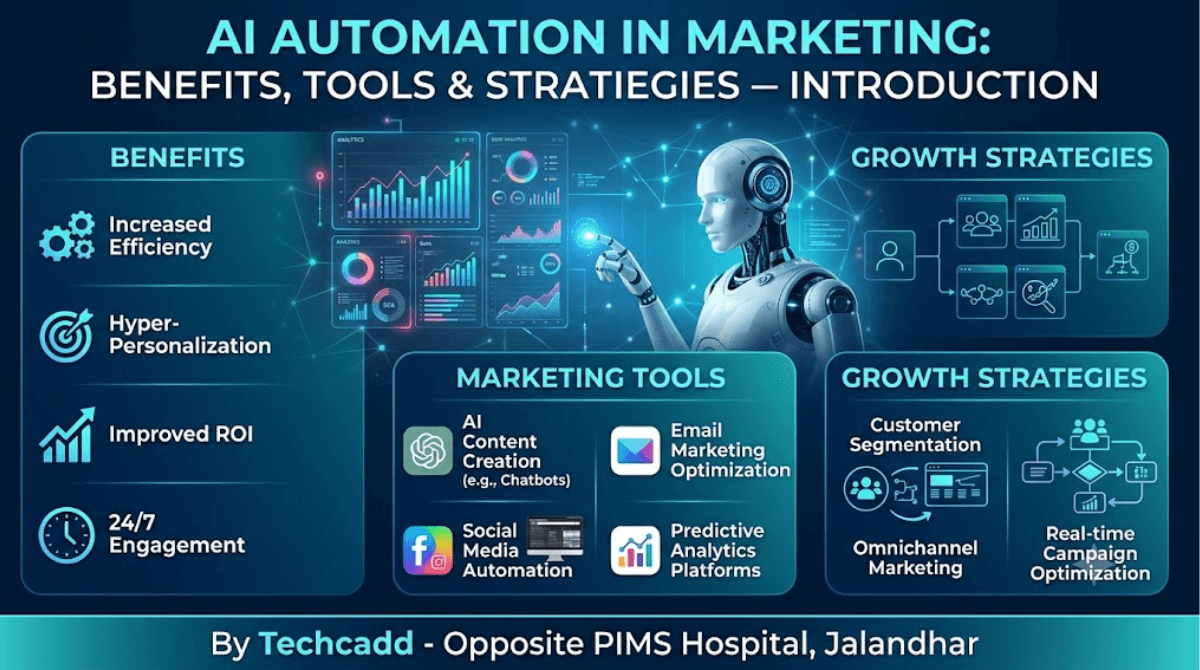
AI Automation in Marketing: Benefits, Tools and Strategies
Introduction
Marketing is becoming faster, smarter, and more data-driven with the growth of Artificial Intelligence (AI) automation. Businesses today need to communicate with customers across websites, search engines, social media, email, and advertising platforms. Managing all these activities manually can take significant time and resources.
AI automation in marketing combines artificial intelligence with automated workflows to help businesses perform repetitive marketing tasks more efficiently. AI can analyze customer behavior, generate insights, personalize communication, automate campaigns, and help marketers make better decisions.
For businesses and digital marketing professionals, learning how to use AI automation effectively can improve productivity while creating more personalized customer experiences.
What Is AI Automation in Marketing?
AI automation in marketing refers to using AI-powered technologies and automated systems to plan, execute, analyze, and optimize marketing activities with minimal manual effort. Traditional automation follows predefined rules, while AI automation can use data, patterns, and machine learning to make more intelligent recommendations or decisions. For example, an automated email system can send a welcome email when someone signs up. An AI-powered system can go further by analyzing the customer's behavior and recommending personalized content, products, or offers.
Major Benefits of AI Automation in Marketing
Saves Time and Reduces Repetitive Work
Marketing teams often spend hours performing repetitive tasks such as scheduling social media posts, sending emails, organizing leads, generating reports, and analyzing campaign data.
AI automation can handle many of these activities automatically, allowing marketers to focus more on strategy, creativity, customer relationships, and business growth. Improves Customer Personalization Customers expect brands to provide relevant experiences. AI can analyze browsing behavior, purchase history, engagement, and other available customer data to help businesses deliver more personalized messages. Personalization can be used for product recommendations, email campaigns, website content, advertisements, and customer communication.
Supports Better Decision-Making:
AI can process large amounts of marketing data much faster than humans. It can identify patterns and provide insights into customer behavior, campaign performance, and audience preferences.
These insights can help marketers determine which campaigns are performing well and where improvements may be needed.
Increases Marketing Productivity:
With AI handling repetitive processes, marketing teams can accomplish more in less time. Automated workflows can help manage leads, campaigns, customer communication, and reporting without requiring constant manual intervention.
Helps Improve Lead Generation and Conversion:
AI automation can identify potential customers, segment audiences, score leads, and trigger follow-up communication. This helps businesses respond to prospects at the right stage of the customer journey.
When combined with effective content and offers, automated lead nurturing can improve the chances of converting prospects into customers.
Popular AI Tools for Marketing Automation
Chat GPT:
Chat GPT can assist marketers with content ideas, campaign planning, keyword research, customer communication, ad copy, social media content, and brainstorming. It can also help marketers organize information and develop marketing strategies.
HubSpot:
HubSpot provides marketing automation features for managing contacts, email campaigns, lead nurturing, customer journeys, and analytics. Its AI capabilities can further assist businesses with content and customer engagement.
Google Analytics
Google Analytics helps businesses understand website traffic and user behavior. AI and machine-learning-powered insights can help marketers identify trends and opportunities within their data.
Canva
Canva uses AI-powered features to help marketers create social media graphics, presentations, advertisements, and other visual marketing materials more efficiently.
Sem rush:
Sem rush provides tools for SEO, content marketing, keyword research, competitor analysis, and digital marketing. AI-powered features can support content planning and optimization.
Mailchimp:
Mailchimp offers email marketing and automation features that allow businesses to create customer journeys, segment audiences, and automate communication.
Automate Email Marketing:
Email automation is one of the most useful applications of AI in marketing. Businesses can create automated workflows for welcome emails, abandoned-cart reminders, product recommendations, follow-ups, and customer retention. AI can help determine what type of content may be more relevant to different customer segments.
Use AI for Lead Scoring:
Not every lead has the same level of buying intent. AI-powered lead scoring can analyze customer interactions and help marketers identify prospects who are more likely to convert. Sales teams can then prioritize high-value leads instead of spending equal time on every prospect.
Personalize Customer Journeys:
A customer journey can include multiple touchpoints, from discovering a brand to making a purchase. AI automation can help personalize these interactions according to customer behavior. For example, someone who repeatedly visits a particular product page could receive relevant content or an appropriate follow-up message.
Automate Social Media Marketing:
AI tools can help marketers generate content ideas, create captions, schedule posts, analyze engagement, and identify trends. However, human review remains important because social media content needs to reflect the brand's personality and audience expectations.
Use AI for SEO and Content Marketing:
AI can assist with keyword clustering, content research, topic ideas, content optimization, internal linking suggestions, and competitor analysis. The best approach is to use AI as an assistant rather than a complete replacement for human expertise. Original research, experience, expert opinions, and useful information should remain central to high-quality content.
Automate Marketing Reports:
Marketing teams need regular performance reports to understand campaign results. Automated reporting can collect information from different platforms and present important metrics in one place. This reduces manual reporting work and allows marketers to spend more time interpreting the results.
Challenges of AI Automation in Marketing:
Despite its advantages, AI automation also has challenges. Businesses need to consider data privacy, inaccurate AI-generated information, excessive automation, lack of human creativity, and customer trust. Automation should not make communication feel robotic. Human oversight is important when creating content, making important decisions, handling customer complaints, or communicating sensitive information. Businesses should also ensure that customer data is collected and used responsibly.
Future of AI Automation in Marketing:
AI automation is expected to become an increasingly important part of digital marketing. Businesses will use AI to understand customers, optimize campaigns, predict trends, personalize experiences, and automate larger portions of the marketing workflow. The future is unlikely to be about AI completely replacing marketers. Instead, successful marketers will increasingly combine human creativity, strategic thinking, and AI-powered automation. Professionals who learn how to use AI tools effectively can improve productivity and adapt to the changing digital marketing environment.
Conclusion
AI automation in marketing is transforming how businesses attract, engage, and retain customers. From automated email campaigns and lead scoring to personalized customer journeys, SEO assistance, social media management, and campaign analysis, AI can make marketing more efficient and data-driven. The most effective strategy is not to automate everything. Instead, businesses should identify repetitive tasks where AI can provide value while keeping humans responsible for strategy, creativity, brand voice, and important decisions. By combining AI tools, smart automation strategies, quality content, and human expertise, businesses can build more efficient marketing systems and create better customer experiences in the evolving digital landscape.
Comments
Loading…