On this page
- Introduction
- What Is AI-Powered Personalization?
- Why Is AI Personalization Becoming a Major Marketing Trend?
- How AI-Powered Personalization Works
- Major Applications of AI-Powered Personalization
- Personalized Product Recommendations
- Personalized Email Marketing
- Customized Website Experiences
- Smarter Digital Advertising
- AI-Powered Chatbots
- Benefits of AI-Powered Personalization
- Better Customer Experience
- Higher Customer Engagement
- Improved Conversion Rates
- Increased Customer Loyalty
- Greater Marketing Efficiency
- Challenges of AI-Powered Personalization
- The Future of AI-Powered Personalization
- How Businesses Can Start Using AI Personalization
- Conclusion
Introduction
Customers today expect more than generic advertisements and one-size-fits-all marketing messages. They want brands to understand their interests, preferences, needs, and buying behavior. This growing demand has made AI-powered personalization one of the most important trends shaping modern digital marketing.
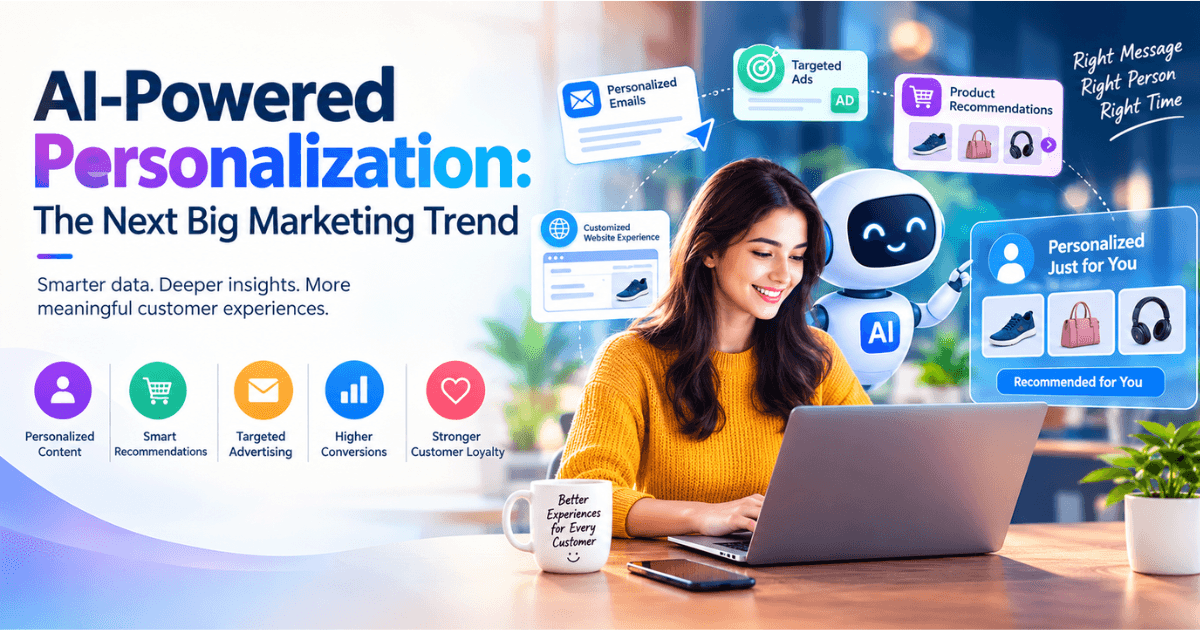
Artificial intelligence allows businesses to analyze large amounts of customer data and use those insights to create more relevant experiences. From personalized product recommendations and emails to customized website experiences and targeted advertisements, AI is helping marketers connect with customers at the right time and with the right message.
As competition increases across digital platforms, AI-powered personalization can help businesses improve customer engagement, increase conversions, and build stronger long-term relationships.
What Is AI-Powered Personalization?
AI-powered personalization is the use of artificial intelligence and machine learning to deliver customized marketing experiences based on individual customer behavior and preferences.
Traditional personalization may rely on basic information such as a customer's name, location, or previous purchase. AI takes personalization much further by analyzing multiple signals, including browsing activity, search behavior, purchase history, content interactions, product preferences, and engagement patterns.
AI systems can identify patterns in this data and predict what a customer may be interested in next. Marketers can then use these insights to create more relevant content, offers, recommendations, and communication.
Why Is AI Personalization Becoming a Major Marketing Trend?
The digital marketplace is becoming increasingly crowded. Customers are exposed to thousands of marketing messages every day, making it difficult for businesses to capture attention.
Personalized marketing helps brands stand out by delivering information that is more relevant to individual users. Instead of showing the same advertisement or recommendation to everyone, businesses can adapt their marketing based on customer interests.
AI makes this process faster and more scalable. It can process huge amounts of data, recognize changing customer behavior, and support personalized experiences across multiple channels.
For marketers, this means better opportunities to deliver the right content to the right customer at the right time.
How AI-Powered Personalization Works
AI personalization generally begins with collecting and organizing customer data. Businesses may gather information from websites, mobile applications, CRM systems, social media interactions, email campaigns, and purchasing activities.
AI algorithms analyze this information to identify patterns and customer segments. Machine learning models can then predict customer interests, preferences, and potential actions.
For example, if a customer frequently views sports shoes on an e-commerce website, an AI-powered system may recommend similar products, display relevant offers, or send personalized messages related to sports footwear.
The system can continuously learn from customer interactions, making future recommendations more relevant.
Major Applications of AI-Powered Personalization
Personalized Product Recommendations
E-commerce businesses can use AI to recommend products based on browsing history, previous purchases, and similar customer behavior. These recommendations can make product discovery easier while creating additional sales opportunities.
Personalized Email Marketing
AI can help marketers determine which content, products, or offers may be relevant to individual subscribers. It can also support decisions about suitable messaging and timing, helping businesses create more meaningful email campaigns.
Customized Website Experiences
A website can provide different content or recommendations depending on visitor behavior. Returning customers may see relevant products, previously viewed items, or content connected to their interests.
Smarter Digital Advertising
AI can help advertisers identify audiences and predict which messages may generate stronger engagement. Personalized advertising can reduce irrelevant impressions and help businesses make better use of advertising budgets.
AI-Powered Chatbots
Intelligent chatbots can analyze customer questions and previous interactions to provide more relevant responses. They can support customers throughout their journey, from answering questions to helping them discover products and services.
Benefits of AI-Powered Personalization
Better Customer Experience
Personalized experiences can make customers feel that a brand understands their needs. Relevant recommendations and useful content can make interactions more convenient and engaging.
Higher Customer Engagement
When people receive content that matches their interests, they are more likely to interact with it. AI personalization can therefore support stronger engagement across websites, emails, advertisements, and other digital channels.
Improved Conversion Rates
Relevant offers and recommendations can help customers move from awareness to consideration and purchase. By understanding customer intent, businesses can create more targeted experiences.
Increased Customer Loyalty
Consistent and meaningful personalization can strengthen relationships between customers and brands. When customers regularly receive useful experiences, they may be more likely to return.
Greater Marketing Efficiency
AI can automate many personalization processes that would otherwise require significant manual effort. Marketers can spend more time developing strategy while AI supports data analysis and repetitive tasks.
Challenges of AI-Powered Personalization
Despite its advantages, AI personalization also comes with challenges. Data privacy and security are among the most important concerns. Businesses must handle customer information responsibly and comply with applicable privacy regulations.
Another challenge is maintaining a balance between personalization and privacy. Customers appreciate relevant experiences, but excessive tracking or overly specific targeting can feel intrusive.
Data quality is also important. If customer data is incomplete, inaccurate, or outdated, AI systems may produce poor recommendations.
Businesses should therefore focus on responsible data practices, transparency, security, and human oversight when implementing AI-powered personalization.
The Future of AI-Powered Personalization
The future of marketing is likely to become increasingly personalized and predictive. AI will continue helping businesses understand customer intent and respond to changing preferences more quickly.
Generative AI can also contribute to personalization by helping marketers create different versions of content, advertisements, product descriptions, and messages for different audiences.
Instead of simply reacting to customer actions, businesses will increasingly use AI to anticipate customer needs and provide helpful experiences proactively.
However, technology alone will not guarantee successful personalization. Brands will need to combine AI capabilities with creativity, strategy, empathy, and responsible data management.
How Businesses Can Start Using AI Personalization
Businesses do not need to transform their entire marketing strategy overnight. They can begin with specific use cases that provide measurable value.
First, identify customer data that is already available and determine how it can improve marketing decisions. Next, choose a practical application such as personalized email recommendations, website content, customer segmentation, or advertising.
Businesses should establish clear goals and measure important metrics such as engagement, conversions, customer retention, and revenue. Regular testing can help marketers understand which personalization strategies work best.
Most importantly, AI should support marketers rather than completely replace human decision-making. Human creativity and understanding remain essential for developing authentic customer experiences.
Conclusion
AI-Powered Personalization: The Next Big Marketing Trend is changing how businesses communicate with their audiences. By analyzing customer behavior and delivering more relevant experiences, artificial intelligence can help brands improve engagement, conversions, loyalty, and marketing efficiency.
From personalized recommendations and email campaigns to customized websites and intelligent chatbots, AI is making marketing more customer-focused and data-driven.
The businesses that succeed with personalization will not simply use AI to send more targeted messages. They will use it responsibly to understand customers better, provide genuine value, and create experiences that feel useful rather than intrusive.
As artificial intelligence continues to evolve, AI-powered personalization is set to become a central part of the future of digital marketing.
Comments
Loading…