On this page
- Introduction: Technology Is Only the Beginning
- 1. The Changing Definition of Technical Competence
- 2. From Knowing the Tools to Understanding the Problem
- 3. Why Practical Learning Matters
- 4. Artificial Intelligence: An Opportunity to Think Differently
- 5. Technical Skills Must Work Alongside Human Skills
- 6. Industry-Academia Collaboration: Connecting Learning with Reality
- 7. Building a Portfolio of Capabilities
- 8. What This Means for Technology Education at techcadd
- 9. My Advice to Students and Aspiring Professionals
- Conclusion: Prepare to Create, Not Just Consume
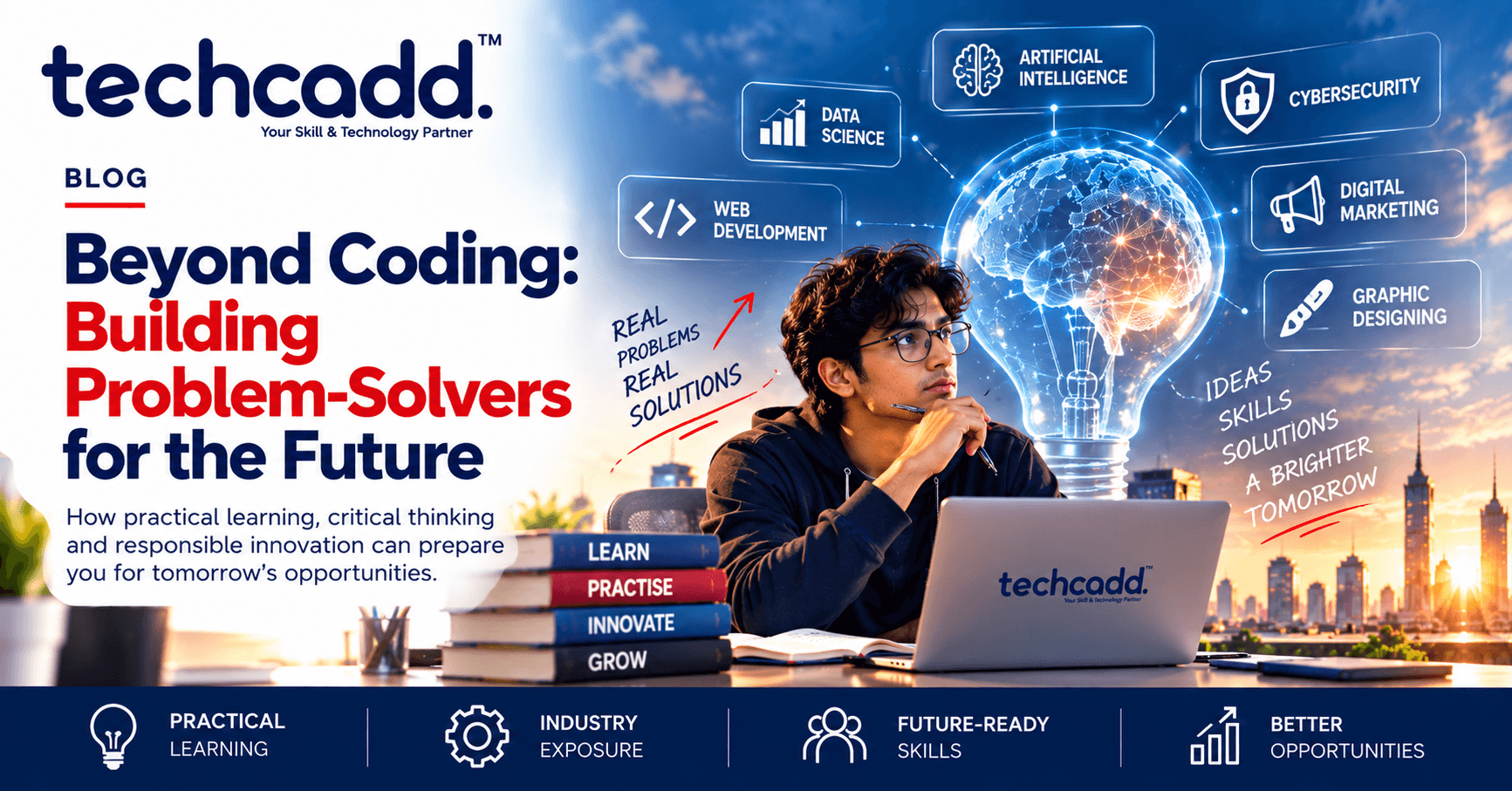
Introduction: Technology Is Only the Beginning
Technology is changing the way we live, work, communicate and do business. Artificial Intelligence is transforming workflows, data is influencing business decisions, cybersecurity is becoming essential to digital trust, and software is enabling ideas to become real-world solutions.
Yet, amid all this technological progress, one question deserves our attention:
Are we preparing young people merely to use technology, or are we preparing them to solve problems with it?
I believe this distinction will define the next generation of professionals.
Knowing how to operate a tool is valuable. Understanding when to use it, why it matters, what problem it solves and what consequences it may create is even more important.
At techcadd, this perspective shapes how I think about technology education and skill development. Our responsibility extends beyond introducing learners to new tools. It involves helping them develop the technical understanding, practical experience and problem-solving mindset required to apply technology meaningfully.
1. The Changing Definition of Technical Competence
For many years, technical competence was often associated with knowing a programming language, operating a particular software application or earning a professional certification.
These remain valuable foundations. However, the modern technology landscape requires a broader combination of capabilities.
A developer must understand more than syntax. A digital marketer must interpret more than campaign metrics. A data analyst must do more than generate reports. A cybersecurity professional must understand not only security tools but also risks, systems and human behaviour.
In every field, the real value of knowledge emerges when it can be applied to a meaningful problem.
The World Economic Forum's Future of Jobs Report 2025 identifies analytical thinking as a leading core skill for employers and highlights technological literacy, AI and big data, and networks and cybersecurity among important areas of evolving skills demand.
The implication is clear: technical knowledge and human capabilities must develop together.
The future belongs to professionals who can understand problems, evaluate possibilities and turn knowledge into solutions.
2. From Knowing the Tools to Understanding the Problem
One of the most important lessons in technology is that tools should serve a purpose.
Consider a business that wants to improve its online presence. Simply knowing how to create a website is not enough. The developer must understand the audience, the business objective, the user experience and the technical requirements.
Similarly, running digital advertisements is only one part of digital marketing. Understanding customer behaviour, measuring performance and improving a campaign based on evidence are what make the process effective.
In data science, producing a chart is not the final objective. The real task is to interpret the information and identify insights that can support better decisions.
This way of thinking encourages learners to approach every assignment with three questions:
What problem am I trying to solve?
Which tools and methods are appropriate?
How will I evaluate whether my solution works?
These questions develop a habit of purposeful thinking. They also help students understand that technology is not an isolated subject; it is a means of creating value.
3. Why Practical Learning Matters
There is a significant difference between understanding a concept during a lesson and applying it independently.
Practical learning allows students to experience that difference.
When learners build a website, analyse a dataset, develop an application, create a digital marketing campaign or work through a cybersecurity scenario, they encounter challenges that theoretical explanations alone cannot fully reproduce.
They must make decisions, test assumptions, identify errors, revise their work and evaluate results.
This process develops more than technical familiarity. It strengthens persistence, logical reasoning, attention to detail and the ability to learn from mistakes.
At techcadd, we believe that practical application should be an essential part of technology learning. Projects and industry-oriented exercises can help students connect concepts with professional expectations and develop work they can explain and demonstrate.
Learning becomes more powerful when students move from observing how something works to building, testing and improving it themselves.
4. Artificial Intelligence: An Opportunity to Think Differently
Artificial Intelligence is one of the most significant developments influencing today's technology ecosystem.
AI tools can assist with writing, coding, research, analysis, design and automation. They can help professionals explore ideas faster and reduce the time spent on certain repetitive tasks.
However, using AI effectively requires more than knowing which prompt to enter.
Users must understand the task, provide relevant context, evaluate the output, identify errors and exercise judgement before relying on the result.
For students, this means learning to treat AI as an aid to thinking rather than a substitute for understanding.
For example, an AI-generated piece of code still needs to be reviewed, tested and understood. An AI-generated analysis needs to be checked against the underlying data. An AI-created marketing message must be evaluated for accuracy, relevance, originality and audience suitability.
There are also important considerations around privacy, bias, intellectual property and responsible use.
My perspective is simple: the objective should not be to compete with every new technology, but to understand it well enough to use it intelligently and responsibly.
5. Technical Skills Must Work Alongside Human Skills
Technology can automate tasks, process information and support complex workflows. But professional success also depends on how people communicate, collaborate and make decisions.
A technically strong individual who cannot explain an idea clearly may struggle to gain support for a solution. A capable developer who cannot understand user requirements may build the wrong product. A knowledgeable professional who resists feedback may find it difficult to improve.
This is why communication, teamwork, creativity, adaptability and critical thinking deserve a place alongside technical training.
At techcadd, our broader approach to career preparation recognises that learners need to develop not only subject knowledge but also the confidence to communicate their abilities and work effectively with others.
A well-rounded professional should be able to answer three questions:
What do I know?
What can I do with that knowledge?
Can I explain, demonstrate and improve my work?
When these capabilities come together, technical knowledge becomes more useful in real professional environments.
6. Industry-Academia Collaboration: Connecting Learning with Reality
Educational institutions provide important academic foundations. Industry offers insight into how knowledge is applied to practical requirements, business objectives and professional challenges.
Stronger collaboration between the two can help students understand the relationship between their studies and their future careers.
At techcadd, engagement with colleges and universities through workshops, seminars, internships, placement initiatives and technology-focused interactions forms part of our broader effort to connect education with industry.
The value of these activities should not be measured only by the number of events conducted or agreements signed. Their real value lies in the learning opportunities they create.
Does a workshop help students understand an emerging technology? Does an internship expose them to professional practices? Does an industry interaction help them understand the skills employers expect? Does a placement initiative help them explore suitable opportunities?
These are the questions that make collaboration meaningful.
A successful education-industry partnership should help students see how knowledge translates into capability and how capability can lead to opportunity.
7. Building a Portfolio of Capabilities
In a competitive professional environment, students benefit from being able to demonstrate what they have learned.
A portfolio can provide evidence of practical ability through projects, case studies, applications, design work, dashboards, campaigns or other relevant outputs.
The appropriate portfolio depends on the chosen field.
A web developer might demonstrate a functional application. A graphic designer might present a collection of carefully developed visual projects. A data analyst might explain a dataset, analytical approach and findings. A digital marketer might showcase a campaign plan and performance analysis.
The important point is not the number of projects but the quality of the work and the learner's ability to explain the decisions behind it.
Students should be able to describe the problem, the approach they selected, the challenges they encountered and the improvements they would make.
This turns a project from a simple course assignment into evidence of thinking, execution and professional development.
8. What This Means for Technology Education at techcadd
At techcadd, we work across technology and skill-development areas that include Artificial Intelligence, Data Science, Cybersecurity, Cloud Computing, Full Stack Development, Digital Marketing, Graphic Designing, CAD/CAM and other professional learning pathways.
Each discipline requires different tools and technical knowledge, but the underlying principles of effective learning remain closely connected.
Learners need strong fundamentals. They need opportunities to practise. They need feedback that helps them improve. They need to understand the context in which their skills will be used, and they need to recognise that professional growth continues beyond the completion of a course.
Our objective is to help learners approach technology with curiosity, develop practical competence and build the confidence to tackle increasingly complex challenges.
For us, skill development should not be a passive process in which students simply receive information. It should be an active process in which they question, experiment, create, evaluate and improve.
That is the mindset we want to encourage.
9. My Advice to Students and Aspiring Professionals
If you are beginning your career in technology, do not feel that you must master every new tool or follow every emerging trend.
Start by understanding your interests and choosing a direction that motivates you.
Build a strong foundation in the fundamentals of your chosen field. Practise consistently. Work on projects that challenge you. Learn to ask better questions, accept constructive feedback and explain your work clearly.
Use AI and other modern tools to enhance your learning, but make sure you understand the concepts behind the results.
Most importantly, do not measure your progress only by the number of courses you complete.
Measure it by the problems you can solve, the quality of your work, the improvements you make and the confidence with which you can apply your knowledge.
A certificate may mark the completion of a learning milestone. Your ability to apply what you have learned is what allows you to build on it.
Conclusion: Prepare to Create, Not Just Consume
The future of technology will bring new tools, new professions and new challenges. Some of the technologies we rely on today will evolve, while others will give way to entirely new approaches.
We cannot predict every development, but we can prepare learners to respond thoughtfully and confidently.
We can encourage stronger fundamentals, practical experience, responsible technology use, critical thinking and collaboration. We can create closer connections between education and industry. And we can help students understand that their professional value is not defined by the tools they know alone, but by what they can accomplish with them.
This is the direction in which I believe technology education must continue to evolve.
At techcadd, our ambition is to contribute to that progress by helping learners build relevant skills, apply their knowledge and approach the future with confidence.
Because the goal is not simply to prepare students to use the technology that exists today.
It is to prepare them to solve the problems, create the solutions and shape the possibilities of tomorrow.
— Mr. Gourav Gupta
Founder & CEO, techcadd
Filed under
Keep reading
- Beyond Technology: The Vision That Drives techcaddHarrachneet Kaur Sandhu, Relationship Manager & Central Head of techcadd, shares the vision of Founder & CEO Gourav Gupta and how techcadd is bridging education and industry through practical learning, emerging technologies, skill development and meaningful opportunities for future-ready careers.
- The Future Belongs to Those Who Keep LearningTechnology is evolving rapidly, changing the skills businesses need and how professionals work. Gourav Gupta, Founder & CEO of techcadd, shares why continuous learning, practical experience and upskilling are essential for building future-ready careers.
- Excel + AI: The New Trend Reshaping Office Work — How techcadd Is Preparing StudentsExcerpt Discover how combining traditional Excel skills with AI tools is transforming modern office productivity. Learn how techcadd is equipping students with advanced, AI-powered spreadsheet techniques to succeed in today's evolving job market.
Comments
Loading…