On this page
- Digital Marketing in 2026: More Than Just Posting on Social Media
- What Has Changed in Digital Marketing in 2026?
- SEO in 2026: Understanding Search Beyond Keywords
- 1. On-Page SEO
- 2. Technical SEO
- 3. Content Strategy
- 4. Local SEO
- 5. Search Performance Analysis
- Students can explore areas such as:
- Technical Skills
- Creative Skills
- Analytical Skills
- Strategic Thinking
- Adaptability
- Communication
- Ready to Build Your Digital Marketing Skills?
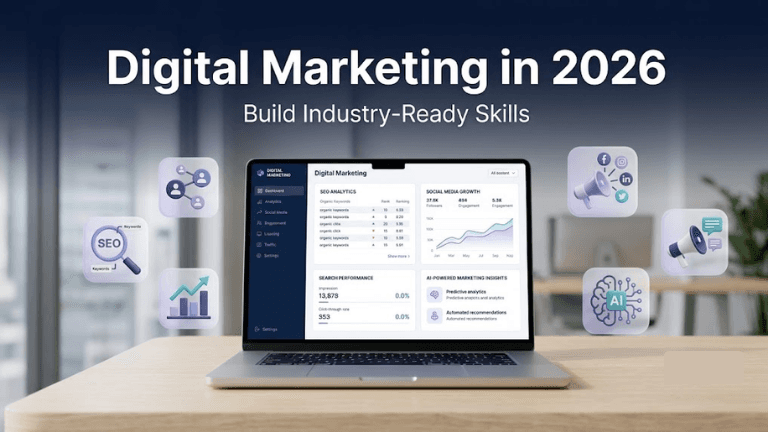
Digital Marketing in 2026: More Than Just Posting on Social Media
Imagine a student sitting in a classroom in Jalandhar, learning how businesses attract customers online.
A few years ago, digital marketing might have meant creating social media posts, running basic advertisements, or learning how to rank a website on Google.
Today, the picture is much bigger.
A business can have a website, social media accounts, Google Business Profile, paid advertising campaigns, email campaigns, videos, blogs, and dozens of customer touchpoints—all working together to attract and convert the right audience.
And now, Artificial Intelligence (AI) is becoming an important part of this process.
This is what makes digital marketing in 2026 both exciting and challenging. The tools are changing quickly, but the fundamentals of understanding customers, creating valuable content, analysing data, and building effective marketing strategies remain essential.
For students who want to enter this field, learning individual tools is no longer enough. They need to understand how different digital marketing activities work together.
That is where practical training can make a difference.
What Has Changed in Digital Marketing in 2026?
Digital marketing is not a fixed skill. Search engines, social media platforms, advertising systems, analytics tools, and AI technologies continue to evolve.
Some of the major areas students need to understand in 2026 include:
Search Engine Optimization (SEO)
AI-assisted content and marketing workflows
Social media marketing
Search and social advertising
Local SEO
Content marketing
Website optimization
Analytics and performance measurement
Conversion-focused marketing
Data-driven decision-making
Online reputation and brand building
The important point is that AI does not replace marketing fundamentals.
Instead, AI can help marketers research ideas, analyse information, generate drafts, automate repetitive tasks, and explore creative possibilities. Human judgement is still required to understand the audience, verify information, develop strategy, maintain brand voice, and make responsible marketing decisions.
The Story of a Modern Digital Marketer
Let's take a simple example.
Suppose a student wants to help a local business increase its online visibility.
The first question isn't:
"Which AI tool should I use?"
The first question should be:
"Who are the customers, what do they need, and how do they search for a solution?"
Once that is understood, the digital marketing process begins.
The student may research relevant search queries, analyse competitors, optimise website pages, create useful content, improve the business's local online presence, plan social media content, and monitor performance through analytics.
If paid advertising is appropriate, campaigns can be planned around specific business objectives.
AI tools may assist with research, brainstorming, content workflows, and analysis—but the marketer still needs to decide what should be done and why.
This combination of marketing knowledge + practical tools + analytical thinking is what makes digital marketing skills valuable.
SEO in 2026: Understanding Search Beyond Keywords
SEO continues to be an important part of digital marketing, but modern SEO is much broader than simply adding keywords to a webpage.
A strong SEO approach can involve:
1. On-Page SEO
Students need to understand how page titles, headings, content structure, internal links, URLs, images, and other page elements contribute to a better search experience.
2. Technical SEO
Website accessibility, crawlability, indexing, site architecture, mobile usability, structured data, and performance can all influence how effectively search engines understand and access a website.
3. Content Strategy
Creating content simply to target keywords is not enough.
Content should address genuine user questions and provide useful, trustworthy information.
4. Local SEO
For businesses serving specific locations, local search visibility can be particularly important.
Students can learn how businesses can improve their local presence through accurate business information, relevant website content, customer reviews, and other local SEO practices.
5. Search Performance Analysis
SEO is also about measurement.
Tools such as Google Search Console can help marketers understand search queries, clicks, impressions, click-through rates, and search positions.
The goal is not simply to achieve a ranking.
The goal is to understand whether search visibility is bringing meaningful value to the business.
AI and Digital Marketing: Learning to Work With Technology
One of the biggest changes in digital marketing is the increasing use of AI.
Tools powered by AI can support marketers in areas such as:
Content ideation
Keyword and topic research
Content outlines
Competitor research
Data analysis
Marketing brainstorming
Image and creative generation
Workflow automation
Audience research
Reporting and summarisation
But there is an important distinction:
Using AI is not the same as understanding digital marketing.
A student who knows how to write a prompt but does not understand SEO, audience intent, content quality, analytics, or conversion principles may struggle to use AI effectively.
That's why modern digital marketing education should teach students how to combine AI with marketing strategy, rather than treating AI as a shortcut.
Why Practical Learning Matters
Digital marketing is a hands-on field.
Reading about SEO is useful.
Understanding Google Analytics is useful.
Watching advertising tutorials is useful.
But practical experience brings those concepts together.
For example, instead of only learning what CTR means, a student can learn how to examine campaign or search data and ask:
Why did the CTR change?
Instead of simply learning what a backlink is, the student can understand how relevant, quality-focused link building fits into an overall SEO strategy.
Instead of memorising social media marketing definitions, students can work on content planning, audience research, creative ideas, and performance analysis.
This practical approach helps students move from "I have studied digital marketing" to "I understand how digital marketing works."
How Techcadd Jalandhar Approaches Digital Marketing Training
At Techcadd Jalandhar, digital marketing learning can be approached as a combination of concepts, tools, strategy, and practical application.
The objective is to help students understand the complete digital marketing ecosystem rather than learning isolated topics.
Students can explore areas such as:
SEO
Learn the fundamentals of on-page, off-page, technical, and local SEO while understanding how search visibility is measured.
Content Marketing
Understand how to research topics, develop content ideas, structure information, and create content around audience needs.
Social Media Marketing
Learn how businesses use social platforms for brand awareness, audience engagement, content distribution, and marketing campaigns.
Paid Advertising
Understand the fundamentals of online advertising, campaign objectives, targeting, creatives, budgets, and performance metrics.
Analytics
Learn how tools such as Google Analytics and Google Search Console can be used to understand website and search performance.
AI Tools for Marketing
Explore how AI can support research, content workflows, ideation, analysis, and repetitive marketing tasks while keeping human review and strategy at the centre.
Local SEO
Understand how businesses can improve their visibility for location-based searches and connect their online presence with local customers.
From Classroom Concepts to Real Marketing Thinking
Consider another situation.
A student creates a blog post and publishes it on a website.
The work doesn't end there.
The student should be able to ask:
Is the topic relevant to the target audience?
Does the content satisfy search intent?
Is the page technically accessible?
Are users clicking the result?
How long are users engaging with the content?
Which queries are bringing impressions?
Is the content generating enquiries or conversions?
What can be improved?
This way of thinking is important because digital marketing is an ongoing process of testing, measuring, learning, and improving.
A good digital marketer doesn't simply publish and move on.
They look at the data, understand what happened, and use those insights to make the next decision.
What Makes a Student Industry-Ready?
Being industry-ready doesn't mean knowing every digital marketing tool available.
The digital marketing ecosystem is too large and changes too quickly for that.
Instead, students should develop a combination of skills.
Technical Skills
Understanding websites, SEO, analytics platforms, advertising platforms, content systems, and commonly used marketing tools.
Creative Skills
Being able to develop content ideas, write clearly, communicate messages, and create marketing concepts.
Analytical Skills
Understanding metrics and using data to identify problems and opportunities.
Strategic Thinking
Knowing why a marketing activity is being performed instead of simply following instructions.
Adaptability
Digital marketing changes constantly. Students need to be comfortable learning new platforms, features, technologies, and workflows.
Communication
Marketers often work with business owners, designers, developers, sales teams, content writers, and clients. Clear communication matters.
Building a Portfolio Along the Way
One of the most useful things a digital marketing student can develop is a portfolio.
Instead of only listing skills on a resume, students can demonstrate what they have actually worked on.
A portfolio could include examples such as:
SEO audits
Keyword research
Content plans
Blog articles
Social media calendars
Search or social advertising projects
Local SEO activities
Website optimization tasks
Analytics reports
Marketing campaign case studies
These projects can help students explain their thinking during internships, interviews, freelance discussions, or client meetings.
The focus should be on showing the process and learning, not simply displaying screenshots.
Why Digital Marketing Can Be an Interesting Career Choice in 2026
Almost every modern business needs some form of online presence.
From local businesses to startups and established companies, organisations use digital channels to reach potential customers, communicate with audiences, build their brands, and generate business opportunities.
This creates different career paths within digital marketing.
Depending on their interests and skills, students may explore roles such as:
SEO Executive
Digital Marketing Executive
Social Media Executive
Content Marketing Executive
PPC/Ads Executive
SEO Analyst
Digital Marketing Analyst
Content Strategist
Performance Marketing Professional
Digital Marketing Freelancer
Career progression depends on practical ability, experience, specialisation, communication skills, and the ability to deliver measurable results.
Why Start Learning Digital Marketing Now?
The biggest advantage of learning digital marketing in 2026 is not simply learning today's tools.
It is learning how to adapt when tomorrow's tools change.
A platform can introduce a new feature.
An AI tool can become popular.
Search behaviour can change.
Advertising platforms can update their systems.
The fundamentals remain valuable:
Understand the audience → create value → reach the right people → measure the results → improve the strategy.
Students who develop this mindset can adapt more confidently as the industry evolves.
Start Your Digital Marketing Journey With Techcadd Jalandhar
Digital marketing in 2026 is no longer just about creating posts or learning a list of tools.
It is about understanding people, technology, search, content, data, advertising, and business objectives—and knowing how these pieces fit together.
At Techcadd Jalandhar, students can build their understanding through a practical approach that connects digital marketing concepts with commonly used tools and real-world marketing scenarios.
If you're a student, graduate, career switcher, or aspiring freelancer looking to develop digital marketing skills, 2026 can be a good time to start building your foundation.
Because the future of digital marketing will not belong only to people who know the most tools.
It will belong to people who know how to use the right tools to solve the right marketing problem.
Ready to Build Your Digital Marketing Skills?
Explore digital marketing training at Techcadd Jalandhar and start developing practical skills for today's evolving digital landscape.
Filed under
Comments
Loading…