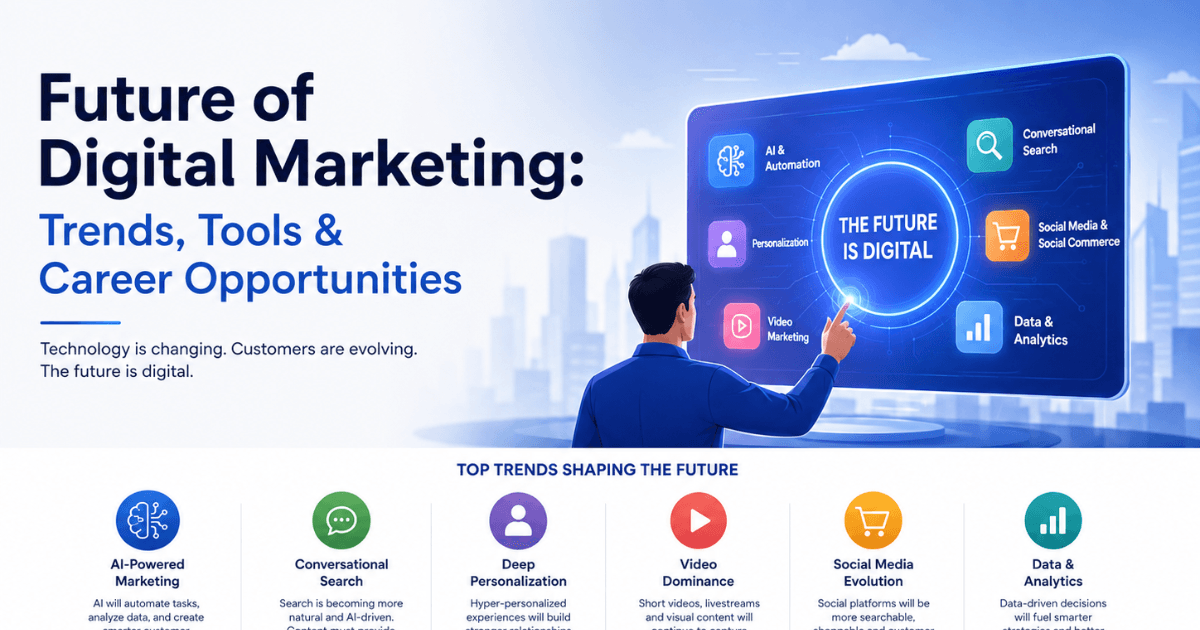
Imagine waking up in 2030 and asking your phone, “What should I buy today?” Within seconds, an AI assistant understands your preferences, compares products, watches your past behavior, and recommends exactly what you need. Behind that simple recommendation is an entire digital marketing ecosystem powered by artificial intelligence, data, automation, content, and human creativity. This is the future of digital marketing. Digital marketing is no longer just about posting on social media or ranking a website on Google. It has evolved into a sophisticated combination of technology, creativity, psychology, analytics, and customer experience. As businesses increasingly move online, the demand for skilled digital marketers is expected to continue what will digital marketing look like in the coming years? Let's explore the future trends, essential tools, and exciting career opportunities shaping the industry.
The Future of Digital Marketing Is Intelligent
Artificial Intelligence is becoming one of the biggest forces behind modern marketing. AI can analyze enormous amounts of customer data, identify patterns, generate content, personalize experiences, and automate repetitive marketing tasks. Marketers can use AI to brainstorm blog topics, analyze campaigns, create advertising variations, segment audiences, predict customer behavior, and improve marketing work flows. But AI does not mean the end of human marketers. Instead, the future belongs to professionals who know how to combine AI capabilities with human creativity and strategic thinking. AI can generate an idea, but a skilled marketer decides whether that idea is relevant, persuasive, ethical, and aligned with the brand.
Trend 1: AI-Powered Marketing Will Become the Norm
AI is moving from an optional tool to an essential part of marketing operations.
Businesses are increasingly using AI for:
Content creation, customer segmentation, predictive analytics, chatbots, personalization, advertising optimization, email marketing, social media management, and campaign analysis. Generative AI is also making it easier to produce text, images, videos, and other creative assets. The marketers of the future will not ask, “Will AI replace marketers?” Instead, they will ask, “How can I use AI to become a better marketer?”
Trend 2: Search Is Becoming More Conversational
Search is changing dramatically. People are no longer relying only on short keyword searches. They are asking longer, more natural questions through AI-powered search and conversational assistants. This is creating new opportunities in Answer Engine Optimization (AEO) and Generative Engine Optimization (GEO).Future marketers will need to create content that is not only optimized for traditional search engines but also useful for AI-driven search experiences. That means focusing on genuine expertise, clear answers, helpful information, structured content, and strong brand authority.
Trend 3: Personalization Will Go Deeper
Customers do not want to feel like another number in a database. They want brands to understand their needs. The future of digital marketing will therefore become increasingly personalized. Imagine an online store that knows what products interest you, an email that recommends something based on your preferences, or a website that changes its content according to your interests. However, personalization must be balanced with privacy and transparency. Businesses that respect customer data will have a better chance of building long-term trust.
Trend 4: Video Will Remain a Marketing Powerhouse
Attention is one of the most valuable resources in the digital world, and video is one of the fastest ways to capture it. Short-form videos, livestreams, tutorials, product demonstrations, educational videos, customer stories, and behind-the-scenes content will continue to play an important role. The future is not simply about producing more videos. It is about creating stories that people want to watch and share. A smartphone, a creative idea, and a strong understanding of your audience can sometimes be more powerful than an expensive production.
Trend 5: Social Media Will Become More Searchable and Shoppable
Social platforms are increasingly becoming places where consumers discover brands, search for information, read reviews, interact with creators, and make purchasing decisions. This means businesses will need to think about social SEO and social commerce. Brands that combine entertaining content with useful information and convenient purchasing experiences can turn social media followers into customers. The Digital Marketing Tools Shaping the Future Technology is at the heart of modern digital marketing. Marketers are using a growing ecosystem of tools to plan, execute, automate, and measure campaigns.
SEO and Analytics Tools
Tools such as Google Search Console, Google Analytics, and similar platforms help marketers understand search performance, keywords, competitors, website traffic, and user behavior. These tools allow marketers to make decisions based on data instead of assumptions.
AI and Content Tools
AI-powered platforms can assist with research, writing, brainstorming, image creation, video production, customer communication, and campaign optimization. The important skill is not simply knowing how to use an AI tool. It is knowing which tool to use, when to use it, and how to evaluate its output.
Advertising Platforms
Platforms such as Google Ads and Meta Ads allow businesses to reach specific audiences and measure campaign performance. Future marketers will increasingly combine advertising platforms with AI-powered automation, customer data, creative testing, and conversion optimization.
CRM and Automation Tools
Customer Relationship Management (CRM) and marketing automation platforms help businesses manage leads, track customer interactions, automate communication, and nurture prospects. Automation allows marketing teams to focus less on repetitive administration and more on strategy and customer relationships.
Career Opportunities in Digital Marketing
One of the most exciting aspects of digital marketing is the variety of career paths it offers. As businesses adopt new technologies and digital channels, professionals can specialize in different areas.
SEO Specialist
SEO professionals help websites improve their visibility in search results. Future SEO specialists will increasingly need knowledge of AI search, technical SEO, content strategy, analytics, and user intent.
Social Media Manager
Social media managers develop strategies, create content, engage communities, monitor trends, and build brand presence across social platforms.
Content Marketing Specialist
Content professionals create blogs, videos, social posts, guides, emails, and other materials designed to attract and educate audiences.
Performance Marketing Specialist
Performance marketers focus on measurable results such as leads, sales, conversions, and return on advertising spend.
PPC and Google Ads Specialist
PPC professionals manage paid search and advertising campaigns while optimizing budgets, targeting, keywords, creative, and conversion performance.
Email Marketing Specialist
Email marketers create campaigns that nurture leads, increase engagement, encourage purchases, and strengthen customer relationships.
Marketing Automation Specialist
These professionals use automation and AI technologies to streamline marketing workflows and improve customer journeys.
Digital Marketing Analyst
Analysts study campaign data and customer behavior to identify opportunities, measure performance, and support business decisions.
AI Marketing Specialist
As AI becomes increasingly important, a new generation of professionals will specialize in applying AI to marketing strategy, content, automation, analytics, and customer experience.
Skills Future Digital Marketers Need
Technology changes quickly, but some skills remain valuable. Future marketers should develop communication, creativity, analytical thinking, problem-solving, storytelling, strategic planning, adaptability, and AI literacy. Technical knowledge is valuable, but understanding customers is equally important. A marketer who knows every tool but does not understand the audience may struggle. A marketer who understands both technology and people can create campaigns that deliver meaningful results.
Is Digital Marketing a Good Career for the Future?
Yes, digital marketing offers diverse career opportunities because almost every modern business needs an online presence. From startups and e-commerce companies to educational institutions, agencies, technology companies, and large enterprises, organizations need professionals who can attract audiences and convert attention into business growth. The industry also offers opportunities for full-time employment, freelancing, consulting, entrepreneurship, remote work, and agency careers. The key is continuous learning. Digital marketing is not a field where learning stops after completing one course or earning one certification. Platforms, algorithms, consumer behavior, and technologies continue to evolve.
The Human Side of the Future
Technology may change how marketing is performed, but the reason marketing exists will remain the same: understanding people and creating value for them. AI can process data. Automation can perform tasks. Algorithms can recommend content. But humans create emotions, stories, ideas, relationships, and trust. That is why the future of digital marketing will not be purely technological. It will be human-centered technology.
Conclusion
The future of digital marketing is full of possibilities. AI, conversational search, personalization, video, social commerce, automation, analytics, and emerging technologies are transforming the way brands connect with customers. At the same time, these changes are creating exciting career opportunities for people who are willing to learn and adapt. The digital marketer of tomorrow will not simply be someone who knows how to post content or run advertisements. They will be a strategist, storyteller, analyst, technologist, and problem-solver who knows how to turn technology into meaningful customer experiences. The future is already here. The real question is not whether digital marketing will change—it will.
Comments
Loading…