On this page
- Is Full-Stack Development Still Worth Learning?
- What Does Full-Stack Actually Mean?
- Why Django and React Make a Strong Pair
- How AI Is Changing the Developer’s Daily Work
- Skills That Will Matter Most in the Coming Years
- Where Does AI Fit Into Your Own Projects?
- How to Start Learning Full-Stack Development in Jalandhar
- What Can You Do After Learning Full-Stack?
- Your Next Step
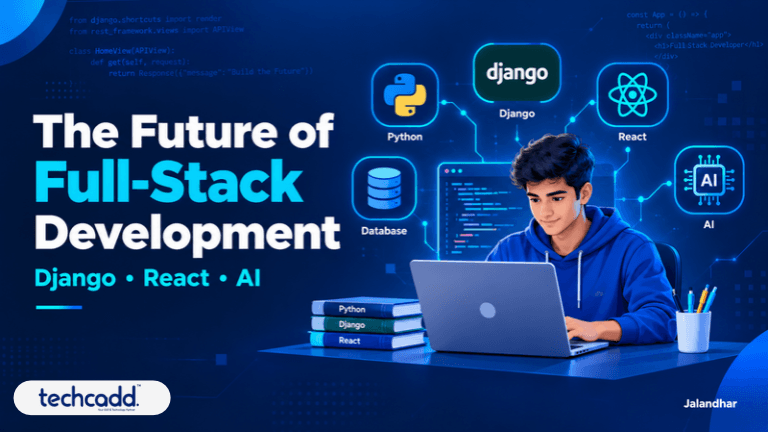
Is Full-Stack Development Still Worth Learning?
If you’re a student in Jalandhar thinking about a career in IT, you’ve probably wondered: “AI can write code now, so will there even be jobs left for developers?”
It’s a fair worry. But here’s what’s actually happening. AI is changing how developers work, not whether companies need them. Businesses still need people who can plan an app, connect its different parts, fix what breaks, and make decisions that no tool can make alone. Full-stack developers do exactly that, which is why the role remains one of the most in-demand in tech.
What Does Full-Stack Actually Mean?
Think of a food delivery app you use every week. The buttons, menus and screens you tap are the front end. The part that stores your order, checks your payment and remembers your address is the back end. A full-stack developer understands both sides and can build the whole product, from the first screen to the last database entry.
That’s a big advantage early in your career. Instead of knowing just one small piece, you understand how a complete application comes together. That makes you more useful to employers, and more confident if you ever want to build your own project or start freelancing.
Why Django and React Make a Strong Pair
Django is a Python framework for the back end. It handles logins, databases, security and APIs without making you write everything from scratch. If you’ve already touched Python in college, Django feels like a natural next step.
React takes care of the front end. It lets you build fast, interactive pages from small reusable pieces, which is why startups and large product teams both rely on it.
Together, they give you a practical, job-relevant stack. Django runs the engine, React designs the dashboard, and you control both.
Now the question most beginners ask: “Do I need to be a coding genius for this?” Not at all. Most students start with basic Python and HTML, then build one small project at a time. Confidence comes from building, not from memorizing.
How AI Is Changing the Developer’s Daily Work
Let’s be honest about what AI tools can do. They can suggest code, explain error messages, generate a quick form or write a first draft of a function. For a student, that’s like having a patient tutor available at any hour.
But here’s the catch. AI makes mistakes, and it makes them confidently. It might give you code that runs but has a security gap, or a database query that slows down the moment real users arrive. If you don’t understand the basics, you won’t even notice the problem. That’s why learning fundamentals still matters more than ever. The developer who can read, question and fix AI-generated code will always be ahead of the one who just copies and pastes.
In real projects, developers are already using AI to speed up routine work like writing test cases, drafting documentation and debugging. The time they save goes into the harder parts: designing features, thinking about users and solving real business problems.
Skills That Will Matter Most in the Coming Years
If you’re wondering what to learn first, here’s a simple order that works well for beginners:
HTML, CSS and JavaScript: the foundation of everything you see on a website.
Python basics: variables, loops, functions and simple problem-solving.
Django: building back-end logic, databases and user authentication.
React: creating interactive, modern interfaces.
APIs and Git: connecting front end to back end and working in teams.
AI-assisted coding: using tools wisely to learn faster, not to skip learning.
Many beginners make the same mistake: jumping to advanced tools before the basics feel comfortable. Another common one is watching endless tutorials without building anything. Try the opposite. After every new concept, make something small, even a simple notes app or a student attendance tracker. Those little projects are what recruiters actually want to see.
Where Does AI Fit Into Your Own Projects?
Here’s an exciting part. Full-stack developers are no longer just building websites. They’re adding features like smart chatbots, product recommendations, resume analyzers and automated report generators. Django works smoothly with Python’s AI libraries, and React can display the results beautifully on screen. This means the stack you’re learning today is already well suited to the AI-powered apps companies are asking for.
How to Start Learning Full-Stack Development in Jalandhar
So, where do you actually begin? The honest answer: start small and stay consistent. You don’t need to master everything in a month. A realistic path is to spend the first few weeks on web basics and Python, then move into Django and React once you’re comfortable writing simple programs. Most students who stick with regular practice find that things start clicking around the second or third month.
Learning in a structured environment also helps more than most people expect. When you’re stuck on an error at 9 PM, having a mentor or classmates to ask can save you hours of frustration. Local, classroom-style training in Jalandhar gives you that support, along with live projects, doubt-clearing sessions and a peer group that keeps you motivated. At techcadd, the focus is on learning by building, so you finish with real projects in your portfolio instead of just certificates.
What Can You Do After Learning Full-Stack?
This is the question every student eventually asks: “Will this skill actually lead somewhere?” Yes, and in more directions than one. You can apply for junior developer roles at software companies and startups, take up internships to gain experience, or start freelancing by building websites and web apps for local businesses. Shops, clinics, coaching centres and manufacturers around Punjab are all moving online, and many of them need someone who can build and maintain their digital tools.
Some students also use full-stack skills as a stepping stone into specialised areas like AI integration, cloud development or product building. The foundation you build now keeps opening doors later.
Your Next Step
Technology will keep changing, and AI will keep getting smarter. But the developers who understand how real applications work, and who can use tools like AI with good judgement, will always have an edge. Django and React give you a solid, practical base to build on.
Pick one small project this week, maybe a personal portfolio page or a simple to-do app, and start building it. Every great developer began with something just as simple.
Filed under
Keep reading
- Why Cyber Security Is Important in Today’s Digital World: A Student’s Guide for JalandharHacked accounts, UPI scams and data leaks are no longer rare. Find out why cyber security matters for students in Jalandhar, what it means for your career, and how techcadd can help you start learning it the right way.
- Essential Data Analytics Skills Every Student in Jalandhar Should LearnThinking about a career in data? Discover the core data analytics skills students in Jalandhar should learn first, from Excel and SQL to visualization and clear thinking, and how to build them step by step with techcadd.
- SQL for Data Science: Why It Matters and How to Learn It in JalandharThinking about a data science career? Start with SQL. Learn why employers expect it first, what beginners should practise, and how students in Jalandhar can build job-ready database skills with techcadd.
Comments
Loading…