ations, advertisements, website content, offers, and customer communication.
For example, an online store can recommend products based on a customer's previous interactions. An email campaign can provide different messages to new visitors and returning customers.
This type of personalization can make marketing more relevant and improve
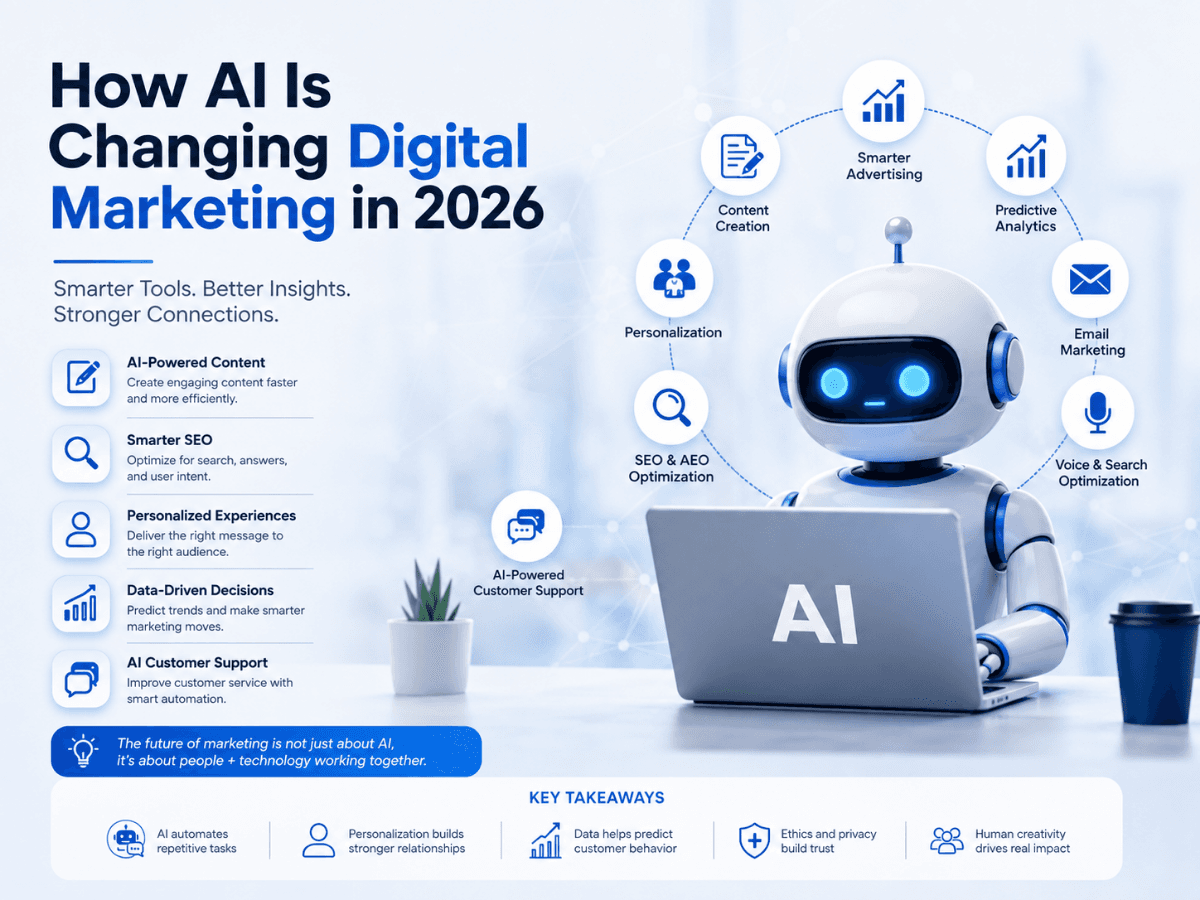
Artificial Intelligence (AI) is transforming the digital marketing industry in 2026. What once required hours of manual research, content creation, data analysis, and campaign optimization can now be supported by intelligent AI-powered tools. Businesses of all sizes are using AI to understand customers, create personalized experiences, improve advertising performance, and make faster marketing decisions.
AI is not simply another digital marketing trend. It is becoming an important part of how modern businesses plan, execute, and measure their marketing activities. At the same time, successful marketers understand that technology works best when combined with human creativity, strategic thinking, and authentic communication.
AI-Powered Content Creation
One of the biggest changes AI has brought to digital marketing is faster content creation. Generative AI tools can help marketers brainstorm topics, create outlines, write drafts, develop social media captions, prepare email campaigns, and generate creative concepts.
This allows marketing teams to spend less time on repetitive tasks and more time on strategy and creativity. However, businesses should not depend entirely on automatically generated content. Human review is essential to maintain accuracy, originality, brand voice, and credibility.
The most effective approach in 2026 is to use AI to support content teams rather than completely replace them.
AI Is Transforming SEO
Search engine optimization is also changing because of AI. Traditional SEO focused heavily on keywords, rankings, backlinks, and website optimization. These factors remain important, but search behavior is becoming more conversational.
Users are increasingly asking complex questions through AI-powered search experiences and expecting direct, useful answers. As a result, businesses are paying more attention to Answer Engine Optimization (AEO) and Generative Engine Optimization (GEO).
Brands should create authoritative content that answers customer questions clearly, demonstrates expertise, uses logical structures, and provides accurate information. Businesses also need to maintain their presence across websites, social media, review platforms, and other trusted sources.
Personalized Marketing Experiences
Customers expect brands to provide relevant experiences rather than generic advertisements. AI makes it possible to analyze large amounts of customer data and identify patterns in interests, browsing behavior, purchasing activity, and engagement.
Businesses can use these insights to personalize emails, product recommend customer engagement when data is collected and used responsibly.
Smarter Digital Advertising
AI is changing how businesses manage paid advertising campaigns. Modern advertising platforms increasingly use machine learning and automation to help marketers identify audiences, optimize bids, test creative variations, and improve campaign performance.
Instead of manually adjusting every campaign element, marketers can provide goals, budgets, audiences, and creative assets while AI helps optimize delivery.
However, automation does not remove the need for human expertise. Marketers still need to understand the target audience, create compelling offers, monitor results, and ensure that advertising aligns with business objectives.
AI-Powered Customer Service
AI-powered chatbots and conversational tools are making customer communication faster and more accessible. Businesses can use AI assistants to answer frequently asked questions, provide product information, guide website visitors, collect leads, and assist customers at different stages of the buying journey.
This can be particularly useful for businesses that receive large numbers of repetitive questions.
Human support remains important for complicated or sensitive situations, but AI can handle routine interactions and allow employees to focus on higher-value customer needs.
Predictive Analytics and Data-Driven Decisions
Marketing has always relied on data, but AI is making data analysis more powerful. Instead of simply showing what happened in a campaign, AI-powered analytics can help marketers identify patterns and predict potential outcomes.
Businesses can use predictive insights to identify promising leads, understand customer behavior, forecast demand, and determine which marketing activities may deliver stronger results.
This can help companies move from reactive marketing to proactive decision-making.
AI and Social Media Marketing
Social media marketers are also using AI to improve their workflows. AI can help identify content ideas, analyze audience engagement, generate captions, assist with creative development, and determine which types of content perform well.
Short-form videos, personalized content, creator collaborations, and community-focused marketing continue to be important areas for brands.
However, social media users value authenticity. Businesses should avoid making their social presence feel completely automated. Genuine conversations, human stories, customer experiences, and original opinions can help brands build stronger relationships.
Voice and Conversational Search
The growth of AI assistants is also influencing how people search for information. Users can interact with digital assistants using natural language instead of typing short keyword phrases.
Businesses should therefore consider conversational search when developing content. Creating clear answers to common questions and using natural language can make information easier for both users and search technologies to understand.
AI-Driven Email Marketing
Email marketing is becoming more intelligent through AI. Marketers can use AI to segment audiences, personalize messages, generate subject-line ideas, recommend content, and identify suitable times for communication.
For example, different customers can receive different product recommendations based on their previous interactions with a brand.
The objective is not to send more emails but to send more relevant emails that provide genuine value.
The Growing Importance of Human Creativity
Although AI is changing almost every part of digital marketing, human skills remain extremely important.
AI can analyze data and generate content quickly, but it does not automatically understand a brand's complete identity, emotional context, customer relationships, or long-term business vision.
Successful marketers in 2026 need a combination of AI literacy and human skills. Creativity, storytelling, communication, critical thinking, strategy, ethical judgment, and emotional intelligence will continue to differentiate strong marketers from those who simply rely on automation.
Ethical and Privacy Considerations
The growing use of AI also creates important responsibilities. Businesses must think carefully about customer privacy, data security, transparency, misinformation, copyright, and responsible AI use.
Companies should avoid collecting unnecessary personal information and should follow applicable privacy and data-protection requirements. AI-generated content should also be reviewed to reduce inaccuracies and misleading claims.
Building customer trust is becoming just as important as using advanced technology.
How Businesses Can Prepare for an AI-Driven Future
Businesses do not need to automate everything immediately. A practical approach is to identify repetitive marketing tasks where AI can provide the greatest value.
Companies can begin by using AI for research, content brainstorming, customer segmentation, reporting, campaign analysis, and workflow automation. Teams should then measure the results and gradually expand successful use cases.
Employees should also develop AI-related skills so they can understand how to use these technologies effectively and responsibly.
Conclusion
AI is changing digital marketing in 2026 by making marketing faster, more personalized, data-driven, automated, and customer-focused. From content creation and SEO to advertising, social media, customer service, analytics, and email marketing, AI is influencing almost every stage of the customer journey.
However, the future of marketing is not about humans versus AI. It is about humans working with AI.
Businesses that combine intelligent automation with original content, strong strategy, human creativity, customer trust, and responsible data practices can gain a significant advantage. As AI continues to evolve, marketers who learn how to use it effectively will be better prepared to adapt, innovate, and grow in the digital economy.
Keep reading
- Best Digital Marketing Course in Jalandhar 2026–2027Discover the best digital marketing course in Jalandhar for 2026–2027. Learn about digital marketing skills, SEO, social media marketing, Google Ads, career opportunities, course benefits, and how to choose the right training program.
- Top Digital Marketing Strategies to Grow Your Business in 2026Discover the top digital marketing strategies for 2026, including SEO, social media, content marketing, paid ads, email marketing, and automation to boost visibility, leads, sales, and growth.
Comments
Loading…