On this page
- How LLMs Work: Transformers, Fine-Tuning, Embeddings & RAG Explained
- So, What Exactly Is an LLM?
- Transformers: The Engine Behind Modern AI
- The Idea of Attention
- Tokens and Layers
- Embeddings: How AI Understands Meaning
- Why Should You Care?
- Fine-Tuning: Teaching a Smart Model Your Subject
- The Beginner Mistake to Avoid
- RAG: Giving AI Access to Fresh, Reliable Information
- How RAG Works, Step by Step
- RAG or Fine-Tuning: Which One First?
- Where Should You Start as a Beginner?
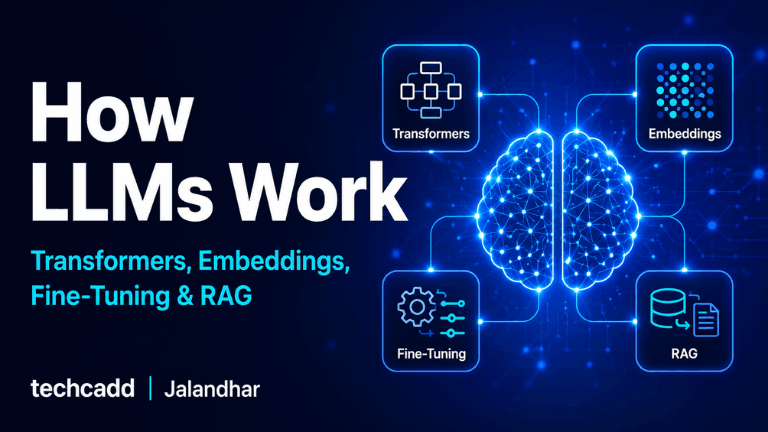
How LLMs Work: Transformers, Fine-Tuning, Embeddings & RAG Explained
So, What Exactly Is an LLM?
You type a question into ChatGPT, and a few seconds later you get an answer that sounds like a person wrote it. It feels like magic, but it isn’t. A Large Language Model (LLM) is a program trained on huge amounts of text to do one surprisingly simple thing: predict the next word.
Give it “The capital of Punjab is” and it works out that “Chandigarh” is the most likely word to come next. Repeat that thousands of times and you get full paragraphs, working code, even poems.
Many students in Jalandhar ask, “Do I need to be a maths genius to understand this?” Not at all. You need curiosity and a little patience. Let’s start with the part everyone keeps talking about.
Transformers: The Engine Behind Modern AI
Before 2017, language models read a sentence one word at a time, like looking through a keyhole. By the time they reached the end, they often forgot how the sentence began. Then researchers at Google introduced the transformer, and everything changed.
The Idea of Attention
A transformer doesn’t crawl through text word by word. It looks at the whole sentence at once and decides which words matter most to each other. This is called attention.
Take this sentence: “Simran gave Harpreet her notes because she was absent.” Who was absent? You instantly link “she” with Harpreet. Attention lets the model make the same connection by giving more weight to the right words.
Tokens and Layers
Models don’t see words the way we do. They split text into small chunks called tokens, convert those chunks into numbers, and pass them through many stacked layers. Each layer refines the meaning a little more, much like editing an assignment draft several times before you submit it.
Embeddings: How AI Understands Meaning
Computers don’t understand words, only numbers. So how does an LLM know that “car” and “vehicle” are related, while “car” and “banana” are not?
The answer is embeddings. An embedding turns a word, sentence or even a whole paragraph into a long list of numbers. These numbers act like coordinates on a giant map of meaning. Words with similar meanings land close together, and unrelated words sit far apart.
Think of it like Google Maps. Two shops on the same street in Jalandhar are close on the map, and a shop in another city is far away. Embeddings do the same thing for ideas.
Why Should You Care?
Embeddings power things you already use:
Search that understands what you mean, not just what you typed
Recommendations on YouTube and Netflix
Chatbots that find the right answer even when your question is worded differently
If you plan to build AI projects, this is a concept you’ll use again and again.
Fine-Tuning: Teaching a Smart Model Your Subject
Here’s a common student doubt: “If ChatGPT already knows so much, why would anyone train it again?”
A base LLM is like a student who has read every book in the library but hasn’t specialised in anything. Fine-tuning means giving that model extra training on a smaller, focused dataset so it becomes good at a specific job.
For example, a hospital might fine-tune a model on medical language, or a law firm might train one on legal documents. The model keeps its general knowledge but picks up the tone, terms and patterns of that field.
The Beginner Mistake to Avoid
Many beginners jump straight to fine-tuning because it sounds impressive. In reality, it needs quality data, time and computing power. Often a simpler method works better and costs far less. That method is our next topic.
RAG: Giving AI Access to Fresh, Reliable Information
An LLM only knows what it learned during training. Ask it about something that happened last week, or about your college’s own syllabus, and it may guess. Sometimes it guesses confidently and gets it wrong. This is called a hallucination.
RAG (Retrieval-Augmented Generation) fixes this in a clever way. Instead of retraining the model, you let it look things up first and then answer.
How RAG Works, Step by Step
Your documents (PDFs, notes, company files) are converted into embeddings and stored in a vector database.
When someone asks a question, the system searches for the most relevant pieces.
Those pieces are handed to the LLM along with the question.
The LLM writes an answer based on that real information.
It’s like an open-book exam. The student doesn’t need to memorise everything, only to find the right page and explain it well.
RAG or Fine-Tuning: Which One First?
If your goal is to answer questions using specific or changing information, start with RAG. If you want the model to follow a particular style or specialised behaviour, consider fine-tuning. Many real projects use both together.
Where Should You Start as a Beginner?
“Will this actually help your career?” Honestly, yes! AI skills are becoming valuable across industries—not just IT, but also design, engineering, marketing, and data analytics. And the best part? You don’t need years of experience to get started.
A sensible learning path begins with understanding basic Python, learning how prompts work and how to write effective ones, exploring embeddings through a simple semantic search project, and finally building a mini RAG chatbot using your own notes.
Remember, small projects lead to big progress! A working chatbot that answers questions from your own study material can teach you more than ten tutorials you never finish.
If you’re a student in Jalandhar looking for guided, practical training instead of learning alone, techcadd's LLM Course in Jalandhar can help you develop your AI skills step by step through hands-on learning and projects.
🚀 Stop waiting for the perfect time. Start building your AI future with techcadd today!
Keep reading
- Top 5 AI & NLP Training Institutes in Jalandhar Worth ConsideringExploring AI and NLP training in Jalandhar? Here's a practical, student-first look at the top institutes to consider, what to check before enrolling, and how to pick the right one for your goals.
- From Confusion to Confidence: One Boy's Journey Into Generative AI at techcadd, Jalandhar A relatable story of a confused beginner who found clarity in Generative AI through techcadd's Jalandhar training — real struggles, real breakthroughs, and a path any student can follow.
- What Are Large Language Models? LLMs Explained for Beginners in JalandharCurious about ChatGPT and how it actually works? This beginner-friendly guide explains large language models (LLMs) in simple words, what they can do, and how students in Jalandhar can start learning AI skills with techcadd.
Comments
Loading…