On this page
- From Confusion to Confidence: One Boy's Journey Into Generative AI
- The Turning Point
- Learning by Doing, Not Just Watching
- Connecting Concepts to Real Career Goals
- Finding His Own Confidence
- What Students Often Get Wrong
- Rohan's journey also highlighted a few common mistakes beginners make when approaching generative AI. Many jump straight into advanced tools without understanding the basics of how these models actually think. Others expect instant mastery and quit after a few confusing sessions. And some rely purely on free online content, which is often scattered, inconsistent, or missing the practical structure a proper course provides.
- If You're Where Rohan Once Was
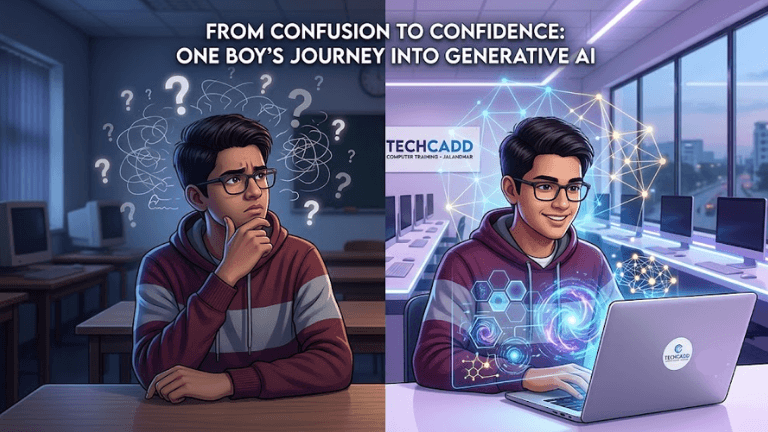
From Confusion to Confidence: One Boy's Journey Into Generative AI
Rohan still remembers the exact moment he felt completely lost. It was during a college seminar in Jalandhar, and everyone around him was throwing around terms like "prompt engineering," "large language models," and "generative AI" as if they were discussing yesterday's cricket match. He nodded along, pretending to understand, while inside he was panicking. He'd heard about ChatGPT, sure. He'd even used it a few times to write assignment introductions. But actually understanding how it worked? That felt like a different universe entirely.
This is a story a lot of students will recognize. You're not bad at technology. You're not "not smart enough." You've just never had someone break it down in a way that actually makes sense.
The Turning Point
Rohan's confusion didn't disappear on its own. What changed things was walking into techcadd's Jalandhar center after a friend mentioned their Generative AI course almost in passing. He wasn't expecting much — maybe a few PowerPoint slides and some theory he'd forget in a week.
Instead, the first session flipped something in his head. Instead of starting with complicated definitions, the trainer asked a simple question: "Have you ever asked ChatGPT something and gotten a weird or wrong answer? Why do you think that happened?" Suddenly, the whole class was talking, guessing, debating. Nobody felt stupid for not knowing. That's usually the biggest fear beginners carry — the fear of asking a "dumb question" in front of others.
By the end of week one, Rohan wasn't just using AI tools. He was starting to understand the logic behind them — how models are trained, why prompts matter, and why generative AI isn't magic, just pattern recognition at a massive scale.
That shift, from passively using a tool to actually understanding it, is where real confidence begins.
Learning by Doing, Not Just Watching
The second thing that changed for Rohan was realizing that watching tutorials and actually building something are two completely different experiences. He'd watched dozens of YouTube videos before joining techcadd, and every single one made sense while he was watching. The moment he closed the video and tried it himself, his mind went blank.
At techcadd, the approach was different. Every concept came with a hands-on task. Learning about prompt structuring wasn't just theory — he was immediately writing prompts, testing them, seeing what worked and what didn't. When the class covered how generative models handle text, images, and code differently, they didn't just discuss it. They experimented with actual tools, comparing outputs, spotting patterns, making mistakes and fixing them in real time.
This is usually where beginners either give up or break through. The mistakes matter. Rohan messed up his first few prompts badly — vague instructions, no context, no examples — and got outputs that made no sense. But instead of feeling discouraged, he started treating it like a puzzle. What's missing? What does the model need to understand what I actually want?
That mindset shift is something a lot of students underestimate. You don't need to be "naturally good with computers" to learn generative AI. You need patience with the process and a willingness to experiment without fearing failure.
Connecting Concepts to Real Career Goals
Somewhere around the third week, Rohan started asking a question a lot of students eventually ask: "Okay, but what can I actually do with this?" It's a fair question. Understanding a technology is one thing. Knowing where it fits into your career is another.
The answer became clearer as the course moved into practical applications — content creation, automation, AI-assisted design, and even how businesses in Jalandhar and nearby regions were beginning to use these tools to save time and cut costs. Suddenly, this wasn't just an interesting subject. It was a skill with real, visible demand.
Finding His Own Confidence
By the final stretch of the course, Rohan wasn't the same student who sat quietly in that seminar, nodding along to words he didn't understand. He was building small projects on his own — automating repetitive writing tasks, experimenting with AI-generated content for a college project, even helping a junior classmate who was stuck exactly where he used to be.
That's usually the clearest sign that learning has actually happened. Not when you can repeat definitions, but when you can explain them to someone else in your own words.
He also started noticing something he hadn't expected: the fear was gone. Not because generative AI suddenly became simple — it's still a fast-moving, sometimes confusing field — but because he finally had a framework for understanding new developments as they came. When a new AI tool made headlines, he wasn't intimidated anymore. He was curious. He wanted to try it, break it, understand it.
What Students Often Get Wrong
Rohan's journey also highlighted a few common mistakes beginners make when approaching generative AI. Many jump straight into advanced tools without understanding the basics of how these models actually think. Others expect instant mastery and quit after a few confusing sessions. And some rely purely on free online content, which is often scattered, inconsistent, or missing the practical structure a proper course provides.
What made the difference for Rohan wasn't intelligence or luck. It was structured learning, real practice, and an environment where questions were welcomed instead of judged.
If You're Where Rohan Once Was
If you're a student in Jalandhar staring at the term "generative AI" and feeling that same confusion Rohan felt, know this — it's not a sign that you're behind. It's simply a sign that you haven't found the right starting point yet.
Sometimes all it takes is one course, one mentor, and one moment of things finally clicking to turn confusion into genuine confidence.
Filed under
Keep reading
- How a Jalandhar Student Used Generative AI to Launch Her Own Design BusinessA Jalandhar student turned her curiosity for generative AI into a real design business. Here's how she did it, what she learned, and how you can start too.
- How Generative AI Is Changing Local Search and Digital Marketing in JalandharGenerative AI is reshaping how Jalandhar businesses get found online. Here's how local search and digital marketing are evolving—and what it means for students learning digital marketing today.
- Excel + AI: The New Trend Reshaping Office Work — How techcadd Is Preparing StudentsExcerpt Discover how combining traditional Excel skills with AI tools is transforming modern office productivity. Learn how techcadd is equipping students with advanced, AI-powered spreadsheet techniques to succeed in today's evolving job market.
Comments
Loading…