What Does RAG Actually Mean?
If you've been exploring AI tools lately, chances are you've bumped into the term "RAG" somewhere — maybe in a YouTube video, a LinkedIn post, or a classroom discussion. And if your first reaction was "wait, what does that even mean?" — don't worry, you're not alone. Most students feel the exact same way the first time they hear it.
RAG stands for Retrieval-Augmented Generation. Sounds technical, right? But the idea behind it is actually pretty simple once you break it down.
Think about how a regular AI chatbot works. It's trained on a huge amount of data, and it answers your questions based on whatever it learned during training. The problem? That training has a cutoff date, and the model can't look things up in real time. So if you ask it something recent, or something very specific to your company's internal documents, it might either not know the answer or — worse — confidently make something up.
This is exactly where RAG comes in.
RAG is a technique that lets an AI model "retrieve" relevant information from an external source — like a database, a set of documents, or the internet — before it generates its answer. Instead of relying purely on what it memorized during training, the model first searches for facts, then uses those facts to write a response.
In short: retrieval means searching for the right information, and generation means using that information to create a well-written, useful answer.
For students in Jalandhar stepping into the world of AI and data science, understanding RAG isn't just a theory lesson — it's quickly becoming one of the most practical and in-demand skills in the industry today.
Why Does RAG Matter So Much Right Now?
Here's a question a lot of students ask: "If AI models are already so smart, why do they even need to look things up?"
Good question. The truth is, even the most advanced AI models have a few real limitations. They can "hallucinate" — meaning they sometimes generate answers that sound confident but are factually wrong. They also don't automatically know about anything that happened after their training ended, and they definitely don't know the private details of your company, college, or project unless someone tells them.
RAG solves these problems in a surprisingly elegant way. Instead of expecting the model to "know everything," it gives the model the ability to go find the answer first — almost like an open-book exam instead of relying purely on memory. This makes responses far more accurate, current, and trustworthy.
This is exactly why RAG has become such a big deal in the AI industry. Companies building customer support bots, internal knowledge assistants, legal research tools, and even healthcare applications are using RAG so their AI systems give answers based on real, verified data — not guesswork.
For students, this matters because RAG sits right at the intersection of a few hot skills: natural language processing, databases, and practical AI application building. You don't need to be a PhD researcher to work with RAG. If you understand the basics of Python, APIs, and how search works, you're already closer than you think.
A common doubt beginners have is, "Is this too advanced for someone just starting out?" Honestly, no. RAG is one of those topics that looks intimidating from the outside but becomes very logical once you see it in action — which is exactly what we'll walk through next.
How RAG Actually Works (In Simple Terms)
Let's break RAG down into steps, the way you'd explain it to a friend over chai.
Imagine you ask an AI assistant, "What's our company's refund policy?" Here's what happens behind the scenes in a RAG system:
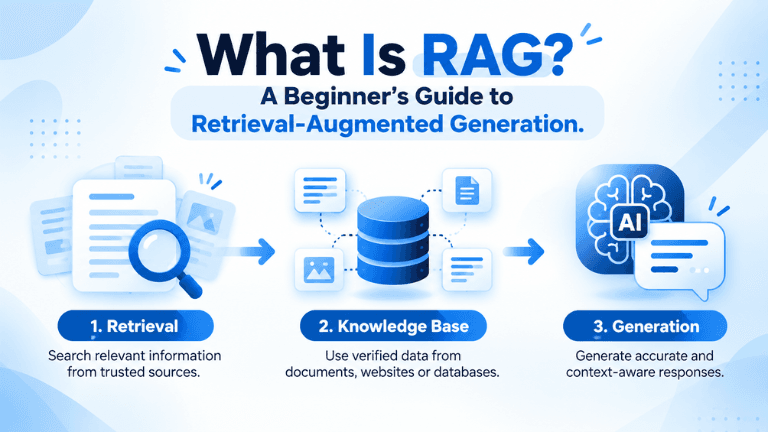
Step 1 — Retrieval: The system takes your question and searches through a connected knowledge base — this could be company documents, a database, or indexed web pages — to find the most relevant pieces of information.
Step 2 — Augmentation: The relevant information it found gets added to the original question, almost like handing the AI a cheat sheet along with the query.
Step 3 — Generation: The AI model then reads both your question and the retrieved information, and generates a clear, natural-language answer based on actual facts, not guesses.
That's it. No magic, just smart engineering.
A common beginner mistake is assuming RAG is a single tool you install. It's actually a system made up of a few parts working together — usually a vector database (to store information in a searchable format), an embedding model (to convert text into a format the system can search through), and a language model (to generate the final answer).
So, what can you actually do after learning RAG? Quite a lot. Students who understand RAG often go on to build AI-powered chatbots, document search tools, internal company assistants, and research helpers — all genuinely useful, job-relevant projects.
If you're a student in Jalandhar curious about where AI is heading, RAG is a great starting point. It's practical, it's in demand, and it teaches you how real-world AI systems are built — not just how to prompt a chatbot.
If you're a student in Jalandhar curious about where AI is heading, RAG is a great starting point. It's practical, it's in demand, and it teaches you how real-world AI systems are built — not just how to prompt a chatbot. For students looking to learn RAG through practical, structured training, techcadd offers a RAG Certificate Course in Jalandhar, covering the concepts and skills needed to work with Retrieval-Augmented Generation and modern AI applications.
Filed under
Keep reading
- From Confusion to Confidence: One Boy's Journey Into Generative AI at techcadd, Jalandhar A relatable story of a confused beginner who found clarity in Generative AI through techcadd's Jalandhar training — real struggles, real breakthroughs, and a path any student can follow.
- Deep Learning vs. Traditional Machine Learning: What's the Difference? | techcadd Jalandhar Confused between deep learning and traditional machine learning? Here's a simple, student-friendly breakdown to help you understand which one to learn first and why it matters for your career.
- Deep Learning Explained: How It Works, Real-World Applications & What's NextConfused about deep learning? This complete guide breaks down how it actually works, where it's used, and why it's a smart skill to learn in Jalandhar right now.
Comments
Loading…