On this page
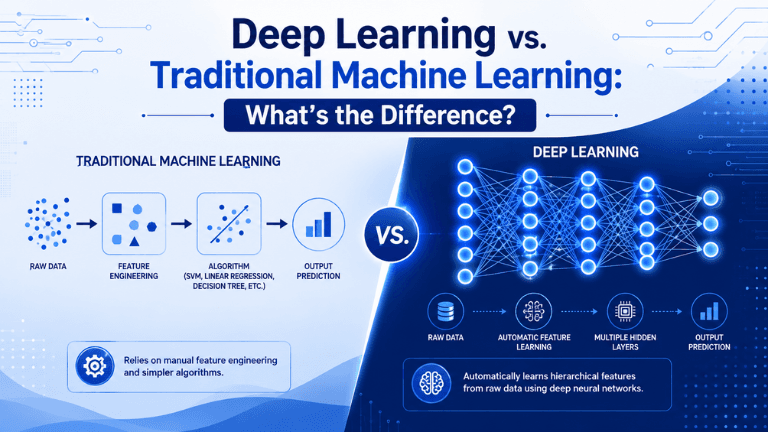
Deep Learning vs. Traditional Machine Learning: What's the Difference?
If you've just started exploring AI and data science, chances are you've already come across these two terms more times than you can count — machine learning and deep learning. And if you're like most students, you're probably wondering, "Aren't these the same thing?"
Fair question. A lot of people use them interchangeably, even in casual tech conversations. But once you start learning the subject properly, you'll realise they're related, yet quite different in how they work, what they need, and where they're used.
Let's break it down in the simplest way possible.
What is Traditional Machine Learning?
Traditional machine learning is basically teaching a computer to find patterns in data and make predictions, without explicitly programming every rule. Think of algorithms like Linear Regression, Decision Trees, or Support Vector Machines.
Here's the catch though — traditional ML usually needs you, the human, to decide which features of the data actually matter. For example, if you're building a model to predict house prices, you'd manually tell the model to consider factors like area, location, and number of rooms. The model learns from this structured input, but it doesn't figure out on its own what's important.
This makes traditional ML great for smaller datasets and problems where the relationships between inputs and outputs are relatively straightforward.
What is Deep Learning?
Deep learning, on the other hand, is a subset of machine learning that uses neural networks — layers upon layers of interconnected nodes inspired loosely by how the human brain works.
The biggest difference? Deep learning models figure out important features on their own. You don't have to tell them what matters. Feed a deep learning model thousands of images of cats and dogs, and it will gradually learn to distinguish between whiskers, ear shapes, and fur patterns — all by itself.
This is why deep learning powers things like facial recognition, voice assistants, and self-driving cars.
Key Differences You Should Actually Know
So now that you have the basic picture, let's get into what really separates the two.
1. Data Requirements
Traditional ML can work reasonably well even with a few thousand data points. Deep learning, though, is data-hungry. It genuinely performs better when you feed it massive amounts of data — think millions of images, text samples, or audio clips. If you don't have that much data, a deep learning model might actually perform worse than a simpler ML algorithm.
2. Computing Power
This is a big one for students. Traditional ML models can run on a regular laptop without much trouble. Deep learning models, especially the larger ones, often need GPUs to train in a reasonable amount of time. That's why you'll see people renting cloud GPU resources just to train their deep learning projects.
3. Feature Engineering
In traditional ML, a huge chunk of your work as a data scientist goes into feature engineering — manually selecting and transforming the right variables. In deep learning, the neural network handles most of that heavy lifting on its own, layer by layer.
4. Interpretability
Here's something beginners don't always think about — traditional ML models are usually easier to explain. If a bank rejects a loan application using a decision tree, you can actually trace back why. Deep learning models, often called "black boxes," are far harder to interpret, even for experienced practitioners.
5. Use Cases
Traditional ML is still widely used for things like fraud detection, customer churn prediction, and recommendation systems with structured data. Deep learning dominates areas like image recognition, natural language processing, and speech-to-text systems.
Neither one is "better" in every situation — it genuinely depends on your data, your problem, and your resources.
Which One Should You Learn First?
This is probably the question on your mind right now, and honestly, it's one we hear a lot from students walking into our Jalandhar centre too.
Our honest suggestion? Start with traditional machine learning. Here's why — deep learning concepts like neural networks, backpropagation, and gradient descent will make a lot more sense once you already understand the basics of how models learn from data. Jumping straight into deep learning without this foundation often leads to confusion, not progress.
Learn the fundamentals first: statistics, Python, regression, classification, and basic algorithms. Once you're comfortable with how a model "learns," transitioning into deep learning frameworks like TensorFlow or PyTorch becomes a lot smoother.
A common beginner mistake? Trying to learn deep learning frameworks before understanding what's actually happening mathematically underneath. You can technically copy-paste code and get a model running, but you won't really understand why it works — or more importantly, why it fails when it does.
Will This Actually Help Your Career?
Absolutely — and increasingly so. Companies today aren't just looking for people who can run pre-built models. They want people who understand when to use a simple algorithm versus when a problem genuinely needs deep learning. That judgment comes from understanding both, not just one.
Whether you're aiming for a role as a data analyst, ML engineer, or AI researcher, having clarity on this distinction puts you ahead of people who only know buzzwords.
If you're based in Jalandhar and serious about building a real career in this field, structured, hands-on guidance makes this journey far less overwhelming — and a lot faster.
Filed under
Keep reading
- Deep Learning Explained: How It Works, Real-World Applications & What's NextConfused about deep learning? This complete guide breaks down how it actually works, where it's used, and why it's a smart skill to learn in Jalandhar right now.
- From Confusion to Confidence: One Boy's Journey Into Generative AI at techcadd, Jalandhar A relatable story of a confused beginner who found clarity in Generative AI through techcadd's Jalandhar training — real struggles, real breakthroughs, and a path any student can follow.
- Top 5 AI & NLP Training Institutes in Jalandhar Worth ConsideringExploring AI and NLP training in Jalandhar? Here's a practical, student-first look at the top institutes to consider, what to check before enrolling, and how to pick the right one for your goals.
Comments
Loading…