On this page
What Exactly Is Deep Learning? (And Why Everyone's Suddenly Talking About It)
If you've scrolled through YouTube, LinkedIn, or even your college WhatsApp group lately, chances are you've bumped into the term "deep learning" at least a dozen times. Maybe it felt like one of those buzzwords that sounds impressive but nobody really explains properly. So let's fix that right here.
Deep learning is a part of artificial intelligence that teaches computers to learn the way our brains sort of do — through layers of understanding, not just one-shot memorization. Think about how a toddler learns to recognize a dog. Nobody hands them a rulebook saying "four legs plus fur plus tail equals dog." They see enough dogs, make a few wrong guesses (calling a cat a dog, maybe), and slowly their brain figures out the pattern on its own.
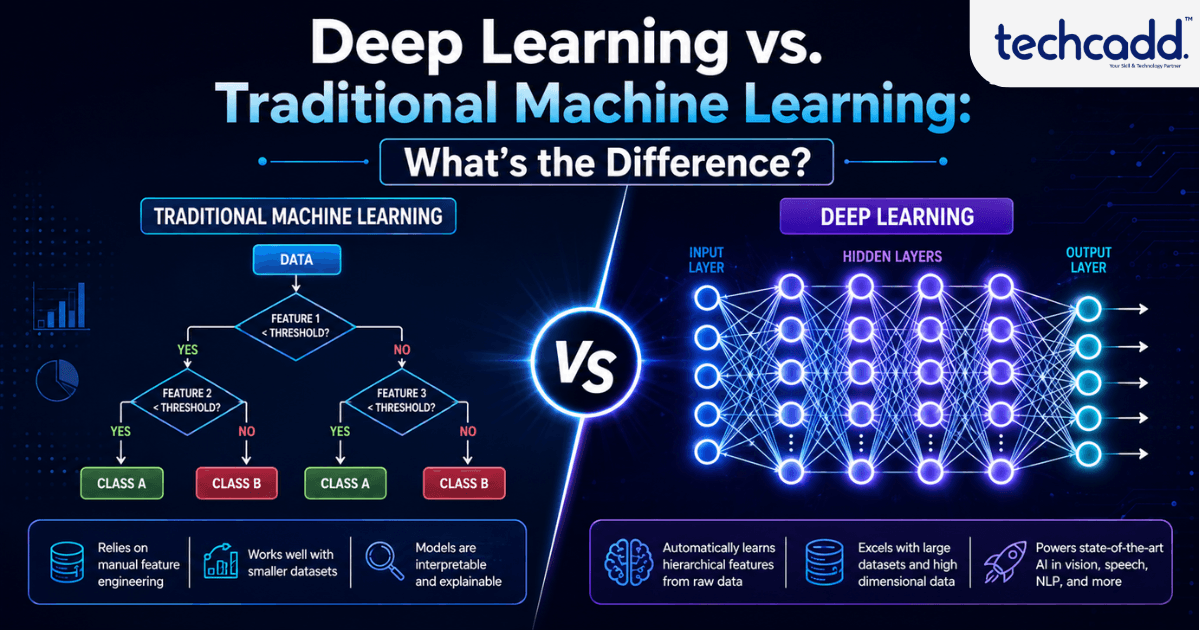
Deep learning models work in a strangely similar way, except instead of a brain, they use something called a neural network — layers of mathematical "neurons" stacked on top of each other. Each layer picks up a slightly more complex pattern than the one before it. The first layer might notice edges in an image, the next layer might notice shapes, and by the time you reach the deeper layers, the model is confidently saying "that's a dog" or "that's a cat."
This is exactly why it's called deep learning — the "depth" refers to the number of these layers stacked together.
Now, here's the part students usually relate to the most: you don't need to be a math genius to start learning this. Yes, there's math involved somewhere behind the scenes, but as a beginner, your journey starts with understanding concepts, not solving equations on a whiteboard. Tools, frameworks, and real project-based learning are what actually build your skill — not memorizing formulas.
If you're someone in Jalandhar wondering whether this field is "too advanced" for you, take a breath. Everyone starts exactly where you are right now — curious, a little confused, and wondering where to even begin.
Where Deep Learning Actually Shows Up in Real Life
Here's the thing about deep learning — it's not some futuristic concept sitting in a research lab. You're already using it, probably every single day, without realizing it.
When Instagram suggests a filter that automatically blurs your background, that's deep learning. When YouTube somehow knows exactly what video to recommend next (sometimes a little too well), that's deep learning too. Google Translate converting a full sentence into another language with decent accuracy? Same technology. Even your phone's face unlock feature relies on a neural network trained to recognize your face from thousands of angles and lighting conditions.
In the medical field, deep learning is being used to scan X-rays and MRI images to catch early signs of diseases that even experienced doctors might miss at first glance. In agriculture, it's helping identify crop diseases from a simple photo of a leaf. In the finance world, it's quietly working behind the scenes to detect fraudulent transactions the moment they happen.
For students, this is where things get genuinely exciting. Deep learning isn't locked away in one industry — it's spread across healthcare, automotive (think self-driving cars), e-commerce, agriculture, security, entertainment, and even voice assistants like Alexa or Siri.
A common question students ask at this point is, "Okay, but will this actually help my career, or is it just a trending topic?" Fair question. The honest answer is that almost every industry is now looking for people who understand how to work with data and AI-driven systems, even at a basic level. You don't need to become a hardcore researcher to benefit from this skill — understanding the fundamentals alone can open doors in software development, data analysis, automation, and product-based roles.
So the applications aren't just "cool examples" to impress someone at a job interview. They're a genuine preview of where industries are heading, and why getting familiar with deep learning now, rather than later, puts you a step ahead.
Why It's Worth Learning Now, and Where It's Headed
Let's talk about the practical side — the benefits and what the future actually looks like.
One of the biggest advantages of deep learning is the automation of tasks that once required significant human effort. Sorting through thousands of images, analyzing large amounts of text, or predicting outcomes from complex data—tasks that could take teams of people weeks can now be completed much faster. This is not just convenient; it is reshaping how industries use technology and data.
For students, this creates real opportunities. As more companies adopt AI-driven systems, the demand for professionals who understand data, automation, neural networks and machine intelligence continues to grow. You don't necessarily have to aim for a research scientist role right away—even foundational knowledge of deep learning can help strengthen your technical skill set and resume.
A common doubt many beginners have is, "What mistakes do people usually make when starting out?" One of the most common mistakes is trying to learn everything at once—jumping into complex mathematics or advanced architectures before understanding the fundamentals. A better approach is to start with the basics, understand how neural networks work conceptually, practice with small beginner-friendly projects, and gradually build your knowledge.
For students looking to develop these skills, Techcadd's Deep Learning Course in Jalandhar provides an opportunity to explore the fundamentals of deep learning and artificial intelligence through structured learning and practical exposure. Learners can focus on understanding core concepts and applying their knowledge through hands-on exercises and projects. Before enrolling, students should review the course syllabus, practical training, project work and certification details.
As for the future, deep learning is becoming increasingly integrated into everyday technology. It is being applied in areas such as personalized healthcare, intelligent voice assistants, AI-generated content, computer vision and climate modeling. These applications are creating opportunities across industries that traditionally had limited involvement with AI.
If you're based in Jalandhar and considering where to begin, you don't necessarily need to relocate to a major technology hub to start learning deep learning. With structured guidance and consistent practice, students can begin building their skills locally. Techcadd's Deep Learning Course in Jalandhar can be considered by learners who want to explore deep learning and develop a foundation for further studies or career opportunities in AI and machine learning.
Filed under
Keep reading
- Deep Learning vs. Traditional Machine Learning: What's the Difference? | techcadd Jalandhar Confused between deep learning and traditional machine learning? Here's a simple, student-friendly breakdown to help you understand which one to learn first and why it matters for your career.
- Top 5 AI & NLP Training Institutes in Jalandhar Worth ConsideringExploring AI and NLP training in Jalandhar? Here's a practical, student-first look at the top institutes to consider, what to check before enrolling, and how to pick the right one for your goals.
- Top 10 Full Stack Development Institutes in Jalandhar Compared (2026 Guide)Confused about where to learn full stack development in Jalandhar? Here's an honest, student-focused comparison of the top 10 institutes to help you pick the right one for your goals.
Comments
Loading…