On this page
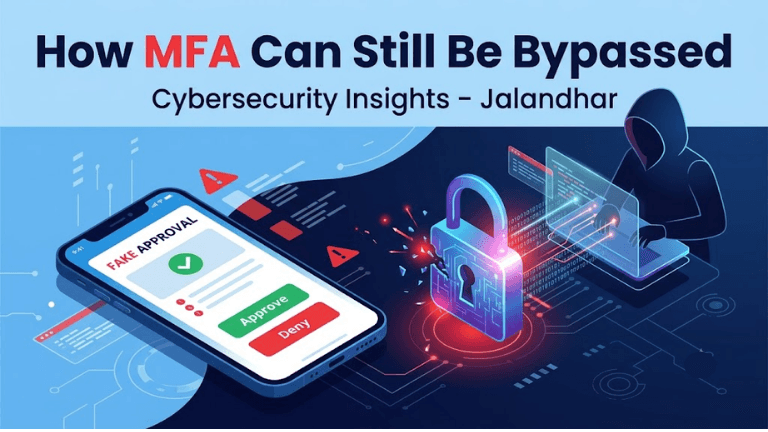
How Multi-Factor Authentication Can Still Be Bypassed: What Students in Jalandhar Should Know
MFA Was Supposed to Be the Answer
If you've started learning cybersecurity, you've probably heard the same reassuring line over and over: "just enable MFA and you're safe." For years, that advice made sense. Multi-factor authentication added a second lock on the door, so even if someone stole your password, they still couldn't get in without your phone or your fingerprint.
But here's the uncomfortable truth that every serious security student eventually has to face: MFA is not unbreakable. Attackers have adapted, and so should the way we think about "secure" logins.
This matters even more if you're a student in Jalandhar planning a career in cybersecurity, ethical hacking, or IT support. Employers don't just want people who can explain what MFA is. They want people who understand where it fails, because that's exactly the kind of thinking that separates a textbook learner from someone who can actually protect a real organization.
Why This Topic Trips Up Beginners
A common mistake new learners make is treating MFA like a magic switch. Turn it on, problem solved. In reality, MFA is just one layer in a much bigger security picture. It reduces risk, but it doesn't eliminate it.
Think about it this way: a second lock on your door is great, but if someone tricks you into handing them the key, the lock doesn't matter anymore. That's essentially what happens in many real-world MFA bypass cases. The technology holds up. The human using it doesn't always.
Understanding this gap is genuinely useful, whether you're aiming for a SOC analyst role, a penetration testing career, or just want to secure your own accounts properly. In the next part, we'll break down the actual methods attackers use, in plain language, without the jargon overload.
The Most Common Ways MFA Gets Bypassed
Let's get into the actual techniques, because this is where things get genuinely interesting for anyone studying cybersecurity.
MFA fatigue attacks are one of the most talked-about methods right now. An attacker who already has your password sends repeated push notification requests to your phone, sometimes at odd hours, hoping you'll get annoyed or confused and just tap "approve" to make it stop. It sounds almost too simple, but it has worked against major companies. This is less about broken technology and more about exploiting human patience.
SIM swapping is another one students often find shocking the first time they learn about it. Attackers convince a mobile carrier to transfer your phone number to a SIM card they control. Suddenly, every OTP meant for you lands in their hands instead.
Phishing with real-time relay takes traditional phishing a step further. Instead of just stealing a password, attackers use fake login pages that capture your password and your OTP simultaneously, then instantly use both on the real site before your code expires. Speed is the entire trick here.
Session hijacking skips the login process altogether. If an attacker steals your session cookie through malware or an unsecured network, they don't need your password or your OTP. They simply take over your already-logged-in session.
And then there's the classic social engineering angle, where attackers impersonate IT support or a helpdesk and simply talk someone into sharing a code or approving a request.
Here's what beginners usually get wrong: they assume these attacks require advanced hacking skills. Most of them actually rely more on psychology than programming. That's an important mindset shift if you're serious about this field.
What This Means If You're Learning Cybersecurity in Jalandhar
So does this mean MFA is pointless? Not at all. It still blocks the vast majority of basic credential-stuffing and password-reuse attacks. The real lesson here is that security is never a single fix, it's layered thinking.
If you're a student trying to build a genuine career in this field, here's what actually matters:
Learn to think like an attacker, not just a defender. Knowing that MFA fatigue attacks exist is one thing. Understanding why they work psychologically is what makes you valuable in an actual security team.
Get comfortable with the practical countermeasures, not just theory. Number-matching push notifications, hardware security keys like YubiKeys, and phishing-resistant methods such as FIDO2 are becoming the industry standard precisely because they close these gaps. If you're studying ethical hacking or network security in Jalandhar, these are the tools worth getting hands-on with.
Don't skip the "boring" basics. A lot of these attacks succeed because someone at a company wasn't trained to recognize a suspicious support call or an unexpected approval request. Employers genuinely value candidates who understand user behavior alongside technical defenses.
A common doubt among beginners is whether this topic is too advanced to start with. It isn't. You don't need to master cryptography to understand MFA bypass techniques. You need curiosity, a willingness to read real breach reports, and practice thinking through "what could go wrong here?"
If ethical hacking, cybersecurity, or IT security careers interest you, this is exactly the kind of practical, real-world knowledge that separates someone who memorized definitions from someone who can actually solve problems on the job.
Filed under
Keep reading
- Passwords vs. Passkeys: Which Is More Secure? A Jalandhar Student's GuidePasswords or passkeys — which one actually keeps your accounts safe? techcadd breaks down the real differences so Jalandhar students can browse, study and work online with confidence.
- A Jalandhar Student's First Android App Now Has Real Users: Here's How It HappenedA Jalandhar student built their first Android app and got real users. Here's the honest journey, the mistakes, and what actually worked.
Comments
Loading…