On this page
- How to Learn C++ from Scratch: A Beginner’s Roadmap
- Is C++ Good for Beginners?
- Do You Need Any Previous Experience?
- Step 1: Set Up Your Tools First
- Step 3: Understand Functions, Arrays and Pointers
- Step 4: Move to Object-Oriented Programming
- Common Mistakes Beginners Make
- Learn STL and Data Structures
- How Long Does It Take to Learn C++?
- A Simple Practice Routine That Works
- Why Guidance Makes a Difference
- Start Today, Not Tomorrow
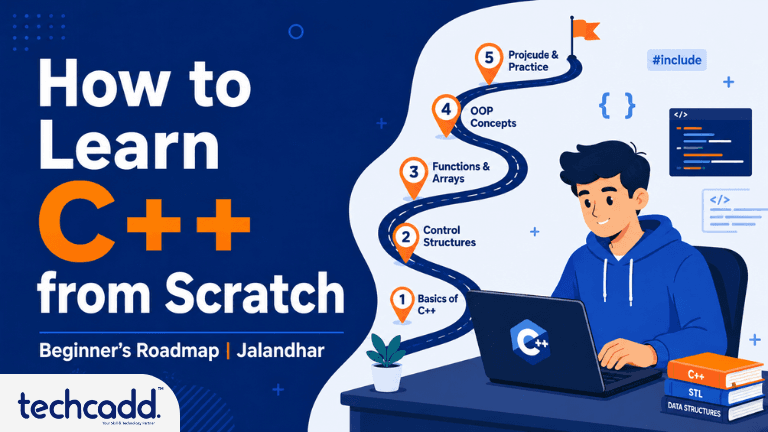
How to Learn C++ from Scratch: A Beginner’s Roadmap
You have heard that C++ is tough. Maybe a senior told you, or a classmate who gave up after two weeks. So you are sitting there wondering if it is even worth trying.
Here is the honest answer: C++ is not impossible. It just needs the right order of learning. Most students struggle because they start in the middle, jumping into complex topics before the basics are clear. This roadmap fixes that.
Is C++ Good for Beginners?
Yes, and it is a great choice if you are serious about programming. C++ teaches you how a computer actually thinks: how memory works, how data is stored, and why your code behaves the way it does. Once you understand C++, picking up Java, Python or C# feels much easier.
It is also still widely used in game development, software engineering, embedded systems and competitive programming. For students in Jalandhar preparing for BCA, B.Tech or placement tests, C++ is often part of the syllabus anyway, so the effort pays off twice.
Do You Need Any Previous Experience?
No. You do not need coding experience, and you do not need to be a maths genius. If you can follow instructions step by step and stay curious, you can start. Many students at techcadd begin with zero programming background and still write their first working program within the first few sessions.
Step 1: Set Up Your Tools First
Before writing any code, get your environment ready. Install a simple compiler and editor, such as Code::Blocks, Dev-C++ or Visual Studio Code with a C++ compiler. Do not spend days comparing tools. Pick one and begin.
Then write the classic first program that prints “Hello, World!” on the screen. It looks small, but it teaches you how a C++ program is structured, how to compile it, and how to fix your first error. That first error, by the way, is completely normal. Every programmer has seen it.Learn the Core Basics Properly
This is where most beginners rush, and it is exactly where problems begin later. Spend real time on the fundamentals:
Variables and data types (int, float, char, string)
Input and output using cin and cout
Operators and expressions
Conditional statements (if, else, switch)
Loops (for, while, do-while)
Do not just read about them. Type every example yourself, change the values, break the code on purpose and then fix it. That is how concepts actually stay in your head.
A good test: can you write a program that checks whether a number is even or odd, or prints a multiplication table, without looking at notes? If yes, you are ready to move ahead.
Step 3: Understand Functions, Arrays and Pointers
Once the basics feel comfortable, move to functions, arrays and strings. Functions teach you to break big problems into small, manageable pieces. Arrays help you handle lots of data without creating fifty separate variables.
Then comes the topic that scares almost everyone: pointers. Here is a simple way to think about it. A variable is a house, and a pointer is the address written on a piece of paper. It does not hold the house itself, only where to find it. Take this slowly, draw diagrams on paper, and do not panic if it takes a few attempts to click. It does for everyone.
Step 4: Move to Object-Oriented Programming
This is the stage that makes C++ powerful. Learn classes and objects, constructors, inheritance, polymorphism and encapsulation. The idea behind OOP is simple: instead of writing scattered code, you model real-world things. A “Student” class can hold a name, roll number and marks, and have its own actions like displaying results.
Build small projects here, like a student record system or a simple bank account program. Projects are where theory turns into real skill, and they also look great on a resume when you apply for internships or jobs.
Common Mistakes Beginners Make
Watching tutorials without coding. Watching feels productive, but only practice builds skill.
Skipping pointers and memory. Avoiding the hard parts only delays the struggle.
Copying code without understanding it. If you cannot explain a line, you have not learned it yet.
Giving up after errors. Errors are not failure. They are the job.
Learn STL and Data Structures
After OOP, explore the Standard Template Library (STL). It gives you ready-made tools like vectors, maps, stacks and queues, so you do not have to build everything from scratch. From here, start learning data structures and algorithms (DSA). This is the stage that prepares you for coding rounds in placements, so it is worth giving it proper time.
How Long Does It Take to Learn C++?
Honestly, it depends on your routine. If you practise 1 to 2 hours daily, you can comfortably cover the basics in about a month. Functions, pointers and OOP may take another two to three months to feel solid. Do not compare your pace with others. Someone who codes slowly but understands deeply will always beat someone who rushes and forgets.
A Simple Practice Routine That Works
Code daily, even for 30 minutes. Consistency beats long, irregular sessions.
Solve small problems regularly. Start with patterns, series and number programs.
Build one mini project per topic. A calculator, a quiz game or a library system works well.
Revise old topics every week. This stops you from forgetting earlier concepts.
Why Guidance Makes a Difference
You can learn C++ on your own, but getting stuck alone is frustrating. A single misunderstood concept can waste days. Learning with a mentor means your doubts get cleared quickly, your code gets reviewed, and you know what to focus on next.
For students in Jalandhar who want structured, hands-on learning, techcadd offers practical training where you learn by actually building programs, not just listening to theory. That kind of environment helps you stay consistent and confident, especially when pointers and OOP start feeling tricky.
Start Today, Not Tomorrow
You do not need to know everything before you begin. Install your compiler, write your first program, and make a promise to code a little every day. Six months from now, you will be glad you started this week.
Keep reading
- Advanced C++ Concepts Explained: OOP, STL, Smart Pointers & Templates for Students in JalandharConfused by OOP, STL, smart pointers and templates in C++? This student-friendly guide breaks each concept down in simple language, so you know what to learn first, why it matters, and how techcadd in Jalandhar can help you build real programming skills.
- Essential Data Analytics Skills Every Student in Jalandhar Should LearnThinking about a career in data? Discover the core data analytics skills students in Jalandhar should learn first, from Excel and SQL to visualization and clear thinking, and how to build them step by step with techcadd.
- SQL for Data Science: Why It Matters and How to Learn It in JalandharThinking about a data science career? Start with SQL. Learn why employers expect it first, what beginners should practise, and how students in Jalandhar can build job-ready database skills with techcadd.
Comments
Loading…