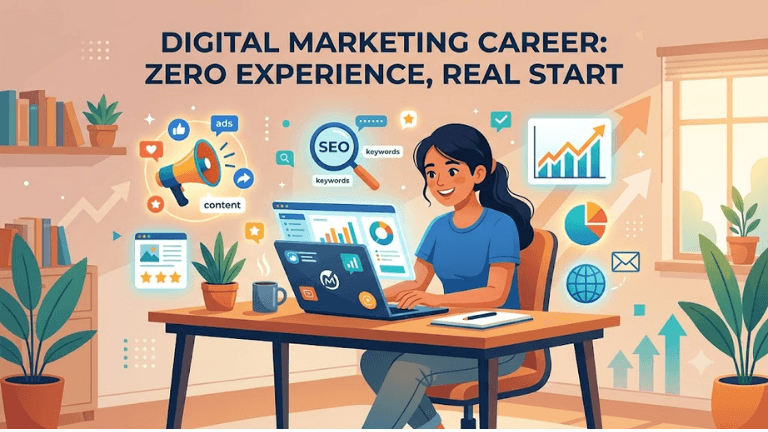
So you want to get into digital marketing, but you have zero experience and honestly no idea where to even begin? Take a breath. You're not behind — you're just at the starting line, and that's exactly where every single digital marketer once stood.
Here's the thing nobody tells beginners: digital marketing doesn't ask for a specific degree. It doesn't care if you studied commerce, arts, engineering, or took a gap year figuring things out. What it actually cares about is whether you can think like a curious problem-solver and are willing to learn tools that change every few months.
A lot of students in Jalandhar ask the same question in different words — "Sir, I don't have any background in marketing, can I still make a career out of this?" Yes. In fact, some of the sharpest digital marketers didn't come from a marketing background at all. They came from customer service, teaching, even mechanical engineering. What connected them all was curiosity about how brands grab attention online and turn that attention into sales.
Before you touch a single tool, it helps to understand what digital marketing actually is at its core: getting the right message in front of the right person, at the right time, on the right platform. Everything else — SEO, social media, ads, email, content — is just a method to do that better.
The biggest mistake beginners make? Trying to learn everything at once. One day they're watching an SEO tutorial, the next they're deep into Facebook Ads, then suddenly they're trying to master Canva, copywriting, and analytics simultaneously. That's a fast track to burnout and confusion.
Instead, start narrow. Pick one skill. Get comfortable. Then expand.
So where should that "one skill" starting point actually be? For most beginners, social media marketing or content writing tends to be the friendliest entry point. Why? Because you're already using social media daily — you already understand what makes you stop scrolling, what makes you click, what makes you ignore an ad. That instinct is more valuable than you think.
From there, layer in the basics of SEO — how Google actually decides what to rank, why keywords matter, and how something as simple as a blog title can bring in traffic for years. Then move toward Google Ads and Meta Ads, where you'll learn how businesses actually spend money to get results, and how to make sure that spending isn't wasted.
A question that comes up constantly: "Do I need to be good at maths or coding for this?" Not really. You need to be comfortable with numbers in the sense of reading a report and understanding whether a campaign is working — not solving equations. Basic Excel and a genuine interest in "why did this work and that didn't" will take you further than any coding skill.
Certifications help, but they're not magic tickets. A Google Ads certificate looks nice on a resume, but what actually gets you hired is proof that you can apply the knowledge — a mock campaign, a small business Instagram page you grew from scratch, a blog you optimized yourself. Employers in Jalandhar's growing business and retail sector are increasingly looking for people who've done something, even at a small scale, not just people who've watched tutorials.
This is also where practical, structured training makes a real difference. Learning in isolation from YouTube videos works for some, but most students find they progress faster with hands-on projects, real feedback, and a clear roadmap — rather than guessing what to learn next.
Let's talk about the part most beginners worry about but rarely ask directly — "How do I actually get my first opportunity with no experience?" Here's the honest answer: you create your own experience before someone hands it to you.
Offer to manage social media for a local shop, a relative's small business, or even a college club — for free or a small fee. Run a mock ad campaign with a small budget just to understand the dashboard. Write blog posts on topics you're genuinely interested in and track how they perform. None of this needs permission from an employer. This is exactly the kind of initiative that turns "no experience" into "here's what I've actually built."
Build a simple portfolio — even a basic one-page website or a PDF works — showing what you did, what you learned, and what results (even small ones) you got. This single step puts you ahead of most other freshers applying for the same internship or entry-level role.
As for difficulty — digital marketing isn't hard in the way calculus is hard. It's hard in the way learning to drive is hard: confusing at first, overwhelming with all the small details, and then suddenly it clicks and becomes second nature. Give yourself three to six months of consistent learning before judging whether you're "good" at it.
For students around Ludhiana and nearby areas exploring this path, the good news is that businesses locally are actively hiring for social media handling, basic SEO, and ad management — you don't need to move to a metro city to start. What you need is a clear learning path, some real practice, and the patience to stick with it past the confusing first few weeks.
That's genuinely the whole secret. Start small, stay consistent, build proof of your skills.
Filed under
Keep reading
- How One Local Business in Jalandhar Can Turn Online Searches into Paying CustomersSee how a local Jalandhar business can turn everyday Google searches into real customers with smart, simple online visibility steps — no big budget needed, just the right strategy.
- Top Digital Marketing Strategies to Grow Your Business in 2026Discover the top digital marketing strategies for 2026, including SEO, social media, content marketing, paid ads, email marketing, and automation to boost visibility, leads, sales, and growth.
Comments
Loading…