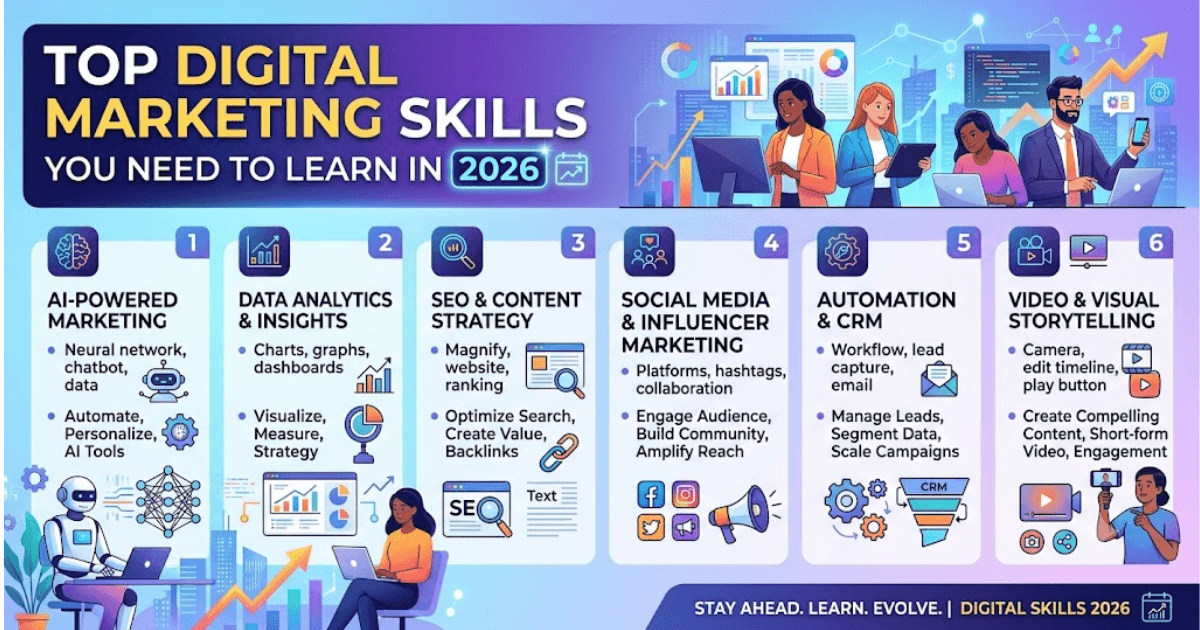
Marketing Has Changed. Have Your Skills?
The digital world moves at incredible speed. A strategy that worked yesterday may not deliver the same results tomorrow. New platforms appear, artificial intelligence is transforming workflows, customer expectations are changing, and search is becoming more conversational. In this rapidly evolving environment, learning digital marketing is no longer simply about knowing how to publish a social media post or optimize a website. Modern digital marketers need a powerful combination of creativity, technology, analytics, communication, and strategic thinking. If you want to build a successful career, grow a business, work as a freelancer, or become a valuable marketing professional, developing the right skills in 2026 can give you a significant advantage. Let's explore the top digital marketing skills you need to learn in 2026.
1. AI Marketing: Learn to Work With Intelligence
Artificial Intelligence is arguably the biggest change happening in digital marketing. AI can help marketers generate ideas, analyze data, personalize campaigns, create content, automate repetitive tasks, improve advertising, and understand customer behavior. But learning AI marketing does not mean simply learning how to type prompts into an AI tool.
A future-ready marketer should know how to:
Create effective prompts, evaluate AI-generated content, automate workflows, analyze AI insights, maintain brand voice, and use AI responsibly.
The winning combination is simple:
Human creativity + AI efficiency = smarter marketing.
2. SEO Beyond Keywords
SEO remains one of the most valuable digital marketing skills, but it is evolving. Search engines are becoming more intelligent, while users are increasingly turning to AI-powered search and conversational platforms for answers. This means marketers need to understand traditional SEO alongside emerging approaches such as Answer Engine Optimization (AEO) and Generative Engine Optimization (GEO). Modern SEO professionals should understand:
Keyword research, search intent, technical SEO, content optimization, internal linking, website performance, backlinks, structured content, local SEO, and AI search behavior. The goal is no longer just to rank. The goal is to become the answer.
3. Content Creation That People Actually Want
The internet is overflowing with content. The challenge in 2026 is not creating content—it is creating content that deserves attention. Content marketers need to understand storytelling, audience psychology, search intent, brand voice, and visual communication. Strong content can educate, entertain, solve problems, build trust, and ultimately influence purchasing decisions.
Learn how to create:
Blogs, videos, social media content, newsletters, case studies, guides, infographics, landing pages, and short-form content. AI can help you create faster, but your creativity should make the content worth reading.
4. Short-Form Video Marketing
Attention spans are changing, and video has become one of the most powerful ways to communicate online. Short-form videos can introduce a brand, demonstrate a product, answer questions, explain complicated concepts, or create an emotional connection within seconds.
Digital marketers should learn the basics of:
Video storytelling, scripting, hooks, editing, captions, thumbnails, audience retention, and platform-specific content. You do not necessarily need expensive equipment. A good idea + strong storytelling + consistent execution can be more valuable than a huge production budget.
5. Social Media Strategy
Social media marketing is much more than posting content every day. In 2026, marketers need to understand how audiences discover content, how communities interact, how social algorithms work, and how brands can turn attention into meaningful business results.
A strong social media professional should know how to:
Build content strategies, analyze trends, engage communities, manage brand reputation, use social SEO, collaborate with creators, and measure performance. The best social media marketers don't just chase followers. They build communities.
6. Performance Marketing and Paid Advertising
Businesses want measurable results, making performance marketing an important skill. Professionals who understand platforms such as Google Ads and Meta Ads can help businesses generate traffic, leads, sales, and conversions.
You should understand:
Audience targeting, campaign structures, keyword selection, ad copy, creative testing, bidding, landing pages, conversion tracking, remarketing, and campaign optimization. Most importantly, learn to connect advertising activity with business outcomes. A campaign with thousands of clicks means little if it produces no meaningful conversions.
7. Data Analytics: Turn Numbers Into Stories
Data is the language of modern marketing. Marketers who can understand data can identify what is working, what is failing, and where opportunities exist.
Learn how to interpret:
Website traffic, engagement, conversion rates, customer acquisition costs, return on ad spend, bounce rates, customer journeys, and campaign performance.
Tools can provide numbers, but marketers need to answer the bigger question:
“What do these numbers mean for the business?”
That ability can make you far more valuable as a professional.
8. Email Marketing and Automation
Email marketing remains a powerful way to build relationships with customers. In 2026, email marketing is becoming increasingly personalized and automated. Marketers can create segmented campaigns based on customer interests, behavior, and interactions.
Important skills include:
Email copywriting, segmentation, automation, personalization, A/B testing, lead nurturing, and performance measurement. The objective is not to send more emails. It is to send better emails.
9. Conversion Rate Optimization
Getting visitors to a website is only half the job. The next challenge is convincing those visitors to take action. Conversion Rate Optimization, or CRO, focuses on improving the percentage of users who complete desired actions such as purchasing a product, submitting a form, booking a consultation, or signing up for a service.
Learn how to improve:
Landing pages, headlines, calls-to-action, website navigation, forms, page speed, trust signals, and user experience. Small changes can sometimes produce significant improvements.
10. Local SEO
For businesses serving specific locations, local SEO can be a powerful growth channel. Marketers should understand how to optimize local business profiles, location pages, customer reviews, local content, and business information across relevant platforms.
Local SEO is particularly valuable for:
Restaurants, educational institutions, healthcare businesses, retailers, agencies, hotels, real-estate businesses, and service providers. If customers search for “best service near me,” businesses need to be visible when that search happens.
11. Communication and Storytelling
Technology can make marketing faster, but communication makes it effective. A marketer needs to explain ideas clearly, write persuasive copy, understand customer concerns, communicate with teams, and tell stories that people remember.
Good communication helps marketers work with:
Clients, designers, developers, sales teams, business owners, customers, and content creators.
In a world filled with automated content, authentic human communication can become a major competitive advantage.
12. Critical Thinking and Problem-Solving
Digital marketing rarely follows a perfect formula. A campaign may fail. Traffic may suddenly fall. An advertisement may stop converting. A competitor may introduce a new strategy. That's where critical thinking becomes essential.
Future marketers need to ask:
What happened? Why did it happen? What evidence supports this conclusion? What should we test next?
The ability to solve marketing problems is often more valuable than simply knowing how to operate a tool.
13. Adaptability: The Skill Behind Every Other Skill
Perhaps the most important digital marketing skill in 2026 is adaptability. Platforms change. Algorithms change. AI tools change. Consumer behavior changes. The marketers who continue learning will have an advantage over those who rely on yesterday's strategies. Don't aim to master one tool forever.
Learn how to learn.
How to Build a Future-Ready Digital Marketing Skill Set
You don't need to learn everything at once. Start with the fundamentals of SEO, content marketing, social media, paid advertising, analytics, and email marketing. Then add AI, automation, video, CRO, and emerging search strategies. Most importantly, practice. Create a website. Start a social media page. Run a small campaign. Write blogs. Analyze data. Experiment with AI tools. Build sample projects.
Knowledge gives you information. Practice gives you skill. Projects give you confidence. Career Opportunities After Learning Digital Marketing
These skills can open doors to a wide range of careers, including:
Digital Marketing Executive, SEO Specialist, Content Strategist, Social Media Manager, PPC Specialist, Performance Marketer, Email Marketing Specialist, Digital Marketing Analyst, Marketing Automation Specialist, E-commerce Marketer, AI Marketing Specialist, and Digital Marketing Consultant. You can also explore freelancing, remote work, agency careers, or build your own digital business.
Final Thoughts
Digital marketing in 2026 is not just about mastering tools. It is about understanding people, technology, data, creativity, and business goals. AI may help you work faster. Analytics may help you understand what happened. SEO may help people discover you. Social media may help you build a community. But your creativity, curiosity, communication, and strategic thinking are what bring everything together. The digital marketing landscape will continue to change.
Comments
Loading…