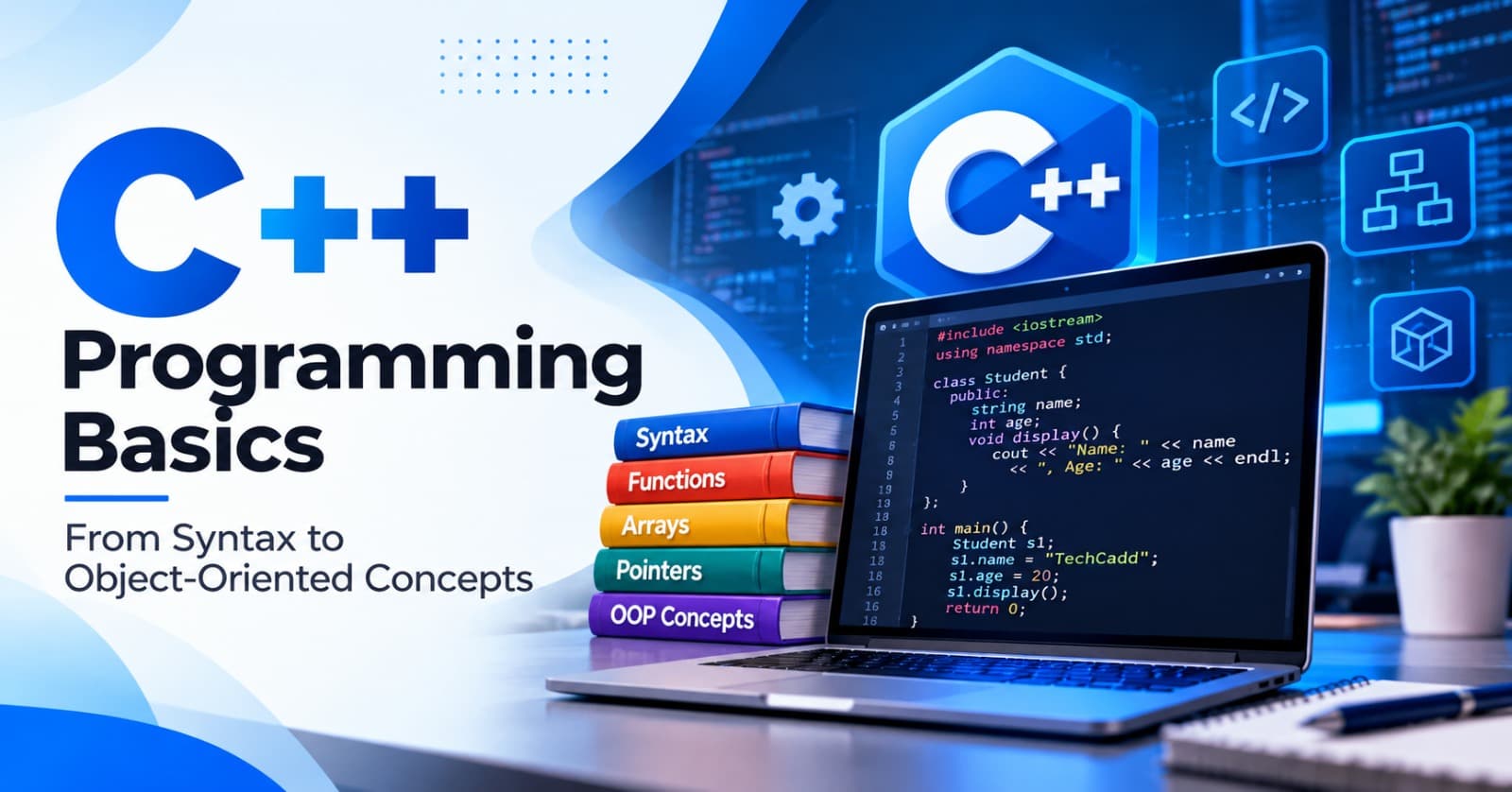
C++ Programming Basics: From Syntax to Object-Oriented Concepts
Learn C++ programming basics, including syntax, loops, functions, classes, objects, and OOP concepts through practical examples and projects.
C++ Programming Basics: From Syntax to Object-Oriented Concepts
C++ is a powerful, general-purpose programming language widely used in software development, game development, system programming, competitive programming, and application development. Known for its performance, flexibility, and support for multiple programming approaches, C++ is an excellent language for beginners who want to build a strong foundation in programming. Learning C++ helps students develop logical thinking, problem-solving abilities, and an understanding of how software applications work.
This guide covers the essential concepts of C++ programming, starting with basic syntax and gradually progressing to Object-Oriented Programming (OOP).
1. Introduction to C++ Programming
C++ was developed by Bjarne Stroustrup as an extension of the C programming language. It supports procedural, object-oriented, and generic programming, making it suitable for projects ranging from small console applications to complex software systems.
One of the first steps in learning C++ is understanding its program structure. A basic C++ program includes header files, the main() function, statements, and a return statement. For example:
#include <iostream>
using namespace std;

int main() {
    cout << "Hello, World!";
    return 0;
}
In this program, #include <iostream> enables input and output operations, main() is the program's entry point, and cout displays output on the screen. Understanding this structure helps beginners write and execute their first programs.
2. Variables, Data Types, and Operators
Variables are used to store information that a program can process. C++ provides several data types, including int for integers, float and double for decimal values, char for individual characters, bool for true or false values, and string for text.
For example, a student management program might store a student's name, age, marks, and enrollment status using different data types.
Operators are symbols that perform operations on values and variables. Arithmetic operators perform calculations, relational operators compare values, logical operators combine conditions, and assignment operators assign values to variables. These concepts are essential for calculations, comparisons, and decision-making in programs.
3. Conditional Statements and Loops
Conditional statements allow a program to make decisions based on specific conditions. C++ supports if, else if, else, and switch statements. For example, a program can use an if-else statement to determine whether a student has passed or failed based on their marks.
Loops help execute a block of code repeatedly without writing the same statements multiple times. The three primary loops in C++ are:
For loop: Suitable when the number of iterations is known.
While loop: Repeats a block of code while a condition remains true.
Do-while loop: Executes the block at least once before checking the condition.
These concepts are commonly used to print number patterns, calculate factorials, generate multiplication tables, and process collections of data.
4. Functions, Arrays, and Strings
Functions are reusable blocks of code designed to perform specific tasks. They improve readability, reduce code duplication, and make programs easier to maintain. Functions can accept parameters, return values, and divide a complex problem into smaller parts.
Arrays allow programmers to store multiple values of the same data type under a single variable name. They are useful for managing student marks, product prices, and other collections of related information. Strings are used to store and manipulate text, including names, addresses, and messages.
Students can also explore pointers and references to understand memory addresses, indirect access to variables, and efficient data handling. These concepts provide an important foundation for learning advanced C++ programming and data structures.
5. Introduction to Object-Oriented Programming (OOP)
Object-Oriented Programming is a programming approach that organizes code around classes and objects. Instead of keeping data and related functions separate, OOP combines them into logical units. This approach helps developers build applications that are easier to organize, reuse, test, and maintain.
A class acts as a blueprint that defines data members and member functions, while an object is an instance of that class.
For example, a Student class may contain information such as a student's name, roll number, and marks, along with functions to display student details. Individual student records can then be represented by separate objects.
Important OOP concepts include constructors, which initialize objects; destructors, which perform cleanup when objects are destroyed; and access specifiers such as public, private, and protected, which control access to class members.
6. The Four Principles of OOP
C++ supports four major principles of Object-Oriented Programming:
Encapsulation: Combines data and functions within a class and controls access to internal data. It helps protect an object's state from inappropriate modification.
Abstraction: Hides unnecessary implementation details and exposes only the functionality required by the user.
Inheritance: Allows a class to acquire properties and behaviors from another class, encouraging code reuse and reducing duplication.
Polymorphism: Allows the same interface to represent different behaviors. Function overloading and operator overloading demonstrate compile-time polymorphism, while virtual functions support runtime polymorphism.
Understanding these principles helps students design flexible and reusable applications. They also provide the foundation for learning software architecture, design patterns, and advanced programming techniques.
7. Practical Projects and Applications
Practical implementation is an essential part of learning C++. Beginners should apply their knowledge through small projects such as calculators, number-guessing games, student record management systems, banking simulations, and library management applications.
These projects encourage learners to combine variables, conditions, loops, functions, arrays, and classes to solve realistic problems. Debugging errors and testing different inputs also help students develop analytical thinking and write more reliable code.
C++ is used in various fields, including game engines, embedded systems, high-performance computing, operating systems, and financial applications. Its efficiency and control over system resources make it particularly valuable in performance-sensitive environments.
Conclusion
Learning C++ programming from basic syntax to Object-Oriented Programming provides students with a strong foundation for their software development journey. By mastering variables, operators, conditional statements, loops, functions, arrays, and classes, learners can progress toward building structured and reusable applications.
Consistent practice, problem-solving exercises, and project development are key to improving programming skills. Whether the goal is to prepare for technical interviews, study Data Structures and Algorithms, participate in competitive programming, or pursue a career in software development, C++ offers valuable skills that can support long-term professional growth.
Learn C++ programming from basic syntax to Object-Oriented Programming (OOP). Explore variables, loops, functions, classes, objects, inheritance, and polymorphism through practical examples. Build problem-solving skills and prepare for DSA and software development.
Learn C++ from Scratch
Start your programming journey with C++. Learn basic syntax, variables, loops, functions, and object-oriented concepts through practical coding exercises. Develop strong programming fundamentals and logical thinking skills.
Master Object-Oriented Programming
Explore Object-Oriented Programming in C++ with classes, objects, inheritance, encapsulation, abstraction, and polymorphism. Understand how to write reusable code and build structured applications through hands-on practice.
Build Practical Programming Skills
Turn programming concepts into practical skills with C++ coding exercises and beginner-friendly projects. Strengthen your problem-solving abilities and prepare for Data Structures and Algorithms, coding interviews, and software development.
Have a questionabout this?
Leave your number and a counsellor will call you back — about batch timings, fees, EMI options, placement record, or which track fits your degree.
- Free career counselling, no registration fee
- Weekday, evening, weekend or 1-on-1 batches
- Internship letter and placement support
Ready to get started?
Start building yourcareer today.
Talk to a counsellor today. One call is usually enough to know which track fits your degree, your schedule and the job you want.
- Free career counselling
- No registration fee
- Placement support included