Data Structures and Algorithms Using C: From Arrays to Graphs
Learn Data Structures and Algorithms using C, from arrays and linked lists to stacks, queues, trees, graphs, searching, and sorting techniques.
On this page
- Introduction to Data Structures and Algorithms Using C
- What Are Data Structures and Algorithms?
- Why Learn DSA Using C?
- 1. Arrays: The Foundation of Data Organization
- 2. Strings and Character Arrays
- 3. Pointers and Dynamic Memory Allocation
- 4. Linked Lists: Flexible Data Storage
- 5. Stacks: Last In, First Out
- 6. Queues: First In, First Out
- 7. Searching Algorithms
- 8. Sorting Algorithms
- 9. Trees: Understanding Hierarchical Data
- 10. Graphs: Representing Relationships and Networks
- 11. Algorithm Complexity and Big O Notation
- 12. Practical Projects Using C
- Benefits of Learning Data Structures and Algorithms
- Build Your Programming Foundation with Techcadd Jalandhar
Introduction to Data Structures and Algorithms Using C
Programming is not just about writing code; it is also about organizing information efficiently and designing logical solutions to problems. Data Structures and Algorithms (DSA) form an important foundation of computer science because they help developers store, process, search, and manipulate data effectively. Learning DSA using C gives students a deeper understanding of memory management, pointers, data organization, and how programming operations work behind the scenes.
At Techcadd Jalandhar, learners interested in strengthening their programming fundamentals can explore concepts related to data structures, algorithms, and logical problem-solving. C is particularly useful for understanding these topics because it provides direct control over memory and requires programmers to work carefully with arrays, pointers, structures, and dynamic memory allocation.
What Are Data Structures and Algorithms?
A data structure is a method of organizing and storing data so that it can be accessed and modified efficiently. Common examples include arrays, linked lists, stacks, queues, trees, graphs, and hash tables.
An algorithm is a sequence of steps designed to solve a specific problem. Searching for an element, sorting a collection of numbers, traversing a tree, and finding a path through a graph are examples of tasks that can be solved using algorithms.
Data structures and algorithms work together. Selecting the right data structure can simplify a problem, while choosing an appropriate algorithm can improve execution time and memory usage.
Why Learn DSA Using C?
C is a foundational programming language that helps learners understand how computer programs manage data and memory. Unlike languages that hide many low-level details, C allows programmers to work directly with pointers, structures, arrays, and dynamic memory allocation.
Learning DSA using C can help students develop logical thinking, understand memory addresses, practise pointer manipulation, and implement fundamental algorithms from scratch. These concepts are valuable for building a strong programming foundation and preparing for more advanced computer science topics.
1. Arrays: The Foundation of Data Organization
An array stores elements of the same data type in consecutive memory locations. It allows programmers to access elements using their index, making it useful for storing lists of numbers, marks, records, and other collections of related data.
In C, learners can practise array declaration, initialization, traversal, insertion, deletion, updating, and searching. They can also explore multidimensional arrays for representing matrices and tabular information.
Arrays provide fast indexed access, generally O(1), but inserting or deleting elements in the middle of a fixed-size array may require shifting other elements. Understanding these trade-offs helps learners choose suitable structures for different tasks.
2. Strings and Character Arrays
Strings in C are represented as character arrays terminated by the null character \0. They are commonly used to store names, messages, identifiers, and other text.
Students can practise string traversal, comparison, copying, concatenation, and searching. They can also learn how to handle character arrays safely and avoid common errors such as accessing memory beyond an array's boundaries.
Understanding strings strengthens basic programming skills and prepares learners for more advanced tasks involving text processing and pattern matching.
3. Pointers and Dynamic Memory Allocation
Pointers store memory addresses and are central to implementing many data structures in C. They allow programs to access variables indirectly, connect elements in linked structures, and work with dynamically allocated memory.
Learners explore pointer declaration, dereferencing, pointer arithmetic, and the relationship between pointers and arrays. They can also study dynamic memory functions such as malloc(), calloc(), realloc(), and free().
These concepts are particularly important when building linked lists, trees, graphs, and other structures whose size can change during program execution. Students should also learn to avoid memory leaks, dangling pointers, and invalid memory access.
4. Linked Lists: Flexible Data Storage
A linked list consists of nodes that store data and links to other nodes. Unlike an array, its elements do not need to occupy consecutive memory locations.
In a singly linked list, each node points to the next node. A doubly linked list maintains links in both directions, while a circular linked list connects its final node back to the beginning.
Using C structures and pointers, learners can implement node creation, traversal, insertion, deletion, and searching. Linked lists are useful for understanding dynamic memory management and the trade-offs between flexible insertion and access speed.
5. Stacks: Last In, First Out
A stack follows the Last In, First Out (LIFO) principle, meaning that the most recently added element is removed first. Common operations include push, pop, and peek.
Stacks can be implemented using arrays or linked lists in C. Learners can practise checking for overflow and underflow and understand how stack operations work.
Stacks are used in function calls, expression evaluation, undo features, and backtracking algorithms. Understanding them also provides a foundation for exploring recursion and parsing expressions.
6. Queues: First In, First Out
A queue follows the First In, First Out (FIFO) principle. Elements are typically added at the rear and removed from the front.
Students can implement simple queues, circular queues, and priority queues using arrays, structures, or linked lists. They learn operations such as enqueue, dequeue, and front-element inspection.
Queues are useful in scheduling, buffering, task management, and breadth-first search. A circular queue also demonstrates how to reuse array space efficiently.
7. Searching Algorithms
Searching algorithms help locate a particular value in a collection of data. Linear search examines elements one by one and can work with unsorted data. Its worst-case time complexity is O(n).
Binary search repeatedly divides the search interval in half. It achieves O(log n) time complexity but requires the data to be sorted and the implementation to handle index boundaries correctly.
Implementing both algorithms in C helps learners compare performance and understand why input conditions matter when selecting a solution.
8. Sorting Algorithms
Sorting arranges data in a specified order, such as ascending or descending. It is a fundamental operation in data processing and helps prepare information for searching and analysis.
Students can explore algorithms such as bubble sort, selection sort, insertion sort, merge sort, and quicksort. Basic sorting techniques are useful for understanding comparisons and element movement, while more advanced approaches introduce recursion and divide-and-conquer strategies.
Comparing sorting algorithms helps learners understand time complexity, auxiliary memory requirements, and how performance changes with different input sizes.
9. Trees: Understanding Hierarchical Data
A tree is a hierarchical data structure made up of nodes connected through parent-child relationships. It is useful for representing file systems, organizational structures, expression trees, and hierarchical information.
Learners can explore binary trees, binary search trees, and tree traversal methods such as preorder, inorder, and postorder. They can also study insertion, searching, and deletion in binary search trees.
Trees introduce recursive problem-solving and help students understand how data can be organized for efficient operations.
10. Graphs: Representing Relationships and Networks
A graph consists of vertices, also called nodes, connected by edges. Graphs can be directed or undirected and may contain weighted or unweighted edges.
Graphs are used to represent road networks, social connections, computer networks, dependencies, and communication systems. Students can learn how to represent graphs using adjacency matrices and adjacency lists.
Important graph algorithms include Breadth-First Search (BFS) and Depth-First Search (DFS). More advanced topics may include shortest-path algorithms and minimum spanning trees. Learning graph fundamentals helps students understand complex relationships and network-based problems.
11. Algorithm Complexity and Big O Notation
Understanding how efficiently an algorithm runs is as important as knowing whether it produces the correct result. Time complexity describes how the number of operations grows with input size, while space complexity describes how memory requirements grow.
Big O notation is commonly used to express algorithmic growth rates. Examples include O(1), O(log n), O(n), O(n log n), and O(n²).
For example, linear search may take O(n) time in the worst case, whereas binary search takes O(log n) time on sorted data. Comparing complexity helps programmers select appropriate solutions as data grows.
12. Practical Projects Using C
Practical projects help learners apply data structures and algorithms to complete tasks. Suitable beginner and intermediate projects include a student record manager using structures, a contact list using linked lists, an expression evaluator using stacks, a task queue, a sorting and searching demonstration, and a simple graph traversal program.
While developing these projects, students can practise designing algorithms, writing modular code, testing different inputs, debugging errors, and analyzing performance. They can also learn to document their approach and explain why a particular data structure was selected.
Benefits of Learning Data Structures and Algorithms
Learning DSA using C strengthens logical thinking, coding discipline, and problem-solving skills. It helps learners understand how programs store and process information, compare algorithmic approaches, and manage memory more carefully.
These skills are relevant to programming assignments, technical interviews, competitive programming, and further study in software development and computer science. A solid foundation in DSA can also make it easier to learn other programming languages and advanced algorithmic concepts.
Build Your Programming Foundation with Techcadd Jalandhar
Data Structures and Algorithms are essential concepts for anyone who wants to understand programming beyond basic syntax. From arrays and linked lists to trees and graphs, each structure introduces different ways of organizing data and solving computational problems.
Techcadd Jalandhar provides computer education and programming learning opportunities for students who want to strengthen their technical foundation. By combining programming fundamentals with algorithmic thinking and regular practice, learners can work toward becoming more confident problem-solvers.
Start with the basics, practise implementing each structure in C, test your solutions carefully, and gradually explore more advanced algorithms. Consistent hands-on learning can help you develop the skills needed to approach programming challenges systematically.
Master Data Structures and Algorithms in C — From Arrays to Graphs
Strengthen your programming fundamentals with Data Structures and Algorithms using C. Explore arrays, linked lists, stacks, queues, searching, sorting, trees, and graphs while learning how to analyze algorithm complexity and manage memory. Develop logical thinking and practical coding skills through structured learning and programming exercises at Techcadd Jalandhar.
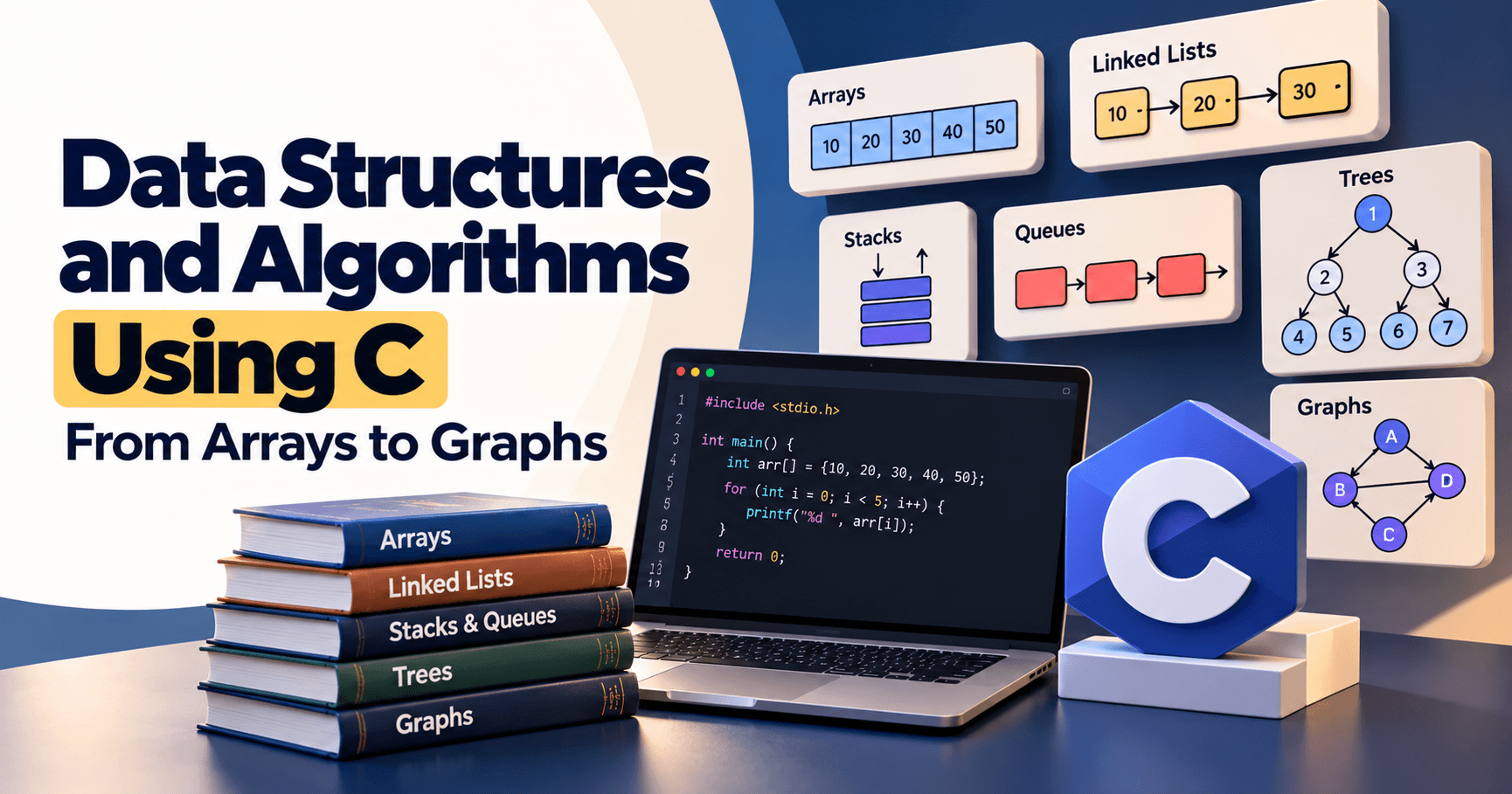
Want to write better code and solve complex programming problems? Explore Data Structures and Algorithms using C with Techcadd Jalandhar.
Explore Programming CoursesHave a questionabout this?
Leave your number and a counsellor will call you back — about batch timings, fees, EMI options, placement record, or which track fits your degree.
- Free career counselling, no registration fee
- Weekday, evening, weekend or 1-on-1 batches
- Internship letter and placement support
Ready to get started?
Start building yourcareer today.
Talk to a counsellor today. One call is usually enough to know which track fits your degree, your schedule and the job you want.
- Free career counselling
- No registration fee
- Placement support included