How Techcadd Jalandhar Builds Strong C Programming and DSA Foundations
Discover how Techcadd Jalandhar builds C programming and DSA foundations through coding fundamentals, data structures, algorithms, and problem-solving practice.
On this page
- Introduction: Building the Foundation for Programming Success
- Why Start with C Programming?
- 1. Strengthening Programming Fundamentals
- 2. Developing Logical Thinking Through Coding
- 3. Understanding Functions, Arrays, and Strings
- 4. Exploring Pointers and Memory Management
- 5. Introducing Data Structures and Algorithms
- 6. Learning Arrays, Linked Lists, Stacks, and Queues
- 7. Practising Searching and Sorting Algorithms
- 8. Understanding Trees, Graphs, and Recursion
- 9. Learning Time and Space Complexity
- 10. Applying Knowledge Through Practical Projects
- 11. Improving Debugging and Problem-Solving Skills
- 12. How C Programming and DSA Support Career Development
- Build Strong Programming Foundations with Techcadd Jalandhar
Introduction: Building the Foundation for Programming Success
Learning programming is about more than memorizing syntax or writing a few lines of code. A strong programming foundation requires logical thinking, a clear understanding of programming concepts, and the ability to break complex problems into manageable steps. C programming and Data Structures and Algorithms (DSA) are valuable starting points because they introduce learners to core computer science concepts and structured problem-solving.
At Techcadd Jalandhar, students interested in developing their programming skills can explore the fundamentals of C programming alongside important DSA concepts. By learning how programs execute, how data is stored, and how algorithms solve problems, learners can build a foundation that supports further study in software development and other technical fields.
Why Start with C Programming?
C is a foundational programming language known for its structured approach, efficiency, and close interaction with memory. It helps learners understand how variables store values, how conditions control program flow, how loops repeat instructions, and how functions organize reusable code.
Learning C can also introduce students to concepts that may be less visible in higher-level languages, including pointers, memory addresses, structures, and dynamic memory allocation. These concepts help learners understand how programs manage data and how different parts of a program interact.
A clear understanding of C programming can make it easier to explore other languages and advanced programming topics later.
1. Strengthening Programming Fundamentals
The first step toward building strong programming skills is understanding the fundamentals. Students begin by exploring variables, data types, operators, input and output, conditional statements, loops, and functions.
These concepts form the foundation of most programming tasks. For example, conditional statements help a program make decisions, loops automate repeated operations, and functions divide a larger program into smaller, reusable sections.
Through regular coding practice, learners can become more familiar with program structure, syntax, and logical execution. Starting with simple programs also helps students identify errors early and develop a systematic approach to debugging.
2. Developing Logical Thinking Through Coding
Logical thinking is essential for solving programming problems. Before writing code, a developer needs to understand what the problem requires, identify the inputs and expected outputs, and determine the steps needed to reach the solution.
Students can practise this process through problems involving calculations, number patterns, conditions, loops, arrays, and strings. Writing pseudocode or drawing flowcharts before implementation can help make the solution easier to understand.
At Techcadd Jalandhar, learners can use programming exercises to develop a structured approach to technical challenges. With consistent practice, students can improve their ability to analyze problems rather than relying only on memorized code.
3. Understanding Functions, Arrays, and Strings
Functions help organize programs into manageable units. They make code easier to reuse, test, and maintain. Students can learn about function declarations, parameters, return values, and the basics of recursion.
Arrays introduce the concept of storing multiple values of the same data type in an indexed collection. Learners can practise traversing arrays, searching for values, updating elements, and performing basic operations.
Strings in C are represented using character arrays terminated by a null character. Working with strings helps students understand text processing, character manipulation, and safe handling of array boundaries.
These topics provide a useful bridge between basic C programming and more advanced data structures.
4. Exploring Pointers and Memory Management
Pointers are one of the most important concepts in C because they store memory addresses and allow programs to access data indirectly. They are essential for implementing linked lists, trees, graphs, and other dynamic structures.
Students can explore pointer declaration, dereferencing, pointer relationships with arrays, and the use of structures. They can also learn about dynamic memory allocation through functions such as malloc(), calloc(), realloc(), and free().
Understanding memory management helps learners recognize common issues such as memory leaks, dangling pointers, and invalid memory access. These skills are important for writing reliable C programs and understanding how data structures operate internally.
5. Introducing Data Structures and Algorithms
Data Structures and Algorithms, commonly known as DSA, help programmers organize data and solve computational problems efficiently.
A data structure determines how information is stored and accessed, while an algorithm defines the steps used to process that information. Choosing an appropriate structure and algorithm can improve the clarity, performance, and scalability of a program.
Students can begin with arrays and strings before progressing to linked lists, stacks, queues, trees, and graphs. Alongside these structures, they can practise searching, sorting, traversal, and other fundamental algorithmic techniques.
6. Learning Arrays, Linked Lists, Stacks, and Queues
Arrays are often the first data structure learners explore because they provide indexed access to stored elements. Linked lists introduce dynamic collections in which nodes are connected using pointers.
Stacks follow the Last In, First Out (LIFO) principle, while queues generally follow the First In, First Out (FIFO) principle. These structures help explain how data can be processed in different orders.
Students can implement these structures in C using arrays, structures, and pointers. Practical implementation helps them understand the operations each structure supports and the trade-offs involved in choosing one over another.
7. Practising Searching and Sorting Algorithms
Searching and sorting are fundamental algorithmic concepts. Linear search checks elements one by one, while binary search repeatedly reduces the search range and requires sorted data.
Sorting algorithms such as bubble sort, selection sort, insertion sort, merge sort, and quicksort introduce different approaches to arranging data. Some are easier to understand, while others offer better performance for larger inputs under appropriate conditions.
Implementing these algorithms in C allows learners to compare their logic, test their results, and understand how performance changes as the amount of data increases.
8. Understanding Trees, Graphs, and Recursion
Trees represent hierarchical relationships, while graphs represent connections between nodes. These structures are used in many computer science applications, including file systems, networks, dependency relationships, and pathfinding problems.
Learners can explore binary trees, tree traversal, graph representation, Breadth-First Search (BFS), and Depth-First Search (DFS). Recursion is also useful for understanding tree traversal and divide-and-conquer algorithms.
Starting with simple examples helps students understand how these structures work before attempting more complex problems.
9. Learning Time and Space Complexity
A program may produce the correct result but still perform poorly when the input becomes large. Algorithm analysis helps programmers understand how a solution's resource requirements grow with input size.
Time complexity describes how the number of operations grows, while space complexity describes memory requirements. Big O notation is commonly used to discuss these growth patterns.
For example, linear search has O(n) worst-case time complexity, while binary search has O(log n) time complexity on sorted data. Learning these concepts helps students compare alternative solutions and make more informed programming decisions.
10. Applying Knowledge Through Practical Projects
Practical projects help learners combine programming concepts and DSA techniques in a single task. Instead of studying each topic in isolation, students can see how different components work together to solve a problem.
Suitable beginner projects include a student record management program, a simple calculator, a contact list, a sorting and searching tool, a stack-based expression evaluator, or a basic queue management system.
As learners progress, they can explore linked-list applications, binary search trees, and graph traversal programs. These activities encourage planning, implementation, testing, debugging, and code improvement.
11. Improving Debugging and Problem-Solving Skills
Debugging is an essential part of programming. A program may fail because of syntax errors, incorrect conditions, invalid memory access, or mistakes in the underlying algorithm.
Students can develop better debugging habits by reading compiler messages, checking variables, testing small sections of code, and examining edge cases. They should also verify whether a program handles empty inputs, duplicate values, and boundary conditions correctly.
By reviewing mistakes and testing alternative solutions, learners can strengthen their understanding and become more systematic problem-solvers.
12. How C Programming and DSA Support Career Development
C programming and DSA provide a foundation for further learning in software development, systems programming, competitive programming, and computer science. These subjects also help learners prepare for coding assessments and technical interviews that evaluate logical reasoning and algorithmic knowledge.
Students may continue exploring languages such as C++, Java, Python, or JavaScript after developing their programming fundamentals. The concepts learned through C and DSA can make it easier to understand how other languages represent data and solve computational problems.
Career opportunities depend on the learner's broader technical skills, practical experience, projects, and employer requirements. C programming and DSA are useful foundations, but continued learning is important for professional growth.
Build Strong Programming Foundations with Techcadd Jalandhar
Developing confidence in programming takes time, practice, and a willingness to learn from mistakes. C programming introduces core concepts such as variables, functions, pointers, and memory management, while Data Structures and Algorithms help learners organize information and solve problems efficiently.
Techcadd Jalandhar focuses on computer education and technical skill development. Students who want to strengthen their programming fundamentals can explore relevant learning opportunities and practise applying concepts through coding exercises and projects.
Whether you are new to programming or looking to improve your problem-solving abilities, start with the basics, practise consistently, and gradually move toward more challenging tasks. A strong foundation in C programming and DSA can support your continued learning journey in computer science and software development.
Build Strong Coding Logic with C Programming and DSA
Develop a solid programming foundation with C programming and Data Structures and Algorithms at Techcadd Jalandhar. Explore variables, functions, arrays, pointers, linked lists, stacks, queues, trees, graphs, and essential searching and sorting techniques. Strengthen logical thinking, understand memory management, and practise solving programming problems through structured exercises and practical projects.
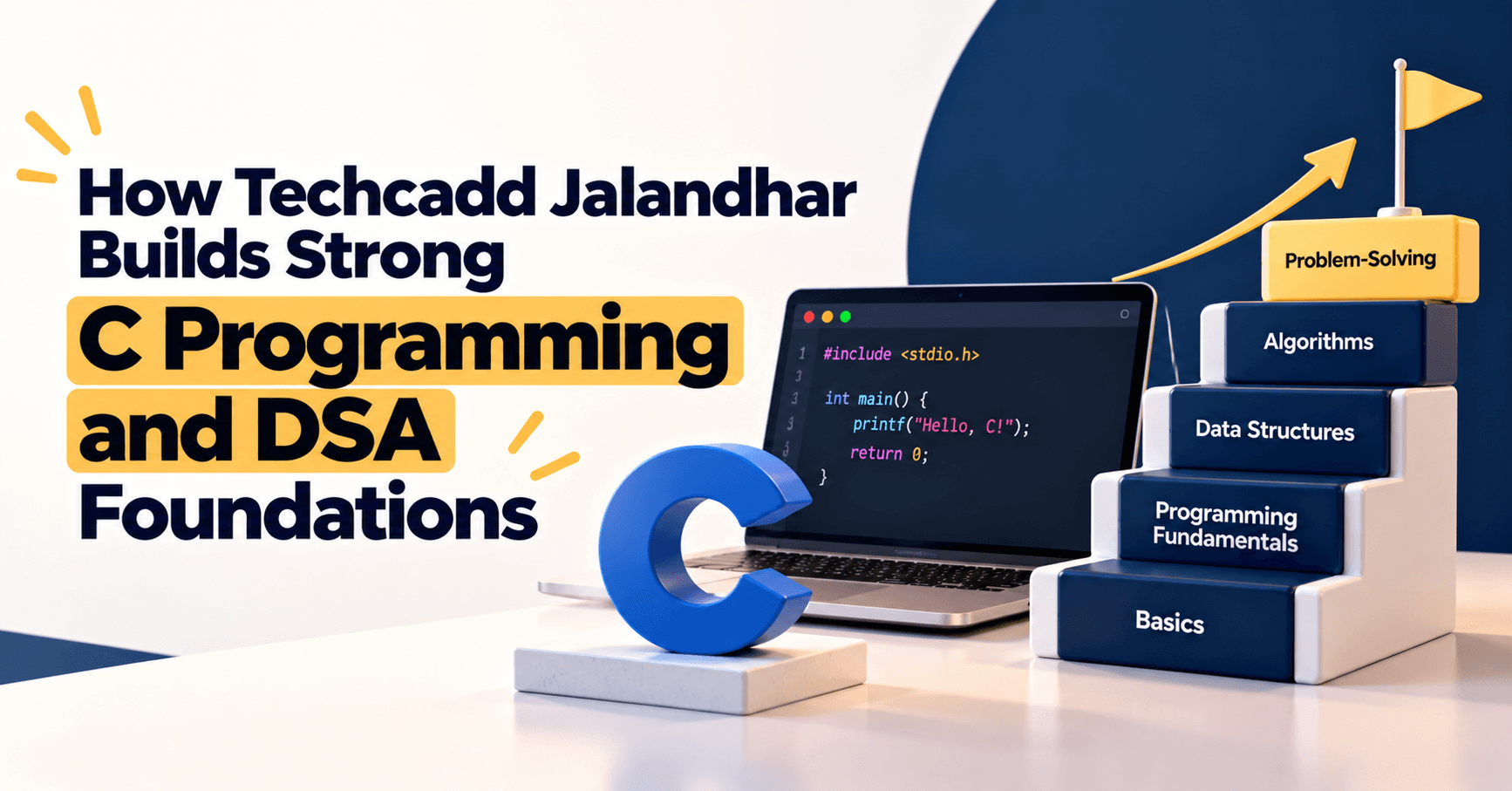
Want to become more confident at coding? Strengthen your C programming fundamentals and learn how Data Structures and Algorithms help you solve problems effectively.
Explore Programming CoursesHave a questionabout this?
Leave your number and a counsellor will call you back — about batch timings, fees, EMI options, placement record, or which track fits your degree.
- Free career counselling, no registration fee
- Weekday, evening, weekend or 1-on-1 batches
- Internship letter and placement support
Ready to get started?
Start building yourcareer today.
Talk to a counsellor today. One call is usually enough to know which track fits your degree, your schedule and the job you want.
- Free career counselling
- No registration fee
- Placement support included