How Techcadd Jalandhar Helps Students Develop Practical Robotics Skills
Master practical robotics skills at Techcadd Jalandhar through hands-on microcontroller programming, sensor interfacing, and live project implementation.
Introduction
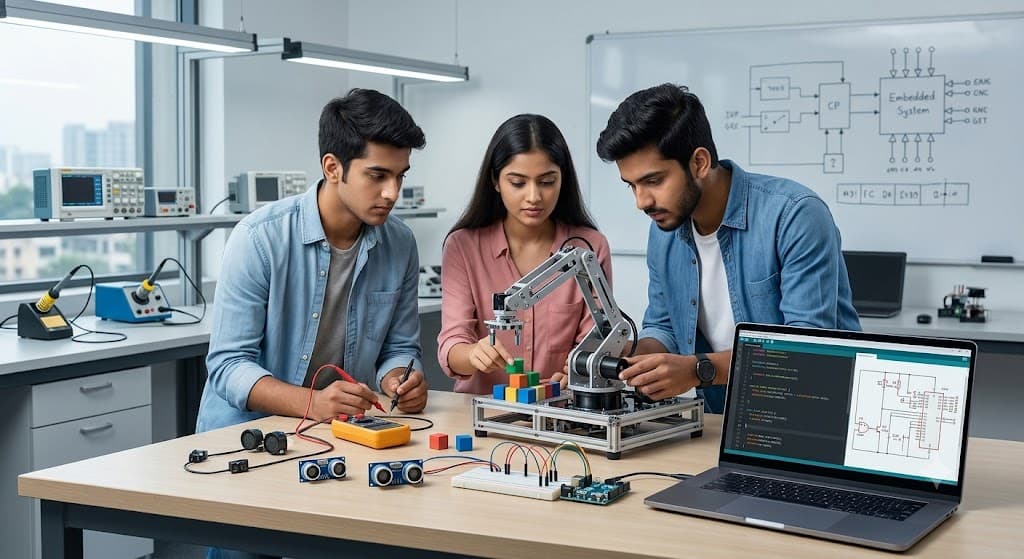
The fusion of mechanical engineering, electronics, and software programming has made robotics one of the most transformative fields in modern technology. From automated manufacturing lines to autonomous vehicles and smart drones, robotics engineers are reshaping industries worldwide. At Techcadd Jalandhar, robotics training is designed to bridge the gap between abstract academic theories and real-world hardware-software integration. Through immersive lab work, microcontroller programming, and live project implementation, Techcadd equips students with the practical skills required to design, build, and troubleshoot intelligent robotic systems.
Certification
Upon successfully completing the robotics training program at Techcadd Jalandhar, students receive an industry-recognized Certificate in Robotics and Embedded Systems. This certification acts as a strong credential on resumes, validating your hands-on expertise with microcontrollers, sensors, actuators, and hardware prototyping to prospective employers.
Industry Demand
As industrial automation, smart warehousing, and Internet of Things (IoT) ecosystems expand rapidly, the demand for skilled robotics and automation professionals has surged across global and regional markets. Companies are constantly seeking engineers who not only understand circuit schematics and mechanical designs but can also program microcontrollers (such as Arduino and Raspberry Pi) and interface sensors to automate complex processes.
Job Opportunities
Proficiency in practical robotics opens doors to diverse engineering and automation roles across domestic and international markets. Graduates from Techcadd Jalandhar can pursue careers in various sectors as:
Robotics Engineer / Technician
Embedded Systems Developer
Automation Control Engineer
IoT Solutions Developer
R&D Prototyping Specialist
Key Job Roles & Responsibilities
Robotics Engineers: Designing robot architectures, integrating sensors and motors, and developing code for autonomous movement or task execution.
Automation Control Engineers: Programming Programmable Logic Controllers (PLCs) and microcontrollers to streamline assembly lines and industrial machinery.
IoT & Embedded Developers: Building connected hardware devices that collect real-time telemetry data and trigger automated physical responses.
Core Skills Taught at Techcadd
Techcadd Jalandhar’s curriculum focuses on critical technical proficiencies needed in the robotics domain:
Microcontroller Programming: Hands-on coding using Arduino, Raspberry Pi, and embedded C/C++.
Sensor & Actuator Interfacing: Working with ultrasonic sensors, infrared sensors, servo motors, stepper motors, and relay modules.
Circuit Design & Prototyping: Reading schematics, soldering, breadboard testing, and PCB basics.
Communication Protocols: Implementing UART, I2C, SPI, and wireless modules (Wi-Fi/Bluetooth) for remote robot control.
Industries Hiring Robotics Professionals
Industrial Automation & Manufacturing: Deploying robotic arms and automated guided vehicles (AGVs) on production floors.
Automotive & Electric Vehicles: Developing driver-assistance systems, sensor integration, and automated testing rigs.
Consumer Electronics & IoT: Designing smart home appliances and automated gadget ecosystems.
Defense & Aerospace: Building specialized drones, surveillance bots, and remote-operated vehicles (ROVs).
Career Growth
Beginning your professional journey as a Robotics Technician or Junior Embedded Engineer establishes a strong foundation in hardware-software troubleshooting. As you gain hands-on experience in managing complex automation frameworks and multi-sensor systems, you can quickly advance to senior roles such as Lead Robotics Architect, Automation Manager, or IoT Product Designer within a few years.
Reality Check
Robotics can appear intimidating because it requires simultaneous command over hardware assembly and software logic. Debugging a malfunctioning circuit or resolving communication lag between a sensor and a microcontroller demands patience and methodical problem-solving. Techcadd addresses this challenge by providing fully equipped hardware labs where students can test, break, and fix prototypes under expert supervision.
Training Methodology at Techcadd Jalandhar
Hands-On Lab Sessions: Direct physical access to hardware components, development boards, and testing tools.
Live Project Building: Designing working prototypes such as line-following robots, obstacle-avoiding bots, and IoT-enabled automation systems.
Expert Mentorship: Continuous guidance from experienced mechatronics and embedded systems instructors.
Flexible Batches: Convenient online and offline classroom schedules available at their Jalandhar facility.
Conclusion
Practical robotics training turns imaginative concepts into tangible engineering solutions. By combining rigorous hardware practice, microcontroller programming, and expert project mentorship, Techcadd Jalandhar empowers aspiring engineers to step into the automation and robotics industry with absolute confidence.
Have a questionabout this?
Leave your number and a counsellor will call you back — about batch timings, fees, EMI options, placement record, or which track fits your degree.
- Free career counselling, no registration fee
- Weekday, evening, weekend or 1-on-1 batches
- Internship letter and placement support
Ready to get started?
Start building yourcareer today.
Talk to a counsellor today. One call is usually enough to know which track fits your degree, your schedule and the job you want.
- Free career counselling
- No registration fee
- Placement support included