MEAN Stack Explained: MongoDB, Express, Angular and Node.js
Learn MEAN Stack development with MongoDB, Express.js, Angular, and Node.js. Explore full-stack concepts, benefits, and practical projects.
MEAN Stack Explained: MongoDB, Express, Angular and Node.js
The MEAN Stack is a popular technology stack used to develop dynamic, scalable, and modern web applications. It combines four powerful technologies: MongoDB, Express.js, Angular, and Node.js. Together, these technologies allow developers to build complete web applications using JavaScript and related technologies across the frontend and backend.
For students and aspiring web developers, learning the MEAN Stack provides a strong foundation in full-stack development. From creating interactive user interfaces to managing databases and building server-side APIs, MEAN Stack development covers the essential skills required to develop modern web applications.
What Is the MEAN Stack?
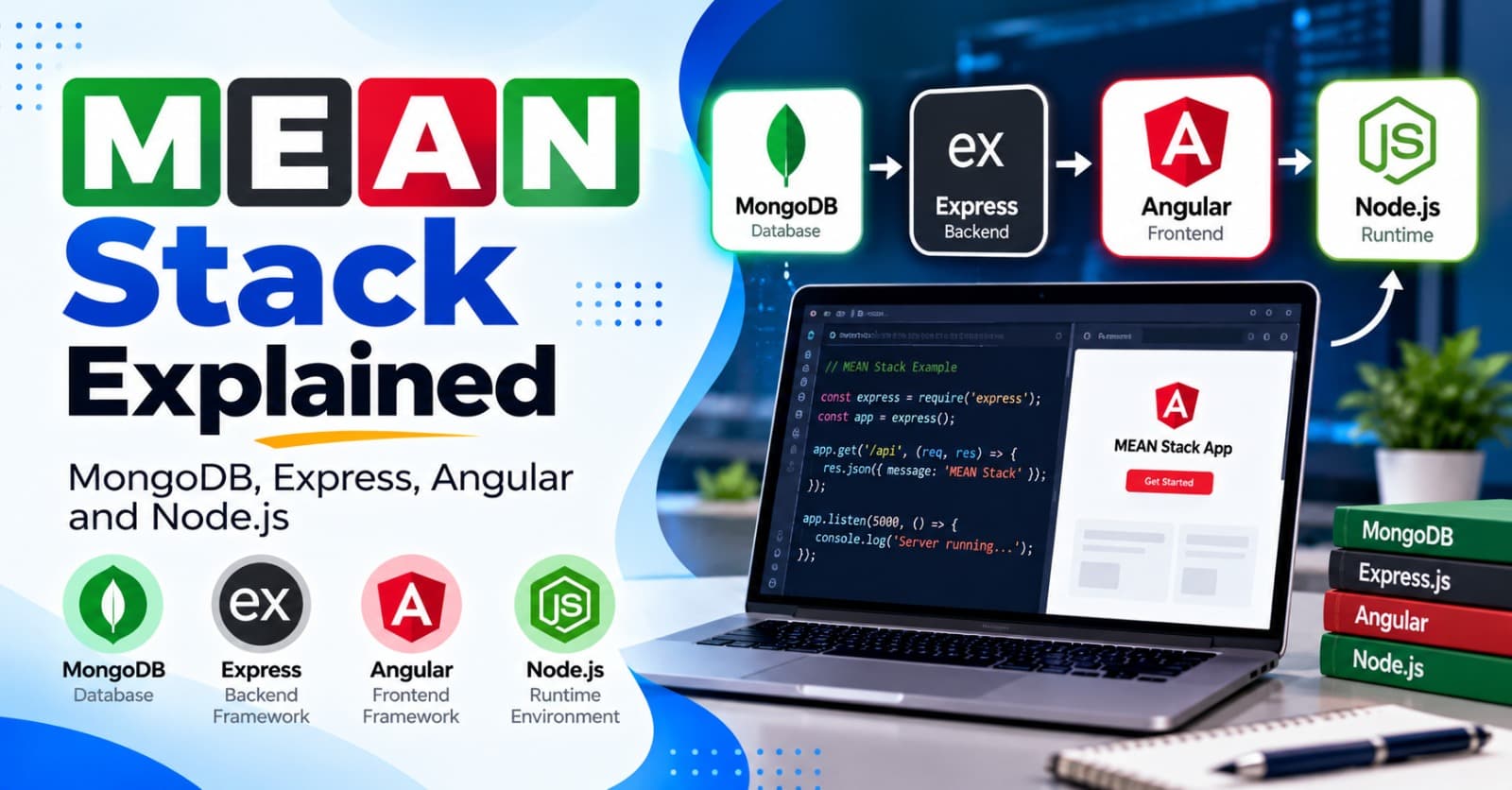
MEAN is an acronym for MongoDB, Express.js, Angular, and Node.js. Each technology performs a specific role in the application development process.
MongoDB: A NoSQL database used to store and manage application data in flexible, document-based structures.
Express.js: A backend web framework for Node.js that simplifies routing, middleware, and API development.
Angular: A frontend framework used to build dynamic, interactive, and maintainable web interfaces.
Node.js: A JavaScript runtime that allows developers to execute JavaScript on the server side.
These technologies work together to create a complete development environment, enabling developers to manage frontend interactions, backend logic, and database operations within one integrated stack.
Understanding the Four MEAN Stack Technologies
1. MongoDB: Database Management
MongoDB is a document-oriented NoSQL database that stores information in flexible, BSON-based documents. Unlike traditional relational databases, MongoDB organizes data into collections and documents rather than tables and rows.
Developers use MongoDB to store user profiles, product information, application settings, orders, and other application data. Its flexible document structure makes it suitable for applications whose data requirements evolve over time.
2. Express.js: Backend Web Framework
Express.js is a lightweight web framework built on Node.js. It helps developers create server-side applications and REST APIs with organized routing and middleware.
Express.js processes incoming HTTP requests, validates data, handles application logic, and communicates with databases. For example, an Express API can receive a registration request, validate the submitted information, save a new user in MongoDB, and return an appropriate response.
3. Angular: Frontend Development
Angular is a TypeScript-based web application framework maintained by Google. It provides tools and features for building structured, interactive, and maintainable user interfaces.
Angular includes components, services, dependency injection, routing, forms, and other development features. Developers can use these capabilities to create dashboards, admin panels, e-commerce interfaces, and other complex web applications.
4. Node.js: Server-Side JavaScript
Node.js is a JavaScript runtime that allows developers to run JavaScript outside a web browser. It is widely used to build network applications, backend services, and APIs.
Node.js uses an event-driven, non-blocking I/O model, making it suitable for many applications that handle multiple concurrent connections. In the MEAN Stack, it provides the runtime environment for Express.js and the server-side application logic.
How Does the MEAN Stack Work?
A typical MEAN Stack application follows a request-and-response workflow:
A user interacts with the Angular frontend through a browser.
Angular sends an HTTP request to the backend API.
Express.js processes the request within the Node.js runtime.
The backend reads or updates the required information in MongoDB.
The server returns a response to Angular.
Angular updates the user interface with the returned information.
For example, in a student management application, Angular can display a student registration form, Express.js can process the submitted data, Node.js can execute the backend code, and MongoDB can store the student record.
Benefits of Learning the MEAN Stack
The MEAN Stack offers several advantages for developers and businesses.
JavaScript and TypeScript-based development: Developers can use JavaScript on the server side and TypeScript with Angular, reducing the need to learn unrelated programming languages for different application layers.
Full-stack development skills: Learning all four technologies helps developers understand how frontend interfaces, APIs, server logic, and databases work together.
Scalable application architecture: Node.js and MongoDB can support applications with changing data requirements and varying workloads when designed and deployed appropriately.
Reusable development practices: Angular components, Express middleware, and modular backend code encourage organized and maintainable development.
Project-based learning opportunities: Developers can apply their knowledge by building applications such as student management systems, e-commerce platforms, task managers, and booking systems.
MEAN Stack vs. MERN Stack
The main difference between the MEAN and MERN stacks is the frontend technology. MEAN uses Angular, while MERN uses React.
Angular provides a more integrated framework with built-in development features, whereas React is a JavaScript library focused primarily on building user interfaces and commonly relies on additional libraries for broader application functionality.
Both stacks use MongoDB, Express.js, and Node.js. The right choice depends on project requirements, preferred development approaches, and career goals.
Career Opportunities After Learning MEAN Stack
MEAN Stack skills can help learners prepare for roles such as full-stack developer, Angular developer, Node.js developer, and web application developer. Career readiness also depends on practical experience, programming fundamentals, database knowledge, debugging, version control, and application deployment.
Building complete projects and learning to develop secure APIs can help students demonstrate their abilities to potential employers.
Conclusion
The MEAN Stack combines MongoDB, Express.js, Angular, and Node.js to provide a comprehensive approach to modern web application development. Each technology plays an important role, from managing application data to creating interactive user interfaces and processing backend requests.
For students who want to pursue full-stack development, learning the MEAN Stack offers an opportunity to develop practical programming skills and understand the complete web development lifecycle. With consistent practice and hands-on projects, learners can build a strong foundation for creating modern web applications and exploring opportunities in the IT industry.
Learn MEAN Stack Fundamentals
Understand MongoDB, Express.js, Angular, and Node.js from the basics. Learn how these technologies work together to build dynamic, interactive, and modern web applications.
Build Full-Stack Applications
Develop practical skills in frontend interfaces, backend APIs, database integration, and server-side programming. Apply your knowledge by creating real-world MEAN Stack projects.
Develop Career-Ready Skills
Strengthen your JavaScript, TypeScript, and problem-solving skills while learning full-stack development. Build projects that demonstrate your abilities and prepare for web development opportunities.
Have a questionabout this?
Leave your number and a counsellor will call you back — about batch timings, fees, EMI options, placement record, or which track fits your degree.
- Free career counselling, no registration fee
- Weekday, evening, weekend or 1-on-1 batches
- Internship letter and placement support
Ready to get started?
Start building yourcareer today.
Talk to a counsellor today. One call is usually enough to know which track fits your degree, your schedule and the job you want.
- Free career counselling
- No registration fee
- Placement support included