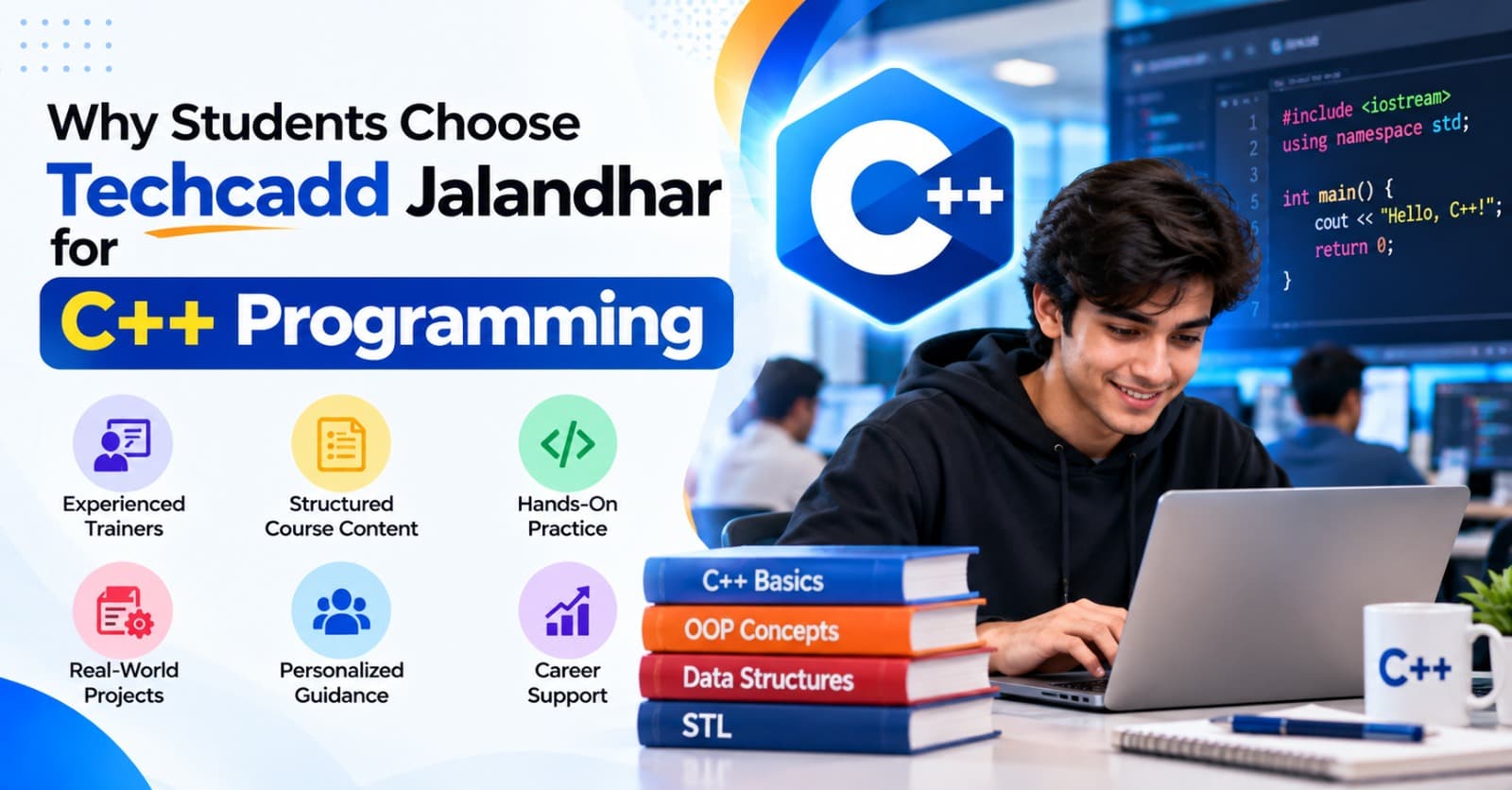
Why Students Choose Techcadd Jalandhar for C++ Programming
Discover why students choose Techcadd Jalandhar for C++ programming, practical coding exercises, OOP concepts, and problem-solving skills.
On this page
- 1. Beginner-Friendly Learning Approach
- 2. Practical Coding and Hands-On Exercises
- 3. Learn Object-Oriented Programming Concepts
- 4. Build Strong Problem-Solving Skills
- 5. Foundation for Data Structures and Algorithms
- 6. Project-Based Learning Opportunities
- 7. Explore Career Opportunities in Technology
- Conclusion
Why Students Choose Techcadd Jalandhar for C++ Programming
C++ is one of the most widely used programming languages in software development, competitive programming, game development, and system programming. For students who want to build a career in the IT industry, learning C++ provides a strong foundation in programming logic, problem-solving, and Object-Oriented Programming (OOP). Choosing the right training institute can help learners understand programming concepts, practice coding regularly, and prepare for advanced technical subjects.
Techcadd Jalandhar is a local option for students interested in learning C++ programming and developing practical coding skills. From understanding basic syntax to exploring advanced programming concepts, a structured learning approach can help beginners gain confidence and prepare for future opportunities in technology.
1. Beginner-Friendly Learning Approach
Starting with a programming language can feel challenging, especially for students who have never written code before. Understanding variables, conditions, loops, and functions requires patience and consistent practice. A step-by-step learning approach helps students develop their skills without feeling overwhelmed by complex concepts.
Students begin with fundamental topics such as program structure, data types, operators, input and output statements, and conditional statements. As their understanding improves, they can progress to loops, functions, arrays, strings, and pointers. This gradual progression helps learners establish a strong foundation before moving toward advanced programming techniques.
2. Practical Coding and Hands-On Exercises
Programming becomes easier to understand when students apply concepts through practical exercises. Instead of focusing only on theoretical explanations, learners should regularly write programs, test different inputs, identify errors, and improve their solutions.
C++ coding exercises can include calculating factorials, checking prime numbers, generating multiplication tables, reversing numbers, and printing patterns. These activities encourage logical thinking and help students understand how different programming statements work together.
At Techcadd Jalandhar, students can explore C++ learning opportunities with a focus on building programming knowledge and applying concepts through coding practice. Consistent hands-on exercises help learners become more comfortable writing and debugging programs independently.
3. Learn Object-Oriented Programming Concepts
One of the major advantages of learning C++ is its support for Object-Oriented Programming. OOP helps developers organize code into classes and objects, making programs easier to structure, reuse, and maintain.
Students can learn important concepts such as classes, objects, constructors, destructors, and access specifiers. They can also explore the four fundamental principles of OOP:
Encapsulation: Combines data and related functions within a class while controlling access to information.
Abstraction: Hides unnecessary implementation details and exposes essential functionality.
Inheritance: Allows one class to reuse and extend the properties and functions of another class.
Polymorphism: Enables the same interface to support different behaviors.
Understanding these concepts helps students move beyond basic programming and develop a better understanding of how larger applications are designed.
4. Build Strong Problem-Solving Skills
Problem-solving is an essential skill for anyone pursuing a career in software development. C++ encourages students to break complex problems into smaller steps, identify patterns, and develop logical solutions.
Regular programming practice helps learners improve their ability to analyze problems and select suitable approaches. Students can gradually progress from simple mathematical problems to more challenging tasks involving arrays, strings, recursion, and searching and sorting techniques.
These skills are valuable for academic assignments, programming competitions, technical assessments, and software development projects. Consistent practice also helps students become more confident when approaching unfamiliar coding challenges.
5. Foundation for Data Structures and Algorithms
Data Structures and Algorithms (DSA) are important topics for computer science students and aspiring software developers. C++ is commonly used to study these subjects because it provides efficient programming capabilities and supports the implementation of different data structures.
After learning the fundamentals of C++, students can explore arrays, linked lists, stacks, queues, trees, graphs, searching algorithms, and sorting algorithms. They can also learn how to evaluate time and space complexity to understand the efficiency of different solutions.
A solid understanding of C++ makes it easier to progress toward advanced DSA concepts and prepare for coding interviews. It also provides useful knowledge for students planning to participate in competitive programming activities.
6. Project-Based Learning Opportunities
Projects help students apply their knowledge to practical problems and understand how programming concepts work together. Developing small applications can improve coding skills, debugging abilities, and confidence in writing complete programs.
Beginners can start with projects such as a calculator, number-guessing game, student record management system, banking simulation, or library management system. These projects can incorporate variables, functions, conditional statements, arrays, and classes.
As students gain experience, they can expand their projects by adding features, improving program organization, and handling different user inputs. Building a collection of practical projects can also help demonstrate programming knowledge during academic evaluations and job interviews.
7. Explore Career Opportunities in Technology
C++ programming knowledge can support learning and career development in several technical fields. These include software development, game programming, embedded systems, systems programming, competitive programming, and performance-intensive applications.
However, career opportunities depend on more than knowing a single programming language. Students should also develop problem-solving abilities, learn relevant tools and technologies, practice DSA, and gain experience through projects.
Learning C++ provides a useful starting point for building these skills. With consistent practice and continued learning, students can prepare for technical interviews, advanced computer science subjects, and future professional opportunities.
Conclusion
Techcadd Jalandhar is an option for students who want to begin learning C++ programming and strengthen their technical foundations. By progressing from basic syntax to Object-Oriented Programming, practicing coding exercises, and exploring projects, learners can develop essential programming and problem-solving skills.
Whether the goal is to improve academic performance, prepare for DSA, participate in coding competitions, or pursue a career in software development, learning C++ can be a valuable step toward achieving long-term technical goals. Regular practice, curiosity, and a willingness to solve challenging problems remain key to becoming a confident programmer.
Learn C++ from Scratch
Start learning C++ with basic syntax, variables, data types, loops, and functions. Build strong programming fundamentals through structured learning and practical coding exercises.
Practical Coding Experience
Improve your coding skills by solving programming problems and developing projects. Practice debugging, logical thinking, and writing efficient C++ programs.
Master Object-Oriented Programming
Understand classes, objects, inheritance, polymorphism, encapsulation, and abstraction. Learn how to write reusable and well-structured C++ code for real-world applications.
Build Your Programming Career
Strengthen your foundation in C++ and prepare for Data Structures and Algorithms, coding interviews, competitive programming, and advanced software development.
Have a questionabout this?
Leave your number and a counsellor will call you back — about batch timings, fees, EMI options, placement record, or which track fits your degree.
- Free career counselling, no registration fee
- Weekday, evening, weekend or 1-on-1 batches
- Internship letter and placement support
Ready to get started?
Start building yourcareer today.
Talk to a counsellor today. One call is usually enough to know which track fits your degree, your schedule and the job you want.
- Free career counselling
- No registration fee
- Placement support included