Structured, guided and project-based
Six months of guided technical learning, practical assignments and project development, ending in an end-to-end AI or ML project you can explain and demonstrate.
Move from theory to practical AI work over six months: Python and statistics, machine learning, deep learning, NLP, computer vision and generative AI — ending in a documented capstone you can demonstrate. See what you will build and whether it fits your university semester before you decide.
No guaranteed employment or university approval. Projects, stipend, certificates, fees and batch dates should be confirmed with the centre before enrolment.

Overview
When you search for a 6 months AI and machine learning internship in Jalandhar, the real question is practical: what will happen during the six months, what will be expected of you, and what evidence of learning will remain at the end? This page answers that in language you can discuss with a parent, faculty coordinator or head of department.
For every topic, ask for an example exercise or project deliverable and its assessment rubric. That is what separates a genuine learning plan from a list of fashionable technologies.
Six months of guided technical learning, practical assignments and project development, ending in an end-to-end AI or ML project you can explain and demonstrate.
The experience depends on whether you work on supervised organisational tasks or attend a project-based training programme. Ask which one this is before you enrol.
The useful question is what evidence of learning remains at the end: notebooks, a repository, a report and a demonstration you can discuss with faculty or an interviewer.
At each stage you should be able to explain the objective, inputs, tools, outputs and limitations of your work — and record it in a portfolio or progress log.
Who can apply
Relevant to B.Tech CSE, AI & Data Science and IT, BCA, MCA, B.Sc Computer Science, B.Sc IT and eligible diploma students. Readiness to practise coding, mathematics and problem solving matters more than your exact degree.
Engineering students often need semester-aligned industrial training and a defensible final report. Each activity connects to a measurable project milestone; confirm your university's format independently.
Computer applications students arrive with different levels of Python and database experience. A foundation path shows how software development skills connect to model serving and AI applications.
Statistical or computing backgrounds translate well into exploratory analysis, model comparison and clear technical writing. Project choice takes your prior coursework into account.
Your time is shared with examinations, viva preparation and departmental submissions. Check the approved duration and reporting requirements before paying a fee.
If you have never evaluated an offer, ask who your mentor is, what the actual work is, the attendance expectations, project scope, assessment process, and whether a stipend or employer supervision exists.
Academic background matters less than readiness to practise coding, mathematics and problem solving consistently. A counsellor can assess where you are before you choose.
Why a six-month AI internship?
Six months gives you time to learn programming fundamentals, handle real datasets, evaluate models properly and present an end-to-end project.
Six months leaves room for Python, Git and statistics before models — the groundwork short courses tend to skip.
Handle messy data, missing values and leakage yourself, instead of only running clean tutorial examples.
Compare models against a baseline on proper validation data, and learn which metric fits which problem.
For final-semester students, the value is a coherent learning record — not a certificate alone.
AI & ML specialisations
Machine learning, deep learning, NLP, computer vision, generative AI, responsible AI, MLOps and data foundations. Which ones you go deep on should match your prerequisites, what is feasible as a project, and mentor availability.
Variables, loops, functions, files, exceptions, virtual environments and version control — practised before tackling large models, and connected to real assignments.
Probability, descriptive statistics, linear algebra intuition and sampling. The goal is not memorising formulas but knowing why a method fits and what its assumptions mean.
Every dataset needs a documented source, usage rights and a privacy review. Projects avoid sensitive personal data without authorisation and disclose synthetic or public data clearly.
Missing values, duplicates, outliers, leakage and skewed categories can distort results. You build a reproducible notebook showing what changed and why, before fitting models.
Regression, classification, clustering and dimensionality reduction are different problem types. Choose a baseline and compare models on validation data, not by popularity.
Accuracy alone can mislead on imbalanced classes. Precision, recall, F1, ROC-AUC, MAE or RMSE are chosen by task, and every experiment records its settings and random seeds.
Neural networks bring training loops, loss functions, overfitting, regularisation and compute trade-offs. A small, explainable prototype comes before complex architectures.
Text classification, semantic search, embeddings and summarisation. Language-model output is evaluated for factual errors, bias, privacy risks and robustness.
Image classification and object detection, on datasets with proper permissions and careful labelling. You explain failure cases such as lighting changes or class imbalance.
Prompt design, retrieval-augmented generation and tool-using workflows, explored with guardrails. Demos separate prototype behaviour from production reliability and include human review.
Version control, experiment tracking, APIs, monitoring and model documentation. A simple deployed demo can be worth more than an ambitious model nobody can reproduce.
A portfolio explains the problem, method, results, limitations and your own contribution. Short demos, readable repositories and honest narratives help interviewers judge your skills.
 Matplotlib
Syllabus & learning roadmap
Each month ends in at least one documented practical milestone, with feedback and areas to revise. The sequence is illustrative — confirm it against the active batch syllabus.
Coding fundamentals, version control, the statistics you need, and a first look at real data.
Clean and prepare data, fit your first supervised models and choose metrics that suit the task.
Unsupervised learning, building better features, and comparing models fairly against a baseline.
Training loops and loss functions, then introductions to working with text and with images.
Prompting and retrieval with guardrails, serving a model behind an API, and testing what you ship.
Finish and document your capstone, write the report, rehearse the demo and prepare for your viva.
AI course vs AI internship
Project-based industrial training can resemble an internship in its practical work, but it should not be presented as employment experience without a real work arrangement. Universities also use these terms differently.
Practical AI & ML projects
Certificates & deliverables
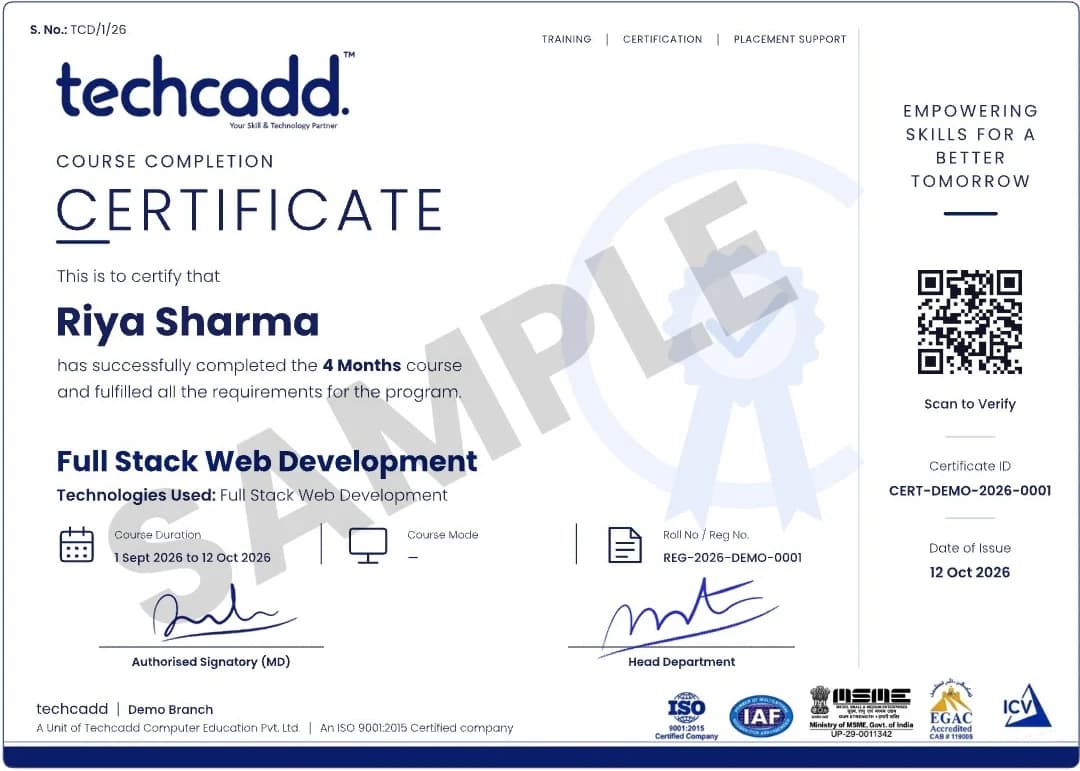
Issued on finishing the programme, with a QR code and certificate ID anyone can verify.
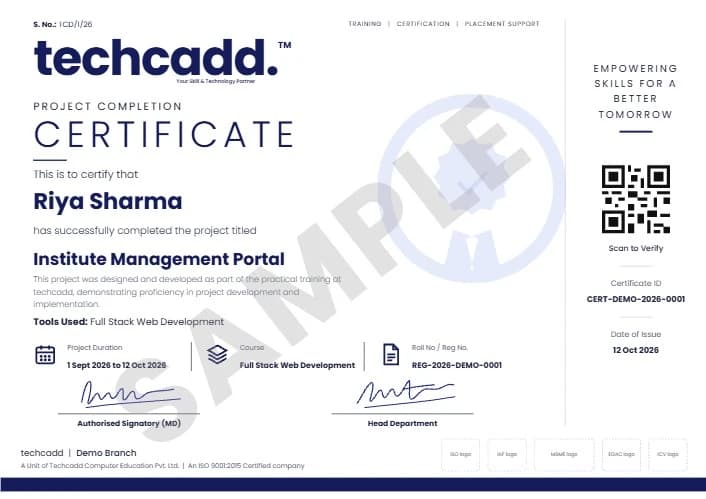
A separate certificate naming the live project you designed and built during training.
College & university documentation
Documents students most often ask about. Whether each is available — and whether your university accepts it — must be confirmed in writing before enrolment.
No training centre can guarantee acceptance by every university. Keep copies of the published syllabus and programme terms you were given.
Duration, semester planning & batches
Roughly 24 weeks, or a university-defined semester window. Ask for the actual contact hours, holidays and examination breaks for your batch.
Check how the batch lines up with your exams, viva and departmental submissions before you join.
Raise it at admission. Confirm in writing how the programme handles a shorter or longer required period.
Plan around batch dates the centre confirms in writing, not dates quoted informally.
Eligibility, fees & what is included
Ask for the current written fee schedule rather than relying on a figure quoted elsewhere — and do not assume every internship is paid.
You do not need advanced mathematics, but practising Python basics — variables, loops, functions and files — before joining makes the first month much easier. A counsellor can suggest a foundation path if you are starting from scratch.
Career scope
Entry-level roles you may explore, depending on your skills and each employer’s hiring criteria:
Completing a programme does not guarantee placement. Hiring depends on skills, projects, interview performance, market conditions and employer criteria.
Practise explaining your problem, method, results and limitations in plain language — and be ready to justify your choice of metric.
Short demos, readable repositories and an honest account of your personal contribution say more than a list of libraries.
Finish with a clear view of the gap your capstone revealed, whether that is deployment, deep learning or statistics.
Why students consider techcadd
Judge us on what you can see: the centre, the trainers, the syllabus and the work students produce in these rooms.
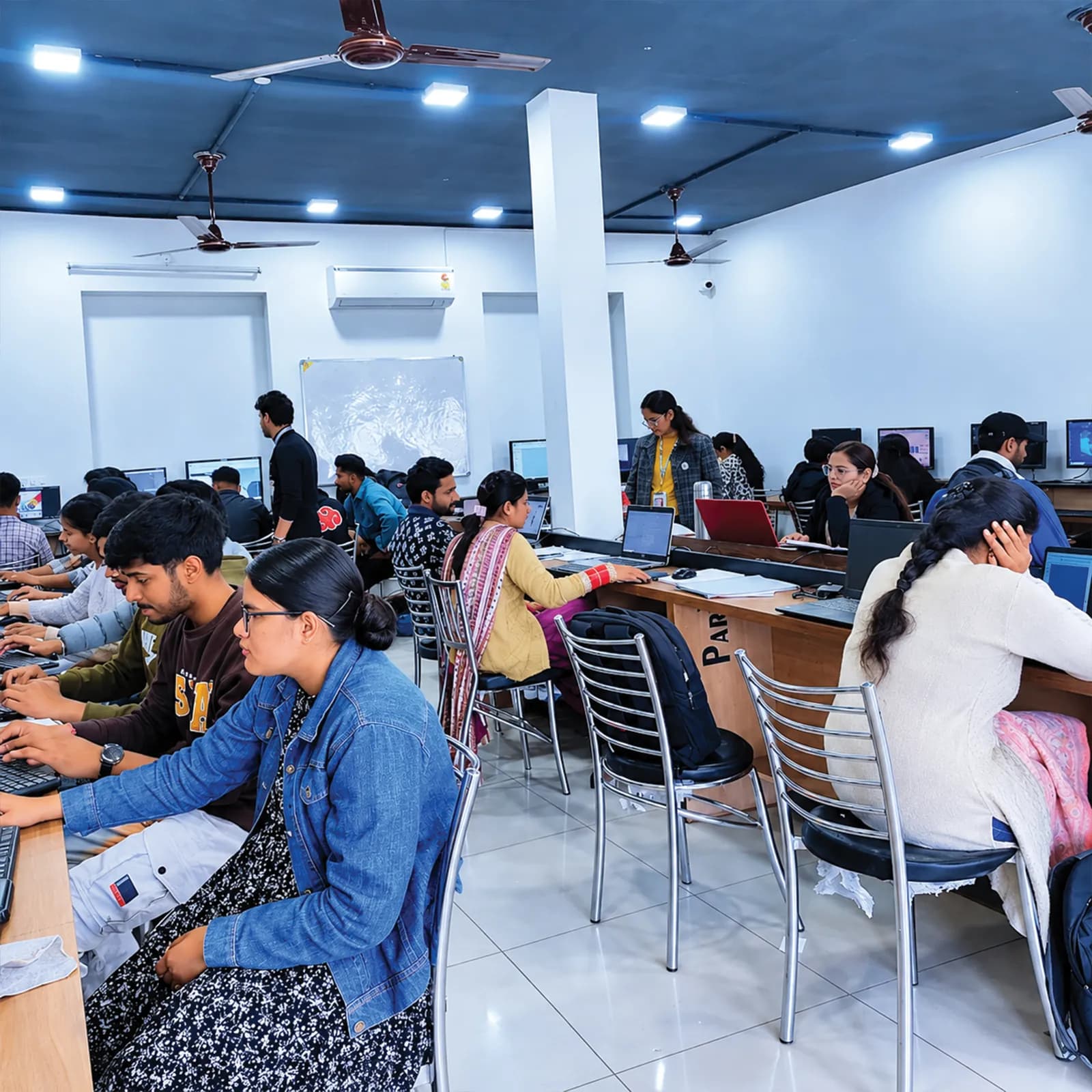
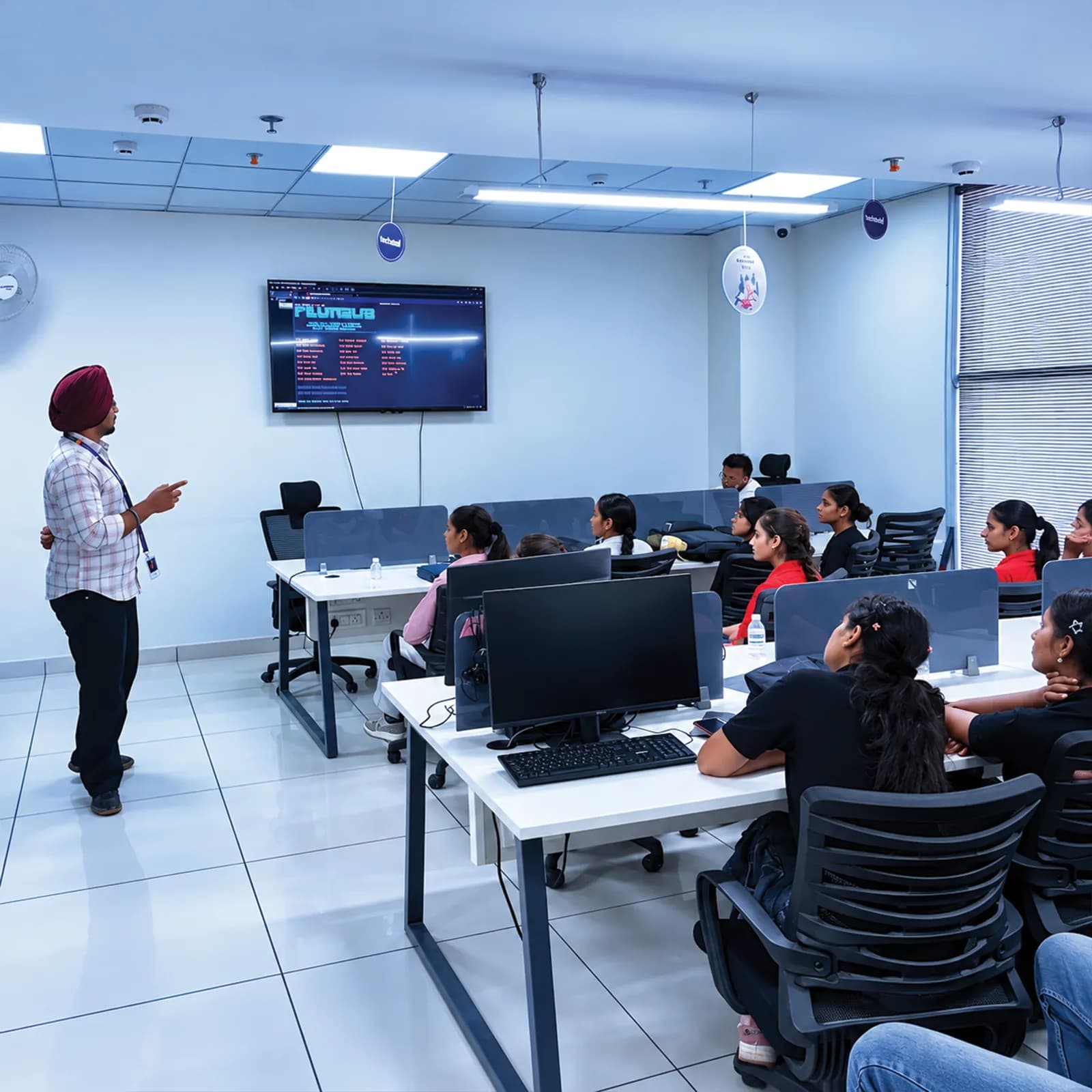
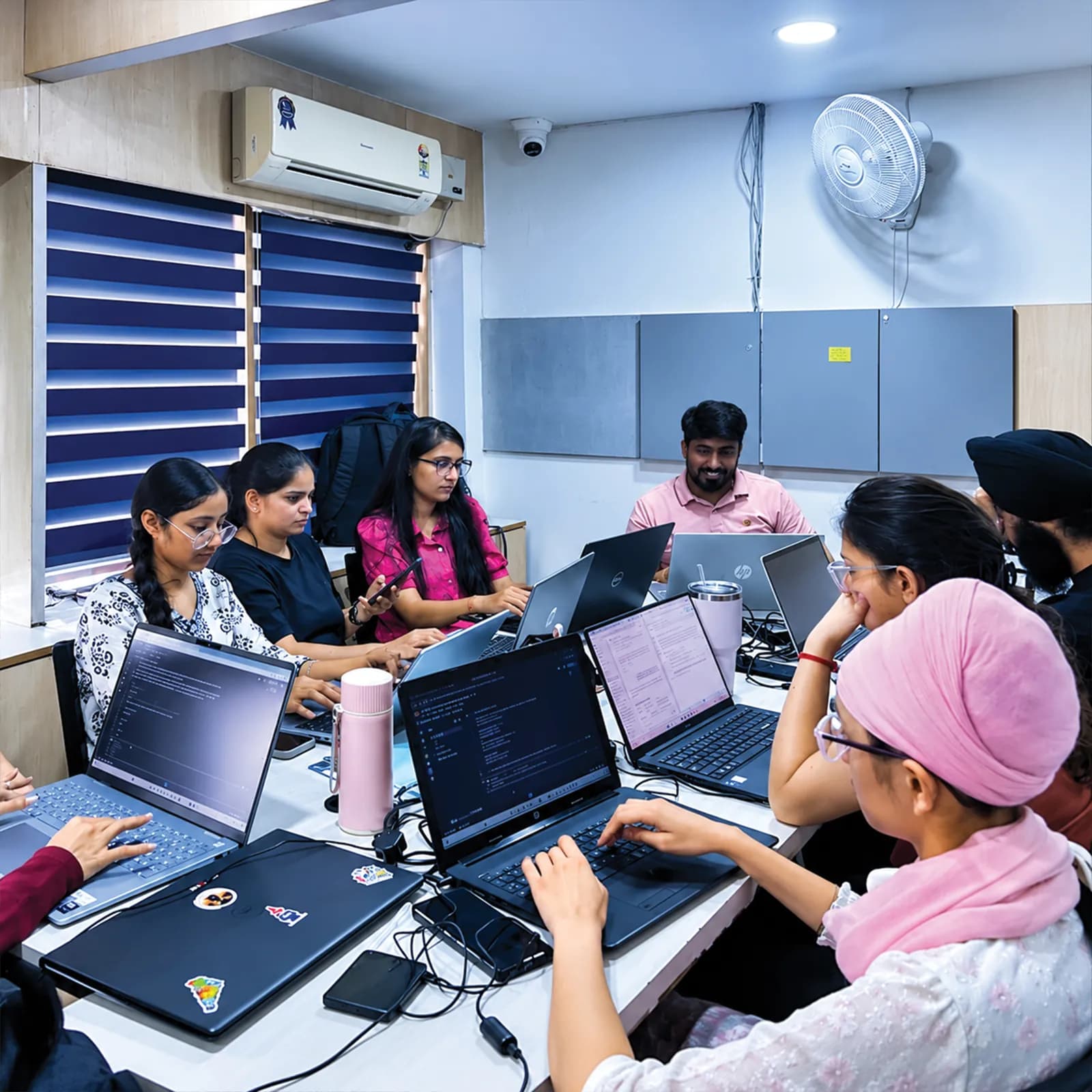
Ask for the current AI & ML syllabus and sample assignment before you enrol, and keep a copy.
Ask how mentors review your code and results — and see it for yourself in a sample session.
Labs, trainers and project reviews at one centre, so you can see where and how you will work.
Your degree, semester and current skills decide the starting point — the conversation comes before any fee.
Plan your commute alongside your college timetable, and come in for a counselling session before you confirm a batch. Students travel in from Phagwara, Kapurthala, Nakodar, Hoshiarpur, Adampur and Kartarpur.
techcadd Jalandhar — 2nd Floor, Crystal Plaza, SCS 78, Opposite PIMS Hospital, Jalandhar, Punjab 144001Frequently asked questions
Answers can differ by degree, semester and batch — confirm any academic requirement directly with your institution.
An indicative path runs from Python, Git and statistics through data preparation, supervised and unsupervised learning, neural networks, NLP and computer vision, to generative AI prototypes, deployment and a documented capstone. Confirm the sequence against the active batch syllabus.
It can be, if the duration and documentation match your university's industrial training rules and the batch fits your semester. Check your department's requirements before enrolling.
Yes. The mathematics needed is basic probability, descriptive statistics and linear algebra intuition, taught for understanding rather than memorisation. Steady practice matters more than prior advanced maths.
A Python course teaches the language. An AI & ML programme uses Python to prepare data, build and evaluate models, and deliver a reproducible project with a report and demonstration.
Ask for the current policy for your batch. Either way, your portfolio and report should state your personal contribution clearly.
Ask the programme team which applies to your batch. Project-based training should not be described as employment experience without a real work arrangement.
The indicative roadmap introduces NLP and computer vision in month four and generative AI prototypes in month five. Confirm the depth of each against the current syllabus.
Yes — version control is part of the first month, and the capstone should end as a readable repository with a clear README, results and limitations.
Ask for the current admission criteria. Practising variables, loops, functions and files before joining makes the first month far easier.
Do not assume one. Ask in writing whether a stipend or employer supervision exists for your batch, and how it can be verified.
It can document participation or completion. It does not by itself prove employment experience or guarantee academic credit — check the issuer and assessment criteria.
Only your college or university can confirm academic acceptance. Get written guidance from your department or training and placement cell before paying fees.
No. It can help you build skills and a portfolio, but hiring depends on your skills, projects, interview performance, market conditions and employer criteria.
Ask for the current written fee schedule, including what is covered, refund terms and any separate assessment charges, rather than relying on a figure quoted elsewhere.
Send an enquiry from this page, call +91 98881 22254, or visit the centre and ask for the AI & ML syllabus and a sample assignment.
techcadd Jalandhar is at 2nd Floor, Crystal Plaza, SCS 78, Opposite PIMS Hospital, Jalandhar, Punjab 144001. Visit for a counselling discussion before you confirm a batch.
Apply
Request the current syllabus, discuss your semester requirements and ask about confirmed batches and fees. We only ask for the details needed to call you back.