Call us

6 Months Internship & Industrial Training in Jalandhar for College Students

Move from classroom concepts to practical technology skills through a structured six-month learning pathway in Jalandhar. Explore domains, understand project expectations and request the detailed syllabus before you decide.

Programme details, batch timings, documentation and available domains should be confirmed with the centre before enrolment.

  • 10technology domains
  • 6months, ending in a capstone
  • Since 2016training in Jalandhar
  • Crystal Plaza, opposite PIMS Hospital

Overview

What is a 6-month internshipor industrial training programme?

For college and university students in Jalandhar, the decision is rarely just about enrolling in another class. You want to know what you will be able to build, which tools you will practise, how the schedule fits your semester, and whether your department will accept the documentation. This page answers those directly, without unrealistic promises.

When comparing options, look beyond slogans such as “industry ready” or “job guaranteed.” Ask to see an indicative timetable, sample assignments, project rubrics and examples of acceptable deliverables.

How a six-month learning journey works

A meaningful learning experience combines explanation, practice, feedback and revision. Instead of treating a technology name as a complete syllabus, it is broken into concepts, lab exercises, progressively harder tasks and a project that can be demonstrated.
What students should expect

Ask what happens in a typical week, how questions are resolved, what happens if you fall behind, and how progress is assessed. A transparent answer to those is more useful than any dramatic claim.

Why duration matters

Six months is long enough to move from guided exercises to a project you planned, built, tested and documented yourself — which is what you will be asked to explain to a teacher or an interviewer.

The role of mentorship and feedback

Feedback is what turns practice into progress. Expect your work to be reviewed, questioned and returned for revision, and expect to explain the decisions behind it.

Who can apply

6 months internship for B.Tech, BCA, MCA and other students

The right choice depends on your starting skills, college requirements, preferred domain and available time. Recent graduates and career changers can join a suitable track according to its prerequisites.

  • B.Tech CSE and IT students

    A six-month programme can complement programming, database, networks, operating systems and software engineering courses. Final-year learners often need project documentation and may have university-prescribed formats.

  • BCA students

    Foundational programming, web technologies, databases and debugging practice can be particularly useful alongside a BCA.

  • MCA students

    MCA students often look for deeper design choices, teamwork and stronger capstone work than an undergraduate track asks for.

  • B.Sc IT and computer science students

    Programming, data and web tracks build on what a B.Sc IT or computer science degree already covers, and add a project you can demonstrate.

  • Diploma and eligible final-year students

    Check that the batch schedule fits your examinations, attendance and submission deadlines, and that your institution permits training in that semester.

  • Students from non-computing degrees

    Check the entry requirements first. An introductory track can help, but advanced AI, cybersecurity or cloud work may require prior mathematics, coding or systems knowledge.

Why a 6-month internship?

Why students choose six months of practical training

These pieces of evidence give you concrete examples to discuss with teachers and interviewers, and make it easier to see your gaps and choose what to learn next.

01

Connect theory with practice

Take what your degree teaches in lectures and apply it in guided labs, where a concept has to produce a working result before you move on.

02

Develop project confidence

The strongest evidence of learning is often small and specific: a working feature, a documented dataset, a clear README, a security checklist, a deployment diagram or a presentation explaining trade-offs.

03

Explore careers before graduation

Six months in one domain tells you whether you enjoy the work day to day — before you commit a job search or a postgraduate degree to it.

04

Build habits employers value

Version control, written status updates, testing before you call something done, and asking clear questions are learned by doing them every week, not by reading about them.

Internship domains

Choose a technology domain for your six-month journey

No single domain suits every student. If you enjoy mathematics and data exploration, consider data science; if you like building interfaces, web development; if you are drawn to systems, cloud or security. A short counselling conversation helps you avoid choosing a field only because it is trending.

  • 01

    Artificial Intelligence and Machine Learning

    Python fundamentals, data preparation, model evaluation, responsible use of AI, and a small reproducible project. Complete beginners should not expect advanced research outcomes.

  • 02

    Data Science

    Collecting, cleaning, exploring, visualising and interpreting data with Python, statistical reasoning and reproducible notebooks — ending in an analysis of an open dataset with transparent charts.

  • 03

    Data Analytics

    Excel, Google Sheets, SQL, Python with NumPy, pandas, Matplotlib and Seaborn, and Power BI or Tableau — cleaning data, defining KPIs and building dashboards, ending in a business report with clear, defensible recommendations.

  • 04

    Full Stack Web Development with Python

    HTML, CSS, JavaScript, Python and Django, REST APIs, MySQL databases, authentication basics, testing and deployment. Projects are built incrementally and documented as they go.

  • 05

    MERN Stack Development

    MongoDB, Express, React and Node.js, from components and state to REST APIs, JWT authentication and deployment, ending in a full application built and shipped end to end.

  • 06

    Cybersecurity and Ethical Hacking

    Networking fundamentals, Linux, security hygiene, logging and authorised lab exercises. Every exercise runs in a permitted environment.

  • 07

    Cloud Computing and DevOps

    Linux, Git, networking, cloud service models, IAM principles, deployment, containers, CI/CD concepts and cost awareness.

  • 08

    Digital Marketing

    Search intent, on-page SEO, content planning, analytics, paid campaign concepts and conversion measurement, ending in a campaign proposal built on realistic assumptions.

  • 09

    Mobile Application Development

    Mobile interface patterns, application state, API integration, testing and release fundamentals, ending in a small app with clear usability goals.

  • 10

    Internet of Things and Robotics

    Sensors, controllers, embedded logic, data transmission, prototyping and safety-conscious testing, ending in a documented demonstrator.

Syllabus & learning roadmap

Six-month internship syllabus, month by month

The outline every domain follows. The tools and project inside it depend on the domain you choose — ask for its detailed syllabus.

  1. Month 1

    Foundations and tools

    Onboarding, a skill baseline, digital tools, programming or domain fundamentals, a study plan and the first practical exercises.

  2. Month 2

    Core skills and guided exercises

    Core technical concepts, supervised lab tasks, code reviews or data reviews, weekly reflection and targeted feedback.

  3. Month 3

    Intermediate workflows

    Collaborative exercises, version control, troubleshooting and a mini-project demonstration.

  4. Month 4

    Project planning

    Problem definition, requirements, milestones, datasets or architecture, ethical constraints and a test plan.

  5. Month 5

    Applied project and teamwork

    Implementation, iteration, peer feedback, bug fixing, documentation and presentation rehearsal.

  6. Month 6

    Capstone, review and career preparation

    Capstone completion, evaluation, report writing, portfolio presentation, mock interviews and an individual next-step plan.

Course vs internship vs industrial training

Understand the difference before you enrol

Training programmes can include internship-like projects without being employment internships, and colleges and providers use these terms differently. Compare the actual learning environment, supervision, deliverables and academic recognition — not just the programme label.

CourseIndustrial trainingInternship
Main focusA defined curriculum and its assessmentsStructured skill development, often during a semester or breakSupervised practical work with defined responsibilities
Where it happensClassroom or onlineClassroom or lab, with guided projectsA professional or supervised work setting
What you come away withAssessed knowledge of the syllabusA demonstrable project and its documentationWork deliverables and a record of supervised experience

Ask your department first

  • Which formats qualify for my training semester — industrial training, internship, or both?
  • Does this provider meet the department's requirements?
  • What evidence must I submit, and in what format?
  • Is there a minimum number of hours or an attendance threshold?

Real-world projects

Build a portfolio with practical technology projects

How projects are selected
A realistic scope with written objectives, audience, technical requirements, constraints and success criteria — then broken into milestones.
Documentation, testing and version control
Work is committed as it is built, tested before it is called finished, and documented well enough that someone else could run it.
Team collaboration and demonstrations
Some work is done in pairs or teams, and every project ends in a demonstration where you explain the problem, approach, challenges and results.
Presenting outcomes ethically
Separate your own contribution from starter templates or team work, share only what you have permission to publish, and state limitations openly.

Certifications & deliverables

Certificates, assessments and project deliverables

Completion certificates and what they mean
A certificate can document participation or completion. It does not by itself prove employment experience or guarantee academic credit.
Project reports and repositories
A written report and a repository you can share are what let a teacher or an interviewer see the work rather than take it on trust.
Skill assessments and presentations
Assessment checks whether you can explain core concepts, demonstrate the project, describe the problems you solved and name the next skill you need.
Verification and university acceptance
Confirm the certificate issuer, eligibility criteria and evaluation method for your batch, and check with your college what it will accept.
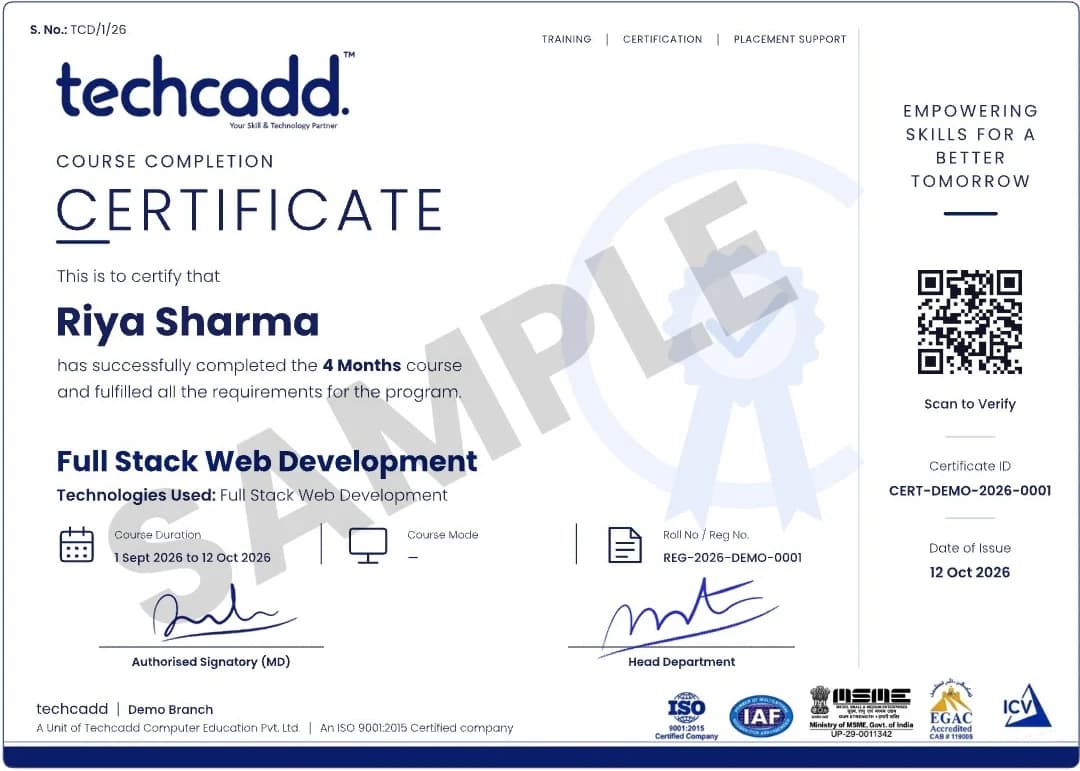
  • Sample TechCADD course completion certificate

    Course Completion Certificate

    Issued on finishing the programme, with a QR code and certificate ID anyone can verify.

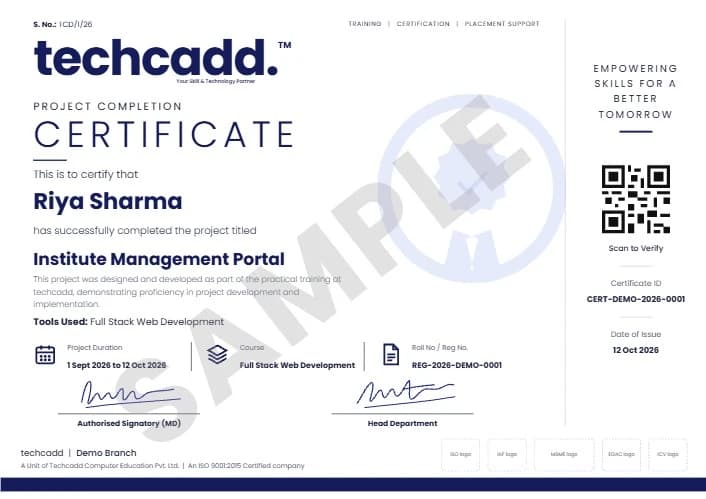
  • Sample TechCADD project completion certificate

    Project Completion Certificate

    A separate certificate naming the live project you designed and built during training.

University & college requirements

College internship letters, reports and university guidelines

Documents that may be relevant to your college. Their availability and wording must be confirmed with the centre for your batch.

  • College permission or NOC
  • Joining confirmation
  • Attendance logs
  • Weekly diary
  • Project report
  • Completion letter

No training centre can guarantee acceptance by every university. Get written guidance from your training and placement cell or department before paying fees.

Internship duration & batches

Semester planning and batches

Semester calendars and joining windows

Match the batch start date to when your college releases you for training, and to when your report is due.

Balancing exams and training

If your examinations fall inside the six months, ask how missed sessions are made up before you join, not after.

Attendance and scheduling

Attendance rules depend on the programme and your college's requirements. Confirm both in writing before you start.

Planning a realistic timeline

Count your travel time, college commitments and project deadlines together, and choose a batch timing you can actually keep for six months.

Fees & eligibility

Six-month internship fees, eligibility and admission questions

Fees vary by what the programme includes, so ask for the current written fee schedule for your domain rather than relying on a figure quoted elsewhere.

What affects the fee

  • Domain
  • Duration
  • Delivery format
  • Lab resources
  • Mentoring
  • Project support

Confirm before payment

  • Taxes and instalment options
  • Refund terms
  • What happens if you miss classes
  • How long you keep access to material
  • Equipment you need to bring
  • Certificate conditions
  • Whether any external exam fee is included

Prerequisites and beginner pathways

Web development, digital marketing and foundational data science are accessible starting points. Advanced AI, cybersecurity and cloud tracks may expect prior coding, mathematics or systems knowledge — a counsellor can assess where you are before you choose.

Career opportunities

Career scope after six-month industrial training

Possible entry-level pathways, depending on demonstrated skills and employer requirements:

  • Junior web developer
  • Software trainee
  • Data analyst trainee
  • QA trainee
  • Cloud support trainee
  • IT support trainee
  • Security operations trainee

No programme alone guarantees a job. Hiring depends on skills, projects, interview performance, location, market conditions and employer criteria.

How to prepare for interviews

Review the fundamentals, practise describing your projects, and prepare examples of problems you troubleshot and the choices you made.

Portfolios and GitHub evidence

Two or three well-explained projects, with screenshots, code and a clear README, say more than a long list of tools.

Learning pathways after completion

Finish with a written next-step plan: the skill gap your project revealed and what you will learn next to close it.

Why choose techcadd?

Why consider techcadd for practical training in Jalandhar?

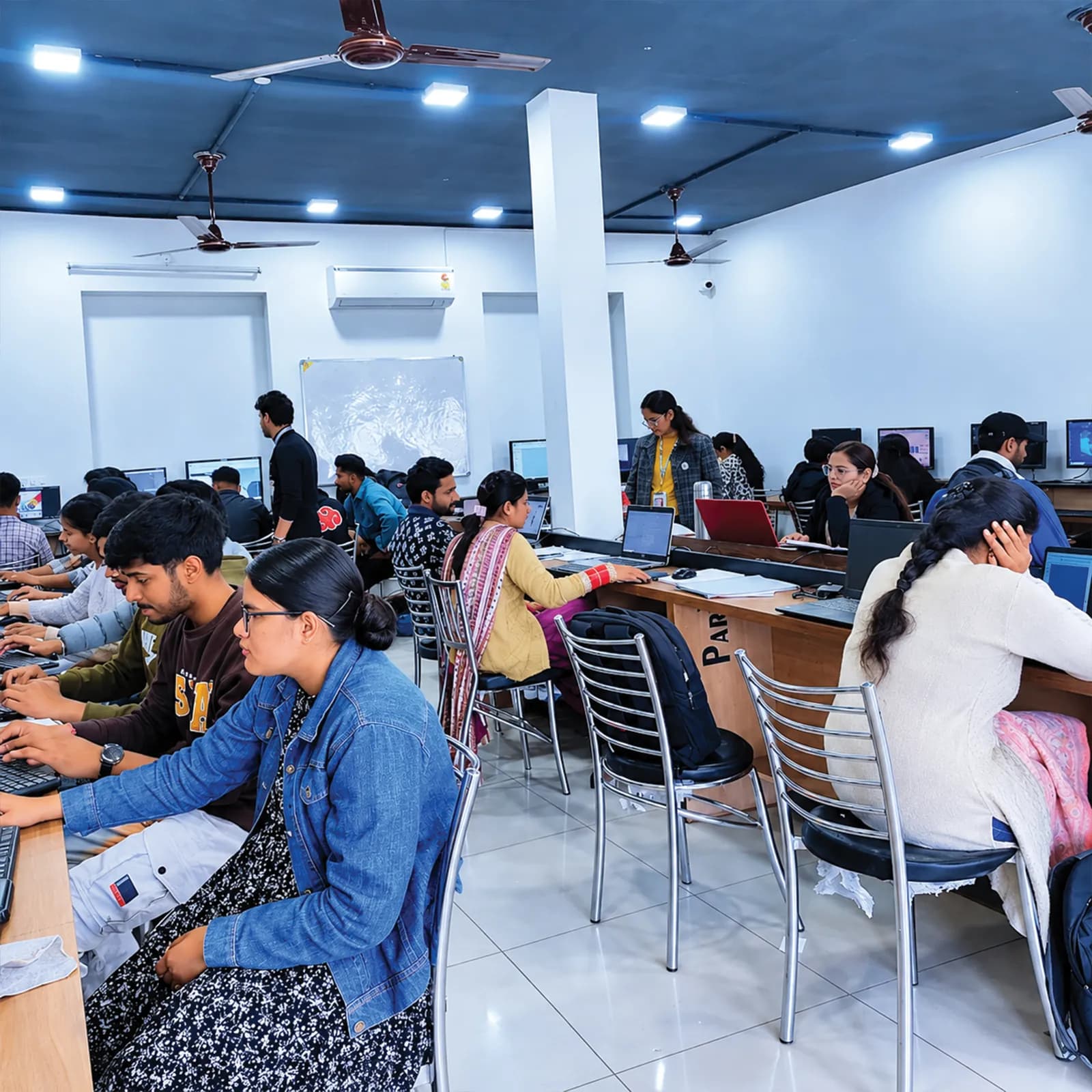
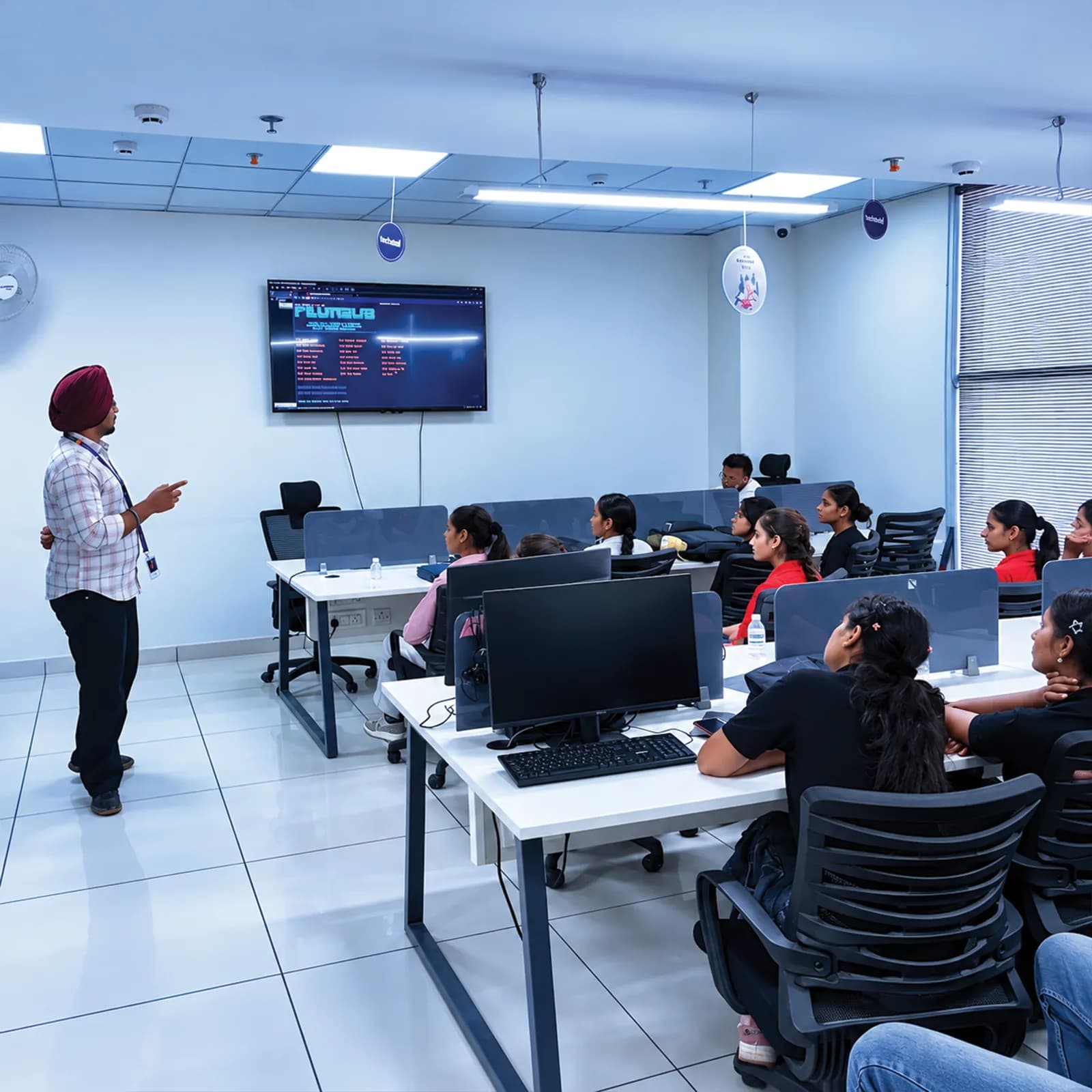
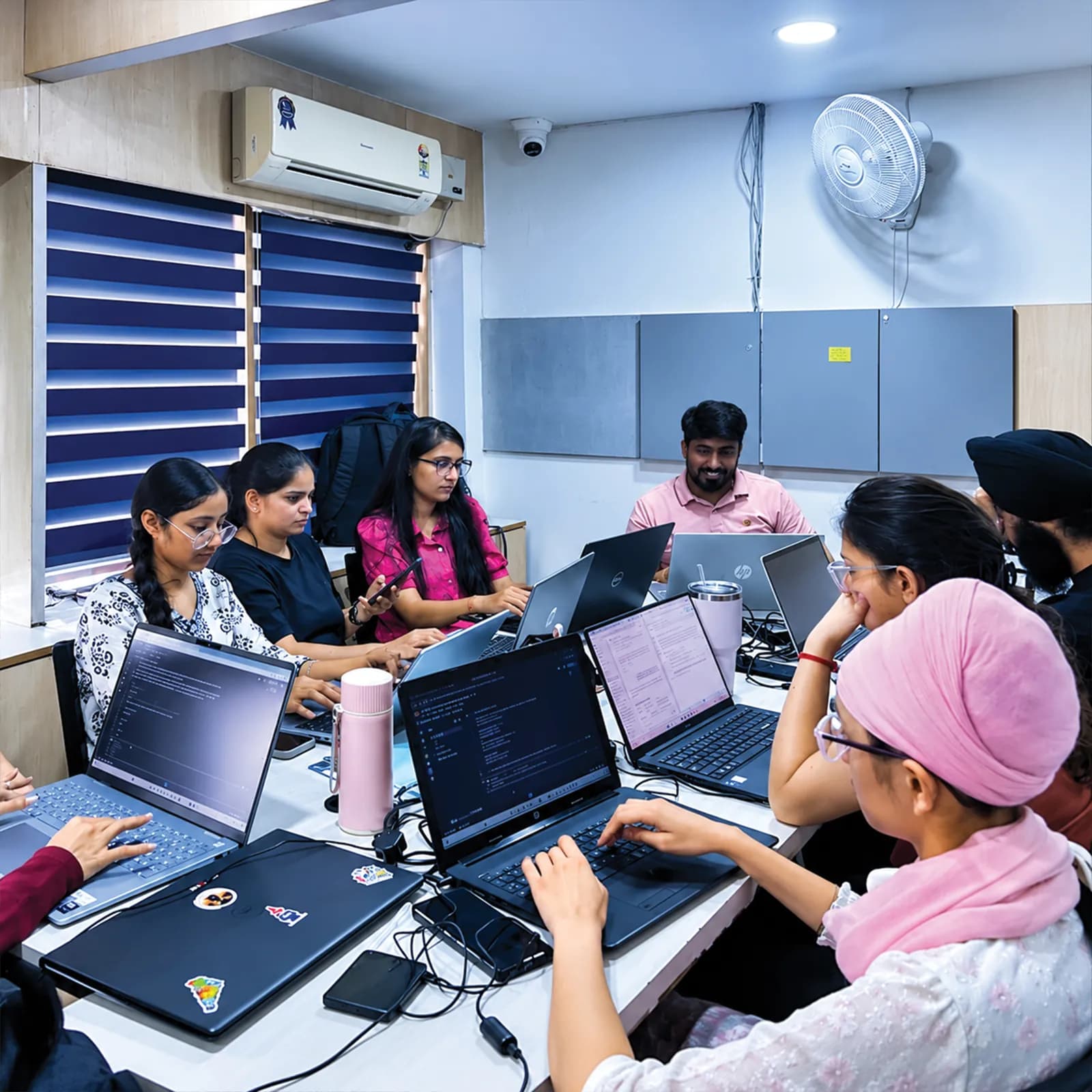
Judge us on what you can see: the centre, the trainers, the course outlines and the work students produce in these rooms.

A full batch at work in techcadd's main computer lab
Trainer explaining a terminal session on the wall screen
Students coding together on laptops around a shared table

Student-centred learning goals

Your degree, semester and the work you enjoy decide the track — a short counselling conversation comes before any enrolment.

Domain selection and guided practice

Ten domains, each taught as concepts, lab exercises and progressively harder tasks rather than a list of tools.

A project-focused learning environment

Labs, trainers and project reviews at one centre in Jalandhar, so you can see where and how you will work before you decide.

A visit before you decide

Come to the centre for a syllabus discussion or a sample session, and judge the format for yourself.

Six-month internship and industrial training in Jalandhar

Students come in from across Jalandhar and from Phagwara, Kapurthala, Nakodar, Hoshiarpur, Adampur and Kartarpur. Plan your travel time alongside your college calendar, and visit the centre before you confirm a batch.

techcadd Jalandhar — 2nd Floor, Crystal Plaza, SCS 78, Opposite PIMS Hospital, Jalandhar, Punjab 144001

Frequently asked questions

FAQs about six-month internships in Jalandhar

The correct answer can differ by degree, semester, domain and batch — confirm any academic requirement directly with your institution.

Is a six-month internship compulsory for B.Tech students?

Requirements vary by university, degree and academic year. Check your department handbook and speak with your faculty coordinator.

Can BCA students join a six-month internship?

Yes. Many training pathways are relevant to BCA students, subject to each track's prerequisites and the current eligibility criteria.

Is six-month industrial training the same as an internship?

Not always. Industrial training can be classroom or lab-based, while an internship often involves supervised workplace tasks. Confirm the actual programme format before you enrol.

Can I do training in my final semester?

Possibly, if your university permits it and the batch schedule fits your examinations, attendance and submission deadlines.

Which internship domain is best for a beginner?

Web development, digital marketing and foundational data science are accessible starting points, but the right choice depends on your interests and prerequisites.

Does an internship guarantee a job?

No. A programme can help you practise skills and prepare a portfolio, but hiring depends on your skills, projects, interview performance, location, market conditions and employer criteria.

Will my college accept the certificate?

Only your college or university can confirm academic acceptance. Verify the documents it requires before enrolling.

Are projects included?

Every track ends in project work. Ask for the current domain-specific syllabus and the exact project requirements for your batch.

Can I switch domains?

Ask about the current policy, and whether switching would affect your duration, fees or prerequisites.

What is the fee for six months of training?

Fees depend on the domain, duration and delivery format. Request the current written fee schedule, inclusions and refund policy from the centre.

Can I join without prior coding knowledge?

An introductory pathway may be appropriate, although advanced specialisations can require coding or technical foundations.

Will I get a joining letter?

Ask the centre what documents it currently issues and whether they meet your university's format.

What is a capstone project?

A capstone is a substantial final assignment that brings together the skills from the programme and can be demonstrated and documented.

Is attendance mandatory?

Attendance rules depend on the programme and your academic requirements. Confirm the policy before joining.

How can I apply in Jalandhar?

Request a counselling discussion, share your degree and semester, review the syllabus and confirm the batch details before registration. Call +91 98881 22254, send an enquiry from this page, or walk in to the centre.

Where is techcadd Jalandhar located?

techcadd Jalandhar is at 2nd Floor, Crystal Plaza, SCS 78, Opposite PIMS Hospital, Jalandhar, Punjab 144001. Students also travel in from Phagwara, Kapurthala, Nakodar, Hoshiarpur, Adampur and Kartarpur.

What are the class timings? Are weekend batches available?

The Jalandhar centre is open Mon – Sat, 9:00 AM – 7:00 PM. Timings and weekend availability depend on the track and batch, so ask for the current timetable.

Apply

Apply for six-month internship training in Jalandhar

Planning your six-month industrial training in Jalandhar? Share your degree, semester and preferred technology to request the relevant syllabus and discuss eligibility with techcadd.

  • Get personalised programme guidance
  • Ask for the detailed syllabus for your domain
  • Confirm your university's requirements
  • Plan your next step and joining month
Call +91 98881 22254
Security check
…

We use these details only to answer your enquiry and never share your number. See our privacy policy.

Gini AI
InternshipJoin