What data science actually involves
Not just running a model and quoting an accuracy figure. It starts with a question, a measurable outcome, suitable data and quality checks — and methods that match the decision.
Turn a college semester into practical data skills. Learn to ask better questions with data, write Python and SQL, explore real datasets, build analytical dashboards, practise machine learning and present a portfolio project — and check whether the schedule fits your university semester.
Admissions, fees, academic documents and project arrangements depend on the current programme. Request written confirmation before enrolling.
Overview
It is a bridge between university subjects and practical work. In a structured programme you progress from Python fundamentals and data handling to exploratory analysis, statistics, visualisation, machine learning and communicating results.
A workplace internship, a supervised project placement and classroom-led industrial training are not interchangeable. Ask what work you will do, who reviews it and what evidence you can show at the end.
Not just running a model and quoting an accuracy figure. It starts with a question, a measurable outcome, suitable data and quality checks — and methods that match the decision.
A good portfolio explains its limitations: the impact of missing data, bias or a small sample. Those habits are what interviewers probe.
Jalandhar students balance semester deadlines, commuting, attendance and exams. A nearby centre makes mentoring and project reviews easier to reach.
Compare learning outcomes, trainer expertise, actual lab time, student work and clear documentation before choosing any six-month programme.
Who can apply
Whatever your degree, check the minimum technical prerequisites, batch timing, attendance expectations, assessment format and any university permission you need before committing.
Turn algorithms, databases, mathematics and programming into documented Python notebooks, SQL queries and reproducible model experiments.
With introductory programming behind you, build a strong foundation in data cleaning, business questions, descriptive statistics and dashboard reporting before predictive models.
Go deeper into data pipelines, evaluation design, feature engineering, deployment considerations and collaborative project practice.
Connect statistics, coding and domain understanding through applied investigations on public or approved datasets.
Mechanical, civil, electronics and electrical students can apply data analysis to quality, sensors, energy, operations and forecasting — with the programming support they need.
Eligibility comes from prerequisites, your academic requirements and the programme design, not an assumption that every student starts in the same place.
Why a six-month data science path?
Data work combines coding, statistics and communication. A semester gives each of them room.
Room to revisit confusing concepts, debug code, take feedback and improve a project instead of rushing through demos.
A problem statement, data dictionary, cleaning decisions, findings and evaluation are easier to discuss in interviews than a list of tools.
Technical work alongside communication, ethics, business context and explaining uncertainty to non-programmers.
Find out whether you enjoy analytics, engineering, modelling, visualisation, data quality or research before you specialise.
A semester project can support your learning objectives when its scope and documentation match university rules — which the university decides.
Domains & specialisations
The current syllabus states the tools actually taught and the level you are expected to reach. Nobody becomes an expert in all ten of these in one semester — the aim is solid foundations and one well-documented project.
Syntax, functions, notebooks, NumPy, pandas, debugging, data structures and reproducible analysis.
Data cleaning, descriptive analysis, KPI definitions, dashboards, stakeholder questions and storytelling.
Joins, aggregations, subqueries, common table expressions, schema awareness and data validation.
Sampling, distributions, hypothesis testing, confidence intervals, correlation and experimental thinking.
Supervised and unsupervised methods, leakage prevention, train-test design, feature engineering and evaluation.
Power BI or Tableau-style reporting concepts, dashboard design, calculated measures and presentation.
Trends, seasonality, forecasting baselines, backtesting and uncertainty.
Text cleaning, tokenisation, vector representations, classification and responsible evaluation.
Files, APIs, basic ETL, pipeline reliability, versioning and data quality checks.
Privacy, consent, bias, explainability, documentation and careful communication of model limits.
 Matplotlib
 Seaborn
 Excel
 Power BI
Syllabus & learning roadmap
Each of the first four months ends in a mini-project. The sequence is indicative — confirm it against the current batch syllabus.
Python environment, variables, loops, functions, collections, files, exceptions, notebooks and Git basics. Mini-project: import a public CSV, identify quality issues and publish a readable notebook.
Joins, filtering, grouping and aggregation; missing values, duplicates, types and outliers in pandas; honest charts. Mini-project: answer a business-style question with SQL and a dashboard.
Distributions, sampling, confidence intervals, probability, correlation and basic hypothesis tests — and defining a metric before analysing it. Mini-project: a defensible comparison with its assumptions.
Regression, classification, clustering, preprocessing, pipelines, cross-validation, class imbalance, leakage and metrics. Mini-project: beat a simple baseline with one improved approach and explain its errors.
Choose an approved project track — churn, retail demand, text classification, education or environmental data. Plan features, document dataset permissions, track experiments and review limitations.
Problem framing, data provenance, quality checks, analysis, evaluation, visuals, a README and a presentation. The final review assesses your process as well as your results.
Data science course vs internship
Students search “6 months industrial training” and “6 months data science internship” for the same academic requirement, but institutions define them differently — and the programme title does not decide university approval.
Real-world projects
Certificates, reports & deliverables
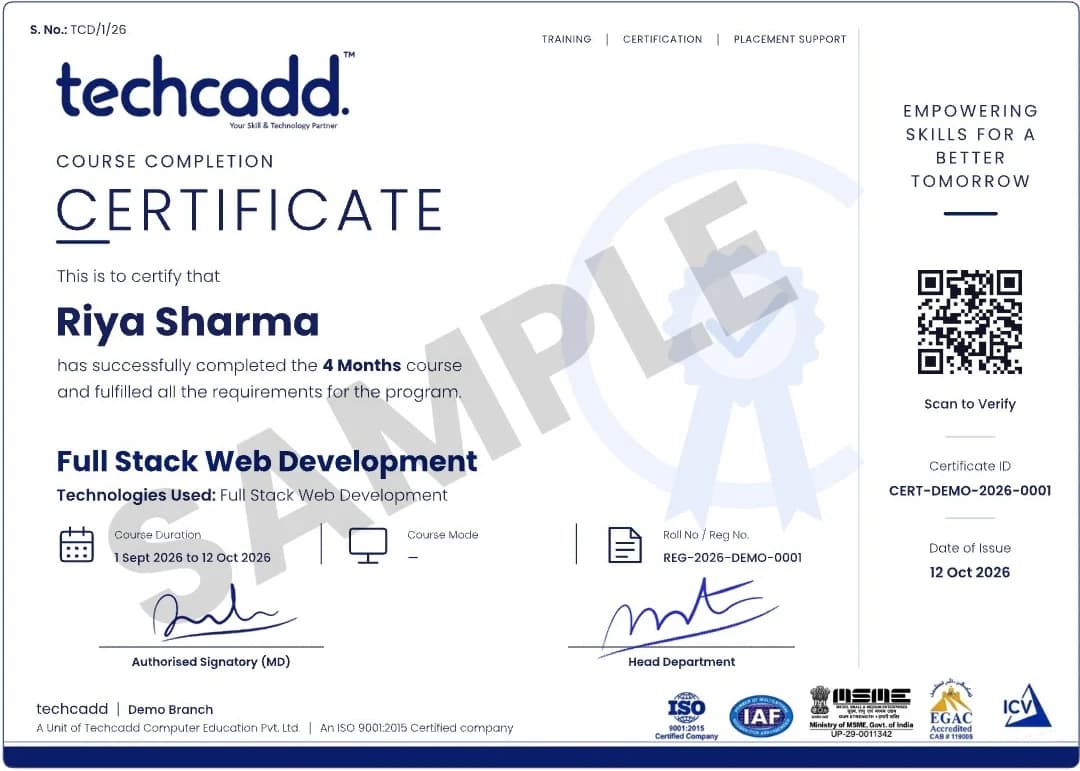
Issued on finishing the programme, with a QR code and certificate ID anyone can verify.
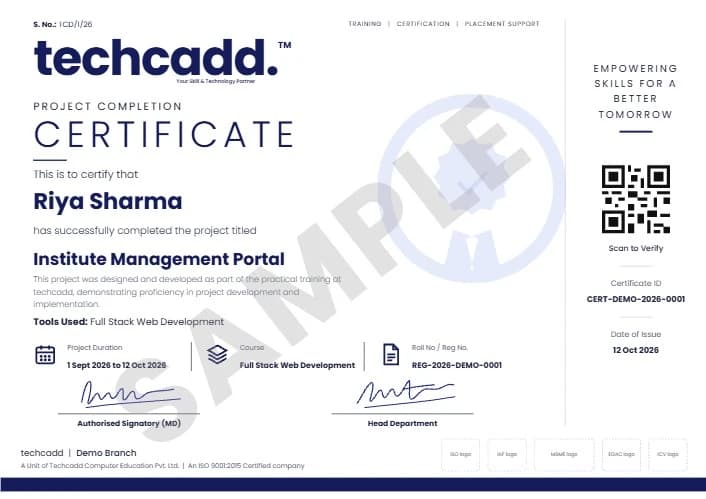
A separate certificate naming the live project you designed and built during training.
Project ideas
Each produces the same evidence: a project brief, dataset source and licence notes, a cleaning log, a notebook or SQL script, figures, a limitations section and a five-minute presentation.
Product-level demand, seasonality, missing transactions and inventory turnover — with a dashboard and a note on where forecasts would be unreliable.
An anonymised or public education dataset, with a discussion of fairness and why predictive scores should not label individuals.
Define churn carefully, compare simple baselines with complex models, and weigh precision, recall and business trade-offs.
Public measurements, sensor gaps and temporal patterns — distinguishing correlation from causation.
Demand variation, peaks and reporting biases in permitted public data, without claiming precise real-world travel outcomes.
Clean text, compare keyword baselines and simple classifiers, and discuss language, sarcasm and domain shift.
An open dataset, class imbalance, and the ethics of profiling and privacy.
Time-aware train/test splits, naive baselines, changing seasons and unexpected events.
Rare-event metrics and false positives on public or synthetic data — a classroom prototype, not a production system.
How to apply
Seven steps, so you know what is confirmed in writing before you pay and what is assessed at the end.
Share your programme, semester, experience, preferred schedule and academic deadlines. Ask for the latest written syllabus.
Confirm what your college requires. A generic certificate may not satisfy an institution-specific requirement.
Work out whether you need a Python foundation or can start directly with analysis and statistics.
Get duration, weekly hours, delivery mode, fees, refund policy, mentoring, project arrangements and documents in writing.
Set up your tools, review data ethics, and understand the evaluation criteria and project timeline.
Exercises, code reviews, checkpoints and project milestones, each with documented feedback.
Submit a reproducible capstone and presentation, complete any assessments and request applicable documents.
University & college requirements
Get a checklist from your college before paying, then confirm in writing which of these techcadd can supply and in what wording.
B.Tech sixth- and eighth-semester students: confirm the semester window, coordinator, accepted training type, report template, attendance rules and viva. Never submit copied notebooks or invented workplace experience — the strongest report describes your own methods and difficulties.
Duration, batches & weekly commitment
Calendar months and training hours are not the same. Ask for the start and end dates, holidays, contact hours and project-review schedule.
Check examinations, practicals, university holidays and travel time. Any flexible timing must be confirmed for your chosen batch.
Offline sessions help peer collaboration and lab support; online improves access. Ask which formats the Jalandhar centre currently runs.
Guided sessions are not enough on their own. Budget regular practice time each week on top of them.
Eligibility, fees & what is included
Ask for the current written fee and what it includes. If a training fee applies, it is not a “free internship.”
Python experience helps, but introductory tracks may take beginners. Basic algebra, probability and comfort with graphs are useful — along with curiosity, regular practice and a willingness to debug.
Career scope
Entry-level roles you might work towards — hiring requirements vary by employer, project quality, communication and prior experience:
A six-month programme is a foundation, not a guarantee of job readiness or placement.
Use SQL, spreadsheets, Python and visualisation to answer operational questions, design metrics and dashboards, and check definitions.
Junior data scientists and ML associates support features, experiments, evaluation and model documentation under supervision.
Investigate missing, duplicated or inconsistent records, and transform and document data models — analytics engineering needs stronger SQL.
Why students consider techcadd
Ask to see the full module plan, sample assignments, trainer credentials, the assessment rubric and anonymised examples of genuine student work.
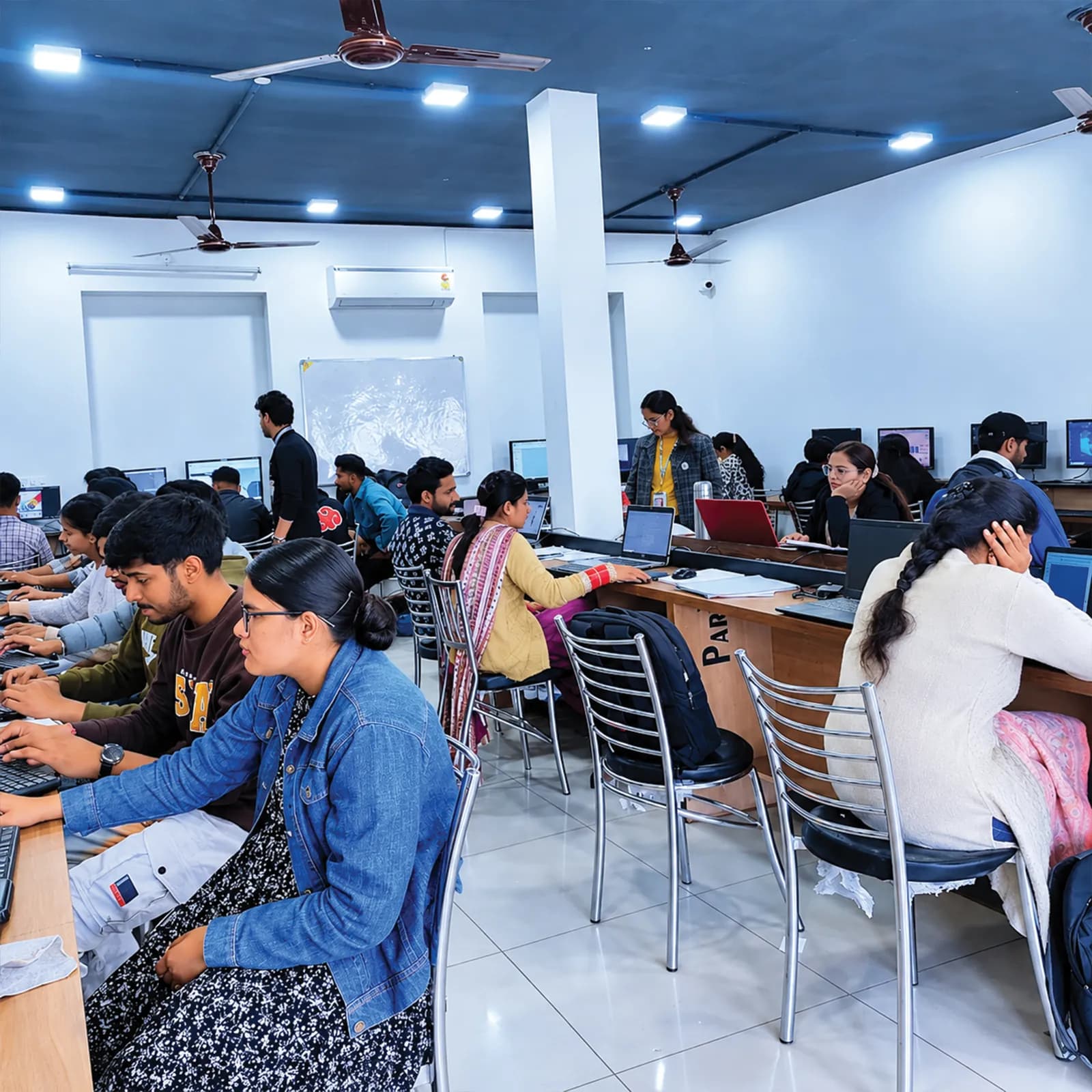
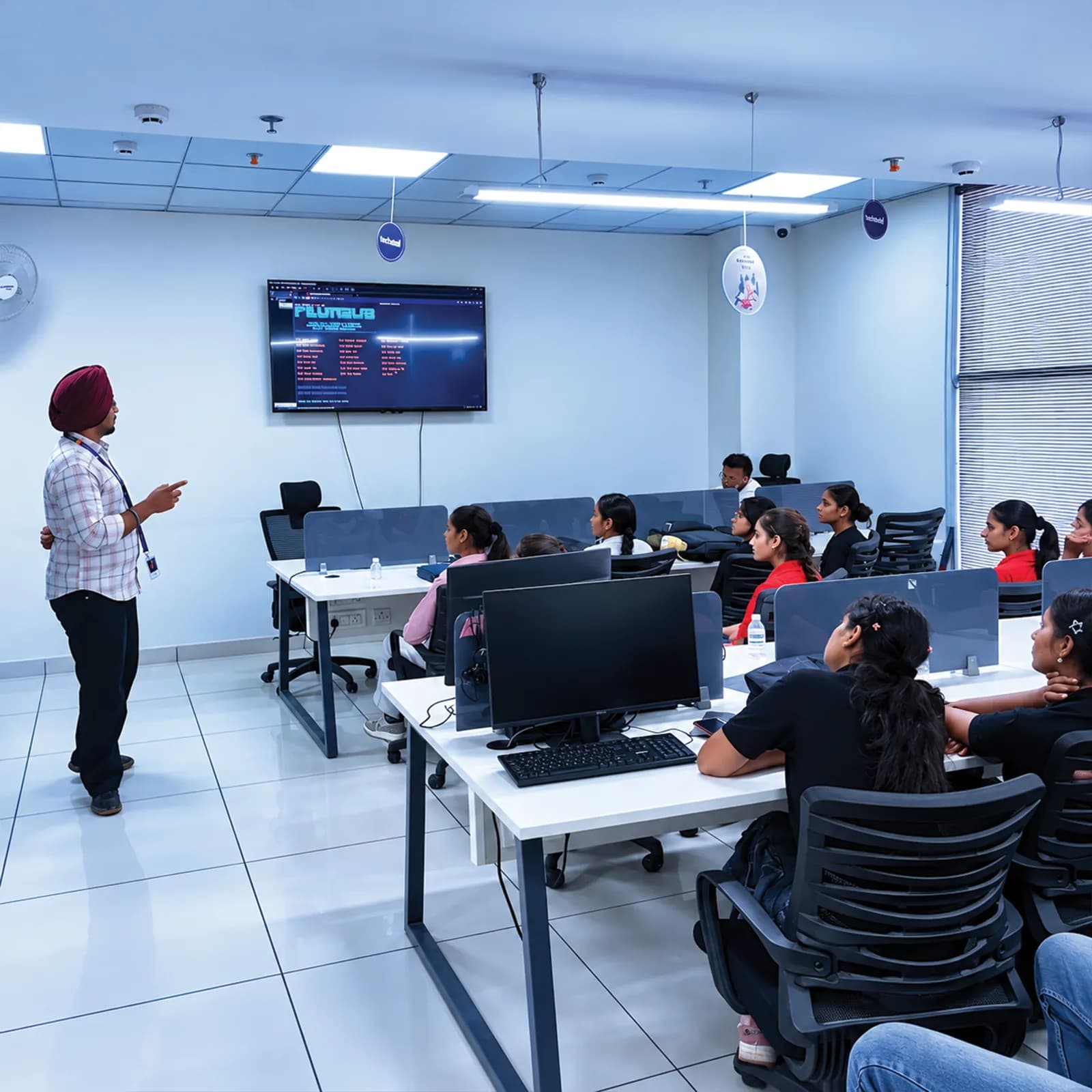
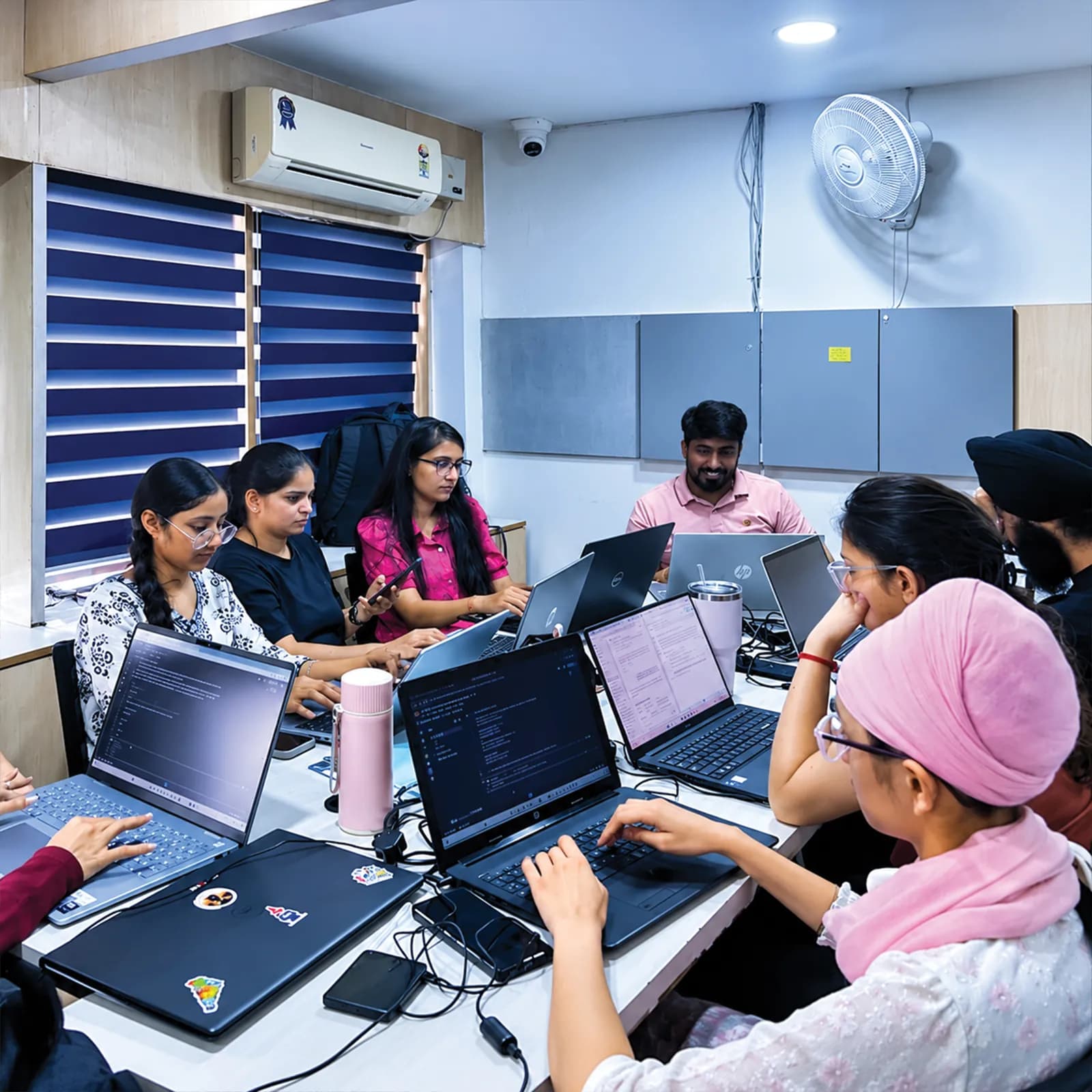
Compare how accessible the centre is, its timetable, its project review process and the instruction on offer.
A counsellor should explain training versus internship, realistic prerequisites and the weekly workload.
Fees, documents, project expectations and how outcomes are assessed — explained before admission.
Visit the centre, meet the trainers and look at the labs before you confirm a batch.
Students travel in from neighbouring towns for practical training. Check the batch location and your travel time against your college timetable before you join.
techcadd Jalandhar — 2nd Floor, Crystal Plaza, SCS 78, Opposite PIMS Hospital, Jalandhar, Punjab 144001Frequently asked questions
Answers can differ by degree, semester and batch — confirm any academic requirement directly with your institution.
A semester-length programme focused on applied data work. Ask whether the specific offering is employer-supervised internship work or structured project-based industrial training.
B.Tech CSE students are a common audience. Check the prerequisites, university rules, programme format and available batch before enrolling.
A beginner-friendly pathway can be, if it teaches Python, SQL, statistics and data handling step by step.
Basic Python helps, but entry requirements depend on the batch. Ask whether a foundation module is included.
Basic algebra, probability, descriptive statistics and comfort with graphs are useful; more advanced topics can be learned progressively.
Usually as one module, alongside SQL, statistics, data cleaning, analysis and visualisation.
Analytics typically explains patterns and supports decisions; data science may add predictive modelling and experimentation. The fields overlap.
SQL is central to data science, and some tracks include dashboards or BI tools. Confirm the current tool list and how much hands-on database work is included.
Ask what “live” means: an actual client assignment, a simulated brief, a public dataset or an internal project. The distinction should be stated accurately.
Only your college or university can confirm whether a project meets its academic rules and approval process.
Ask for the exact certificate type, issuing organisation and conditions, whether it represents training or supervised work, and written confirmation of any letters and their wording.
Stipends depend on whether a genuine paid work placement is offered. Do not assume fee-based training includes one.
No. Evaluate the skills and support offered; hiring depends on your projects, communication, experience and each employer's criteria.
Fees can change. Request the current written fee schedule, inclusions and refund terms from techcadd.
You can build solid foundations and complete focused projects; advanced expertise takes longer practice.
A concise problem statement, dataset provenance, notebooks or scripts, analysis, evaluation, limitations and a clear README.
Ask about lab access and device requirements. Substantial independent practice may need a suitable computer.
Yes, if the programme supports their starting level. Data analysis applies well to quality, sensors, energy and operations problems.
Send an enquiry from this page or call +91 98881 22254, share your degree and semester, and request the latest syllabus, fee and documentation details.
techcadd Jalandhar is at 2nd Floor, Crystal Plaza, SCS 78, Opposite PIMS Hospital, Jalandhar, Punjab 144001. Visit for a counselling discussion before you confirm a batch.
Apply
Looking for a 6 months data science internship, a final-semester industrial training option or a project-focused pathway? Share your academic requirements, current skill level and preferred schedule, and request the curriculum, project structure, fees and available documents before you decide.