Full stack is not just copying tutorials
An app that works on one laptop can still break with real input, slow networks or a second user. The goal is engineering judgement — structure, validation, security and debugging — not memorised code.
Make your final semester count. Build complete web applications with MongoDB, Express, React and Node.js — responsive interfaces, REST APIs, authentication, testing and deployment through a structured six-month pathway — and check whether the format fits your university requirements.
Ask for the current fee, format, schedule, project supervision and certificate details in writing before enrolling.
Overview
MERN is a JavaScript stack: MongoDB stores the data, Express and Node.js run the server and API, and React builds the interface people use. Six months gives you time to practise the whole process: plan a feature, design the data, write and test the API, build the screens, secure the login, deploy the app and explain the decisions you made.
A workplace internship usually includes supervised responsibilities in an organisation; industrial training centres on instruction, lab work and guided projects. Both can be valuable, but they are not interchangeable — ask who supervises the work, what deliverables are required and which documents your university accepts.
An app that works on one laptop can still break with real input, slow networks or a second user. The goal is engineering judgement — structure, validation, security and debugging — not memorised code.
React decides what the user sees; the API decides what data is allowed in and out. Understanding both sides is what makes you useful on a small team.
Jalandhar students coordinate lab sessions with semester classes, examinations and final presentations. A nearby centre makes code reviews and mentoring easier to reach.
Compare mentor availability, project depth, code review, assessment, timetable and clear administrative processes before choosing any six-month programme.
Who can apply
Whatever your degree, check eligibility, assessment standards, attendance rules, laptop or lab access and university permission before enrolling.
Connect data structures, DBMS, networking and software engineering subjects with API design, database modelling and a deployed, version-controlled application.
Build from web and programming basics toward JavaScript, React interfaces, Node.js APIs and portfolio-ready full stack projects.
Explore architecture, authentication, testing, performance, documentation and team workflows on a larger application.
Apply programming fundamentals to working web products, with emphasis on clean code, data validation and explaining your design.
Students from other streams can learn the stack, but expect to spend extra time on JavaScript fundamentals before React and Node.js.
Eligibility depends on starting skills, available time and academic requirements rather than a one-size-fits-all promise.
Why a six-month MERN path?
Asynchronous JavaScript, React state, API design and authentication each take repeated practice before they feel natural. A semester gives each of them room.
A semester-long plan leaves time for debugging, refactoring and code review instead of rushing through demos.
A GitHub repository with a readable history, API documentation, tests, a deployed demo and a short write-up of the decisions behind it.
Branches, pull requests, issue tracking and code review are how developers work together. Practising them early makes a first job less of a shock.
Compare front-end, back-end, full stack and support engineering roles before committing to a specialisation.
A structured project helps you practise reporting and viva presentations — but acceptance as compulsory industrial training depends on your college or university.
Tools & technologies
Taught in the order a developer meets them: the web basics first, then React on the front end, then Node.js, Express and MongoDB on the back end, then testing and deployment. Git runs through every module. Ask for the module-by-module list for your batch.
Semantic markup, forms, accessibility basics, Flexbox, Grid and responsive layouts, with Tailwind CSS for faster styling.
Functions, arrays and objects, the DOM, ES modules, promises and async/await — the language the whole stack runs on.
Types for props, API responses and models, so mistakes surface while you write code rather than in the browser.
Components, props, state, hooks, forms, routing and data fetching, set up with Vite for a fast development loop.
Shared application state with Redux Toolkit — slices, async requests and when a simpler approach is enough.
Servers, routing, middleware, error handling, environment variables and a clean folder structure for a REST API.
Documents and collections, schema design with Mongoose, queries, indexes, relationships and aggregation basics.
Password hashing, JWT-based login, protected routes, roles, input validation and common web vulnerabilities to avoid.
Exercising endpoints in Postman, writing unit and API tests in Jest, and documenting requests and responses.
Branches, commits, pull requests and code review, then deploying the front end and API to services such as Vercel and Render.
Syllabus & learning roadmap
Each month ends in a deliverable. A typical week holds one concept lesson, one guided lab, one independent exercise and one code review — confirm contact hours and mentor arrangements for your batch.
Semantic HTML, forms, accessibility basics, CSS layout with Flexbox and Grid, responsive design and Tailwind CSS, with every exercise committed to Git and GitHub. Deliverable: a responsive multi-page site in a public repository.
Core JavaScript, the DOM, events, modules, fetch, promises and async/await, then TypeScript basics for safer code. Deliverable: an interactive browser app that reads data from a public API.
Components, props, state, hooks, forms, routing and data fetching with Vite, then shared state with Redux Toolkit. Deliverable: a multi-screen React app with routing and managed state.
Express servers, REST API design, middleware and error handling, MongoDB with Mongoose models, validation and queries, tested in Postman. Deliverable: a documented REST API with a MongoDB database.
Connect React to your API, add JWT authentication, protected routes, roles and file uploads, write Jest tests and review the app for common vulnerabilities. Deliverable: a working full stack project draft with tests and an API reference.
Refine the project, handle edge cases, deploy the front end and API to services such as Vercel and Render, and present it. Practise explaining React state, REST, MongoDB design and authentication. Deliverable: deployed app, repository, report and demonstration.
Course vs internship vs industrial training
Engineering colleges use “industrial training”, “six-month training” and “internship” differently. Your university handbook, department coordinator and academic policy decide what counts — not the programme title.
Real-world MERN projects
Certificates & deliverables
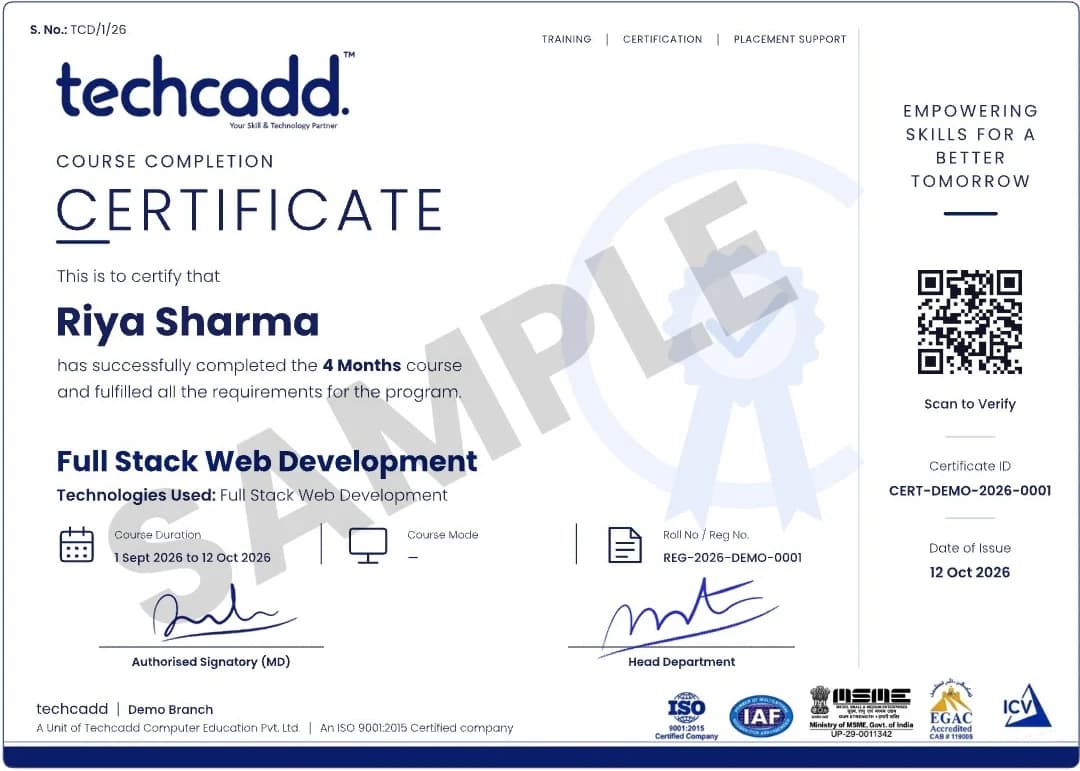
Issued on finishing the programme, with a QR code and certificate ID anyone can verify.
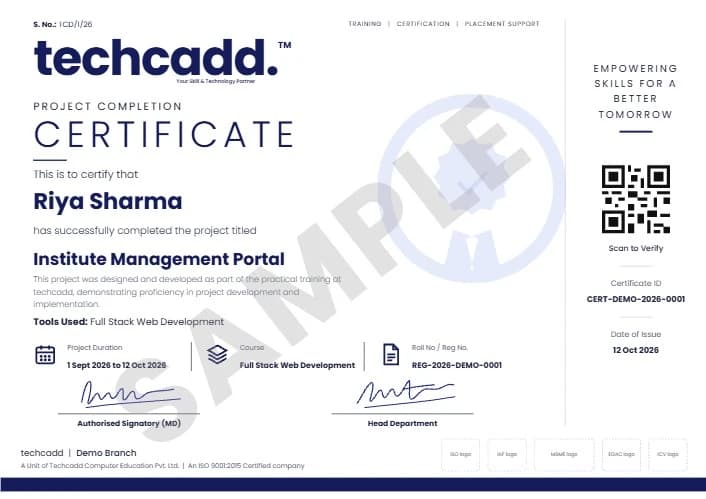
A separate certificate naming the live project you designed and built during training.
Project ideas
Each follows the same method: identify the users and what they need to do, write the features and data model first, build and test the API, then the interface, add authentication, deploy it, and finish with a demo, a test checklist and a short presentation.
Boards, tasks, due dates and assignees, with user accounts and role-based access.
Product catalogue, cart, order history and an admin panel, using a test payment mode only.
Event listings, registrations and an organiser dashboard, built on synthetic student data.
Posts, comments, tags, image uploads and editor permissions.
Rooms, direct messages and online status, with message history stored in MongoDB.
Listings, search and filters, applications and separate employer and student roles.
Books, members, issue and return records, due-date reminders and simple reports.
Categories, monthly budgets and charts, with data scoped to each signed-in user.
Available slots, bookings, cancellations and an admin calendar for a clinic or salon.
How to apply
Six steps, so you know what is confirmed in writing before you pay and what is assessed at the end.
Share your degree, semester, preferred start month and whether your university requires a specific type of placement.
Review prerequisites, curriculum, format, hours, fees, project expectations and documentation.
Receive current programme details, policies and any required approvals before registration.
Begin with HTML, CSS, JavaScript and Git, then React and Node.js, with regular exercises and code reviews.
Select a suitable application idea, plan checkpoints and receive structured feedback on your code.
Demonstrate the deployed app, explain your code and submit the report and portfolio materials.
University & college requirements
Ask your training and placement cell or department coordinator before paying, keep copies of written approvals, and ask techcadd to confirm which documents it can genuinely issue.
Requirements differ between universities and even departments. A practical checklist includes the department handbook, approval email, project scope, timetable, attendance method, evaluation rubric and final submission date. Do not assume an institute certificate alone satisfies a university internship requirement.
Duration, semester planning & batches
Six months can align with a final-semester calendar, but confirm the actual dates, weekly hours and holidays for your batch.
Plan around examinations, faculty reviews, report submission and commuting time.
Ask for the current intake month, batch format and seat availability rather than relying on an “admissions open” banner.
Guided labs are not enough on their own. Budget regular time each week to write code, debug and push to GitHub.
Eligibility, fees & what is included
Ask for the real programme fee in writing and what it includes. Compare total cost and the quality of supervision, not a headline discount.
Basic computer skills help; no prior coding is assumed for the HTML and CSS modules. Some programming practice makes the JavaScript, React and Node.js months easier, and the level needed depends on the batch and your project.
Career scope
Entry-level roles you might work towards — job titles, hiring criteria and salaries vary by employer:
A six-month programme does not guarantee employment; a credible portfolio and continuing practice support future applications.
Build accessible, responsive React interfaces, manage state and connect screens to APIs.
Design REST APIs and database schemas, handle authentication and keep the server secure and reliable.
Own a feature end to end on a small team — from the data model to the deployed screen — and debug across both sides.
Why students consider techcadd
Ask about instructor experience, class size, practical lab time, code review, project feedback and mentoring — and ask to see sample projects and student repositories published with permission.

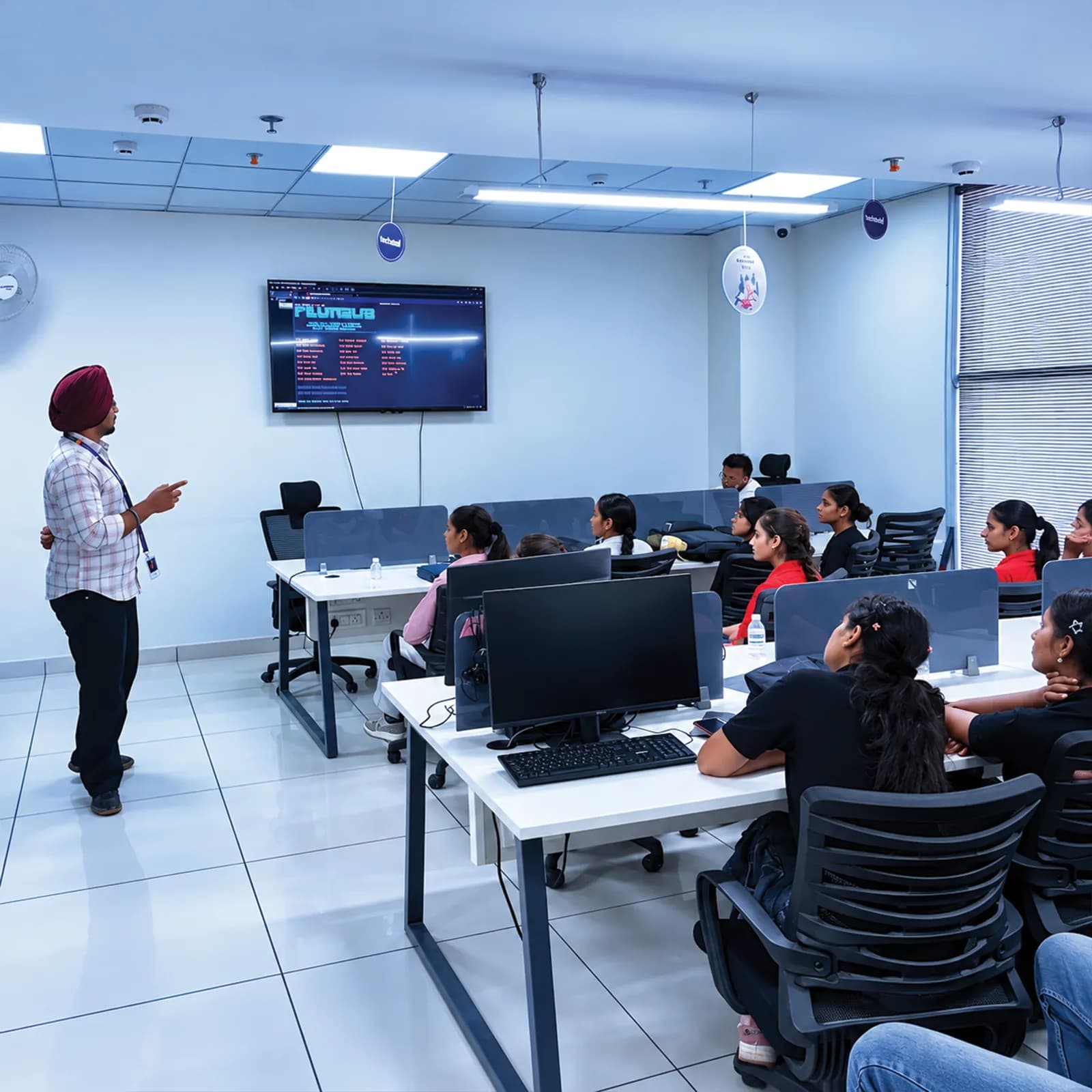
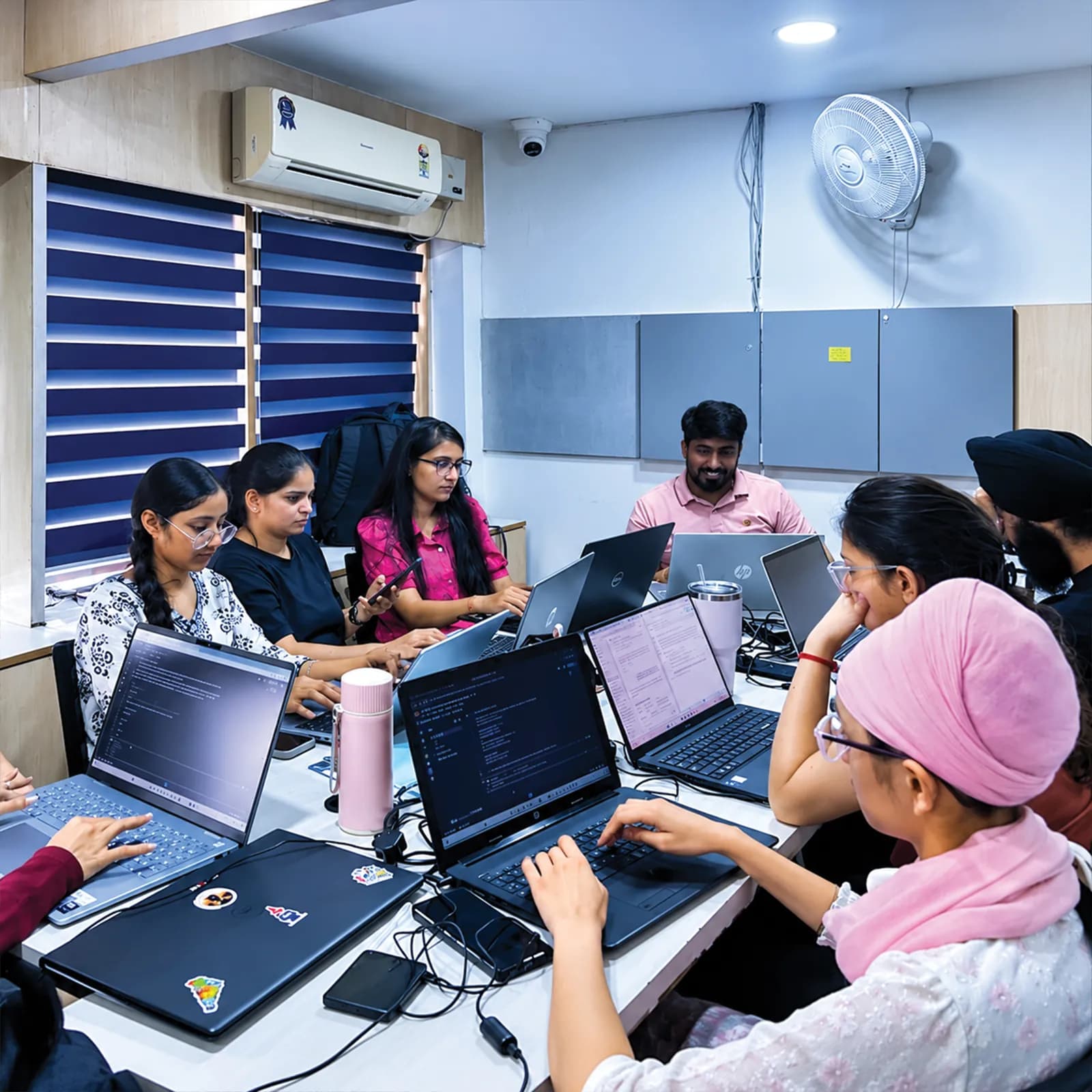
A deliverable at the end of every month, so you can see your progress and what is assessed.
Hands-on lab time in React, Node.js, Express, MongoDB, Git and modern deployment tools.
Fees, documents, project expectations and how outcomes are assessed — explained before admission.
Visit the centre, meet the trainers and look at the labs before you confirm a batch.
The centre is at 2nd Floor, Crystal Plaza, SCS 78, Opposite PIMS Hospital, Jalandhar. Ask about the learning format, counselling hours and public transport before you join, and check your travel time against your college timetable.
techcadd Jalandhar — 2nd Floor, Crystal Plaza, SCS 78, Opposite PIMS Hospital, Jalandhar, Punjab 144001Frequently asked questions
Answers can differ by degree, semester and batch — confirm any academic requirement directly with your institution.
You can enquire about the current MERN stack programme at techcadd. Confirm whether it is a workplace internship or industrial training.
It may suit students who want applied web development, API and database practice, subject to university requirements.
BCA students can often start with HTML, CSS and JavaScript before React and Node.js. Confirm the entry requirements.
A full stack capstone can be appropriate if it meets the department's academic rules.
MongoDB, Express, React and Node.js — a database, a server framework, a front-end library and the runtime that ties them together, all using JavaScript.
HTML, CSS and Tailwind CSS, JavaScript and TypeScript, React with Redux and Vite, Node.js and Express, MongoDB, JWT authentication, Postman, Jest, Git and GitHub, and deployment to services such as Vercel and Render. Ask for the module-by-module list for your batch.
Both use MongoDB, Express and Node.js. MERN uses React for the front end; MEAN uses Angular.
Basic computer skills help. The programming level needed depends on the batch and project complexity, and the first months start from the basics.
TypeScript is introduced after core JavaScript. Ask how far your batch takes it in the React and Node.js modules.
A set of URLs your server exposes so the front end can read and change data using standard HTTP methods such as GET, POST, PUT and DELETE.
A JSON Web Token is a signed token the server issues after login, which the app sends with later requests to prove who the user is.
The capstone month covers deploying the front end and API to services such as Vercel and Render. Free tiers have limits, so ask what your batch uses.
Only if actual supervised client work is available and appropriately authorised. Ask for written details.
Confirm the exact document issued, the conditions, and whether it reflects actual work or training.
Only your college or university can confirm recognition for its academic requirements.
Request the current fee sheet and ask which services and assessment charges are included.
No. Evaluate any career support separately, and don't treat training as a job guarantee.
Ask about lab availability and the recommended specification for independent practice; most of the tools are free to install.
Send an enquiry from this page or call +91 98881 22254, share your degree and semester, and request the verified syllabus and joining details.
techcadd Jalandhar is at 2nd Floor, Crystal Plaza, SCS 78, Opposite PIMS Hospital, Jalandhar, Punjab 144001. Visit for a counselling discussion before you confirm a batch.
Apply
Looking for a 6 months MERN stack internship in Jalandhar, full stack industrial training or a final-semester web development project pathway? Tell us your degree, university requirements, preferred start month and learning goals, and request the syllabus, fee structure, project evaluation process and documentation before you enrol.