AI-Powered MERN Stack Development Certificate Program in Jalandhar
Master MongoDB, Express.js, React.js and Node.js through practical, project-based learning. Build full-stack web applications, REST APIs, authentication systems, real-time platforms, deployment pipelines and AI-integrated applications.
- Live client projects
- Practitioner trainers
- Placement support
- Certificate + internship
- Duration
- 3, 6 or 9 Months
- Syllabus
- 20 Modules, 10 Projects
- Mode
- Classroom, Weekend & 1-on-1
- Includes
- Internship Letter
- Students trained
- 25,000+Students trainedsince 2016
- Google rating
- 4.9★Google rating556+ reviews
- Practical training
- 100%Practical traininglive client work
Course overview
The AI-Powered MERN Stack Development Certificate Programme is designed to take learners from programming fundamentals to production-grade application development. Students learn JavaScript, frontend development with React, backend engineering using Node.js and Express, database design with MongoDB, and deployment on modern cloud platforms. The programme follows a Learn → Build → Test → Deploy → Scale workflow and focuses on real-world applications rather than theoretical exercises.
MERN is one of the most widely adopted full-stack JavaScript ecosystems. Organisations use React for modern interfaces, Node.js for scalable backends, Express for APIs and MongoDB for flexible data storage — which means one primary language, JavaScript, carries you from the browser to the database and out to a live deployment.
What you get: practical project-based training, live application development, Git and GitHub workflow training, API development and testing, authentication and authorisation systems, database design and management, cloud deployment and CI/CD concepts, portfolio development, internship-oriented projects, placement assistance and an industry-recognised certification.
One language,the whole application
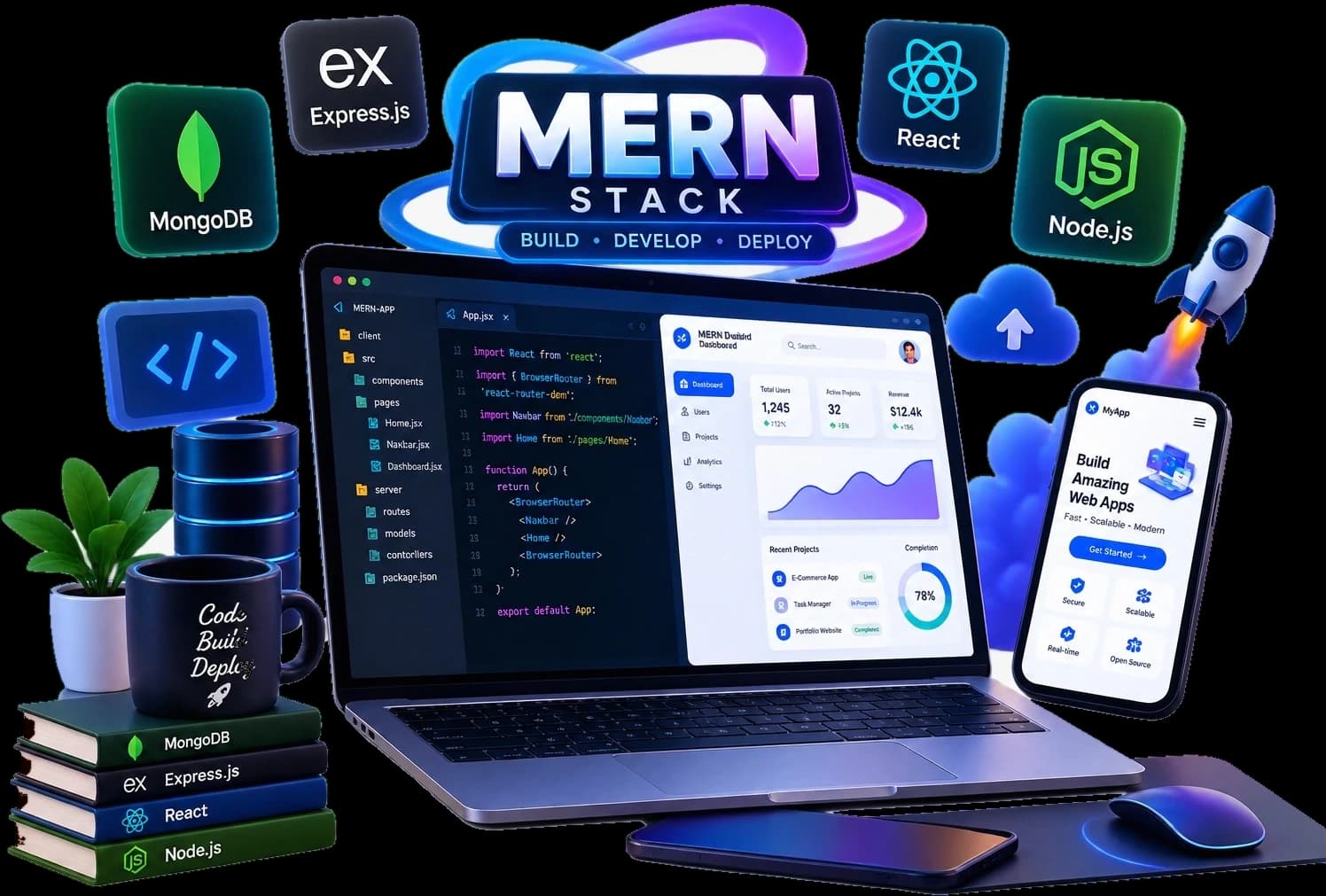
MERN is not a single tool but a set of four that work together to build a complete web application: MongoDB stores the data, Express.js and Node.js run the server and its APIs, and React builds the screens people click on. All four use JavaScript, so one language carries you from the browser to the database.
Think of a restaurant. React is the dining hall and menu the customer sees, Express and Node are the kitchen that takes orders and cooks them, and MongoDB is the storeroom where everything is kept. A MERN developer can work in all three rooms, which is why small companies and startups like hiring one. Each field below shows where these skills are used and how much of it this course actually covers.
- Job-ready focus5 fields
- The course trains you for entry-level work in this field.
- Strong foundation
- You learn the base skills here; one specialised course makes you job-ready.
- Introduced3 fields
- You will use it in the course, but it is not a specialisation.
- Not covered
- Not part of this course; available as a separate techcadd course.
What this course makes you job-ready for
Job-ready focusFront-End Development (React)
Building the part of a website or web app that people see and use: pages, buttons, forms, menus, and the way they respond when you click or type.
The product listing, filters and cart on an online clothing store, updating instantly without the whole page reloading.
- MERN Stack tools used
- HTML5CSS3JavaScriptReactReact RouterRedux ToolkitVite
- Job roles
- Frontend DeveloperReact DeveloperUI Developer
Modules 01–04 (JavaScript, HTML/CSS, React, React Router and Context), plus Redux Toolkit (Module 11) on the 6- and 9-month tracks. Projects: JavaScript Task Manager, Responsive Business Website, React Product Catalog.
Backend & API Development (Node.js, Express)
The behind-the-scenes logic of an app: checking logins, saving and fetching data, and sending it to the website or mobile app through an API.
When you book a doctor's appointment online, the backend checks the slot is free, saves your booking and sends a confirmation.
- MERN Stack tools used
- Node.jsExpress.jsREST APIsJWTPassport.jsPostman
- Job roles
- Node.js DeveloperBackend Developer (junior)API Developer
Modules 05 and 07 (Express, REST APIs, JWT, role-based access), with OAuth, advanced authentication and API documentation (Modules 12–14) on the 6- and 9-month tracks. Projects: Authentication System, Database-Driven API.
Databases (MongoDB)
Designing how an application's data is stored and fetched so it stays correct and fast as it grows.
Storing a coaching institute's students, batches and fee records so a report of pending fees can be pulled in a second.
- MERN Stack tools used
- MongoDBMongooseMongoDB AtlasMongoDB Compass
- Job roles
- MERN DeveloperBackend Developer (junior)
Module 06 (schemas, validation, indexing, database design) and MongoDB Atlas in Module 09; the aggregation pipeline (Module 15) on the 9-month track. Project: Database-Driven API.
Full-Stack Web Applications
Building a complete working product end to end: the screens, the server, the database and the live deployment, connected together.
A booking system for a Jalandhar salon where customers pick a slot online, the owner sees bookings on a dashboard and no two people get the same time.
- MERN Stack tools used
- ReactExpress.jsNode.jsMongoDBAxiosGitGitHubVercelRender
- Job roles
- MERN Stack DeveloperFull-Stack DeveloperWeb Application DeveloperFreelance Developer
Modules 08–10 (MERN integration, deployment, Practitioner Capstone) on every track. Projects: Full MERN CRUD Application, E-Commerce Platform, Appointment Booking System, Final Full-Stack Capstone Application.
Real-Time Apps & Progressive Web Apps
Apps that update live without refreshing (chat, notifications, live tracking), and websites that can be installed on a phone and work offline.
A chat window on a support website, or a delivery-status page that updates the moment the rider moves.
- MERN Stack tools used
- Socket.ioService WorkersWeb App Manifest
- Job roles
- MERN DeveloperFull-Stack Developer (product companies)
9-month Expert track only: Progressive Web Apps (Module 17) and Socket.io (Module 18). Project: Real-Time Chat Application. Not part of the 3- or 6-month tracks.
What this course introduces
IntroducedTesting & Performance
Writing automated tests so code keeps working after changes, and measuring and fixing slow pages or queries.
A test suite that checks the login API still rejects a wrong password every time someone changes the code.
- MERN Stack tools used
- JestSupertest
- Job roles
- Full-Stack DeveloperQA Automation Engineer (with more study)
9-month Expert track: Testing with Jest & Supertest (Module 16) and Performance Optimization (Module 19). This is testing as a developer does it, not a dedicated QA or software-testing specialisation.
Deployment, DevOps & Cloud
Getting an application from a laptop onto the internet and keeping it running reliably, often with automated build-and-release pipelines.
Every time a developer pushes code to GitHub, the site is tested and published automatically.
- MERN Stack tools used
- VercelRenderRailwayMongoDB AtlasGitHubCI/CD
- Job roles
- DevOps EngineerCloud Engineer (with a further course)
Module 09 (Vercel, Render, MongoDB Atlas, production environments) on every track; CI/CD concepts on the 9-month track. Servers, containers and cloud infrastructure are not covered; see DevOps Engineering or AWS Cloud.
AI-Powered Applications
Adding AI features such as chatbots, smart search or text generation into a web app by connecting it to an AI model.
A help chatbot on a college website that answers admission questions from the prospectus.
- MERN Stack tools used
- AI model APIsChatGPTGitHub Copilot
- Job roles
- AI Application Developer (with Generative AI course)
AI coding assistants (ChatGPT, GitHub Copilot) are part of the daily workflow, and a MERN app can call an AI API like any other API. Building AI systems in depth (prompting, RAG, agents) is taught in techcadd's Generative AI course.
Clearing up common confusions
Is a front-end developer the same as a web designer?
No. A designer decides how a page should look (layout, colours, user flow), usually in a design tool such as Figma. A front-end developer turns that design into working code. This course trains you to build interfaces in React; it does not teach visual or UX design. For that, see techcadd's UI/UX Design course.
Will I learn SQL / MySQL here?
No. MERN uses MongoDB, a document (NoSQL) database. Many company jobs also ask for SQL databases such as MySQL or PostgreSQL; the database ideas you learn here carry over, but SQL itself is taught in other techcadd courses such as PHP Full Stack and Python.
What does “AI-Powered” in the course name mean?
Mainly that you learn to develop the way working developers now do: using AI assistants to write, explain and debug code, and checking where they get things wrong. It does not mean you will train AI models. That is a separate field, covered in techcadd's AI and Generative AI courses.
MERN Stack is also used in…
Mobile apps (React Native builds phone apps with React), desktop apps (Electron), serverless cloud functions and large enterprise dashboards. These are not part of this course, but the JavaScript and React you learn here are the starting point for all of them.
At a glance: what this course covers
| Field | Coverage in this course | Where you learn it | Next step at techcadd |
|---|---|---|---|
| Front-end (React) | Job-ready focus | Modules 01–04, 11 | Ready to apply |
| Backend & APIs (Node, Express) | Job-ready focus | Modules 05, 07, 12–14 | Ready to apply |
| Databases (MongoDB) | Job-ready focus | Modules 06, 09, 15 | Ready to apply |
| Full-stack web apps | Job-ready focus | Modules 08–10, 20 | Ready to apply |
| Real-time apps & PWAs | Job-ready focus | Modules 17–18 (9-month track) | Choose the 9-month track |
| Testing & performance | Introduced | Modules 16, 19 (9-month track) | — |
| DevOps & cloud | Introduced | Module 09 | DevOps Engineering, AWS Cloud |
| AI-powered apps | Introduced | Throughout (AI assistants) | Generative AI course |
| UI/UX design | Not covered | — | UI/UX Design course |
| Native mobile apps | Not covered | — | Flutter or Kotlin course |
Which MERN Stack pathsuits you?
You do not need to choose a speciality before you join. Every track starts at Module 01 with the same JavaScript foundation, and most students discover whether they lean towards screens or servers while building projects. If you already have an idea, this guide helps:
| If you… | You will probably enjoy | Typical first job |
|---|---|---|
| Like seeing your work on screen and care how a page feels to use | Front-end development with React | Frontend / React Developer |
| Prefer logic, data and making things work behind the scenes | Backend and API development | Node.js / Backend Developer (junior) |
| Want to build a whole product on your own | Full-stack MERN | MERN Stack Developer |
| Want to freelance for local businesses or remote clients | Full-stack MERN with deployment | Freelance Web Developer |
| Are aiming at product companies or campus placements | Real-time apps, testing and performance (9-month track) | Full-Stack Developer, Software Engineer |
| Are curious about servers, automation and the cloud | Deployment, then DevOps | MERN Developer now, DevOps Engineer later |
| Are not sure yet | Start with this course | Decide with your trainer once you have built a few projects |
Industry-Ready Training in MERN Stack
- 100% practical, project-based learning
- AI tools integrated into every module
- Live client projects under trainer supervision
- Internship letter and placement support
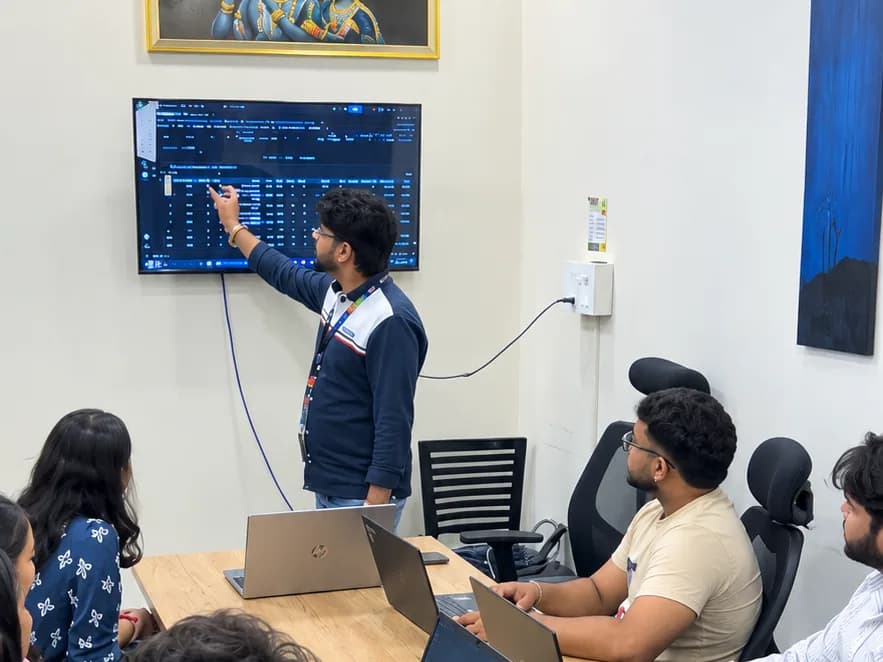
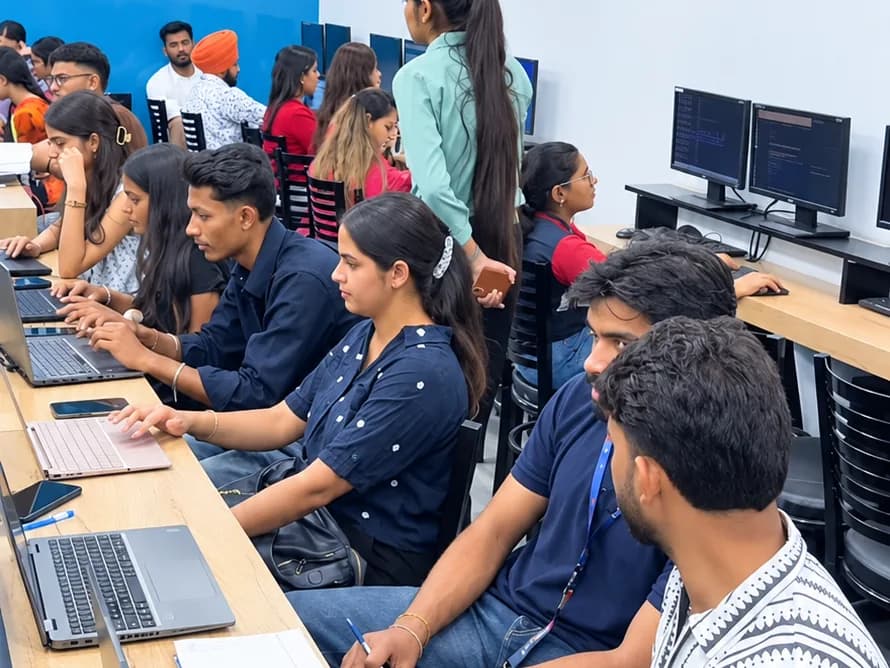
- Small batches with daily doubt clearing
What you will
actually build
Twenty modules on one ladder with three exit points. Months 1–3 cover the Practitioner core — JavaScript, HTML, CSS, React, Node, MongoDB and MERN basics — ending in a deployed CRUD application with authentication. Months 4–6 add state management with Redux Toolkit, OAuth, advanced authentication and documented APIs. Months 7–9 add testing, real-time systems with Socket.io, MongoDB aggregation, progressive web apps, performance optimisation and a large-scale capstone. Every major module ends in a practical deliverable that goes into your portfolio.
Programming Foundations & Modern JavaScript
- Variables, functions, arrays and objects
Core JavaScript building blocks before any framework — the syntax every React component and Express route in later modules is written in.
- Asynchronous JavaScript, promises and async/await
Promises and async/await replacing callback chains, essential once API calls and database queries start appearing in Module 5.
- DOM manipulation and debugging
Manipulating the DOM directly and debugging in browser devtools, the fundamentals React's virtual DOM abstracts away in Module 3.
- Git fundamentals
Git commits and branches from day one, the version control every GitHub and deployment module later builds on.
Useful for: Every field. JavaScript is the base of the whole MERN stack.
Ready to Become a Full-Stack Developer?
- Learn the skills, build real projects, create your portfolio and prepare for interviews — every major module ends in a practical deliverable that goes into it.
- MERN Developer roles in Punjab start around ₹20,000 – ₹35,000 a month for a fresher with a working portfolio.
Reviewed by mentors. Built for interviews.Who can dothis course
Students after 12th, graduates, final-year students, working professionals, freelancers, entrepreneurs and career switchers can all join, and the batch is deliberately mixed. No prior coding experience is required for the beginner track — every track opens at Module 01, and the one you pick decides how far you go, not where you start.
Students after 12th
Join from any stream. You start from fundamentals with no assumed knowledge, and most students run the 3 or 6-month track alongside a degree at a Jalandhar college using the weekday or weekend batch.
Graduates and final-year students
If you are finishing a BA, BBA, B.Com, BCA or B.Tech, this is the shortest route from degree to salary. The 9-month Expert track is the one to ask about here: testing, real-time systems and performance work are what product-company interviews probe, and the large-scale capstone gives you something to answer from.
Working professionals
The weekend batch exists for people already earning. Career switchers typically become interview-ready for MERN Developer roles within five to six months on the Professional track, without leaving their current job.
Business owners and freelancers
Owners join this programme to stop outsourcing work they cannot judge. Freelancers join it to bill clients beyond Punjab — a deployed application with authentication and an API behind it is the whole job, not a piece of it.
Career restarters
A gap on the CV counts for less than work you can point at. The programme starts at zero and finishes with a portfolio and a documented internship letter, which is what an interviewer asks about after a break.
Self-taught learners
If free videos left you with notes but nothing built, what changes here is a trainer who reviews what you produced this week and a deadline attached to every module.
One course.A mesh of real tools.
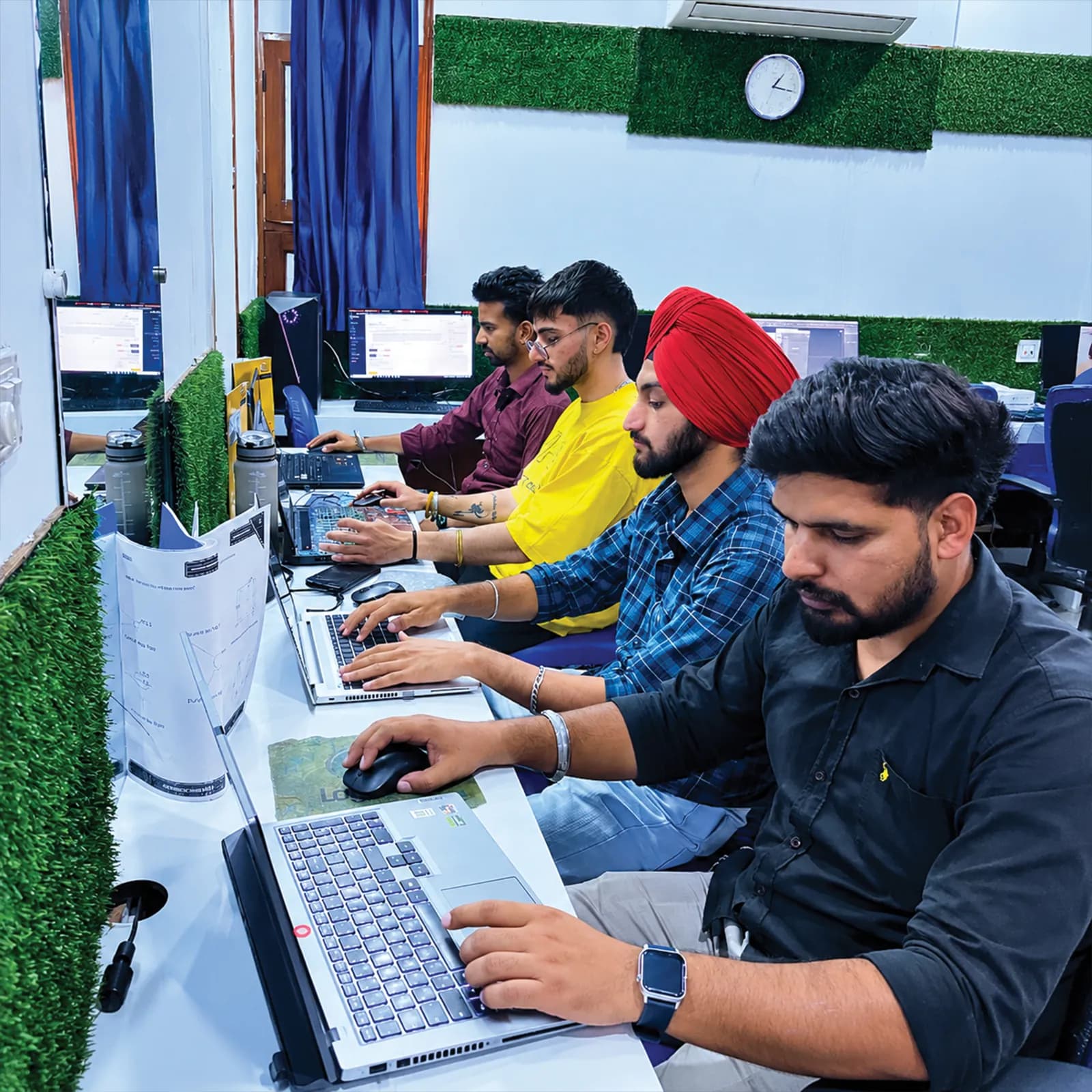
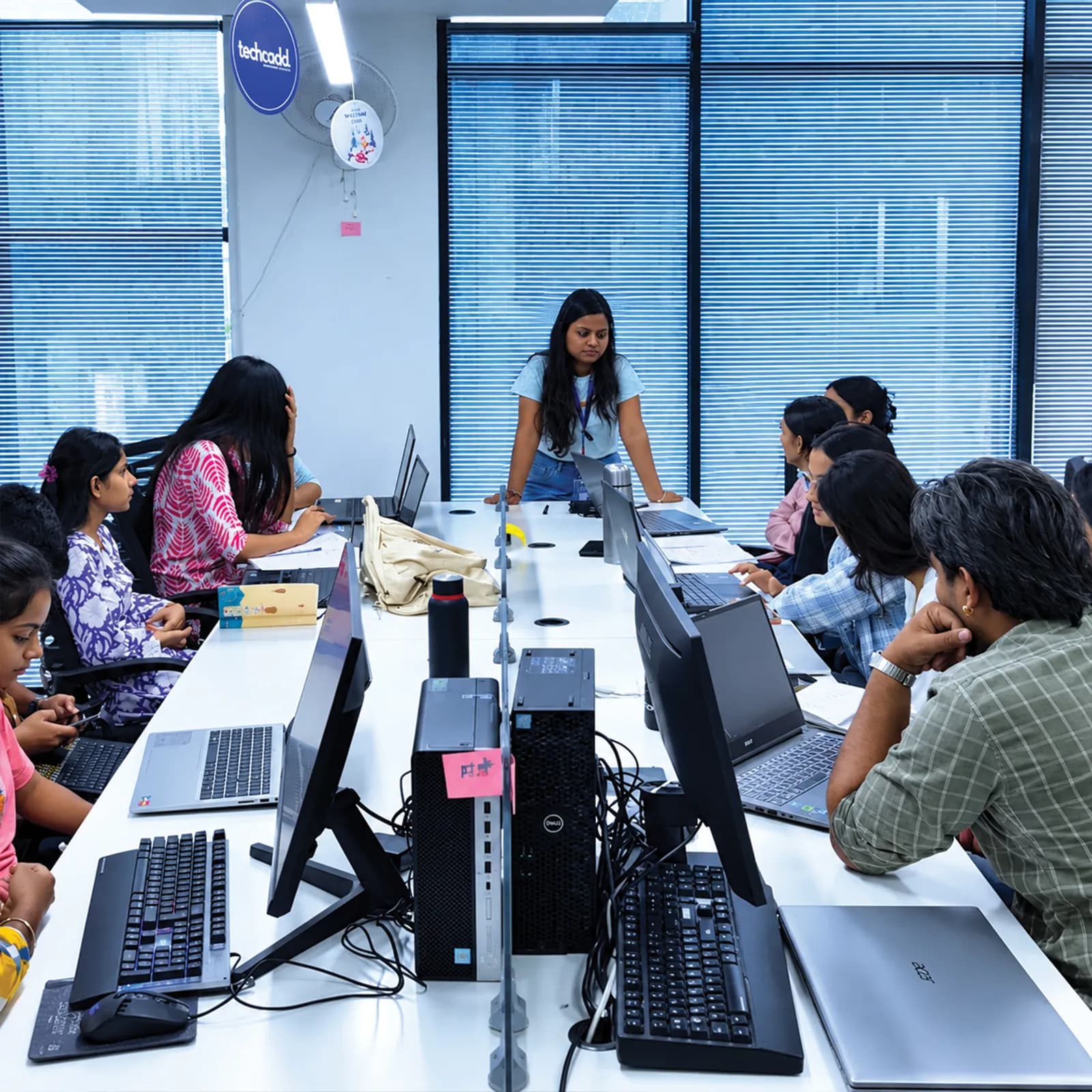
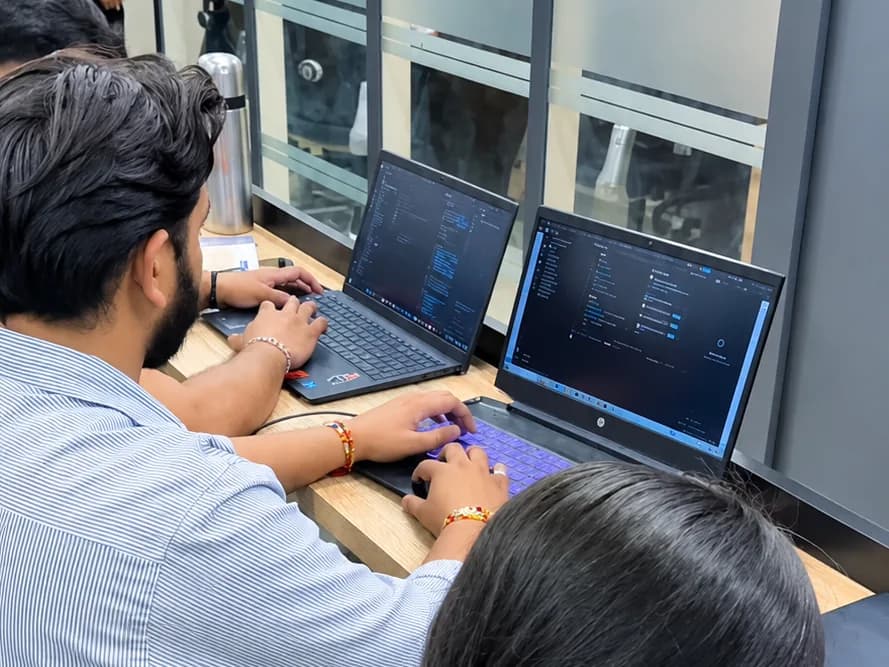
Everything below is installed on the lab machines and used on live client work, not shown once in a slide and forgotten.
 GitHub
- HTML5
- Gives every web page its structure
- CSS3
- Controls layout, colours and responsive design
- JavaScript
- The one language used across the whole MERN stack
- React
- Builds the screens and interactive parts of the app
- React Router
- Moves between pages inside a React app
- Redux Toolkit
- Manages app-wide data in larger React apps
- Vite
- Starts and builds React projects quickly
- Node.js
- Runs JavaScript on the server
- Express.js
- Framework for building the server and its APIs
- JWT
- Tokens that keep users logged in securely
- Passport.js
- Adds sign-in with Google or GitHub
- MongoDB Atlas
- MongoDB database hosted in the cloud
- Mongoose
- Defines data shapes and rules for MongoDB
- MongoDB Compass
- Visual tool to browse and query your data
- VS Code
- The code editor you work in daily
- Git
- Saves every version of your code
- GitHub
- Hosts your code and portfolio for employers to see
- Postman
- Tests APIs before the front end uses them
- Vercel
- Hosts the React front end on a live URL
- Render
- Hosts the Node/Express backend
- Railway
- Another simple platform for deploying apps
- Jest
- Runs automated tests on your code
- Supertest
- Tests Express API routes automatically
- Socket.io
- Powers live chat and real-time updates
- ChatGPT
- AI assistant for explaining and debugging code
- GitHub Copilot
- AI that suggests code as you type
Get Certified in
MERN Stack
Complete the course with a portfolio of live projects and receive an industry-recognised certificate, plus a documented internship letter accepted by Punjab universities.
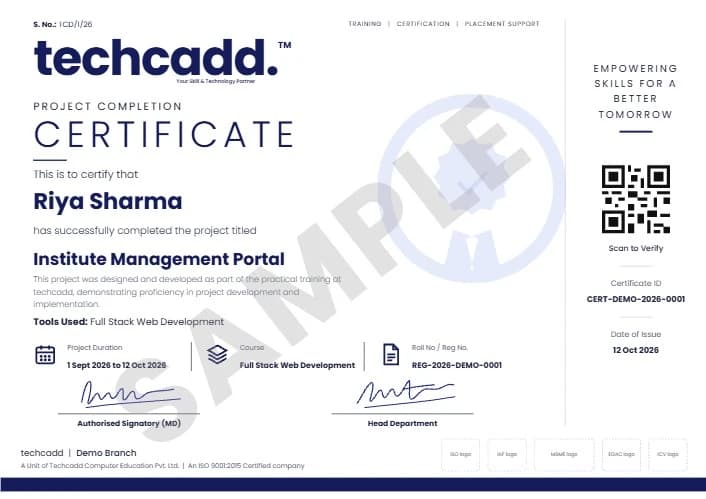
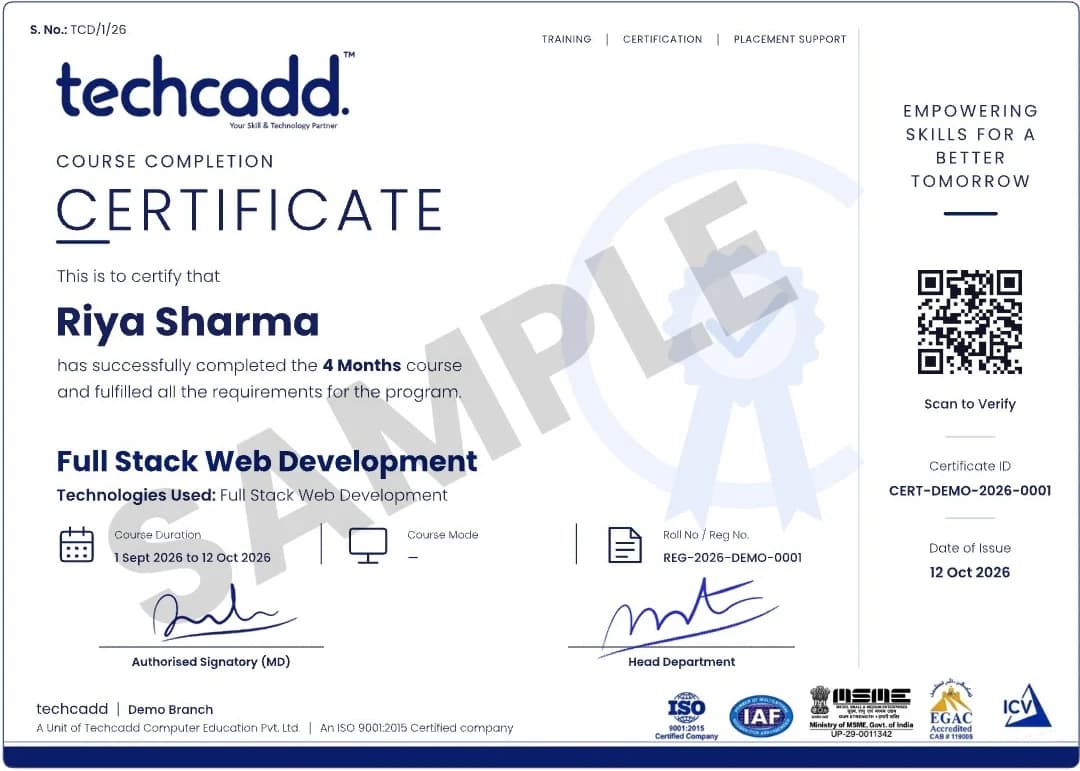
Two certificates on completion — the course certificate and a separate capstone project certificate.
Where this coursetakes you
The roles this opens, what they pay in Punjab and beyond, and who is hiring for them — the same figures our free Salary Estimator publishes, not a brochure number.
Full-Stack Developer
Builds and ships complete web applications, front end to back end.
- Starting package
- ₹2.4–4.5LPA
- After 2 years
- ₹5–9LPA
Indicative ranges for Full-Stack Developer roles, compiled from public job-market listings and drawn on the same scale in every market. Actual offers vary by employer, skillset and interview performance — Punjab pay typically reaches 2× the fresher ceiling within two years of delivery experience.
Open the salary estimatorWhere Full-Stack Developer graduates get hired
- Product & SaaS startups (Mohali IT Park, Chandigarh)
- IT services & staffing companies across Tricity and NCR
- Remote-first teams and freelance marketplaces
- MNC captive development centres
What job roles open up after MERN Stack?
Because MERN covers the browser, the server and the database, you can apply for front-end, backend and full-stack roles. The roles fall into two groups:
- MERN Stack Developer
- Full-Stack Developer (junior)
- Frontend / React Developer
- Node.js / Backend Developer (junior)
- API Developer
- Freelance Web Developer
- DevOps Engineer (with DevOps Engineering course)
- Cloud Engineer (with AWS Cloud course)
- AI Application Developer (with Generative AI course)
- Mobile App Developer (with Flutter course)
- UI/UX Designer (with UI/UX Design course)
What job roles does this programme prepare me for?
MERN Stack Developer, Frontend Developer, Backend Developer, Full-Stack Developer, React Developer, Node.js Developer, Software Engineer, Web Application Developer, API Developer, Freelance Developer and Startup Technical Associate. Which of them is realistic depends less on the track you take than on what you can open and demonstrate at the interview.
What can I earn, and how fast does it grow?
A fresher with a working portfolio typically starts around ₹20,000 – ₹35,000 a month in the Jalandhar market. With two years of delivery experience that usually doubles, and developers who keep shipping — particularly on the testing, real-time and performance side — move well beyond it. These are indicative market figures, not a guaranteed offer.
Which track should I actually take?
Take the 3-month Practitioner track if you need a job quickly and want the core stack done properly, ending in a deployed CRUD application with authentication. Take the 6-month Professional track if you want state management at scale, OAuth, advanced authentication and documented APIs on top of that. Take the 9-month Expert track if you are targeting product companies or campus placements — testing, real-time systems, aggregation, performance optimisation, CI/CD concepts and a large-scale capstone are what those interviews probe.
Can I freelance or work remotely with this skill?
Yes. A Jalandhar address costs you nothing on a remote brief, and one JavaScript codebase covering the browser, the API and the database is exactly what a small client wants to buy from one person. Authentication, payments-shaped flows, deployment and API documentation are all in the ladder, which is the difference between building for a client and being able to hand the result over.
What actually goes on my resume at the end?
Ten portfolio projects — a task manager, a responsive site, a React catalogue, an authentication system, a database-driven API, a full MERN CRUD app, a real-time chat, an e-commerce platform, a booking system and a large-scale capstone — plus a certificate programme completion certificate, internship-oriented assignments and practical evaluations, and a documented internship letter accepted for university industrial training across Punjab.
Your MERN Stack careerroadmap
For most web development jobs, this course is enough on its own: it already covers the front-end, backend, database and deployment. If you want to move into a neighbouring field, one more focused course gets you there. Here is how each path looks:
| Goal | Step 1 | Step 2 | Where you arrive |
|---|---|---|---|
| MERN / Full-Stack Developer | MERN Stack Certificate Program | Ready to apply | MERN Stack Developer |
| Frontend / React Developer | MERN Stack Certificate Program | Ready to apply | Frontend / React Developer |
| Designer-developer | MERN Stack Certificate Program | UI/UX Design | Front-end Developer with design skills |
| DevOps / Cloud Engineer | MERN Stack Certificate Program | DevOps Engineering or AWS Cloud | DevOps / Cloud Engineer |
| AI Application Developer | MERN Stack Certificate Program | Generative AI | AI Application Developer |
| Mobile App Developer | MERN Stack Certificate Program | Flutter | Mobile + Web Developer |
Hands-on projectsyou will ship
JavaScript Task Manager
Your first working build: state held in the browser, rendered to the DOM and persisted, using the language features from Module 01 rather than a framework hiding them.
Field: Front-End Development (JavaScript)
Responsive Business Website
A multi-page site laid out with Flexbox and Grid, with forms, animations and cross-browser testing — the front end that everything later plugs into.
Field: Front-End Development, Freelance Websites
React Product Catalog
A component-driven catalogue with props, hooks, conditional rendering and routing between list and detail views.
Field: Front-End Development (React)
Authentication System
Registration, login and protected routes built on JWT and bcrypt, with role-based access control and the API security that goes with it.
Field: Backend Development, Web Security
Database-Driven API
A REST API over MongoDB with Mongoose schemas, validation and indexing, tested end to end in Postman.
Field: Backend & API Development, Databases
Full MERN CRUD Application
React talking to Express over Axios with CORS and environment configuration handled properly, file uploads included — the Practitioner capstone, deployed and documented.
Field: Full-Stack Web Applications
Real-Time Chat Application
Rooms, presence and live message delivery over Socket.io, with reconnection handled rather than assumed away.
Field: Real-Time Applications
E-Commerce Platform
Catalogue, cart and orders backed by aggregation queries for reporting, with Redux Toolkit holding the client state together.
Field: Full-Stack Web Applications, E-Commerce
Appointment Booking System
Availability, conflicts and confirmations — the kind of scheduling logic that looks simple until two people book the same slot.
Field: Full-Stack Web Applications, Business Software
Final Full-Stack Capstone Application
A large-scale application carrying testing, real-time features, performance budgets and a deployment pipeline, presented as the centrepiece of your portfolio.
Field: Full-Stack Development (product-company level)
Learn it. Build it. Make it yours.
Every project moves through the same loop: understand the brief, build with guidance, then explain the decisions behind your work.
Understand
Break a real requirement into a clear plan and the right tools.
JavaScript Task ManagerBuild
Work hands-on with trainer feedback while the decisions are still easy to change.
Responsive Business WebsitePresent
Turn the finished work into a portfolio story you can defend in an interview.
React Product CatalogWhy students choosetechcadd
There are many places to learn this in Jalandhar and the brochure syllabus looks similar at all of them. What differs is who teaches, whether you ever touch real work, whether the AI modules are more than a demo video, and whether anyone picks up the phone after you have paid. techcadd has trained students across Punjab since 2016 on the same model: small batches, working practitioners as trainers, client projects as coursework.
Trainers who still do the work
Your trainer is not a full-time lecturer. They deliver client projects for techcadd's services arm, so examples in class are current rather than a case study from five years ago.
Three tracks, one honest ladder
The duration table on this page is the same one your counsellor reads from. You pick a track knowing exactly which modules it does and does not include, before you pay rather than after.
Live projects, real consequences
You work on genuine client requirements under supervision. This is where a portfolio comes from, and it is the first thing an interviewer asks to see.
AI on your own API keys
AI-assisted development is part of the workflow, not a demo: you work with ChatGPT and GitHub Copilot on your own code, and see where they help and where they quietly get it wrong.
Internship letter and certificate
Every student finishes with an industry-recognised certificate and a documented internship on real work, accepted for university industrial training requirements.
A placement cell that persists
Mock interviews, CV reviews and drives with hiring partners across Jalandhar and Ludhiana, repeated after a rejection, not abandoned.
How techcaddcompares
Every institute teaches the same four letters. These are the eight things worth asking before you pay any of them, including this one.
| Feature | techcadd | Other institutes |
|---|---|---|
| Curriculum | Industry-aligned, updated regularly | Often outdated or generic |
| Learning style | 100% hands-on, project-based | Mostly theory-heavy |
| Trainers | Industry-experienced mentors who still deliver client work | Mixed experience levels |
| Real projects | Ten portfolio projects plus a capstone | Limited or simulated projects |
| Deployed work | Apps deployed to Vercel, Render and MongoDB Atlas on a live URL you own | Projects that never leave the classroom |
| Placement support | Dedicated career and interview preparation | Often limited or absent |
| Batch flexibility | Weekday, evening, weekend and 1-on-1 options | Fixed schedules |
| Doubt support | Ongoing mentor and community support | Limited post-class support |
| Certification | Industry-recognised certificate plus a documented internship letter | Varies |
The right-hand column describes what is commonly offered in the market, not any particular institute. Ask any institute you are considering — this one included — to show you the work its students actually produced.
What our studentsin Jalandhar say
- Google
I travelled in for the weekend MERN Stack batch and it was worth every trip. Small batch, real work, no time wasted on theory nobody uses.
Karan MehtaB.Tech Student · Jalandhar Googletechcadd's placement cell kept calling me for drives until I was placed. That persistence mattered more than the certificate for MERN Stack.
Sandeep KaurPlaced Fresher · Phillaur GoogleThe projects are the programme. By the time I sat interviews I had a deployed app with login and a real database behind it, and every conversation went straight to it.
Harpreet KaurSoftware Trainee · Jalandhar GoogleI travelled in for the weekend MERN Stack batch and it was worth every trip. Small batch, real work, no time wasted on theory nobody uses.
Karan MehtaB.Tech Student · Jalandhar Googletechcadd's placement cell kept calling me for drives until I was placed. That persistence mattered more than the certificate for MERN Stack.
Sandeep KaurPlaced Fresher · Phillaur GoogleThe projects are the programme. By the time I sat interviews I had a deployed app with login and a real database behind it, and every conversation went straight to it.
Harpreet KaurSoftware Trainee · Jalandhar
- Google
I joined the MERN Stack batch with almost no background and finished with a project I could actually show. The trainers correct your work daily rather than just moving to the next slide.
Rohit SharmaJunior Analyst · Phagwara GoogleThe longer track paid for itself the first time a client asked for social login and a live notification feed and I already knew how to build both.
Simranjeet SinghFreelancer · Kapurthala GoogleThe MERN Stack programme got me interview-ready faster than I expected. My interviewer asked to see my project and that was the whole conversation.
Anjali VermaCareer Switcher · Jalandhar Cantt GoogleI joined the MERN Stack batch with almost no background and finished with a project I could actually show. The trainers correct your work daily rather than just moving to the next slide.
Rohit SharmaJunior Analyst · Phagwara GoogleThe longer track paid for itself the first time a client asked for social login and a live notification feed and I already knew how to build both.
Simranjeet SinghFreelancer · Kapurthala GoogleThe MERN Stack programme got me interview-ready faster than I expected. My interviewer asked to see my project and that was the whole conversation.
Anjali VermaCareer Switcher · Jalandhar Cantt
Choose howyou want to learn
Every mode covers the same syllabus, projects and placement support. Pick the schedule that fits your life.
Weekday Classroom
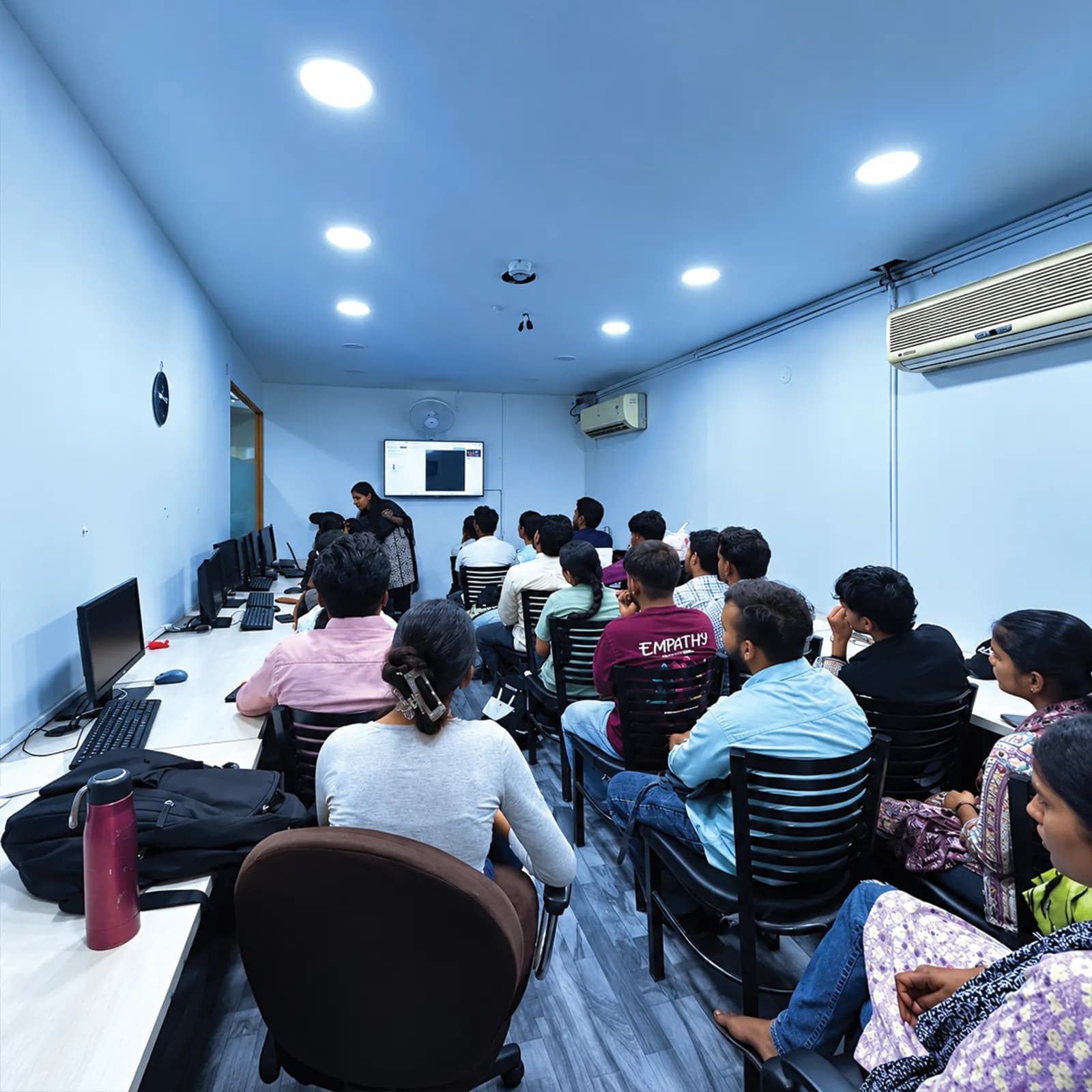
Two hours a day at the Jalandhar centre, on lab machines with your trainer in the room. The default for the 9-month Expert track.
Learn moreWeekend Batch
For people already working. Same track, same projects, delivered across Saturday and Sunday sessions.
Learn moreLive Online
Live classes, not recordings, with the same trainer review of your code each week. For students outside Jalandhar.
Learn more1-on-1 Training
Your own schedule and pace, useful if you are compressing the advanced modules or preparing for a specific interview.
Learn moreFrequently Asked Questions
No. Module 01 starts at variables and functions, and no prior coding experience is required for the beginner track. Students after 12th, graduates, final-year students, working professionals, freelancers, entrepreneurs and career switchers all join the same mixed batch.
Three tracks: 3-month Practitioner (JavaScript, HTML, CSS, React, Node, MongoDB and MERN basics), 6-month Professional (adds advanced React, state management, authentication, deployment and production workflows) and 9-month Expert (adds testing, real-time applications, advanced databases, performance optimisation, CI/CD concepts and large-scale capstone projects).
Fees vary by track (3, 6 or 9 months) and format (Classroom, Weekend, Live Online or 1-on-1). A counsellor will share the current fee structure, EMI options and any active offers when you book a demo — the demo class itself is free.
Yes — ten of them, from a JavaScript task manager through to a large-scale capstone application. Every major module includes a practical deliverable that contributes to your professional portfolio, and the batch works on live briefs rather than a to-do app.
Yes. Module 09 covers version control, branching and pull requests alongside Vercel and Render deployment, MongoDB Atlas and production environment management. The 9-month track goes further into CI/CD concepts.
Yes. MongoDB and Mongoose in Module 06 — collections, documents, schemas, models, validation, indexing and database design — and the 9-month track adds the aggregation pipeline for reporting queries that run in the database rather than in Node.
Yes. REST APIs with Express from Module 05, tested in Postman, secured with JWT and role-based access in Module 07, consumed from React in Module 08, and documented properly on the Professional track.
Yes. React runs across Modules 03 and 04 — components, hooks, routing, Context and useReducer — with Redux Toolkit on the Professional track. Node and Express run from Module 05 through the API, authentication and deployment modules, and into real-time work with Socket.io on the Expert track.
Yes. Students completing the programme receive a certificate programme completion certificate, and portfolio projects, internship-oriented assignments and practical evaluations mean you graduate with demonstrable work. The documented internship letter is accepted for university industrial training requirements across Punjab.
No, and no training provider can honestly guarantee one. What is provided is placement assistance: CV reviews, mock interviews, portfolio preparation and repeated drives with hiring partners across Jalandhar and Ludhiana.
Yes. One JavaScript codebase covering the browser, the API and the database is what a small client wants to buy from one person, and the ladder covers authentication, deployment and API documentation — the parts that let you hand a finished project over rather than only build it.
Frontend: HTML5, CSS3, JavaScript, React, React Router, Redux Toolkit and Vite. Backend: Node.js, Express.js, JWT and Passport.js. Database: MongoDB Atlas, Mongoose and MongoDB Compass. Development: VS Code, Git, GitHub and Postman. Deployment: Vercel, Render and Railway. Testing: Jest and Supertest. Real-time: Socket.io. AI-assisted development: ChatGPT, GitHub Copilot and AI productivity tools.
Yes. Weekday classroom, weekend, live online and 1-on-1 formats all run in parallel so working professionals and college students can both attend. Every class runs for 2 hours; book a free demo class to see the lab and meet the trainer before enrolling.
MERN is one way of doing full-stack development. “Full stack” just means building both the front end and the backend; MERN does it with MongoDB, Express, React and Node.js, all in JavaScript. Other stacks do the same job with different tools, such as MEAN (Angular), PHP with Laravel, or Python with Django.
Both share the same backend (Node.js, Express, MongoDB); the difference is the front end. MERN uses React, which is more common in startups and product companies. MEAN uses Angular with TypeScript, which many enterprise and service companies prefer. If you have no preference, React has more openings overall; if you are targeting a company that uses Angular, choose MEAN.
No. You will write HTML and CSS and build responsive layouts (Module 02), but the course is about building working applications, not visual design. If you want to design how websites look and feel, see the UI/UX Design course; if you want a lighter, front-end-only start, see Web Designing.
Not native mobile apps. The 9-month track teaches Progressive Web Apps, which can be installed on a phone and work offline, and the APIs you build can serve any mobile app. Building Android or iOS apps themselves needs another course, such as Flutter or Kotlin.
No. You will deploy your own apps to Vercel, Render and MongoDB Atlas, and the 9-month track introduces CI/CD concepts, which is what a developer needs. Managing servers, containers and cloud infrastructure is a separate career, covered in techcadd's DevOps Engineering and AWS Cloud courses.
You do not have to decide before joining. Every track teaches both, so you will build screens in React and APIs in Node within the first few months. Most students find which side they enjoy during the projects, and many stay full-stack. Your trainer can help you choose a direction based on your work.
Choose the rightduration for you
A tick means the module is taught and assessed at that length; a cross means it is not included. Every track opens at Module 01 with no assumed knowledge, and the longer tracks continue where the shorter ones end rather than repeating them.
Practitioner
10 modules
JavaScript, HTML, CSS, React, Node, MongoDB and MERN basics — ending in a complete CRUD application with authentication, database integration, deployment and documentation.
Professional
+4 modules
Adds advanced React and state management with Redux Toolkit, OAuth and advanced authentication, documented APIs and production workflows on top of the Practitioner core.
Expert
+6 modules
Adds testing with Jest and Supertest, real-time applications with Socket.io, MongoDB aggregation, progressive web apps, performance optimisation and CI/CD concepts, closing on a large-scale capstone.
| Module | 3 Months | 6 Months | 9 Months |
|---|---|---|---|
| 01Programming Foundations & Modern JavaScriptVariables, functions, arrays, objects, asynchronous JavaScript, promises, async/await, DOM manipulation, debugging and Git fundamentals. | Included | Included | Included |
| 02HTML5, CSS3 & Responsive DesignSemantic HTML, Flexbox, Grid, responsive layouts, forms, animations, cross-browser testing and UI development. | Included | Included | Included |
| 03React FundamentalsComponents, JSX, props, state management, hooks, forms, conditional rendering, lists and the React development workflow. | Included | Included | Included |
| 04React Router & State ManagementRouting, nested routes, Context API, custom hooks, useReducer and scalable architecture. | Included | Included | Included |
| 05Node.js & Express.jsServer creation, middleware, routing, REST APIs, the request-response lifecycle, error handling and backend architecture. | Included | Included | Included |
| 06MongoDB & MongooseCollections, documents, schemas, models, validation, indexing and database design. | Included | Included | Included |
| 07Authentication & AuthorizationJWT, bcrypt, role-based access control, protected routes and API security. | Included | Included | Included |
| 08Full MERN IntegrationConnecting React with Express APIs, CRUD operations, Axios, CORS, environment configuration and file uploads. | Included | Included | Included |
| 09GitHub & DeploymentVersion control, branching, pull requests, Vercel and Render deployment, MongoDB Atlas and production environments. | Included | Included | Included |
| 10Practitioner CapstoneA complete CRUD application with authentication, database integration, deployment and documentation. | Included | Included | Included |
| 11Redux ToolkitSlices, the store, async thunks and RTK Query — predictable state once Context stops being enough. | Not included | Included | Included |
| 12OAuthGoogle and GitHub sign-in through Passport.js: provider callbacks, sessions, token exchange and account linking. | Not included | Included | Included |
| 13Advanced AuthenticationRefresh tokens and rotation, secure cookie storage, password reset and email verification, session invalidation. | Not included | Included | Included |
| 14API DocumentationRequest and response schemas, error codes and examples — an API another developer can consume without asking you. | Not included | Included | Included |
| 15MongoDB AggregationThe aggregation pipeline — match, group, project, lookup — for reporting queries that run in the database, plus indexing and execution plans. | Not included | Not included | Included |
| 16Testing with Jest & SupertestUnit tests for business logic, integration tests against live Express routes, test data and mocking, and running the suite in CI. | Not included | Not included | Included |
| 17Progressive Web AppsService workers, caching strategies, offline behaviour, the web app manifest and installability. | Not included | Not included | Included |
| 18Real-Time Applications with Socket.ioRooms, namespaces and event-driven messaging, live notifications and presence, reconnection and scaling a socket server. | Not included | Not included | Included |
| 19Performance OptimizationBundle size, code splitting and render profiling in React; query tuning, pagination and caching on the server; measuring before and after. | Not included | Not included | Included |
| 20Expert Capstone — Large-Scale ApplicationA large-scale application carrying testing, real-time features, aggregation and performance budgets, presented and defended. | Not included | Not included | Included |
Modules carry forward: everything in Practitioner is also in Professional and Expert, and nothing is dropped as the track lengthens. If you are not sure which length fits the role you are aiming at, a counsellor will map it against the jobs actually hiring in Punjab right now.
Not sure which MERN track or path is right for you?
One call with a counsellor is usually enough. Tell us whether you need a job quickly, want to freelance or are aiming at product companies, and we will show you which track fits and where it can lead. Book a free demo class and see the lab before you decide.
Ask aboutMERN Stack
Send your question and a counsellor will call you back about batch timings, fees, EMI options, placement record, or whether this course fits your degree.
- Free counselling and demo class
- Weekday, evening, weekend or 1-on-1, all 2-hour classes
- Internship letter and placement support