On this page
- AI and Data Analytics: Jobs & Career Scope in Jalandhar 2026–2027
- What is Artificial Intelligence?
- Common Applications of AI
- What is Data Analytics?
- Four Major Types of Data Analytics
- 1. Descriptive Analytics
- 2. Diagnostic Analytics
- 3. Predictive Analytics
- 4. Prescriptive Analytics
- How AI and Data Analytics Work Together
- Benefits of AI and Data Analytics
- 1. Better Decision-Making
- 2. Automation of Repetitive Tasks
- 3. Improved Customer Experience
- 4. Cost Reduction
- 5. Faster Insights
- 6. Business Growth
- 7. Improved Productivity
- 8. Better Risk Management
- 9. Competitive Advantage
- 10. Strong Career Opportunities
- Career Opportunities in AI and Data Analytics
- AI and Data Analytics Salary Package in India 2026–2027
- Salary by Job Role
- AI and Data Analytics Career Scope in Jalandhar
- Why Choose AI and Data Analytics as a Career in 2026–2027?
- Skills Required for AI and Data Analytics
- Technical Skills
- Soft Skills
- Why Python is Important for AI and Data Analytics
- Importance of SQL in Data Analytics
- Role of Power BI and Data Visualization
- AI and Data Analytics for Students
- Practical Projects for AI and Data Analytics Students
- AI and Data Analytics Internship Opportunities
- AI and Data Analytics for Non-Technical Students
- AI and Data Analytics for Working Professionals
- Future Scope of AI and Data Analytics
- AI and Data Analytics: Job Opportunities Beyond Jalandhar
- Conclusion
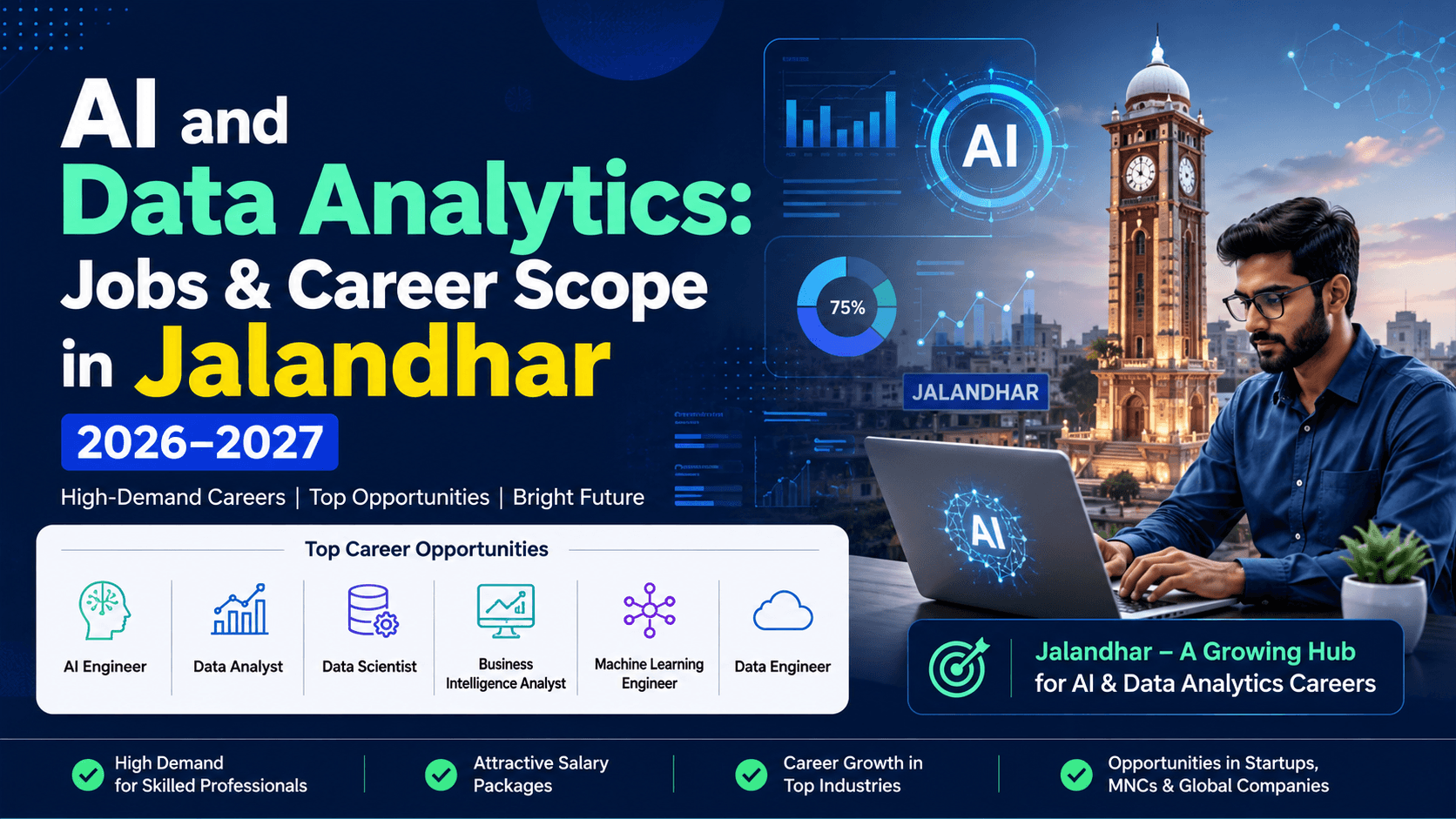
AI and Data Analytics: Jobs & Career Scope in Jalandhar 2026–2027
Artificial Intelligence (AI) and Data Analytics are becoming two of the most important technologies in the modern digital world. Businesses generate huge amounts of data every day, but collecting data is only the first step. AI and Data Analytics: Jobs & Career Scope in Jalandhar 2026–2027 Organizations need advanced technologies to understand this information, identify patterns, predict future trends, automate tasks, and make better decisions. This is where AI and Data Analytics work together.
In Jalandhar, the demand for technology-focused skills is also growing as businesses, startups, educational institutions, e-commerce companies, digital agencies, and service-based organizations increasingly depend on digital technologies. For students and professionals looking for a future-oriented career in 2026–2027, AI and Data Analytics can be valuable fields to explore.
AI enables computers and software to learn from data, identify patterns, automate processes, and generate intelligent insights. Data Analytics focuses on examining data to discover useful information and support business decisions. When combined, these technologies help organizations improve productivity, reduce costs, understand customers, optimize operations, and create better products and services.
What is Artificial Intelligence?
Artificial Intelligence refers to technologies that enable machines and computer systems to perform tasks that normally require human intelligence. AI can analyse information, recognize patterns, understand language, make predictions, generate content, and support decision-making.
AI is no longer limited to research laboratories or large technology companies. Today, AI is being integrated into marketing, finance, healthcare, education, retail, manufacturing, customer service, software development, and many other industries.
Common Applications of AI
Chatbots and virtual assistants
Recommendation systems
Image and speech recognition
Predictive analytics
Fraud detection
Automated customer support
Generative AI
Natural Language Processing
Machine learning
Smart business applications
Personalized marketing
Automated reporting
AI is increasingly being used across industries such as healthcare, banking, education, retail, manufacturing, digital marketing, e-commerce, and information technology.
What is Data Analytics?
Data Analytics is the process of collecting, cleaning, organizing, analysing, and interpreting data to find meaningful insights. Businesses use analytics to understand what has happened, why it happened, what may happen next, and what actions should be taken.
For example, an online business can analyse sales data to identify its best-selling products. A marketing company can analyse campaign data to understand which advertisements generate better results. A bank can analyse transactions to identify unusual activity.
Data Analytics therefore plays an important role in converting raw data into useful business information.
Four Major Types of Data Analytics
1. Descriptive Analytics
Descriptive analytics explains what happened in the past. Businesses use reports, dashboards, charts, and performance metrics to understand historical data.
2. Diagnostic Analytics
Diagnostic analytics focuses on understanding why something happened. It helps organizations identify relationships, patterns, and possible causes behind business results.
3. Predictive Analytics
Predictive analytics uses historical data, statistical techniques, and machine learning to estimate what could happen in the future.
For example, a company can use historical sales data to forecast future product demand.
4. Prescriptive Analytics
Prescriptive analytics recommends possible actions based on available data and predictions. It helps businesses decide what they should do to achieve better outcomes.
How AI and Data Analytics Work Together
AI can make Data Analytics faster, smarter, and more automated. Traditional analytics may require professionals to manually examine large datasets, whereas AI-powered systems can process large amounts of information and identify patterns more efficiently.
For example, an e-commerce company can use Data Analytics to understand customer purchases. AI can then analyse customer behaviour and recommend products that are more likely to interest individual customers.
Similarly, a company can use AI and analytics to identify unusual transactions, forecast sales, optimize marketing campaigns, predict customer behaviour, and improve customer experiences.
This combination is making AI-powered Data Analytics an increasingly valuable skill for modern businesses.
Benefits of AI and Data Analytics
AI and Data Analytics provide benefits for both organizations and professionals. Businesses can use these technologies to make better decisions, while students and professionals can develop career-ready technical skills.
1. Better Decision-Making
Data-driven insights help organizations make decisions based on evidence rather than assumptions. Managers can analyse business performance and identify opportunities using accurate data.
2. Automation of Repetitive Tasks
AI can automate repetitive tasks such as data processing, reporting, classification, and basic analysis. This allows professionals to spend more time on strategic and creative activities.
3. Improved Customer Experience
Businesses can analyse customer behaviour and use AI to provide personalized recommendations, communication, and services.
4. Cost Reduction
Predictive analytics can help organizations identify inefficiencies, reduce operational costs, and improve resource allocation.
5. Faster Insights
AI-powered analytics can process large datasets quickly and identify useful patterns, allowing businesses to respond faster to changing market conditions.
6. Business Growth
Organizations can identify new market opportunities, understand customer demand, optimize pricing, and improve their products using data-driven insights.
7. Improved Productivity
AI tools can support employees by automating routine analytical work and helping them access useful information more efficiently.
8. Better Risk Management
Organizations can use predictive models to identify potential risks and unusual patterns before they become major problems.
9. Competitive Advantage
Businesses that effectively use data and AI can understand their customers and markets better, helping them compete in an increasingly digital economy.
10. Strong Career Opportunities
AI and Data Analytics are creating career opportunities across IT, finance, healthcare, marketing, e-commerce, banking, education, and other industries.
Career Opportunities in AI and Data Analytics
The growth of AI and Data Analytics is creating new career opportunities for students, graduates, and working professionals.
Popular career roles include:
Data Analyst
Business Analyst
Data Scientist
Machine Learning Engineer
AI Engineer
Business Intelligence Analyst
Data Engineer
AI Data Analyst
Marketing Data Analyst
Machine Learning Specialist
Junior Data Scientist
Business Intelligence Developer
AI/ML Developer
Data Visualization Specialist
The exact responsibilities and salary can vary depending on the role, technical skills, education, experience, and organization.
AI and Data Analytics Salary Package in India 2026–2027
Salary is one of the major reasons students are interested in AI and Data Analytics careers. However, there is no single fixed salary package for every professional. Compensation depends on job role, experience, technical knowledge, location, company size, and specialization.
An indicative salary range can be considered as follows:
Experience LevelApprox. Salary RangeFresher / Entry Level₹3 LPA – ₹6 LPA1–2 Years Experience₹4 LPA – ₹8 LPA2–4 Years Experience₹6 LPA – ₹12 LPA4–7 Years Experience₹10 LPA – ₹20 LPA+Senior AI/Data Professional₹15 LPA – ₹30 LPA+
These are indicative ranges, not guaranteed packages. Actual compensation may be lower or higher depending on skills, company, location, interview performance, and specialization.
Salary by Job Role
Job RoleIndicative Salary RangeData Analyst₹3 LPA – ₹8 LPABusiness Analyst₹4 LPA – ₹10 LPAData Scientist₹6 LPA – ₹15 LPA+Machine Learning Engineer₹5 LPA – ₹15 LPA+AI Engineer₹6 LPA – ₹18 LPA+Data Engineer₹5 LPA – ₹14 LPA+Business Intelligence Analyst₹4 LPA – ₹10 LPAAI/ML Specialist₹7 LPA – ₹20 LPA+
Professionals with strong programming, machine learning, cloud, data engineering, statistics, and AI skills can potentially access higher-paying opportunities as they gain experience.
AI and Data Analytics Career Scope in Jalandhar
Jalandhar is developing as an important commercial and educational centre in Punjab. Students and professionals in the city can explore opportunities in technology companies, startups, digital businesses, educational organizations, e-commerce, banking, healthcare, manufacturing, and service industries.
Businesses in Jalandhar can benefit from Data Analytics for sales analysis, customer research, marketing performance, inventory management, financial reporting, and business forecasting.
AI can further enhance these activities through automation, prediction, intelligent recommendations, and customer support.
For local students, learning AI and Data Analytics can therefore provide skills that are useful not only for jobs in Jalandhar but also for opportunities across India and remote work environments.
Why Choose AI and Data Analytics as a Career in 2026–2027?
The technology industry is continuously evolving, and businesses are becoming increasingly dependent on data. At the same time, AI is changing how organizations process information and automate business operations.
Choosing AI and Data Analytics in 2026–2027 can offer several advantages:
Growing demand for data-driven professionals
Opportunities across multiple industries
Scope for career specialization
Potential for competitive salaries
Opportunities for remote and hybrid jobs
Ability to work with modern AI technologies
Strong relevance to digital transformation
Opportunities for continuous learning
Possibility of moving into advanced AI and machine learning roles
Skills Required for AI and Data Analytics
To start a career in AI and Data Analytics, learners should develop both technical and analytical skills.
Technical Skills
Important technical skills include:
Python
SQL
Excel
Statistics
Data Visualization
Power BI
Tableau
Machine Learning
Data Cleaning
Database Management
Basic Artificial Intelligence
Generative AI
Cloud Computing fundamentals
Soft Skills
Technical knowledge alone is not enough. Professionals should also develop:
Problem-solving
Critical thinking
Communication
Analytical thinking
Time management
Presentation skills
Business understanding
Teamwork
Communication skills are particularly important because data professionals need to explain complex insights to managers, clients, and other teams.
Why Python is Important for AI and Data Analytics
Python is one of the most popular programming languages used in Data Analytics, Artificial Intelligence, and Machine Learning.
Beginners can use Python for:
Data cleaning
Data analysis
Data visualization
Machine learning
Automation
AI development
Working with datasets
Libraries and frameworks such as Pandas, NumPy, Matplotlib, and Scikit-learn are widely used for data-related tasks.
Importance of SQL in Data Analytics
SQL is another essential skill for aspiring data professionals. Businesses store large amounts of information in databases, and SQL allows professionals to retrieve, filter, organize, and analyse that information.
A student who combines Python + SQL + Excel + Power BI + Statistics can build a strong foundation for entry-level Data Analytics roles.
Role of Power BI and Data Visualization
Data visualization makes complex information easier to understand. Tools such as Power BI and Tableau help professionals create dashboards, charts, reports, and interactive visualizations.
For example, a business dashboard can display:
Monthly sales
Customer growth
Revenue
Product performance
Marketing results
Regional performance
Inventory levels
These visual reports allow decision-makers to understand business performance quickly.
AI and Data Analytics for Students
AI and Data Analytics can be excellent career options for college students and recent graduates. Students can begin with basic computer skills, Excel, SQL, and statistics before moving toward Python, data visualization, machine learning, and AI.
Students do not necessarily need to master every advanced technology at the beginning. A structured learning path can make the process easier.
Practical Projects for AI and Data Analytics Students
Practical projects can help students understand how these technologies are used in real-world situations.
Students can build projects such as:
Sales Data Analysis Dashboard
Customer Segmentation Project
E-commerce Sales Prediction
Student Performance Analysis
Marketing Campaign Analysis
Employee Data Dashboard
Product Recommendation System
Customer Churn Prediction
House Price Prediction
Social Media Analytics Dashboard
Projects demonstrate practical knowledge and can strengthen a student's resume and portfolio.
AI and Data Analytics Internship Opportunities
Internships can help students gain practical exposure before entering the full-time job market.
Possible internship roles include:
Data Analytics Intern
Business Analytics Intern
AI Intern
Machine Learning Intern
Python Intern
Data Science Intern
Business Intelligence Intern
During an internship, students can gain experience working with real datasets, dashboards, reports, databases, and business problems.
AI and Data Analytics for Non-Technical Students
Students from non-technical backgrounds can also begin learning Data Analytics. They may start with Excel, basic statistics, SQL, data visualization, and business analytics before moving toward Python and AI.
The most important factors are interest, consistent practice, logical thinking, and willingness to learn.
AI and Data Analytics for Working Professionals
Working professionals can use AI and Data Analytics skills to improve their existing careers. For example, marketing professionals can learn customer analytics, finance professionals can learn financial data analysis, and business professionals can use dashboards for decision-making.
Learning AI tools can also help professionals automate repetitive tasks and improve productivity.
Future Scope of AI and Data Analytics
The future scope of AI and Data Analytics is expected to remain strong as businesses continue to become more data-driven. Organizations across different industries are adopting AI-powered systems to improve efficiency and make faster decisions.
Generative AI, machine learning, predictive analytics, automation, real-time data processing, and intelligent business applications are expected to become increasingly important.
Professionals who understand both data and AI can benefit from the growing demand for intelligent business solutions.
AI and Data Analytics: Job Opportunities Beyond Jalandhar
One of the biggest advantages of developing AI and Data Analytics skills is that professionals are not limited to one city. After gaining the required skills and experience, candidates can explore opportunities in major technology and business hubs across India.
Potential locations include:
Jalandhar
Chandigarh
Mohali
Ludhiana
Amritsar
Delhi NCR
Bengaluru
Hyderabad
Pune
Mumbai
Chennai
Remote and hybrid work opportunities can also allow skilled professionals to work with companies outside their local city.
Conclusion
AI and Data Analytics are transforming the way businesses understand information, automate processes, and make decisions. AI provides intelligent automation and predictive capabilities, while Data Analytics helps organizations turn raw information into meaningful insights.
For students and professionals in Jalandhar, learning AI and Data Analytics in 2026–2027 can be a valuable step toward building a technology-focused career. Skills such as Python, SQL, Excel, Power BI, statistics, machine learning, data visualization, and AI can help learners prepare for a wide range of career opportunities.
The combination of technical skills, practical projects, internships, and continuous learning can help students move from beginner-level knowledge toward professional roles such as Data Analyst, Business Analyst, Data Scientist, AI Engineer, Machine Learning Engineer, and Data Engineer.
As businesses continue to adopt AI and data-driven technologies, professionals who can understand data and convert it into actionable insights are likely to remain valuable in the evolving digital economy.
Filed under
Comments
Loading…