On this page
- What Programming Actually Does in a Robot
- The Three Jobs Every Robot Program Does
- A Simple Example
- Which Programming Languages Should Beginners Learn?
- What Beginners Usually Get Wrong
- Do You Need Prior Experience?
- How Programming Connects to Real Careers
- How Students in Jalandhar Can Start Learning Robotics Programming
- A Simple Roadmap to Follow
- Tips to Stay on Track
- Final Thoughts
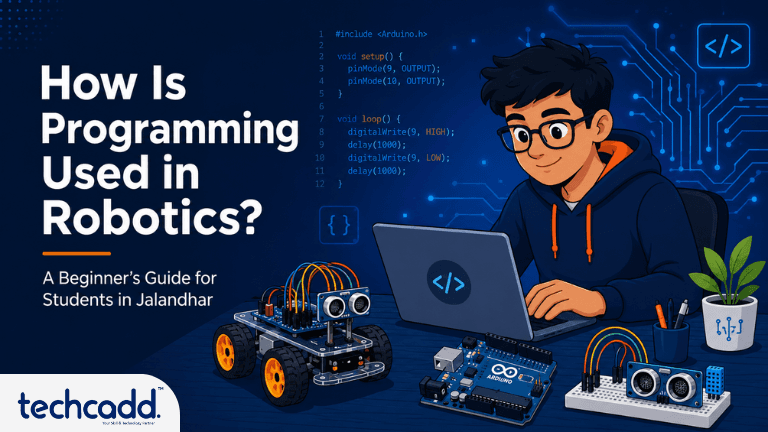
What Programming Actually Does in a Robot
Think of a robot as a body without a brain. It has motors, wheels, arms and sensors, but on its own it can’t do anything useful. Programming is what gives it instructions. Every time a robot moves forward, stops at an obstacle or picks up an object, a program told it exactly what to do and when.
If you’ve ever wondered, “Do robots really think?”, the honest answer is no. They follow the logic we write for them. That’s good news for beginners, because it means you don’t need to be a genius. You need to learn how to give clear, step-by-step instructions.
The Three Jobs Every Robot Program Does
Almost every robot, from a simple line-following car to a factory arm, runs on the same basic cycle:
1. Sense. Sensors collect information about the world, such as distance, light, temperature or touch. Your code reads this data.
2. Decide. The program checks conditions. For example: “If the obstacle is closer than 10 cm, stop and turn.”
3. Act. The code sends signals to motors or other parts so the robot actually moves.
This loop repeats many times every second. That’s how a robot seems to react instantly to its surroundings.
A Simple Example
Imagine a small robot car in your college lab. You want it to avoid walls. Your program keeps reading the distance sensor. If the path is clear, the motors run forward. If a wall appears, the program stops the motors and tells one wheel to reverse so the car turns away.
That’s it. No magic, just sensing, deciding and acting. Many students feel nervous before their first robotics project, but this basic logic is exactly where every beginner starts, and it’s much easier than it sounds once you see it working on real hardware.
Which Programming Languages Should Beginners Learn?
This is the question almost every student asks first, and it’s a fair one. The good news is that you don’t need to learn everything at once. Start with one language, understand the logic, and the rest becomes much easier.
Python is the most beginner-friendly choice. Its syntax reads almost like plain English, and it’s widely used for robotics projects involving sensors, vision and artificial intelligence. If you’ve never written code before, this is a comfortable place to begin.
C and C++ are what you’ll meet when working with microcontrollers like Arduino. They’re closer to the hardware, so they help you understand how a robot’s motors and sensors really respond to your commands. They feel a little harder at first, but the learning pays off.
Other tools like ROS (Robot Operating System) come later. Most students don’t need these in the first few months, so don’t feel pressured to learn them early.
What Beginners Usually Get Wrong
A common mistake is jumping straight to advanced topics like AI or machine vision without understanding basic logic. Another is spending weeks watching tutorials without ever building anything. Robotics is a hands-on subject. You learn faster when a wheel actually turns because of your code, and even more when something goes wrong and you have to fix it.
Don’t worry if your first program doesn’t work. Debugging is a normal part of the process, and every experienced programmer has been through it.
Do You Need Prior Experience?
Not really. A basic understanding of logic helps, but most beginners start from zero. What matters more is curiosity and the patience to try things again when they fail.
How Programming Connects to Real Careers
Robotics skills are useful far beyond robots. Automation, embedded systems, IoT, manufacturing and smart devices all rely on the same foundations. Learning to program robots builds problem-solving habits that help in almost any technical career, which makes it a worthwhile skill for students thinking about their future.
How Students in Jalandhar Can Start Learning Robotics Programming
Reading about robotics is a good first step, but the real learning begins when you build something. If you’re a student in Jalandhar, the best approach is to combine structured guidance with plenty of hands-on practice. A training institute like techcadd can help you move from basic coding to working projects with proper mentorship, instead of getting stuck alone on errors that take days to figure out.
A Simple Roadmap to Follow
You don’t need a complicated plan. Here is a practical order that works for most beginners:
Step 1: Learn basic programming logic. Understand variables, conditions and loops using Python. These three ideas appear in almost every robot program.
Step 2: Get a starter kit. An Arduino board with a few sensors and motors is affordable and perfect for experimenting. Seeing your code control real hardware keeps you motivated.
Step 3: Build small projects. Start with an LED that blinks, then a distance-sensing alarm, then a line-following or obstacle-avoiding car. Each project teaches something new.
Step 4: Explore advanced topics slowly. Once the basics feel comfortable, look into computer vision, automation or ROS.
Tips to Stay on Track
Be patient with yourself. Everyone gets confused by their first error message. Keep a small notebook of the mistakes you’ve fixed, because you’ll run into them again. Try working with friends or classmates too, since explaining your code to someone else is one of the fastest ways to understand it.
Final Thoughts
Programming is the part of robotics that turns metal and wires into something that responds, moves and solves problems. You don’t need a perfect background or expensive equipment to begin. You only need to start small, stay consistent and keep building. Take that first step this week, and in a few months you’ll be surprised by how much you can make a robot do.
Keep reading
- Essential Data Analytics Skills Every Student in Jalandhar Should LearnThinking about a career in data? Discover the core data analytics skills students in Jalandhar should learn first, from Excel and SQL to visualization and clear thinking, and how to build them step by step with techcadd.
- SQL for Data Science: Why It Matters and How to Learn It in JalandharThinking about a data science career? Start with SQL. Learn why employers expect it first, what beginners should practise, and how students in Jalandhar can build job-ready database skills with techcadd.
- How to Learn Sensor Interfacing Through Live Projects in JalandharStruggling to move from theory to real circuits? Learn how sensor interfacing through live projects in Jalandhar helps you build practical skills, avoid beginner mistakes, and get job-ready with hands-on guidance from techcadd.
Comments
Loading…