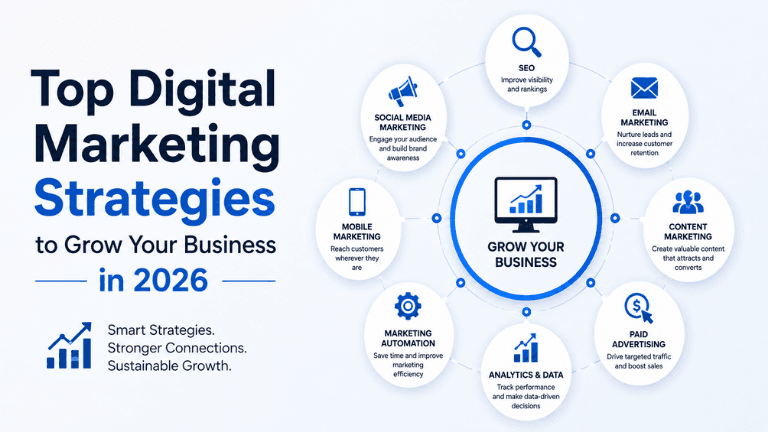
Digital marketing continues to evolve rapidly in 2026. Businesses are no longer relying on traditional SEO, social media posts, or paid advertising alone. Artificial intelligence, AI-powered search, short-form video, personalization, social commerce, and data-driven marketing are changing how brands attract customers and generate revenue. For businesses that want sustainable growth, the key is not to follow every trend blindly. Instead, companies should build an integrated digital marketing strategy that combines technology with valuable content, customer understanding, and measurable goals.
Here are the top digital marketing strategies to grow your business in 2026.
1. Use AI to Improve Marketing Efficiency
Artificial Intelligence has become an important part of modern marketing. Businesses can use AI to brainstorm content ideas, analyze customer behavior, personalize campaigns, automate repetitive tasks, generate creative concepts, and support customer service. AI can also help marketers analyze large amounts of data and identify patterns more quickly. However, businesses should maintain human oversight because automatically generated content can contain inaccuracies and may lack a distinctive brand voice. The best approach is to use AI as a marketing assistant rather than a complete replacement for human creativity and strategy.
2. Optimize for AI-Powered Search
SEO is changing in 2026 because customers are increasingly using AI-powered search experiences alongside traditional search engines. People are asking detailed questions and expecting direct, conversational answers.
Businesses should therefore focus on Search Engine Optimization (SEO), Answer Engine Optimization (AEO), and Generative Engine Optimization (GEO). Create content that answers real customer questions, demonstrates expertise, uses clear headings, includes relevant information, and provides genuine value. According to HubSpot's 2026 research, updating SEO strategies for changes in search is one of the major priorities for marketers.
3. Create High-Quality Content
Content marketing remains one of the strongest ways to attract and educate potential customers. Instead of producing large amounts of generic content, businesses should focus on useful, original, and audience-focused content. Blog posts, guides, case studies, videos, infographics, FAQs, customer stories, and expert insights can help establish authority and build trust. In 2026, businesses should also repurpose strong content. For example, one detailed blog post can become a LinkedIn post, Instagram Reel, YouTube Short, email newsletter, infographic, and FAQ section.
4. Invest in Short-Form Video Marketing
Short-form video continues to be one of the most effective digital marketing formats. Platforms such as Instagram, YouTube, and TikTok provide businesses with opportunities to reach new audiences quickly. Research from HubSpot's 2026 marketing data identifies short-form video as a leading-performing media format.
Businesses can create videos showing product demonstrations, tutorials, customer testimonials, behind-the-scenes activities, industry tips, and frequently asked questions. The focus should be on value, authenticity, and attention-grabbing storytelling, rather than simply producing highly polished videos.
5. Build a Strong Social Media Strategy
Social media has developed into much more than a brand awareness channel. Consumers increasingly use social platforms for discovery, research, shopping, and customer service. Businesses should choose platforms based on where their target audience spends time instead of trying to maintain a weak presence everywhere. Social media strategies in 2026 should include engaging videos, educational content, community interaction, customer-generated content, social search optimization, and consistent brand messaging.
6. Focus on Personalization
Customers expect brands to understand their needs and interests. Personalized marketing can make campaigns more relevant and improve customer engagement. Businesses can personalize emails, product recommendations, website experiences, advertisements, offers, and content based on customer behavior and preferences. AI makes it easier to deliver personalization at scale. HubSpot's 2026 research identifies AI-powered personalized content as one of the major marketing trends, with many marketers reporting improved engagement from personalization. However, personalization should always be balanced with responsible data use and customer privacy.
7. Strengthen Local SEO
For businesses serving a specific city or region, local SEO can be a powerful growth strategy. Optimizing your Google Business Profile, website, location pages, reviews, and local content can help customers discover your business when they are searching for nearby products or services. Businesses should use location-specific keywords naturally and encourage satisfied customers to leave genuine reviews. Local SEO is especially valuable for restaurants, educational institutions, healthcare providers, retailers, agencies, service providers, and other location-based businesses.
8. Use Performance Marketing and Paid Advertising
Organic marketing takes time, while paid advertising can help businesses reach targeted audiences more quickly. Businesses can use platforms such as Google Ads and social media advertising to target customers based on search intent, interests, demographics, behavior, and other signals. However, simply increasing the advertising budget does not guarantee growth. Businesses should continuously test ad copy, creative formats, audiences, landing pages, and offers. Track metrics such as conversion rate, customer acquisition cost, return on ad spend, and revenue rather than focusing only on impressions and clicks.
9. Work With Micro-Influencers and Creators
Influencer marketing is becoming more focused on authenticity and audience relevance. Businesses do not always need celebrities or creators with millions of followers. Micro- and mid-tier creators can offer strong engagement within specific communities. HubSpot's 2026 social media research highlights the growing importance of creator marketing and the performance of smaller creator tiers. Choose creators based on audience quality, engagement, credibility, content style, and relevance to your brand rather than follower count alone.
10. Build First-Party Data and Customer Relationships
Businesses should not depend completely on third-party platforms for customer relationships. Building first-party data through websites, email subscriptions, purchases, CRM systems, customer feedback, and loyalty programs can provide valuable insights. Email marketing remains particularly useful for nurturing leads and maintaining relationships with existing customers. The goal is to build a database of people who have voluntarily interacted with your business and use that information responsibly to provide better experiences.
11. Measure Everything That Matters
A successful digital marketing strategy needs clear measurement. Businesses should establish specific goals before launching campaigns. Important metrics can include: Website traffic, qualified leads, conversion rates, customer acquisition cost, return on advertising spend, email engagement, social engagement, customer lifetime value, and revenue. AI-powered analytics can help marketers identify patterns and make faster decisions, but businesses still need accurate data and meaningful KPIs.
Conclusion
The top digital marketing strategies for 2026 combine AI, SEO, AI search optimization, content marketing, short-form video, social media, personalization, local SEO, paid advertising, influencer marketing, first-party data, and analytics. The most successful businesses will not necessarily be those that use the most marketing tools. They will be those that understand their customers, provide genuine value, use technology intelligently, and continuously measure and improve their results. In 2026, digital marketing is becoming more AI-driven, personalized, visual, conversational, and customer-focused. Businesses that adapt their strategies today can create stronger brand visibility, attract more qualified customers, and build sustainable long-term growth.
Keep reading
- How AI Is Changing Digital Marketing in 2026AI is transforming digital marketing in 2026 through smarter content creation, SEO, personalization, advertising, analytics, customer service, and automation while keeping human creativity.
- Best Digital Marketing Course in Jalandhar 2026–2027Discover the best digital marketing course in Jalandhar for 2026–2027. Learn about digital marketing skills, SEO, social media marketing, Google Ads, career opportunities, course benefits, and how to choose the right training program.
Comments
Loading…