On this page
- What Is Data Cleaning?
- Why Does Data Cleaning Matter So Much?
- Is Data Cleaning Difficult for Beginners?
- Common Data Problems You Will Meet
- How Data Cleaning Works: A Simple Step-by-Step Process
- Which Tools Should You Learn First?
- Mistakes Beginners Usually Make
- What Can You Do After Learning Data Cleaning?
- How to Start Learning in Jalandhar
What Is Data Cleaning?
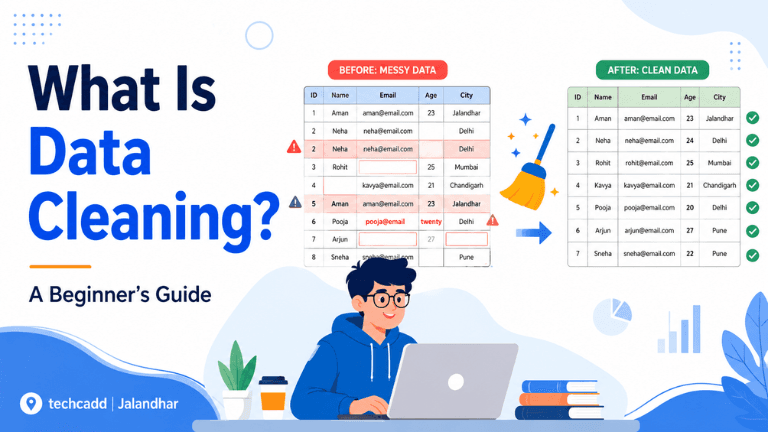
Imagine you open a spreadsheet with 500 student records. Some names are typed in capitals, others in lowercase. A few phone numbers have extra digits. Some rows are completely empty, and one student appears three times. Before you can analyse anything, you have to fix all of that.
That fixing is data cleaning. It means finding and correcting errors, duplicates, missing values and inconsistencies in a dataset so it becomes accurate and ready to use. Some people call it data cleansing or data scrubbing, but the idea is the same: make the data trustworthy before you rely on it.
Why Does Data Cleaning Matter So Much?
Here’s the part many beginners don’t expect. Most data professionals spend a big chunk of their time cleaning data, not building fancy charts or models. It isn’t the glamorous part of the job, but it decides whether everything else works.
Think of it like cooking. If you start with spoiled vegetables, no recipe can save the dish. In the same way, if your data has mistakes, your results will be wrong, no matter how good your tools or skills are. A sales report with duplicate entries can show inflated numbers. A survey with missing answers can lead to the wrong conclusion. Decisions made on that kind of data can cost a business real money.
Is Data Cleaning Difficult for Beginners?
Honestly, no. The concept is simple, and you can start with tools you may already know, like Excel or Google Sheets. You don’t need years of experience or advanced coding to understand what’s wrong with a messy dataset. You mostly need patience and a habit of asking, “Does this look right?”
That’s also why it’s a great entry point for students in Jalandhar who are curious about data analytics but aren’t sure where to begin. At techcadd, beginners often find that cleaning data is the first skill that makes the rest of analytics click, because it teaches you to actually look at your data instead of just trusting it.
Common Data Problems You Will Meet
Once you start working with real data, you’ll notice the same troubles appearing again and again. Knowing them in advance makes them far less scary.
Duplicate records: The same customer or student entered two or three times.
Missing values: Blank cells where an age, email or marks should be.
Inconsistent formatting: “Jalandhar,” “jalandhar” and “Jalandhar City” all meaning the same place, or dates written as 05/03/2026 in one row and 5 March 2026 in another.
Typing errors: Spelling mistakes, extra spaces or numbers entered in the wrong column.
Outliers: A value that looks wildly out of place, like an age of 250.
How Data Cleaning Works: A Simple Step-by-Step Process
You don’t need a complicated system. Most beginners can follow this order:
Look at your data first. Scroll through it, check column names, and spot obvious problems before changing anything.
Remove duplicates. Keep only one clean copy of each record.
Handle missing values. Decide whether to fill them in, leave them marked as blank, or remove the row, depending on how important that information is.
Fix formatting. Make dates, names, currencies and spellings consistent.
Check for outliers. Ask whether a strange value is a genuine result or a typing mistake.
Save a clean copy. Always keep your original file untouched, so you can go back if something goes wrong.
Which Tools Should You Learn First?
If you’re wondering where to start, begin with Excel or Google Sheets. Features like Remove Duplicates, Find and Replace, filters and Text to Columns can solve a surprising number of problems. Once you’re comfortable, you can move on to Power Query for repeatable cleaning, and later to SQL or Python (with Pandas) for larger datasets.
Don’t try to learn everything at once. That’s one of the most common beginner mistakes. Master one tool, clean a few messy files, and then take the next step.
Mistakes Beginners Usually Make
Everyone slips up here at the start, so don’t feel bad if you recognise yourself in this list.
The biggest one is editing the original file. One wrong click and the raw data is gone for good. Always work on a copy.
Another is deleting rows too quickly. A blank cell doesn’t always mean the whole record is useless. Sometimes a student’s marks are missing but their attendance and fee details are perfectly valid. Think before you delete.
Many beginners also forget to document what they changed. A short note like “removed 42 duplicates, fixed city spellings” saves you a lot of confusion later, especially when someone else opens your file.
What Can You Do After Learning Data Cleaning?
This is the question most students quietly worry about: will this skill actually help my career?
Yes, and in more places than you might expect. Data cleaning is the foundation for roles like data analyst, business analyst, MIS executive and reporting assistant. Even if you aren’t aiming for a data career, it helps in accounts, marketing, operations and research, because almost every office job involves messy spreadsheets at some point.
Employers also notice it. When you can take a chaotic file and turn it into something accurate and readable, you become the person the team trusts with data. That’s a strong place to start from, especially as a fresher.
How to Start Learning in Jalandhar
You can begin today with a free practice dataset and Excel. Download a messy sample file, try the six steps above, and see how much you can fix on your own. Then, when you’re ready for structured guidance, hands-on projects and mentors who can answer your doubts, look for a training institute in Jalandhar that teaches data skills through practice rather than just theory.
At techcadd, the focus is on learning by doing, so you work on real, imperfect data instead of tidy textbook examples. That’s how the skill actually sticks.
Start small, stay curious, and don’t aim for perfection on day one. Your first messy spreadsheet is the best teacher you’ll get.
Filed under
Keep reading
- How Data Analytics Is Changing the Future of Business: A Student’s Guide from JalandharBusinesses no longer run on guesswork. Data analytics is reshaping how companies decide, hire and grow. Here’s what it means for students in Jalandhar, and how learning it with techcadd can open doors to a fast-growing career.
- Advanced Data Cleaning Techniques Using Python, Pandas & SQL for Students in Jalandhar Messy data slows down every analyst. Learn advanced data cleaning techniques using Python, Pandas and SQL in simple steps, with practical tips for students in Jalandhar who want job-ready data skills. Learn the techcadd way.
- Essential Data Analytics Skills Every Student in Jalandhar Should LearnThinking about a career in data? Discover the core data analytics skills students in Jalandhar should learn first, from Excel and SQL to visualization and clear thinking, and how to build them step by step with techcadd.
Comments
Loading…