On this page
- What Is React JS, Really?
- Why Was React Created?
- The Idea That Makes React Special: Components
- Who Uses React?
- Do I Need Coding Experience Before Learning React?
- Is React Hard to Learn?
- What Should You Learn First?
- Mistakes Beginners Often Make
- What Can You Do After Learning React?
- Projects That Help Beginners Stand Out
- Why Learning in Jalandhar Makes Sense
- Final Thoughts
What Is React JS, Really?
If you’ve started exploring web development, you’ve probably heard seniors, friends or YouTube tutorials say, “Just learn React.” It sounds simple, but the first question most students ask is: what exactly is React?
React JS is a JavaScript library created by Facebook (now Meta) for building user interfaces. A user interface is everything you see and click on a website: buttons, menus, forms, product cards, comment sections. React helps developers build all of that in a clean, organised way.
Notice the word “library.” React isn’t a full programming language. It’s a toolkit built on top of JavaScript, so you’ll need some JavaScript basics before it starts to feel comfortable.
Why Was React Created?
Think about Instagram. You like a post and the heart turns red instantly, without the whole page reloading. Before React, building that kind of smooth experience meant writing a lot of messy, hard-to-manage code.
React solved this by letting developers update only the part of the page that changes. The rest stays untouched. That makes websites faster, and it makes the developer’s life much easier.
The Idea That Makes React Special: Components
This is the concept that makes everything click. In React, you build your website out of small, reusable pieces called components.
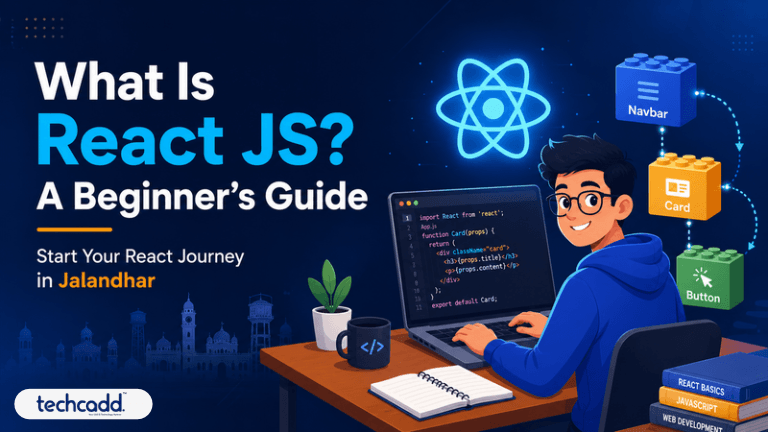
Imagine building with LEGO blocks. A navigation bar is one block. A product card is another. A footer is another. Once you build a block, you can reuse it anywhere, as many times as you like.
Say you’re building a course page with ten course cards. You don’t write ten separate designs. You build one card component and reuse it ten times with different details. Less repetition, fewer mistakes, and much easier fixes later.
Who Uses React?
React isn’t just a college-project tool. Companies like Netflix, Airbnb and Instagram use it, and thousands of startups and IT companies rely on it too. That’s a big reason students in Jalandhar who want a real career in web development choose it as their first serious framework to learn.
Do I Need Coding Experience Before Learning React?
You don’t need to be a coding genius, but you do need the basics. Before touching React, get comfortable with HTML, CSS and core JavaScript. Variables, functions, arrays, objects and loops come up in almost every React project.
Many students skip this step because they’re excited to jump straight in. A few days later they’re stuck and thinking, “Maybe I’m just not good at this.” Usually the problem isn’t talent. The foundation is missing.
Is React Hard to Learn?
Honestly, it feels confusing at the start. Concepts like state, props and hooks sound intimidating, but they’re easier than they look.
Props are how you pass information into a component, like handing a name to a greeting card.
State is the data a component remembers and can change, like a counter that goes up each time you click a button.
Hooks are special functions that let components use features like state without extra complexity.
Learn them one at a time, build something small after each, and the confusion fades quickly.
What Should You Learn First?
A simple order works well for most beginners:
Strong JavaScript basics (especially ES6 features)
Components and JSX, the HTML-like syntax React uses
Props and state
Handling events and forms
Hooks like useState and useEffect
Routing and fetching data from APIs
Mistakes Beginners Often Make
The biggest one is watching tutorials endlessly without building anything. You can follow a video perfectly and still freeze when you open a blank file. Type the code yourself, break it, fix it, and repeat.
Another common mistake is trying to learn everything at once. React has a huge ecosystem, but you don’t need all of it on day one. Master the fundamentals first and the rest will come naturally.
What Can You Do After Learning React?
This is the question that really matters. Once you’re comfortable with React, a lot of doors open. You can apply for roles like Front-End Developer, React Developer or Junior Web Developer. You can also build your own projects, take on freelance work, or move toward full-stack development by adding Node.js and databases.
The market for web development skills in Punjab is growing, and employers care less about certificates and more about whether you can actually build things. That’s why a portfolio matters so much.
Projects That Help Beginners Stand Out
You don’t need a massive idea. Start small and build up:
A to-do list app to practise state and events
A weather app that fetches live data from an API
A simple e-commerce product page with a cart
A personal portfolio website built with React components
Put these on GitHub and mention them in your resume. A recruiter in Jalandhar or anywhere else would much rather see three working projects than a long list of topics you’ve “studied.”
Why Learning in Jalandhar Makes Sense
You don’t have to move to a big metro city to start a tech career. Learning locally means you can attend classroom sessions, ask doubts face to face and get guidance from trainers who understand where you’re coming from. Many students also find it easier to stay consistent when they’re surrounded by a learning environment instead of studying alone at home.
At techcadd, the focus is on practical learning: building real projects, understanding concepts step by step and preparing for what employers actually look for.
Final Thoughts
React isn’t magic, and you don’t need to be a genius. You need patience, regular practice and a willingness to build, break and fix things. Start with the basics, take it one concept at a time, and keep creating small projects. A few months from now, you’ll be surprised by how much you can build.
Filed under
Keep reading
- Essential Data Analytics Skills Every Student in Jalandhar Should LearnThinking about a career in data? Discover the core data analytics skills students in Jalandhar should learn first, from Excel and SQL to visualization and clear thinking, and how to build them step by step with techcadd.
- SQL for Data Science: Why It Matters and How to Learn It in JalandharThinking about a data science career? Start with SQL. Learn why employers expect it first, what beginners should practise, and how students in Jalandhar can build job-ready database skills with techcadd.
- How to Learn Sensor Interfacing Through Live Projects in JalandharStruggling to move from theory to real circuits? Learn how sensor interfacing through live projects in Jalandhar helps you build practical skills, avoid beginner mistakes, and get job-ready with hands-on guidance from techcadd.
Comments
Loading…