Introductory practical training
A short, project-led summer training programme: a structured introduction to Python, data preparation, machine learning and small projects. It builds foundations, not advanced professional competence.
A short, project-led summer training programme for B.Tech CSE, BCA, MCA and B.Sc IT students and motivated beginners. In 45 days you get a structured introduction to Python, data preparation, machine learning and small projects — starting from what you already know, and ending in a mini project you can explain.
This is training, not an internship. No guaranteed placement or university credit. Ask for the latest syllabus, session plan, fees and batch dates before you pay.
Overview
When you search for 45 days AI and machine learning training in Jalandhar, the useful question is what the 45 days will actually contain. This programme is introductory practical training: guided practicals in Python and machine learning, an entry assessment to set your starting point, and a mini project at the end.
Ask what is taught in the batch and what is optional self-study, and request the latest syllabus and session plan before paying. If your college requires academic training, get its written approval first.
A short, project-led summer training programme: a structured introduction to Python, data preparation, machine learning and small projects. It builds foundations, not advanced professional competence.
A university-recognised industrial training requirement has its own rules on duration, approval and reporting. Only your department can say whether this programme meets them — get that in writing.
A genuine internship means supervised work inside an organisation. This 45-day programme is classroom and lab training, and it should be described that way on your CV and in your report.
Ask to see a sample assignment brief, a project rubric, permitted examples of student documentation and the certificate policy before you pay.
Who can apply
A B.Tech CSE student who can program but has never trained a model and a BCA student who knows spreadsheets but is new to Python start in different places. An entry assessment and recommended prerequisites set the right starting point for each.
You can probably program already but may never have trained a model. The early days move faster for you, and the mini project can go further.
A BCA student who knows spreadsheets but is new to Python starts at a different point from an MCA student with coding experience. The entry assessment sets your starting point.
Computing or statistics coursework helps with data handling and evaluation. Diploma candidates should check prerequisites with a counsellor first.
Coming from commerce, science or another branch is possible if you are ready to practise Python and basic statistics every day.
A holiday batch is a reasonable first look at AI and machine learning, as long as you treat it as a foundation rather than a specialisation.
Ask about optional foundation work before the batch starts. Arriving with Python basics makes the 45 days far more productive.
Why 45 days?
45 days is long enough to cover Python, data handling, core machine learning and a mini project — without promising mastery, employment or university credit.
Forty-five days suits summer or winter vacation, so the training does not compete with semester classes.
Enough time for Python, data handling, core machine learning and one mini project — not for every branch of AI.
The last eight days go to a documented mini project you can explain, rather than a certificate alone.
It does not promise mastery, employment or university credit. It gives you a clear next learning plan.
What the training covers
Each topic follows the same pattern: a learning objective, a guided demo, an individual exercise and a review. The emphasis is on foundations, correct terminology and decisions you can defend.
Notebooks, data types, control flow, functions, lists, dictionaries and files — the groundwork every later topic depends on.
NumPy and pandas for loading, cleaning and summarising data, with descriptive statistics and exploratory analysis before any model.

Matplotlib and Seaborn charts that explain a dataset honestly — distributions, trends and comparisons with clear labels.
Regression and classification with scikit-learn: linear and logistic regression, decision trees, random forests, k-nearest neighbours and naive Bayes.
Train, validation and test splits, baselines, regression metrics, confusion matrices, precision, recall and cross-validation — and how leakage misleads.
k-means clustering and the ideas behind principal component analysis, with care about what clusters can and cannot tell you.
Text preprocessing, text features and simple sentiment baselines, using spaCy and scikit-learn on openly licensed text.
What generative AI tools can and cannot do, how to evaluate and verify their output, and the fairness and privacy questions they raise.
Matplotlib Seaborn
Syllabus & learning roadmap
The exact pace depends on the entry assessment and the batch. Each day runs objective → guided practical on a toy or openly licensed dataset, compared against a simple baseline → independent notebook or worksheet → mentor checkpoint. No private student records are used.
AI use cases and your learning goals, Python and notebook setup, variables and data types, control flow and functions, then lists, dictionaries and file handling. You produce a set of working Python exercise notebooks.
NumPy arrays and vectorisation, pandas data frames and indexing, CSV import and quality checks, missing values and duplicates, descriptive statistics, Matplotlib storytelling and exploratory analysis. You produce a cleaned dataset and a data-cleaning checkpoint notebook.
The workflow and data leakage, train/validation/test splits, linear regression against a baseline, regression metrics and residuals, feature engineering for tabular data, and regularisation. You produce a documented regression notebook compared with a baseline.
Logistic regression, confusion matrices, precision and recall, decision trees, random forests, gradient boosting concepts, cross-validation and tuning, class imbalance and ethical evaluation. You produce a classification comparison with justified metrics.
k-nearest neighbours and scaling, naive Bayes for text classification, k-means clustering, principal component analysis concepts, language preprocessing, text features and sentiment baselines. You produce a small text-classification or clustering exercise.
Neural network fundamentals, training and overfitting, generative AI concepts and limitations, prompt evaluation and verification, and fairness and privacy. You produce a short written evaluation of an AI tool's output.
Scoping and a problem statement, dataset provenance and a data dictionary, a baseline model, feature experiments, robustness and edge cases, explainability and a model card, then presentation and final evaluation. You produce a documented mini project and a next learning plan.
Training vs internship
This 45-day programme is project-based training. It has practical work, but it is not a workplace internship, and universities use these terms differently — so check what yours requires.
AI & ML mini projects
Assessment & certificates
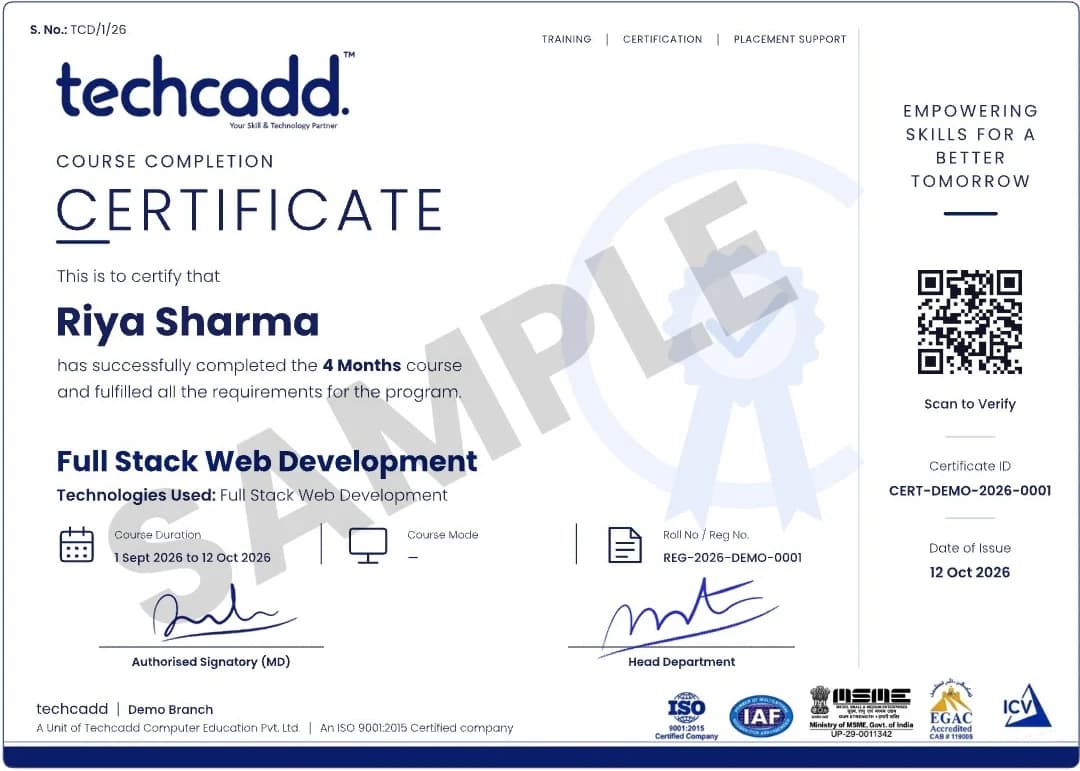
Issued on finishing the programme, with a QR code and certificate ID anyone can verify.
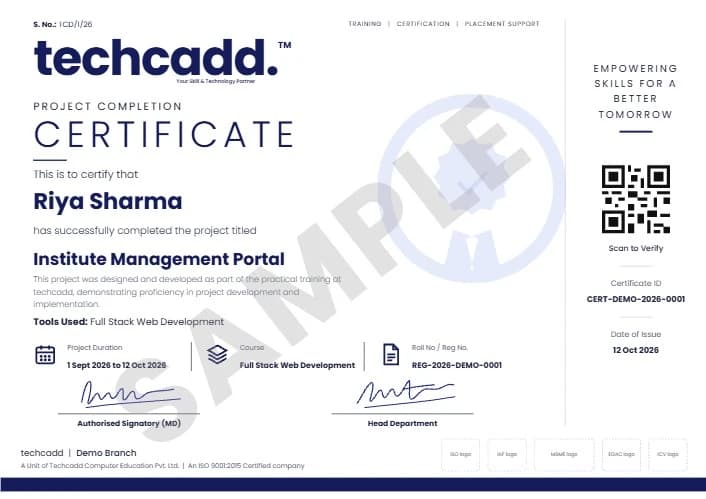
A separate certificate naming the live project you designed and built during training.
Project ideas
Each project needs a notebook, a visual summary, an evaluation, error analysis and a note on ethical limitations. Use public, synthetic or anonymised data — never classmates' private data without consent.
Analyse your own or synthetic study logs and predict which topics need more time.
Classify public movie reviews as positive or negative and compare against a word-count baseline.
Forecast attendance for college events from day, time and event type, using anonymised records.
Explore borrowing patterns by subject and month, and cluster similar titles.
Predict weekly demand for products in a public retail dataset and explain the errors.
Explore openly published air-quality readings and visualise seasonal patterns.
Group skills from synthetic or permitted resumes into categories with basic NLP.
Summarise an anonymised member survey and find what drives satisfaction.
Find recurring themes and sentiment in anonymised course feedback comments.
How to apply
Six steps from first enquiry to final evaluation.
Send an enquiry or call with your course, semester and Python experience.
Discuss your goals, college requirements and the batch options available.
A short entry assessment shows whether you need foundation work first.
Confirm what is taught in the batch and what is optional self-study.
Set up Python and notebooks, and agree attendance and project expectations.
Daily checkpoints, a mini project and a final evaluation with feedback.
College & university documentation
Documents students often ask about for 45 days of summer training. Requirements are university-specific — confirm which ones are available and accepted before you enrol.
No training centre can guarantee acceptance by every university. Keep copies of the syllabus and terms you were given.
Batches & scheduling
The most common window — plan around your final examination dates and when your college expects the report.
A shorter break may need a more intensive daily schedule. Ask how the 45 days are spread.
Ask for the daily contact hours and whether weekend sessions are part of the schedule.
Verify batch start dates with the centre in writing rather than relying on dates quoted informally.
Eligibility, fees & what is included
No fee is published here. Ask for the current written fee and what it covers before you pay.
No advanced mathematics is needed. Basic Python is recommended; if you have never coded, ask about optional foundation work so the first week is not a struggle.
Career scope
Roles you can work towards with further study and practice — not roles this programme promises:
A 45-day programme does not guarantee placement. Hiring depends on skills, projects, interview performance, market conditions and employer criteria.
The six-month AI & ML programme covers deep learning, NLP, computer vision, generative AI and deployment in the depth 45 days cannot.
Extend your mini project, tidy the repository and add a second project on a different problem type.
Forty-five days is a start. Employers look for sustained practice, projects and interview performance, not one short course.
Why students consider techcadd
No unverified claims about trainers or placements — judge the syllabus, the centre and the work students produce.
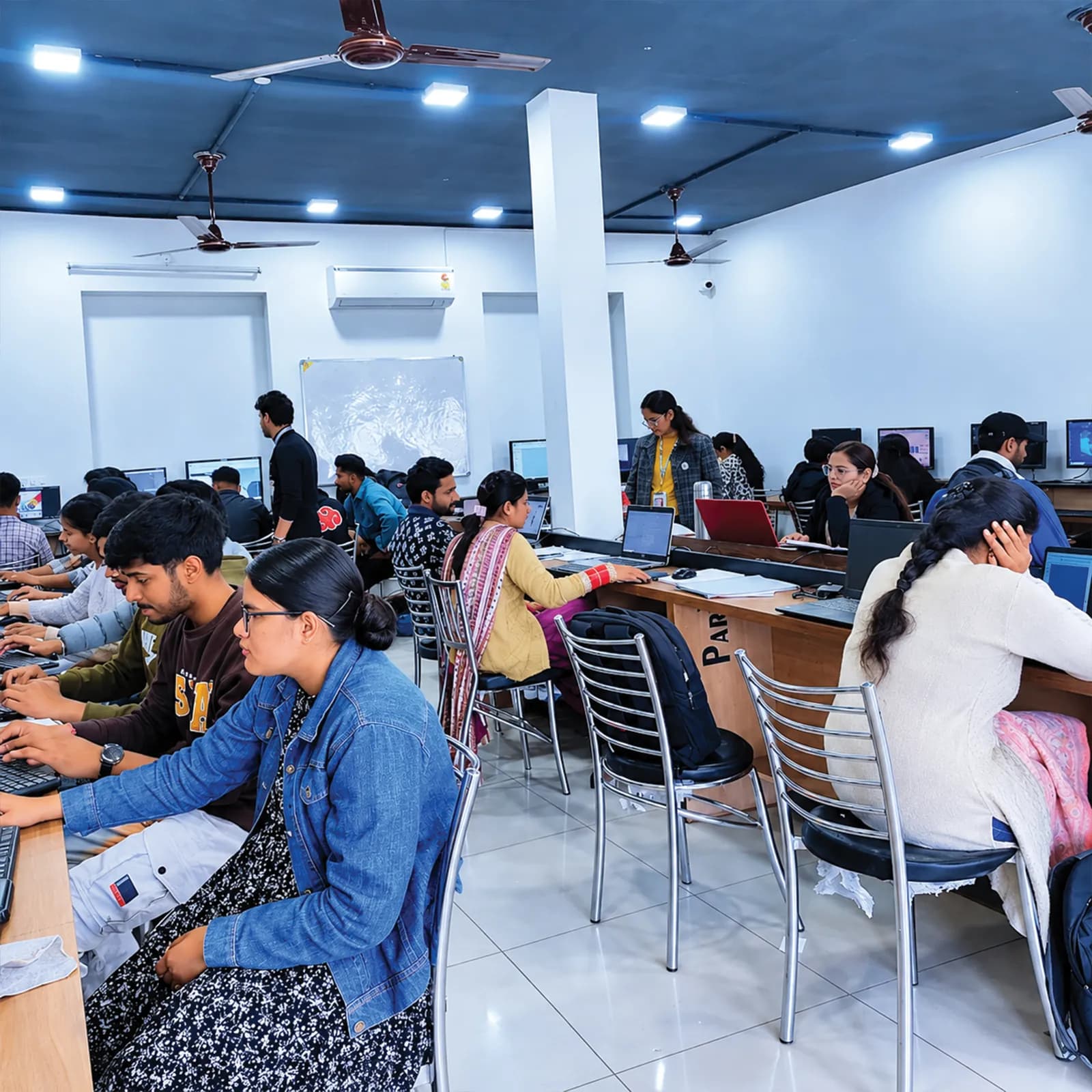
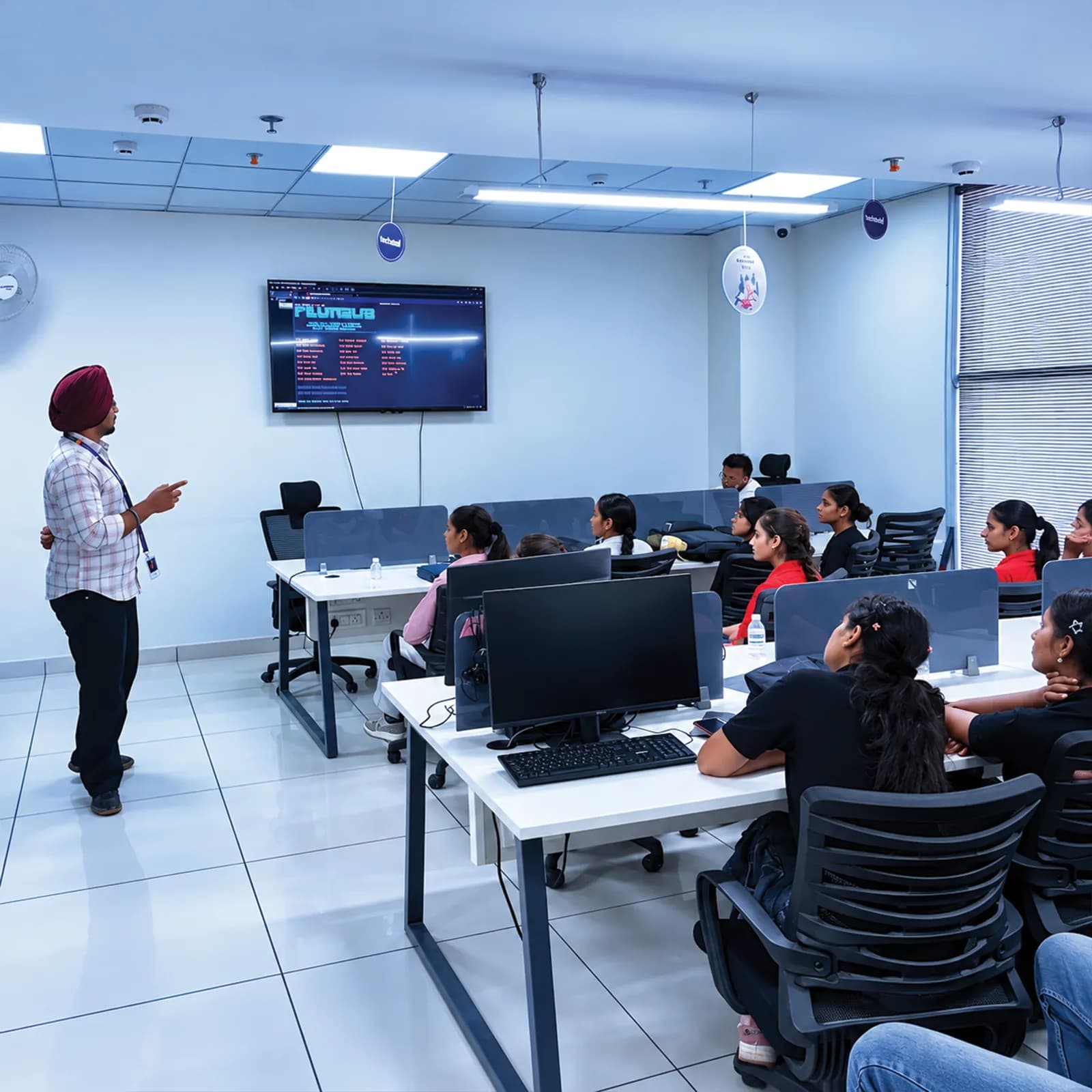
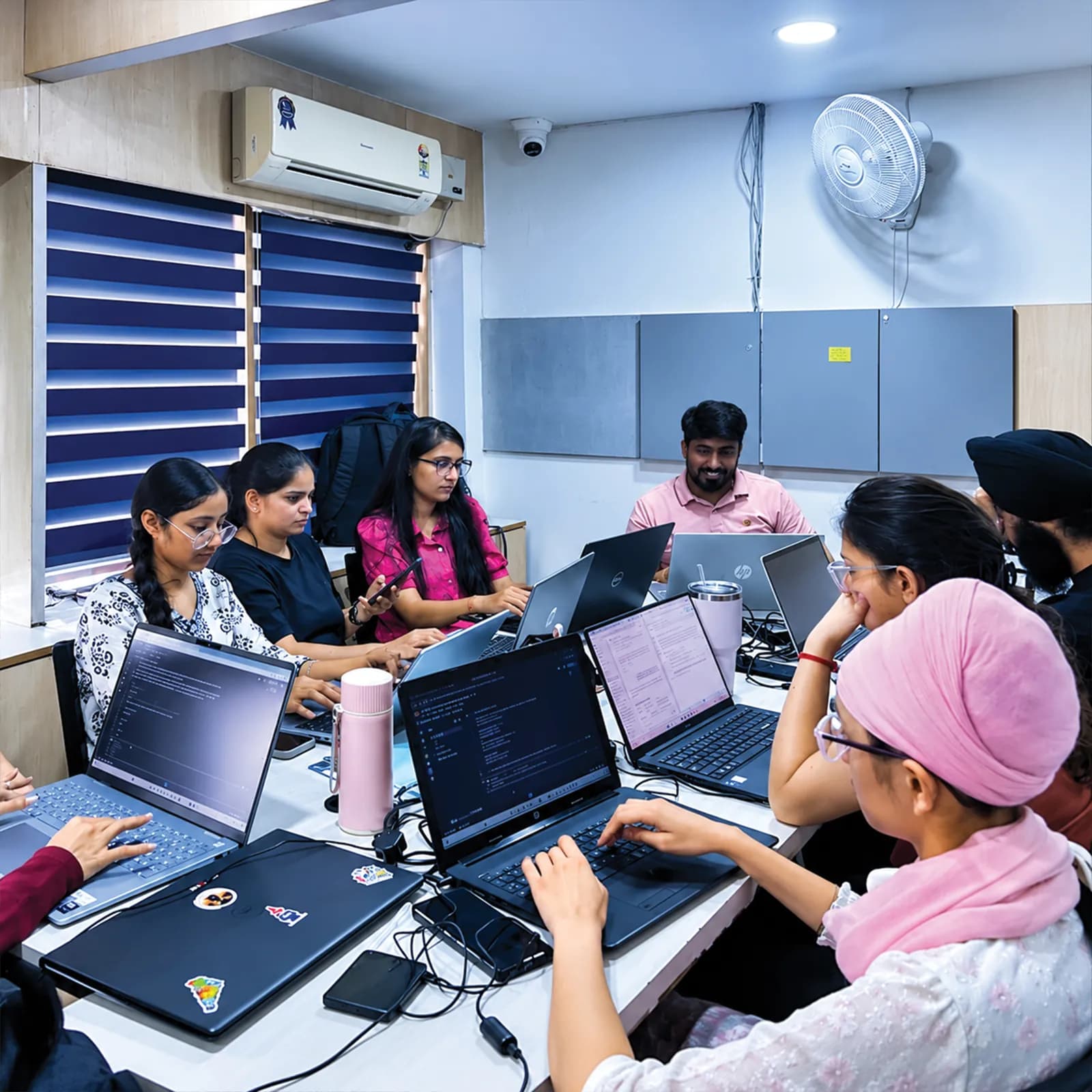
Counselling, practicals and project reviews at one centre in Jalandhar.
Every day ends in a notebook or worksheet you complete yourself, checked by a mentor.
Ask for the syllabus, a sample assignment, the rubric and the certificate policy before you pay.
An entry assessment decides where you begin, rather than one pace for every student.
Plan your commute around your holidays, and come in for counselling before you confirm a batch. Students travel in from Phagwara, Kapurthala, Nakodar, Hoshiarpur, Adampur and Kartarpur.
techcadd Jalandhar — 2nd Floor, Crystal Plaza, SCS 78, Opposite PIMS Hospital, Jalandhar, Punjab 144001Frequently asked questions
Answers can differ by degree, semester and batch — confirm academic requirements with your own institution.
It is enough for a structured introduction: Python, data preparation, core machine learning models, evaluation and a mini project. It is not enough to become an expert, and the page does not claim otherwise.
Yes. The programme uses basic statistics and the intuition behind models rather than formal proofs. Regular practice matters more than advanced mathematics.
Not strictly — the first five days cover Python basics. But the pace is quick, so practising variables, loops and functions beforehand, or doing the optional foundation work, helps a lot.
It is training: 45 days of guided practicals and a mini project. It is not a workplace internship, and should not be described as one in your report or CV.
Only your college or university can confirm that. Check its summer or industrial training rules and get written approval before you join.
Ask which documents are available for your batch — joining letter, attendance record, training report format. Any document will describe the programme as training, and university acceptance is not guaranteed.
Yes. The last eight days are a mini project with a problem statement, data dictionary, baseline, experiments, model card and presentation.
Artificial intelligence is the broad field of systems that perform tasks needing human-like judgement. Machine learning is the part of AI where models learn patterns from data — most of this programme.
You get an introduction to generative AI concepts and limitations, prompt evaluation and how to verify output responsibly. It is not a dedicated generative AI course.
Ask the centre for its current laptop requirement. Many exercises also run in Google Colab in a browser, but your own machine helps with practice at home.
Yes, as a foundation. First-year students should expect an introduction and plan to keep practising afterwards.
Yes. MCA students with programming experience usually move through the Python days quickly and can take on a more ambitious mini project.
Data science training puts more weight on analysis, statistics and reporting; AI and machine learning training focuses on building and evaluating models. Compare the two syllabi day by day before choosing.
Yes — an entry assessment, daily worksheets or notebooks, mentor checkpoints and a final project evaluation.
No fee is published here. Ask for the written fee including taxes, any assessment or material charges, and the refund terms before you pay.
No. A 45-day programme builds foundations; hiring depends on your skills, projects, interviews and employer criteria.
You can still join, but ask about the foundation work and do it before the batch. Expect to spend extra time practising Python in the first two weeks.
Only the fundamentals of neural networks and overfitting. Deep learning in depth belongs in the six-month programme.
Send an enquiry from this page or call +91 98881 22254 with your course, semester and Python experience. A counsellor will explain the batch, syllabus and fees.
techcadd Jalandhar is at 2nd Floor, Crystal Plaza, SCS 78, Opposite PIMS Hospital, Jalandhar, Punjab 144001. Visit for counselling before you confirm a batch.
Apply
Request the syllabus, batch dates, fees and eligibility. Tell us your course, semester, Python experience and whether you need university training documentation.