6 Months Industrial Training Program in Jalandhar with Live Projects
Explore 6 months industrial training in Jalandhar with live projects, guided skills development and portfolio-focused learning. Enquire at techcadd.
On this page
- 6 Months Industrial Training Program in Jalandhar with Live Projects
- What is a 6-month industrial training program?
- Why live projects matter more than just finishing a syllabus
- Who should consider industrial training in Jalandhar?
- B.Tech and engineering students
- BCA and MCA students
- Diploma students
- Beginners, recent graduates and career explorers
- Explore technology pathways for your six-month training
- A practical 6-month learning roadmap
- What does “live project training” actually include?
- Example: build a full-stack service booking application
- How projects can be reviewed
- What skills could you gain by the end?
- Industrial training, internship and short-term course: what is the difference?
- College documentation checklist before you enrol
- Why consider techcadd for industrial training in Jalandhar?
- How a project portfolio can support career preparation
- How to choose the right training track
- Admissions and programme enquiry in Jalandhar
- Frequently asked questions
- Who can apply for six-month industrial training in Jalandhar?
- Does the six-month programme include live projects?
- Is six-month industrial training compulsory for every student?
- Can BCA and MCA students choose full-stack development?
- Which technologies are useful in software development training?
- Will I receive a certificate after training?
- Is an internship letter the same as a training certificate?
- Does industrial training guarantee a job?
- Will the project be available on GitHub?
- Can diploma students enrol in training in Jalandhar?
- How are live projects different from classroom assignments?
- What documents should I take to the enquiry?
- How much does six-month industrial training cost?
- Are online or offline batches available?
- Can the programme help with a final-year project?
- What should a final project report contain?
- What if I am unsure between web development and data analytics?
- How do I apply for the next six-month training batch at techcadd Jalandhar?
- Start building experience you can explain
6 Months Industrial Training Program in Jalandhar with Live Projects
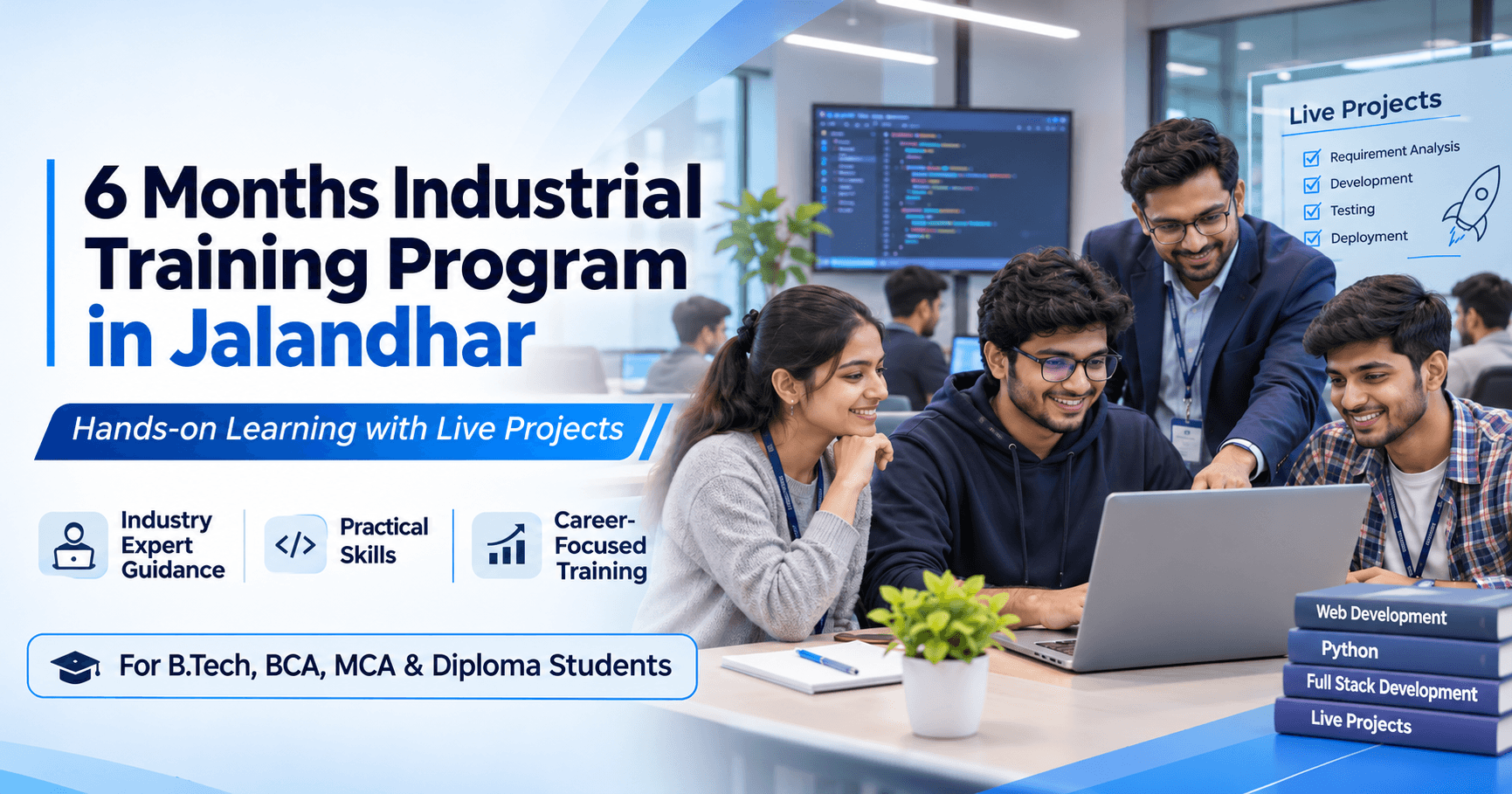
College teaches you the concepts. A real project shows whether you can use them. If you have ever completed a programming assignment but felt unsure how to build, debug and explain an entire application, a structured six-month training experience can help bridge that gap.
The 6 Months Industrial Training Program in Jalandhar with Live Projects at techcadd is designed around an essential goal: moving from isolated lessons to practical, demonstrable work. Students can explore a suitable technology pathway, practise with hands-on assignments, and work toward a substantial project they can explain in an interview or academic presentation. Confirm the currently available track, project format and documentation requirements during your enquiry.
For B.Tech, BCA, MCA and eligible diploma students, the most useful training is not simply a long list of topics. It is a clear learning plan with feedback, project milestones and a final deliverable worth showing.
What is a 6-month industrial training program?
Six-month industrial training in Jalandhar is an extended period of practical, skill-focused learning that may form part of a college curriculum or serve as independent professional development. In technology pathways, learners typically progress through foundations, guided exercises, teamwork practices and a capstone application or analysis project. The exact requirement depends on the university, board, degree and semester.
Industrial training and an internship are related but not always identical. Training may combine instruction with project work; an internship usually implies assigned workplace responsibilities. A simulated or mentor-led project should not be described as paid employment or live client delivery. Before joining, ask what type of project you will complete and what supporting documents your institution requires.
Why live projects matter more than just finishing a syllabus
Imagine learning React components, databases and APIs separately. You understand each chapter, but a hiring manager asks: “How did you handle login, validation, errors and deployment in one application?” A project-based training model gives you a reason to connect those skills. You learn to solve practical problems, not merely repeat definitions.
· Apply concepts in a connected product or workflow.
· Practise planning, debugging, testing and explaining technical decisions.
· Maintain a project repository with meaningful commits and documentation.
· Present a working demonstration and discuss what you would improve.
· Create evidence of learning that may support internships and entry-level interviews.
Who should consider industrial training in Jalandhar?
B.Tech and engineering students
If your degree requires semester training or a major project, start by checking the academic calendar, approval form, evaluation rubric and the number of training weeks required. Match your chosen development track to your branch and career goal.
BCA and MCA students
Students who know programming fundamentals but lack end-to-end application experience can use a structured pathway to strengthen database design, API development, version control, testing and project presentation.
Diploma students
Diploma learners can benefit from practical training, but documentation and approval rules differ by board and programme. Ask your institution what kind of provider, project evidence, attendance records and reports it accepts before enrolment.
Beginners, recent graduates and career explorers
A beginner may start with programming basics, while someone with prior experience may need a more demanding capstone. The right starting point depends on the track. You do not need to know every technology before making an enquiry, but you should be clear about your learning level and time commitment.
Explore technology pathways for your six-month training
Choose a direction that aligns with your interests and entry-level role targets. The examples below describe relevant skills and projects; availability and final module selection should be confirmed with techcadd Jalandhar.
Pathway
What you could learn
Example outcome
Full stack / MERN
HTML, CSS, JavaScript, React, Node.js, Express, MongoDB
A booking or task-management web application
Python / backend
Python, APIs, SQL, Django / Flask concepts
A stock-management or helpdesk system
Data analytics
Excel, SQL, Python, Pandas, dashboards
An interactive sales performance dashboard
AI / ML
Data preparation, model training, metrics, simple deployment
A prediction demo with evaluation notes
Cloud / DevOps
Linux, Git, containers, deployment fundamentals
A containerized app and deployment notes
Cybersecurity
Network basics, safe web security practices, OWASP
A controlled lab audit and remediation report
A practical 6-month learning roadmap
The six-stage plan below is a suggested structure for a 24-week learning journey. It is not a claim that each techcadd batch follows identical dates, hours or assessment methods.
Stage
Main learning objective
Evidence of progress
Month 1 — Foundations
Programming, computer/web fundamentals, tools and problem-solving
Small exercises and a clean Git repository
Month 2 — Core stack
Language/framework fundamentals, databases and APIs
Working mini-feature or data workflow
Month 3 — Applied development
Architecture, integration and data handling
Functional project prototype
Month 4 — Project build
User stories, development milestones, collaboration
Sprint demos, documented decisions
Month 5 — Quality and delivery
Testing, fixes, security basics and deployment
Stable build, test notes and live/demo environment
Month 6 — Capstone and readiness
Project polish, documentation, presentation, interview practice
Portfolio-ready project, README and final demo
What does “live project training” actually include?
“Live project” can mean different things across training providers. It may be a realistic simulated brief, a project developed within the institute or work linked to an external client. The learning value depends less on the label and more on the responsibilities you actually complete. Ask whether you will write code or analysis yourself, receive reviews, manage changes and present the finished result.
Example: build a full-stack service booking application
1. Plan the requirements: users should browse services, book appointments and view booking status.
2. Design the interface: build responsive pages with HTML, CSS, JavaScript and React.
3. Create the backend: expose REST API endpoints with Node.js and Express.
4. Store and retrieve data: use MongoDB or an appropriately selected SQL database.
5. Implement access control: validate input, use secure password handling, and enforce server-side permissions.
6. Test and debug: cover important flows, failure cases and validation messages.
7. Deploy and document: publish a working demo where feasible, commit code to Git and write a useful README.
8. Present: explain architecture, lessons learned, trade-offs and future improvements.
How projects can be reviewed
A practical assessment can look at functionality, code clarity, test coverage, data handling, security basics, commit history, project explanation and documentation. Even when a project is unfinished, a well-documented problem-solving process can reveal genuine progress.
What skills could you gain by the end?
· Problem decomposition: turn a vague requirement into achievable tasks.
· Technical fluency: connect a chosen language or framework to practical use cases.
· Debugging habits: identify errors systematically instead of copying a fix without understanding it.
· Project delivery: use version control, requirements, tests and documentation.
· Professional communication: explain your work to mentors, classmates and interviewers.
· Career direction: discover whether frontend, backend, full stack, analytics or another area suits your strengths.
Industrial training, internship and short-term course: what is the difference?
Option
Typical emphasis
Best fit
6-month industrial training
Extended guided skills practice and sustained project work
Academic semester requirements or deep skill-building
Internship
Workplace tasks under an organisation, with responsibilities depending on role
Exposure to team processes and actual work contexts
Short course
Focused topics over a shorter period
Learning one skill or testing an interest
These categories may overlap. The title alone does not prove employment status, university recognition or any stipend. Ask for the written scope of the specific programme.
College documentation checklist before you enrol
Students often discover paperwork requirements too late. Before committing to a six-month industrial training programme in Jalandhar, check with your department or training and placement cell about the following:
· Training approval or permission letter and required joining date.
· Required attendance format, weekly diary or logbook.
· Project topic approval and supervisor sign-off expectations.
· Training completion certificate or letter format, if required.
· Final report, presentation, evaluation and viva requirements.
· Whether institute-led projects are acceptable under your specific university or board policy.
techcadd can be asked about current documentation practices, but only your college or university can confirm what it will accept for your individual programme.
Why consider techcadd for industrial training in Jalandhar?
A useful conversation with techcadd should begin with your goals: your course and semester, your current skills, the type of role you want and any academic paperwork. From there, you can ask to review the current track syllabus, the expected project workflow, mentor feedback arrangements, attendance expectations and the final deliverables.
Instead of judging an institute only by claims about job placement, judge the learning process. Can you see what you will build? Will you receive feedback? Can you describe how your progress is checked? These questions help you make a more informed decision.
How a project portfolio can support career preparation
A portfolio does not replace sound fundamentals, nor does it guarantee a job. But it gives interviewers concrete material to discuss. A strong portfolio entry can include a problem statement, architecture diagram, GitHub repository, screenshots or demo, the parts you built, tests and an honest explanation of limitations.
Learning pathway
Possible entry-level directions
Full stack / backend
Junior web developer, backend trainee, software developer intern
Data analytics
Junior data analyst, reporting analyst trainee, BI intern
AI / ML
ML intern or junior data role when prerequisites are met
Cloud / DevOps
Cloud support trainee, junior DevOps trainee
Cybersecurity
Security operations trainee or junior security support
Job titles and suitability depend on the learner’s skills, portfolio and employer criteria. Hiring and placement outcomes are not guaranteed.
How to choose the right training track
9. Identify your starting point: complete beginner, familiar with basic coding or already building apps.
10. Decide your target: university project, skill development, portfolio or internship preparation.
11. Choose one primary track rather than collecting unrelated technologies.
12. Request the latest module plan, project examples and assessment method.
13. Confirm batch timings, teaching mode, fees, certificate wording and college documentation in writing.
14. Compare the real work you will complete, not just the number of tools listed.
Admissions and programme enquiry in Jalandhar
Interested in six months of practical technology training? Contact techcadd Jalandhar to discuss current batch availability, suitable tracks, prerequisites, project options, course charges and how the programme may align with your college timetable. If you require specific institutional paperwork, bring the official format to the enquiry conversation.
Frequently asked questions
Who can apply for six-month industrial training in Jalandhar?
The programme is relevant to B.Tech, BCA, MCA and eligible diploma students, as well as other learners seeking extended practical study. Entry requirements vary by chosen technology track and current batch.
Does the six-month programme include live projects?
The page focuses on project-led learning. Ask techcadd Jalandhar whether the current track uses a simulated, institute or external-client brief and what project work you will personally complete.
Is six-month industrial training compulsory for every student?
No single rule applies across all universities, courses and semesters. Your academic department or board can confirm whether industrial training is required and which formats qualify.
Can BCA and MCA students choose full-stack development?
Yes, full-stack development is a relevant option for learners interested in web applications. The appropriate entry level and current track availability should be checked before enrolment.
Which technologies are useful in software development training?
Common tools include HTML, CSS, JavaScript, React, Node.js, Express, Python, SQL or MongoDB, plus Git and API testing. Your chosen pathway determines which are relevant.
Will I receive a certificate after training?
Ask techcadd for the exact document issued, its conditions, sample wording and the completion requirements. Confirm separately that your college accepts the format.
Is an internship letter the same as a training certificate?
Not necessarily. Documents can serve different academic or employment purposes. Check the issuer, dates, activities described and the format required by your institution.
Does industrial training guarantee a job?
No. Practical projects and preparation may support applications, but hiring depends on skills, vacancies, assessments and employer decisions.
Will the project be available on GitHub?
A repository and clear README are recommended portfolio deliverables, subject to project ownership, privacy rules and the current programme workflow.
Can diploma students enrol in training in Jalandhar?
Diploma students may be eligible, but they should first confirm relevant batch options and their board’s approval and reporting requirements.
How are live projects different from classroom assignments?
A substantial project normally integrates multiple skills over time, including requirements, implementation, testing and demonstration. Simple assignments typically practise one concept at a time.
What documents should I take to the enquiry?
Bring your current qualification details, semester dates, a list of existing skills and any college-issued training or internship forms.
How much does six-month industrial training cost?
Fees may depend on the batch and chosen track. Request the latest written fee breakdown and check what materials or services are included.
Are online or offline batches available?
Teaching modes and batch schedules can change. Ask the Jalandhar team what is currently available for your intended track.
Can the programme help with a final-year project?
A suitable project pathway may help you develop a practical major project, but your academic supervisor must approve the topic and submission requirements.
What should a final project report contain?
Usually a problem statement, objectives, technology stack, system design, implementation, testing, results, limitations and references, adapted to your college format.
What if I am unsure between web development and data analytics?
Compare the actual tasks: web development is centred on building applications, while analytics involves preparing, querying and interpreting data. Ask to review sample project briefs.
How do I apply for the next six-month training batch at techcadd Jalandhar?
Contact the Jalandhar team, share your course and career goal, and request verified information about available tracks, schedules, prerequisites, documents and fees.
Start building experience you can explain
The value of six months is not measured only by attendance. It is measured by how confidently you can show what you built, explain the decisions you made and improve the result after feedback. Explore a suitable project-led industrial training pathway with techcadd Jalandhar and get clear answers before you enrol.
Have a questionabout this?
Leave your number and a counsellor will call you back — about batch timings, fees, EMI options, placement record, or which track fits your degree.
- Free career counselling, no registration fee
- Weekday, evening, weekend or 1-on-1 batches
- Internship letter and placement support
Ready to get started?
Start building yourcareer today.
Talk to a counsellor today. One call is usually enough to know which track fits your degree, your schedule and the job you want.
- Free career counselling
- No registration fee
- Placement support included