After 12th 6-Month Artificial Intelligence Program in Jalandhar
A project-driven path into modern AI — Python for AI, deep learning, NLP, LLM internals, prompt engineering, RAG, AI agents and the production deployment of AI applications, spread across six hands-on months.
Artificial Intelligence Certificate Program Course in Jalandhar
Enrol in the 6-month Artificial Intelligence course after 12th at techcadd Jalandhar (4.9★, 556+ reviews). Learn Python, scikit-learn, PyTorch, NLP, Transformers, LLM internals, prompting, multi-model APIs, vector search, RAG, LangChain and CrewAI agents, FastAPI backends, multimodal AI, Docker and cloud deployment — ending with an industry capstone.
Key Highlights :
- Duration: 6 Months
- Mode: Practical + Theory
- Eligibility: 12th Pass, Any Stream
- Includes: Certificate + Placement Support
Course Overview
techcadd's 6-Month Artificial Intelligence programme in Jalandhar is written for students after 12th from any stream, with no coding background assumed. It moves through Python and AI/ML foundations, deep learning and NLP, LLM internals and prompting, RAG and AI agents, AI application development, and finally deployment, security and a capstone — six months of hands-on, project-driven training combining practical labs with the theory behind them.
The extra length compared to the shorter Artificial Intelligence track buys depth rather than filler: machine learning gets its own dedicated time with model training, evaluation and cross-validation using scikit-learn; NLP is taught separately from Transformers and Hugging Face; chatbot design and multimodal AI are separated from general application development; and AI security — prompt injection, jailbreak defence and secret management — plus responsible AI get proper coverage. The final month adds project documentation, a GitHub portfolio, resume building and mock interviews on top of the end-to-end capstone, which integrates LLMs, RAG pipelines, AI agents, Docker and full cloud deployment into one application.
What You'll Learn
Every module ends in something you have built and a trainer has reviewed, so the list below is work you will have done rather than topics you will have heard about.
- 01
Build neural networks and computer vision models using PyTorch
Tensor operations, neural networks, CNNs, transfer learning and OpenCV — written and trained rather than described.
- 02
Understand LLM internals: tokenization, embeddings and attention
Why a context window costs what it costs, why token boundaries break code, and what attention is actually doing underneath a chat interface.
- 03
Write effective, structured prompts across multiple model APIs
System prompts, structured prompting and prompt optimization, applied across OpenAI, Gemini, Claude, Grok and local Ollama models.
- 04
Design and query vector databases for semantic search and RAG
Embeddings into FAISS, ChromaDB, Pinecone and Qdrant, then hybrid search, re-ranking, evaluation and guardrails on top.
- 05
Build AI agents and multi-agent systems with LangChain and CrewAI
Chains, memory and prompt templates, then tool calling and MCP, then autonomous workflows and enterprise agent design.
- 06
Deploy AI applications with FastAPI, Docker and major cloud platforms
Async backends with background tasks and WebSockets, containerised behind Nginx and shipped to AWS, Azure AI or Google Vertex AI, including serverless.
- 07
Ship a complete AI industry capstone with a professional portfolio
One end-to-end application integrating LLMs, RAG, agents, Docker and cloud deployment, with documentation, a GitHub portfolio, a resume and mock interviews behind it.
Course Curriculum
Six months of hands-on learning, organised month by month: Python and AI/ML foundations, then deep learning and NLP, then LLM fundamentals and prompting, then RAG and AI agents, then AI application development, and finally deployment and the capstone.
Month 1 — Python & AI/ML Foundations
- 1
Python fundamentals — the language from the ground up.
- 2
VS Code as the working environment.
- 3
The uv package manager and virtual environments.
- 4
Git and GitHub for version control.
- 5
ChatGPT and GitHub Copilot as development tools.
- 6
Object-oriented programming.
- 7
Exception handling and logging.
- 8
Type hinting.
- 9
pytest for automated testing.
- 10
APIs and JSON.
- 11
FastAPI basics.
- 12
NumPy for numerical computing.
- 13
Pandas basics for working with tabular data.
- 14
Statistics and probability for AI.
- 15
Linear algebra essentials.
- 16
Machine learning with scikit-learn.
- 17
Model training, evaluation and cross validation.
Tools you will actually work in
Everything here is installed on the lab machines and used on live client work, not shown once in a slide and forgotten.
- VSGPTCh
Who can do this course
Students straight after 12th
Join from any stream. There is no assumed technical knowledge and no programming prerequisite. Most students run the programme alongside a degree at a Jalandhar college using the weekday or weekend batch.
Graduates and final-year students
If you are finishing a BCA, B.Sc, BBA or B.Tech, this is the version that changes which interviews you are invited to. You arrive with a deployed AI application, a GitHub portfolio and mock interviews behind you.
Career changers
The weekend batch exists for people already earning. Six months of evenings and Saturdays is enough to move into AI Engineer and AI Application Developer roles without leaving your current job first.
Developers and analysts
If you already write Python or work with data, the foundation topics move quickly and the LLM, RAG, agent and deployment months are the point. Those are the skills currently missing from almost every engineering team.
Build with AI. Ship it for real.
- Modern AI work is a stack, not a subject: a model, a retrieval layer that grounds it in your own data, an agent loop that lets it act, a backend and interface people can use, a deployment that survives traffic, and guardrails for the day a prompt injection arrives.
- This programme teaches every one of those layers in sequence, with a single capstone that integrates LLMs, RAG pipelines, AI agents, Docker containerisation and full cloud deployment into one application you can put your name on.
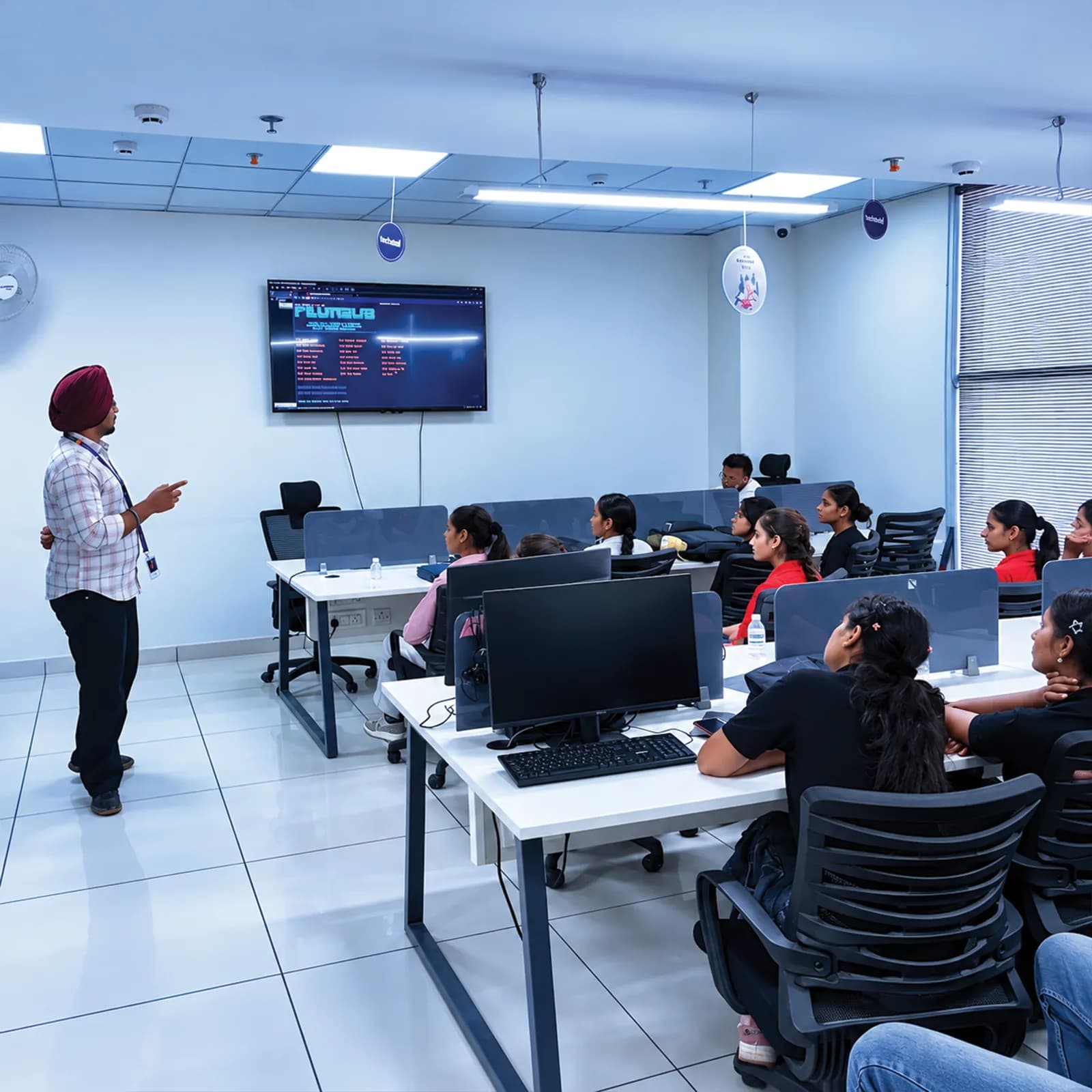
Get certified in Artificial Intelligence Certificate Program
Complete the course with a portfolio of live projects and receive an industry-recognised certificate, plus a documented internship letter accepted by Punjab universities.
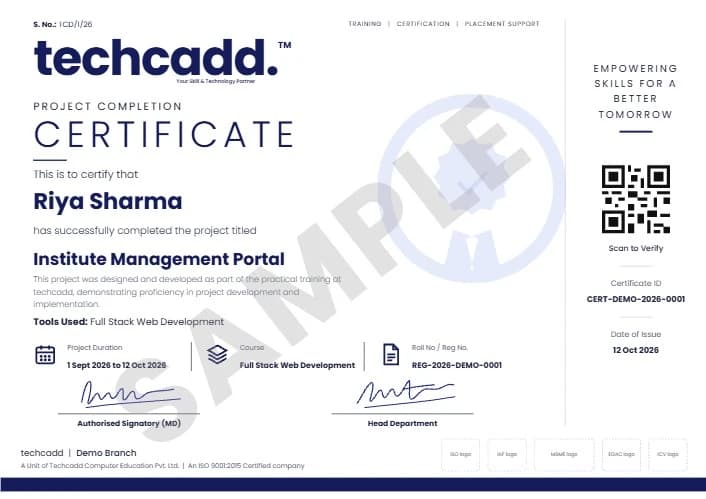
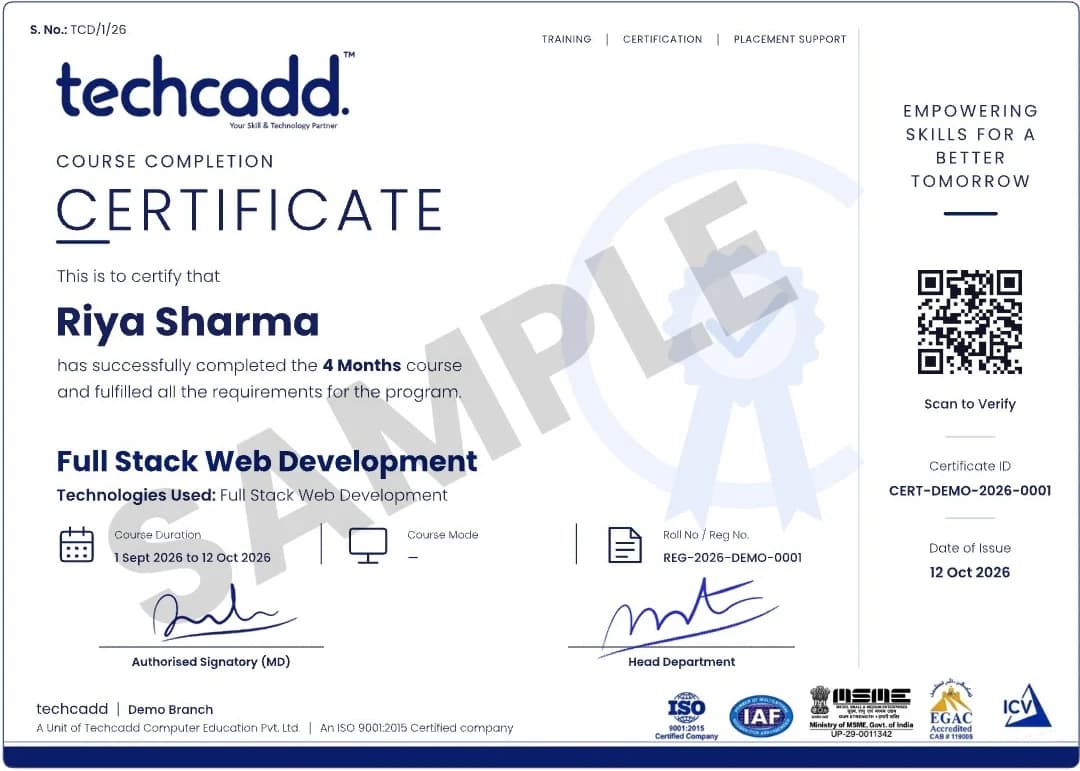
Two certificates on completion — the course certificate and a separate capstone project certificate.
Where this course takes you
The roles this opens, what they pay in Punjab and beyond, and who is hiring for them — the same figures our free Salary Estimator publishes, not a brochure number.
The core destination from this programme. You build and ship systems with models in them — retrieval, agents, backends and deployment — rather than training models from scratch. Show: the capstone, the RAG pipeline and the deployed application.
Closer to the model than the product: scikit-learn, model training, evaluation and cross-validation, then PyTorch and neural networks. That block is this role's foundation and it gets a full two months.
Neural networks, CNNs, transfer learning and computer vision with OpenCV, then Transformers and the Hugging Face Model Hub. The six-month course is the one that gives this dedicated depth rather than a single pass.
Owning the model layer of a product — tokenization, embeddings, context windows, multi-provider routing through LiteLLM, and the cost and latency decisions that follow. The language-model, retrieval and deployment topics are exactly this work.
Building systems that act rather than answer: LangChain and LangGraph, CrewAI, MCP, tool calling, multi-agent systems and enterprise agent design. Currently the hardest AI role to fill.
The full product: an async FastAPI backend with WebSockets behind a Streamlit, Gradio or Chainlit interface, containerised with Docker and deployed to AWS, Azure AI or Vertex AI. The capstone is the portfolio piece this interview asks for.
Hands-on projects you will ship
Artificial Intelligence Certificate Program Fundamentals Build
A guided artificial intelligence certificate program exercise that applies the first modules to a complete, working outcome.
Artificial Intelligence Certificate Program Real-World Brief
A realistic artificial intelligence certificate program brief with requirements, constraints, review cycles and a documented final result.
Live Client-Style Project
A supervised project modelled on the work delivered by techcadd's service teams, with scope, feedback and handoff practice.
Portfolio Capstone
A final artificial intelligence certificate program project you explain through a case study, demonstration and interview-ready portfolio entry.
Learn it. Build it. Make it yours.
Every project moves through the same loop: understand the brief, build with guidance, then explain the decisions behind your work.
Understand
Break a real requirement into a clear plan and the right tools.
Artificial Intelligence Certificate Program Fundamentals BuildBuild
Work hands-on with trainer feedback while the decisions are still easy to change.
Artificial Intelligence Certificate Program Real-World BriefPresent
Turn the finished work into a portfolio story you can defend in an interview.
Live Client-Style ProjectWhy students choose techcadd
Nine campuses across Punjab, 4.9★ from 556+ reviews, and a syllabus that is republished each year rather than reprinted.
Learn at your own pace
You advance when a deliverable passes review. A student who needs extra time on Transformers gets it; nobody is moved on because the timetable says so.
Real model APIs, with budgets
Labs run against live OpenAI, Gemini, Claude and Grok endpoints with per-student token budgets, plus local models through Ollama — so the cost of a design decision is something you have felt.
Trainers who still ship
The people teaching RAG evaluation and agent orchestration are the people writing them for client work, which is why the guardrails sections cover failures that actually happen.
Placement prep is built in
The final month includes project documentation, a GitHub portfolio, resume building, mock interviews and industry standards — the part most AI courses leave to the student.
Frequently asked questions
Find answers to the questions students ask before enrolling.
Six months, organised month by month: Python and AI/ML foundations, deep learning and NLP, LLM fundamentals and prompting, RAG and AI agents, AI application development, and deployment with the capstone. Weekday, evening and weekend batches cover the same syllabus, and 1-on-1 training is available if you would rather set your own pace. Every class runs for 2 hours, whichever format you choose.
The shorter track covers the same arc in four months. This six-month course adds depth rather than new topics: machine learning gets its own dedicated time with training, evaluation and cross-validation; NLP separates from Transformers; agents get thorough coverage instead of a brief overview; chatbot design and multimodal AI separate from application development; AI security gets proper attention; and placement preparation is added at the end.
No. The course begins with Python fundamentals and the tooling around them, then adds engineering practice, the maths and machine learning before PyTorch appears. The programme is built for students joining straight after 12th from any stream.
OpenAI, Gemini, Claude and Grok through their APIs, local models through Ollama, and LiteLLM to route between them. On top of that: PyTorch and Hugging Face for models you train or fine-tune, and Whisper and vision-language models for multimodal AI.
RAG grounds a model's answers in your own documents rather than in whatever it memorised — embeddings, a vector database, hybrid search, re-ranking and guardrails. An agent goes further: it plans its own next step, calls a real tool, reads the result and repeats. The later months build both, including multi-agent systems.
One complete, industry-level AI application — the capstone — an LLM-powered app with RAG, AI agents, Docker containerisation and full cloud deployment, followed by project documentation, a GitHub portfolio, resume building and mock interviews. Every month before it contributes a working piece of that build.
The syllabus targets nine roles: AI Engineer, Machine Learning Engineer, Deep Learning Engineer, LLM Engineer, AI Agent Developer, Prompt Engineer, NLP Engineer, AI Application Developer and Freelance AI Consultant. Which one fits depends on whether you lean toward the model, the product or the agent layer — and the capstone is the evidence all nine interviews ask for.
A fresher with a deployed AI application and a documented portfolio typically starts around ₹25,000 – ₹50,000 per month in the Jalandhar and Ludhiana market, rising quickly with a second year of production experience. AI work also carries more remote and freelance opportunity than most, since the systems are not in the room.
No training provider can honestly guarantee a job, and you should be cautious of anyone in Jalandhar who claims one. techcadd guarantees placement support: CV reviews, mock interviews, portfolio preparation and repeated drives with hiring partners across Jalandhar and Ludhiana — and the final month is built around exactly that.
Yes. The programme ends in a documented final evaluation — capstone demonstration, technical viva and certification — and every student receives an industry-recognised certificate on completion alongside a documented internship letter based on live project work.
Ask about Artificial Intelligence Certificate Program
Send your question and a counsellor will call you back about batch timings, fees, EMI options, placement record, or whether this course fits your degree.
- info@techcadd.com
- Phone
- +91 98881 22254
- Address
- 2nd Floor, Crystal Plaza, SCS 78, Opposite PIMS Hospital, Jalandhar, Punjab 144001
- Counselling hours
- Monday – Saturday, 9:00 AM – 7:00 PM
Not sure if Artificial Intelligence Certificate Program is the right fit?
One call with a counsellor is usually enough to find out. Book a free demo class and see the lab before you decide.