Best After 12th 6-Month Data Science Certificate Program in Jalandhar
A six-month, project-driven path you can start straight after school — from Excel and Python fundamentals through machine learning and deep learning to LLMs, RAG, AI agents and a deployed industry capstone.
Data Science Certificate Program Course in Jalandhar
A 6-month, project-driven Data Science programme for school leavers at techcadd Jalandhar (4.9★, 556+ reviews): Excel and Power BI, Python, SQL, Pandas and Polars, machine learning, deep learning, LLMs, vector databases, RAG, AI agents, FastAPI and cloud deployment — 24 modules and one industry AI capstone. Fresher Data Analyst and AI roles start around ₹18,000 – ₹32,000.
Key Highlights :
- Duration: 6 Months
- Mode: Classroom & 1-on-1
- Eligibility: 12th Pass
- Includes: Placement Support
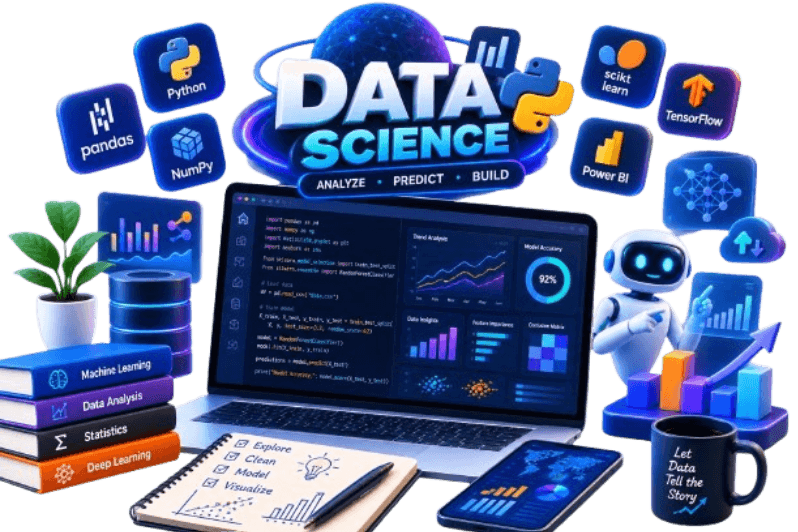
Course Overview
This is the 2026 edition of the Data Science Mastery Program, written for someone starting straight after 12th. Six months, one theme per month, 24 modules, and something you have built at the end of each. What makes it different from an older data science syllabus is that the classical pipeline and the AI stack are taught as one job rather than two courses — you finish able to clean data and train a model, and also to put a working AI assistant in front of a business.
Month one is data and programming foundations: advanced Excel, Power Query, Power BI, DAX, business dashboards and KPI reporting; then Python from the ground up with VS Code, the uv package manager, virtual environments, OOP, exception handling, logging, type hinting, pytest, Ruff and Black; Git, GitHub and AI coding tools including Copilot and Cursor; and SQL on PostgreSQL with database design, window functions, query optimisation, APIs, JSON, FastAPI basics, authentication with JWT and Postman.
Month two is data engineering and machine learning — Pandas 2.x, NumPy, Polars, DuckDB and PyArrow, then data cleaning, feature engineering, EDA, interactive visualisation with Plotly and Streamlit, statistics and probability, scikit-learn pipelines and cross validation, and gradient boosting with XGBoost, LightGBM and CatBoost. Month three is deep learning and computer vision: PyTorch, tensors and neural networks, CNNs and transfer learning with OpenCV, YOLO, OCR, image segmentation and Vision Transformers, then Hugging Face, tokenizers and the Model Hub.
Months four and five are the AI half. Month four covers LLM fundamentals — tokenization, embeddings, context windows and attention — prompt engineering and structured prompting, the OpenAI, Gemini, Claude and Grok APIs alongside Ollama and LiteLLM, and embeddings with FAISS, ChromaDB, Pinecone, Qdrant and Milvus for semantic search. Month five turns that into applications: RAG architecture with hybrid search, re-ranking, evaluation and guardrails; LangChain, LangGraph, CrewAI and the Model Context Protocol with tool calling and structured outputs; AI agents and multi-agent systems; and FastAPI advanced, async, background tasks, WebSockets, Streamlit, Gradio and Chainlit. Month six deploys everything — Docker and Docker Compose, Linux, Nginx, AWS, Azure AI and Google Vertex AI, AI security including prompt injection and jailbreak defence, secret management, responsible AI and CI/CD with GitHub Actions — and finishes with a complete industry-level AI SaaS application built on FastAPI, PostgreSQL, RAG pipelines and AI agents, documented and pushed to a professional GitHub repository.
What You'll Learn
Every module ends in something you have built and a trainer has reviewed, so the list below is work you will have done rather than topics you will have heard about.
- 01
A business dashboard in month one
Advanced Excel, Power Query, DAX and Power BI producing a real KPI dashboard — the piece that makes you useful to a Jalandhar employer before the Python work has even finished.
- 02
A tuned, evaluated model
Not a fitted notebook: a scikit-learn pipeline with cross validation, then XGBoost, LightGBM and CatBoost compared and hyperparameter-tuned, with an evaluation report you can defend.
- 03
A working RAG assistant
Documents chunked and embedded into a vector database, retrieved with hybrid search and re-ranking, answered by an LLM behind guardrails, and evaluated rather than assumed to work.
- 04
An industry AI SaaS capstone
The whole of month six: FastAPI, PostgreSQL, RAG pipelines and AI agents, containerised with Docker, deployed to the cloud with CI/CD, documented and pushed to a professional GitHub repository.
Course Curriculum
The syllabus is a six-month calendar of 24 modules, four per month, and every module produces something a trainer reads rather than a set of notes. Months 1 and 2 build the data and machine learning foundation, month 3 is deep learning and computer vision, months 4 and 5 open the LLM, RAG and agent stack and turn it into applications, and month 6 is deployment, AI security and the industry capstone.
Month 1 — Data & Programming Foundations
- 1
Module 01 · Excel, Power BI & Data Literacy — Excel Advanced, Power Query, Power BI, DAX, business dashboards, KPI reporting, AI productivity, data literacy
- 2
Module 02 · Python Fundamentals & Engineering Practices — VS Code, uv package manager, virtual environments, OOP, exception handling, logging, type hinting, pytest, Ruff, Black
- 3
Module 03 · Git, GitHub & AI Coding Tools — Git, GitHub, Git Flow, GitHub Copilot, Cursor AI, Windsurf IDE
- 4
Module 04 · SQL, Database Design & APIs — SQL (PostgreSQL), database design, window functions, query optimisation, APIs, JSON, FastAPI basics, authentication, JWT, Postman
Tools you will actually work in
Everything here is installed on the lab machines and used on live client work, not shown once in a slide and forgotten.
- XlPBSPPOXGLICAYOGPTGACRMCFAChPcAWSAAGVGGVS
Who can do this course
Students doing a degree alongside
Most students run this next to a BCA, B.Sc, BBA or B.Com at a Jalandhar college. Six months of evenings or weekends puts a deployed AI application on your CV well before campus placements begin.
Commerce and arts students
Nothing here needs school physics or higher mathematics. Statistics and probability are taught in month two at the depth the modelling actually needs, and the Excel and Power BI work in month one is directly employable on its own.
Anyone choosing between a degree and a skill
You do not have to choose. This is a certificate programme with a fixed six-month end date, and what it produces — a GitHub repository, a deployed capstone, a dashboard someone can use — is what a first employer inspects.
Career restarters and switchers
A gap or an unrelated background counts for less than work someone can open. The syllabus is identical whoever you are; only the batch timing changes.
Self-taught learners
If free videos left you with half-finished notebooks, what changes here is a trainer reading your code every week and a capstone month with a deadline attached to it.
Why this programme is worth your year
Excel, Power BI and data literacy
Advanced Excel, Power Query, DAX, business dashboards and KPI reporting in month one — the half of the syllabus that is employable before the rest of it finishes.
Python and SQL, properly
Modern Python with uv, virtual environments, OOP, type hinting, pytest and Ruff, plus PostgreSQL with window functions, query optimisation and FastAPI basics with JWT.
Machine learning and deep learning
scikit-learn pipelines and cross validation, XGBoost, LightGBM and CatBoost, then PyTorch, CNNs, transfer learning, YOLO, OCR and Hugging Face.
LLMs, RAG and AI agents
Tokenization, embeddings and attention; the OpenAI, Gemini, Claude and Grok APIs; five vector databases; RAG with hybrid search and guardrails; LangChain, LangGraph, CrewAI and MCP.
Cloud deployment and AI security
Docker, Nginx, AWS, Azure AI and Google Vertex AI with GitHub Actions CI/CD — plus prompt injection and jailbreak defence, secret management and responsible AI.
1 industry-level capstone
A full month on one end-to-end AI SaaS application with FastAPI, PostgreSQL, RAG and agents, delivered with documentation, code review and a managed GitHub repository.
Classical Data Science and the AI Stack, in One Six-Month Programme
- 24 modules from Excel and SQL through machine learning, deep learning, RAG and AI agents — ending in a deployed industry AI SaaS capstone.
- Fresher Data Analyst and AI roles in Punjab start around ₹18,000 – ₹32,000 a month for someone with a portfolio an employer can open.
Get certified in Data Science Certificate Program
Complete the course with a portfolio of live projects and receive an industry-recognised certificate, plus a documented internship letter accepted by Punjab universities.
 Computer Education · JalandharCertificateof Project ExcellenceThis is to certify thatStudent Name
has designed, built and deployed a live capstone project in Data Science Certificate Program, reviewed and graded under industry mentorship.
Computer Education · JalandharCertificateof Course CompletionThis is to certify thatStudent Namehas successfully completed the professional training programme in Data Science Certificate Program with a grade of A+.
Two certificates on completion — the course certificate and a separate capstone project certificate.
Where this course takes you
The roles this opens, what they pay in Punjab and beyond, and who is hiring for them — the same figures our free Salary Estimator publishes, not a brochure number.
Build complete data pipelines from Excel and SQL through Python-based data engineering; train, tune and evaluate machine learning and deep learning models for real tasks; design and query vector databases for semantic search and RAG; build production LLM applications with LangChain, LangGraph, CrewAI and MCP; deploy AI applications with FastAPI, Docker, CI/CD and the major cloud AI platforms; apply AI security and responsible AI practice in production; and ship a full industry-level AI SaaS capstone with a professional GitHub portfolio.
Data Analyst, Data Scientist, Machine Learning Engineer, Deep Learning Engineer, LLM / AI Engineer, AI Agent Developer, AI Application Developer, Backend / API Developer and freelance AI consultant. Straight after 12th the realistic first step is usually Data Analyst or an AI application role; the rest open as the portfolio grows.
A fresher with a deployed portfolio typically starts around ₹18,000 – ₹32,000 a month in the Jalandhar market. Two years of delivery experience usually doubles that, and candidates who can demonstrably ship a RAG system or an agent workflow move well beyond it, because far fewer applicants can show one.
No. Statistics and probability are taught in month two at the level the work actually needs — distributions, sampling, evaluation metrics and what a result does and does not prove. Month one starts at Excel and Python fundamentals, so commerce and arts students sit in the same batch and finish the same capstone.
Yes, and this syllabus suits it unusually well. A dashboard, a forecast or a RAG assistant over a client's own documents are all billable independent work, and a Jalandhar address costs you nothing on a remote brief. You finish able to scope it, secure it, deploy it and document it.
Yes. Students who want more depth move on to the 9-month programme or to an adjacent techcadd track — Artificial Intelligence, Data Analytics or Full Stack Development. The Python, SQL, Git and deployment work carries straight over, so the second course is faster than the first.
Hands-on projects you will ship
Business KPI Dashboard
Month one's build: a real business dashboard in Power BI with Power Query transformations and DAX measures, reporting the KPIs a manager actually asks for.
SQL Data Service with FastAPI
A designed PostgreSQL schema with window functions and optimised queries, exposed through a JWT-authenticated FastAPI endpoint and tested in Postman.
End-to-End ML Pipeline
A messy real dataset cleaned and engineered in Pandas and Polars, explored with Plotly, then modelled through a scikit-learn pipeline and beaten with XGBoost, LightGBM and CatBoost — with the evaluation to prove it.
Computer Vision Build
A PyTorch CNN with transfer learning, extended into object detection and OCR with YOLO and OpenCV — the project that makes deep learning concrete rather than theoretical.
RAG Assistant over Real Documents
Embeddings in a vector database with hybrid search, re-ranking and guardrails, answered by an LLM API and evaluated for hallucination — then wrapped in a Streamlit or Chainlit interface.
Industry AI SaaS Capstone
The whole of month six on one application: FastAPI and PostgreSQL, RAG pipelines and AI agents, containerised with Docker, secured against prompt injection, deployed to the cloud with GitHub Actions and documented for review. This is the one interviewers ask about.
Learn it. Build it. Make it yours.
Every project moves through the same loop: understand the brief, build with guidance, then explain the decisions behind your work.
Understand
Break a real requirement into a clear plan and the right tools.
Business KPI DashboardBuild
Work hands-on with trainer feedback while the decisions are still easy to change.
SQL Data Service with FastAPIPresent
Turn the finished work into a portfolio story you can defend in an interview.
End-to-End ML PipelineWhy students choose techcadd
There are many places to learn data science in Jalandhar and the brochure syllabus looks similar at all of them. What differs is who teaches, whether the tooling is current, whether the LLM modules are more than a demo video, and whether anyone picks up the phone after you have paid. techcadd has trained students across Punjab since 2007 on the same model: small batches, working practitioners as trainers, live client work as coursework.
Trainers who still do the work
Your trainer is not a full-time lecturer. They deliver data and AI work for techcadd's services arm, so the examples in class are current rather than a case study from five years ago.
Written for a school leaver
Month one begins at Excel and Python fundamentals. Nothing is assumed, and nothing is skipped on the assumption that a degree will fill the gap later.
Classical and AI in one programme
Gradient boosting and vector databases, scikit-learn pipelines and LangGraph agents, taught in the same six months by the same trainer — because that is how the job is now advertised.
Current tooling, not legacy habits
uv, Ruff, Black and pytest from month one; Polars and DuckDB alongside Pandas; PyTorch and Hugging Face for deep learning. You learn the stack a 2026 team actually runs.
AI on your own API keys
OpenAI, Gemini, Claude and Grok through real API calls, plus Ollama and LiteLLM for local and routed models — with cost, context limits and failure handling met head on rather than skipped.
A placement cell that persists
Resume and portfolio guidance built into the programme, mock interviews and CV reviews, and repeated drives with hiring partners across Jalandhar and Ludhiana.
What our students say
Real experiences from learners across Jalandhar and the districts around it.
“I came from commerce and was sure the maths would stop me. It never did — statistics came in month two and only as much as the models actually needed.”
JKJaspreet KaurAfter 12th Student · Jalandhar “The Power BI dashboard from month one got me a part-time reporting job before I had even reached the machine learning modules.”
DMDhruv MalhotraJunior Data Analyst · Phagwara “I ran this alongside my degree. Nobody else in my class could explain what an embedding is, let alone show a deployed app that used one.”
RBRitika BansalB.Sc Student · Kapurthala “I came from commerce and was sure the maths would stop me. It never did — statistics came in month two and only as much as the models actually needed.”
JKJaspreet KaurAfter 12th Student · Jalandhar “The Power BI dashboard from month one got me a part-time reporting job before I had even reached the machine learning modules.”
DMDhruv MalhotraJunior Data Analyst · Phagwara “I ran this alongside my degree. Nobody else in my class could explain what an embedding is, let alone show a deployed app that used one.”
RBRitika BansalB.Sc Student · Kapurthala
“Month five changed what I could charge. A client wanted a chatbot over their own PDFs and I had already built exactly that, with re-ranking and guardrails.”
YSYuvraj SandhuFreelancer · Hoshiarpur “The capstone month is why the interview went well. They opened my GitHub, read the documentation and asked about my architecture choices.”
SASneha AroraPlaced Fresher · Jalandhar Cantt “Every module ends with something finished and reviewed. That structure is the reason I did not drift the way I had with free videos.”
KSKaranveer SinghAfter 12th Student · Nakodar “Month five changed what I could charge. A client wanted a chatbot over their own PDFs and I had already built exactly that, with re-ranking and guardrails.”
YSYuvraj SandhuFreelancer · Hoshiarpur “The capstone month is why the interview went well. They opened my GitHub, read the documentation and asked about my architecture choices.”
SASneha AroraPlaced Fresher · Jalandhar Cantt “Every module ends with something finished and reviewed. That structure is the reason I did not drift the way I had with free videos.”
KSKaranveer SinghAfter 12th Student · Nakodar
Frequently asked questions
Find answers to the questions students ask before enrolling.
Six months, running as a fixed calendar of 24 modules: data and programming foundations, data engineering and machine learning, deep learning and computer vision, LLM fundamentals and vector search, RAG and AI agents, then deployment and the industry capstone. Weekday, evening and weekend batches cover the same syllabus, and 1-on-1 training is available. Every class runs for 2 hours.
No. Nothing in the six months requires school physics or higher mathematics. Statistics and probability are covered in month two at the depth the modelling needs, and students from all three streams sit in the same batch.
Both, and that is the point of the 2026 edition. Months 1 to 3 are the classical pipeline — Excel and Power BI, Python, SQL, data engineering, machine learning, gradient boosting, deep learning and computer vision. Months 4 to 6 are the LLM stack: tokenization and embeddings, prompt engineering, the OpenAI, Gemini, Claude and Grok APIs, vector databases, RAG architecture, LangChain, LangGraph, CrewAI, MCP, AI agents, FastAPI applications and cloud deployment.
FAISS, ChromaDB, Pinecone, Qdrant and Milvus for vector search. GitHub Copilot, Cursor AI and Windsurf as coding assistants from month one. The OpenAI, Gemini, Claude and Grok APIs with Ollama for local models and LiteLLM for routing in month four, then LangChain, LangGraph, CrewAI and the Model Context Protocol in month five. Real keys, real costs, real rate limits.
Every module produces something a trainer reviews, and six are substantial portfolio pieces: a Power BI KPI dashboard, a JWT-secured FastAPI data service over PostgreSQL, an end-to-end ML pipeline with tuned gradient boosting, a PyTorch computer vision build with YOLO and OCR, a RAG assistant over real documents, and the month-six industry AI SaaS capstone.
A complete industry-level AI SaaS application built over the final month — FastAPI and PostgreSQL, RAG pipelines, AI agents, Docker containerisation and full cloud deployment on AWS, Azure AI or Google Vertex AI. The last module covers the delivery standard: project documentation, code review practice, GitHub repository management and industry best practice.
It is module 22, and it is there because student LLM apps are exactly where prompt injection, leaked API keys and jailbreaks show up. You cover prompt injection and jailbreak defence, secret management, responsible AI and CI/CD with GitHub Actions before the capstone is deployed.
In Jalandhar, six-month programmes with live projects, an internship and placement support typically run in the ₹18,000 to ₹40,000 range, with AI-integrated tracks at the upper end. techcadd counsellors share the current fee sheet and EMI options on request, and a demo class is free.
No institute can honestly guarantee a job, and you should be cautious of any in Jalandhar that does. techcadd guarantees placement support: resume and portfolio guidance built into the programme, CV reviews, mock interviews and repeated drives with hiring partners across Jalandhar and Ludhiana, continued after a rejection rather than abandoned.
Yes — a course completion certificate, plus a documented internship letter based on live work. Alongside them you leave with a professional GitHub portfolio and a deployed capstone application, which is what an interviewer actually opens.
The three-month programme covers the data foundations and analysis; this six-month certificate programme adds machine learning, deep learning, the full LLM and RAG stack, cloud deployment and the industry capstone. The nine-month diploma goes further again. A counsellor can walk you through which fits your timeline.
Yes. techcadd Jalandhar runs weekday, evening and weekend batches in parallel so college students and working people can both attend, and 1-on-1 training is available for a fully personal schedule. Every class runs for 2 hours; book a free demo class to see the lab and meet the trainer before enrolling.
Ask about Data Science Certificate Program
Send your question and a counsellor will call you back about batch timings, fees, EMI options, placement record, or whether this course fits your degree.
- info@techcadd.com
- Phone
- +91 98881 22254
- Address
- 2nd Floor, Crystal Plaza, SCS 78, Opposite PIMS Hospital, Jalandhar, Punjab 144001
- Counselling hours
- Monday – Saturday, 9:00 AM – 7:00 PM
Not sure if Data Science Certificate Program is the right fit?
One call with a counsellor is usually enough to find out. Book a free demo class and see the lab before you decide.