On this page
- What Is Agentic AI, and Why Is Everyone Talking About It?
- How Agentic AI Is Changing Data Science
- What an AI agent can already do
- Will AI take away data science jobs?
- What Should You Learn First? A Practical Roadmap for Students
- Start with the basics that never go out of style
- Then move towards machine learning and AI agents
- Common mistakes beginners make
- Do you need a technical background?
- Why Learning This in Jalandhar Makes Sense
- Learn by doing, not just by watching
- Your next step
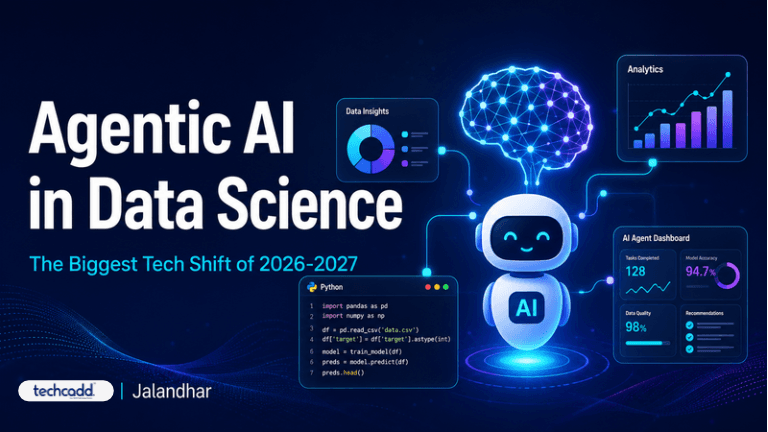
What Is Agentic AI, and Why Is Everyone Talking About It?
If you have used ChatGPT or Claude, you already know how a regular AI tool works. You ask a question, it replies, and then you decide what to do next. Agentic AI works differently. You give it a goal, and it plans the steps, uses tools, checks its own results and keeps going until the job is done.
Think of it as the difference between asking a friend for directions and hiring a driver. One tells you the way. The other takes you there.
How Agentic AI Is Changing Data Science
Data science has always involved a lot of repetitive work. Anyone who has opened a real dataset knows the feeling: missing values, strange formatting, duplicate rows. Cleaning and preparing data often eats up most of a project’s time, long before any exciting modelling begins.
This is exactly where AI agents are stepping in.
What an AI agent can already do
Clean and organise raw data without being told every step
Write, run and debug Python code
Test several models and compare their results
Build a first draft of a dashboard or report
For a student, that sounds either thrilling or a little scary. Probably both.
Will AI take away data science jobs?
This is the question many students quietly worry about, so here is the honest answer. Agents are very good at completing tasks. They are not good at deciding which problem is worth solving, or whether a result actually makes sense for a real business. Someone still has to ask the right question, question the output and explain the findings in plain language to a person who has never seen a line of code.
So the work is not disappearing. It is shifting from doing every step by hand to guiding, checking and improving what the AI produces. Students who understand the basics underneath, like statistics, Python and how models behave, will be far better placed than those who only know how to press buttons.
What Should You Learn First? A Practical Roadmap for Students
Here is the good news: you do not need to master everything at once. If you are just starting out, a clear order makes the whole journey feel much lighter.
Start with the basics that never go out of style
Begin with Python and simple statistics. These two are the backbone of almost everything in data science. Python helps you work with data, and statistics helps you understand what the data is actually telling you. Without them, even the smartest AI agent will leave you confused about whether its answer is right or wrong.
After that, add SQL for working with databases, and a tool like Power BI or Tableau for showing results visually. Many beginners skip SQL because it looks boring, and later realise most real company data lives in databases. Do not make that mistake.
Then move towards machine learning and AI agents
Once your foundation feels comfortable, step into machine learning. Learn how models are trained, why they fail and how to measure their performance. Only after this does it make sense to explore agentic AI tools, where you learn to give clear goals, review what the agent has done and fix what it gets wrong.
Common mistakes beginners make
Jumping straight to AI tools without learning the fundamentals
Collecting certificates instead of building real projects
Copying code without understanding why it works
Trusting AI output without checking it
Do you need a technical background?
Not necessarily. Many students from commerce, science and even arts backgrounds start data science from zero. What matters more is curiosity, regular practice and a willingness to get things wrong a few times before they go right. The learning curve feels steep in the first month and gets easier after that.
Why Learning This in Jalandhar Makes Sense
Jalandhar has quietly become a strong place to start a tech career. Between its growing IT training scene, local businesses going digital and easy access to nearby cities like Ludhiana, Amritsar and Chandigarh, students no longer need to move far away just to get good exposure. Sports goods, manufacturing, education and retail companies around the region are already collecting data, and many of them need people who can make sense of it.
Learn by doing, not just by watching
The biggest difference between a student who gets hired and one who struggles is usually practical experience. Reading about agentic AI is useful, but building something with it is what actually sticks. At techcadd, the focus stays on hands-on learning, where you work on real projects, get your doubts cleared in person and practise the tools companies are actually asking for.
A simple project is enough to begin with. Take a messy sales dataset, let an AI agent help you clean it, then check its work yourself and build a small dashboard. That one project teaches you more than a week of passive tutorials.
Your next step
You do not have to wait until you feel “ready”. Nobody does. Start with Python this week, build one small project next month and keep adding to your skills step by step. By 2027, the students who began early will be the ones companies notice first.
If you are in Jalandhar and want guidance on where to begin, techcadd can help you plan a learning path that fits your background, your pace and your career goals.
Keep reading
- Top 10 Data Science Applications in Real Life: A Simple Guide for Jalandhar StudentsEver wondered where data science is actually used? From Netflix suggestions to hospital diagnoses, here are 10 real-life applications explained simply for Jalandhar students exploring a data science career with techcadd.
- GraphRAG: The Next Big Thing in AI and Data Science (A Student’s Guide for Jalandhar) GraphRAG is changing how AI understands data by connecting information instead of just searching it. Curious what it means for your career? Explore how it works, why it matters, and how students in Jalandhar can start learning AI and data science with techcadd.
- AI vs. Human Intelligence: Who Has the Edge? A Student’s Guide from JalandharWill AI take over human jobs, or do people still hold the upper hand? Find out where AI wins, where human intelligence shines, and how students in Jalandhar can build future-ready skills with techcadd.
Comments
Loading…