On this page
- Full Stack React Development at techcadd Jalandhar: Skills, Tools and Industry Trends
- Why So Many Students Are Choosing Full Stack React
- What Does “Full Stack” Actually Mean?
- Is It Suitable for Beginners?
- How techcadd Jalandhar Approaches Learning
- The Skills You Need to Learn, in the Right Order
- Tools Worth Getting Comfortable With
- Industry Trends Students Should Know About
- Building Projects That Get You Noticed
- What Can You Do After Learning Full Stack React?
- A Few Honest Tips Before You Start
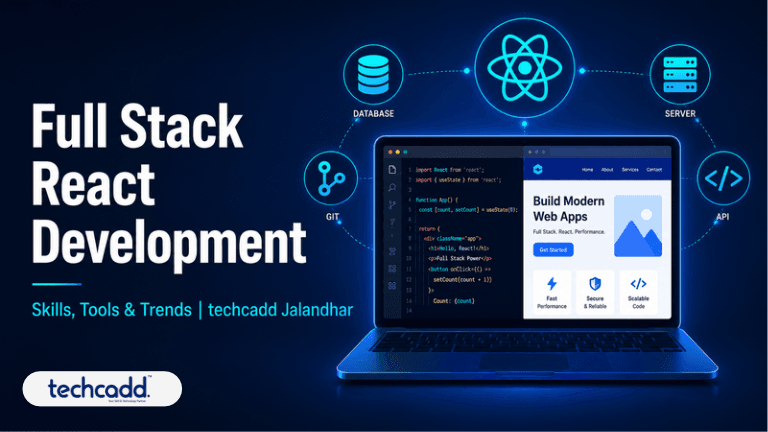
Full Stack React Development at techcadd Jalandhar: Skills, Tools and Industry Trends
Why So Many Students Are Choosing Full Stack React
Ask any final-year student in Jalandhar what they want to do after college, and you’ll hear the same mix of excitement and worry. They want a tech career, but the options feel endless: web design, app development, data, cloud. Where do you even begin?
Full stack React development keeps coming up as an answer, and for good reason. It lets you build a complete web application on your own, from the screen people see to the server and database working quietly behind it.
What Does “Full Stack” Actually Mean?
Think of a food delivery app. The menus, buttons and cart you tap on are the front end. The system that stores your order, checks your payment and tells the restaurant to start cooking is the back end. A full stack developer understands both sides.
React handles the front end. It’s a JavaScript library created by Meta that helps you build fast, interactive pages out of small reusable pieces called components. Pair it with Node.js on the server and a database like MongoDB, and you can build something real from start to finish.
Is It Suitable for Beginners?
This is the question students ask most, and the honest answer is yes, as long as you start in the right order. You don’t need a computer science degree or years of coding experience. You do need patience and a willingness to build things, break them, and fix them again.
The most common beginner mistake is jumping straight into React without learning HTML, CSS and basic JavaScript first. It feels faster, but it leaves gaps that later show up as confusing bugs. With strong basics, React feels far less intimidating.
How techcadd Jalandhar Approaches Learning
At techcadd in Jalandhar, the emphasis is on learning by building. Instead of only watching lectures and copying code, students work on practical projects, so concepts stick because you’ve actually used them. That matters more than it sounds: when you sit in an interview, showing something you built speaks louder than listing topics you’ve studied.
The Skills You Need to Learn, in the Right Order
One reason students feel lost is that they try to learn everything at once. A smoother path is to take it step by step.
1. HTML, CSS and JavaScript. This is your foundation. Spend real time here, especially on JavaScript concepts like functions, arrays, objects and asynchronous code. Everything in React builds on them.
2. React fundamentals. Components, props, state and hooks like useState and useEffect are the core. Once these click, you can build things like a to-do app, a weather dashboard or a simple portfolio site.
3. Back end with Node.js and Express. This is where your app learns to think. You’ll create APIs, handle user requests and connect everything together.
4. Databases. MongoDB is popular with beginners because it’s flexible, while SQL databases like MySQL are widely used in companies. Knowing the basics of both is a real advantage.
5. Git and GitHub. Many students skip this until it’s too late. Employers expect you to know version control, and your GitHub profile quietly acts as your second resume.
Tools Worth Getting Comfortable With
You don’t need dozens of tools, just the right ones. VS Code is the editor most developers use. Postman helps you test your APIs without building a front end first. Chrome DevTools shows you exactly what’s going wrong when something breaks. For styling, Tailwind CSS has become a favourite because it speeds up design work considerably. Many teams also use Next.js, a framework built on React, so it’s a smart skill to explore once your React basics feel solid.
Industry Trends Students Should Know About
The web development world keeps moving, but a few trends are clearly here to stay:
Next.js and server-side rendering are becoming standard because they help pages load faster and rank better on search engines.
TypeScript is showing up more and more in job descriptions, since it catches errors before your code even runs.
AI-assisted coding tools are now part of many developers’ daily workflow. They’re helpful, but you still need to understand the code they produce. Learn the fundamentals first, then let these tools speed you up.
Full stack roles are in demand with startups and small teams, where one developer often handles several responsibilities.
Notice what stays constant: strong fundamentals matter more than chasing every new tool.
Building Projects That Get You Noticed
Certificates are nice, but a portfolio is what makes a recruiter stop scrolling. Aim for three or four solid projects instead of ten half-finished ones. A good starting set could be:
A personal portfolio website to show who you are and what you’ve built.
An e-commerce or booking app with login, a product or service list, and a cart or booking form.
A blog or notes app with full create, edit and delete features connected to a database.
Keep each project on GitHub with a clear README, and if possible, deploy it online so anyone can open it with a single link. Interviewers love that.
What Can You Do After Learning Full Stack React?
Once you’re comfortable, several doors open. You can apply for roles like junior React developer, front end developer, MERN stack developer or full stack developer. Many students also begin with internships or freelance work for local businesses in Jalandhar and nearby cities, which gives real experience while you keep learning. Skills like these can also lead to remote opportunities with companies outside Punjab, so your location doesn’t have to limit your career.
A Few Honest Tips Before You Start
Learning to code can feel slow at first, and that’s completely normal. Almost every developer you admire once stared at an error message for an hour. Here’s what tends to help:
Code a little every day instead of cramming once a week.
Build along with tutorials, then rebuild the same project without looking.
Ask doubts early. Getting stuck alone for days drains motivation.
Learn in a place where mentors review your work and push you to improve.
That last point is where a structured environment makes a difference. At techcadd in Jalandhar, students get guided practice, project-based learning and feedback from trainers who understand where beginners struggle. If you’ve been wondering whether this path is right for you, start with the basics, build something small this week, and let your confidence grow from there.
Keep reading
- Top 10 Full Stack Development Institutes in Jalandhar Compared (2026 Guide)Confused about where to learn full stack development in Jalandhar? Here's an honest, student-focused comparison of the top 10 institutes to help you pick the right one for your goals.
- From Confused Beginner to Full Stack Developer: A Jalandhar Success StoryA real Jalandhar student's journey from knowing nothing about coding to becoming a full stack developer — the doubts, the struggles, and what actually made the difference.
- Advanced React JS in Jalandhar: Master Hooks, Context API & State Management with techcaddStruggling to move beyond React basics? Learn how Hooks, Context API and state management work in real projects, and how students in Jalandhar can build job-ready React skills with techcadd.
Comments
Loading…