On this page
- Why Ranking on Google Actually Matters
- What Ranking Really Depends On
- Is This Something Beginners Can Actually Learn?
- Keyword Research: The Foundation of Everything
- On-Page SEO: Making Google Understand Your Page
- Technical Basics You Shouldn’t Skip
- Backlinks, Authority, and Common Beginner Mistakes
- Mistakes Beginners Make Again and Again
- Where Do You Go From Here?
Why Ranking on Google Actually Matters
If you’ve ever typed something into Google and clicked the first link without even thinking twice — congratulations, you’ve just experienced exactly why SEO exists. Most people never scroll past the first page. Ever.
So if you’re a student in Jalandhar thinking about building websites, running a blog, or even helping local businesses get noticed online, understanding how Google ranking works isn’t optional anymore. It’s one of the most practical, real-world skills you can pick up right now.
Here’s the thing most beginners get wrong: they think SEO is some secret code only tech wizards understand. It’s not. It’s more like understanding what Google is actually trying to do — which is simple. Google wants to show people the most helpful, trustworthy, relevant answer to whatever they typed. Your job as someone learning SEO is to make your website that answer.
What Ranking Really Depends On
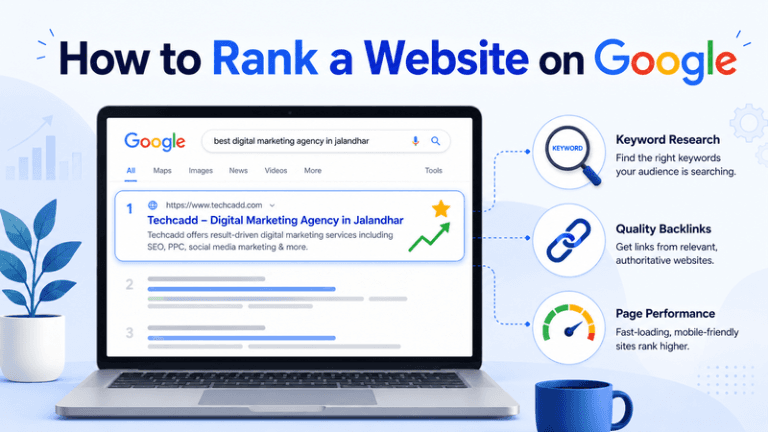
Ranking isn’t one single trick. It’s a mix of things working together:
Relevance — does your content actually match what people are searching for?
Authority — do other trustworthy sites link back to you or mention you?
User experience — does your site load fast, work on mobile, and feel easy to use?
Content quality — are you genuinely answering the question, or just filling space?
A lot of students assume ranking is all about stuffing keywords everywhere. That’s actually one of the fastest ways to get ignored — or worse, penalized — by Google.
Is This Something Beginners Can Actually Learn?
Yes, honestly. You don’t need to be a coding expert to understand SEO fundamentals. What you need is patience and the willingness to think like a searcher, not just a website owner. Once that shift happens, SEO starts making a lot more sense.
Keyword Research: The Foundation of Everything
Before you write a single line of content, you need to know what people are actually searching for. This is where keyword research comes in, and it’s honestly the step most beginners rush through — which is a mistake.
Think about it this way: if you write an amazing article but nobody is searching for those exact words, Google has nothing to match you with. Tools like Google Keyword Planner, Ubersuggest, or even just Google’s autocomplete and “People also ask” section can show you real phrases people type in.
A common beginner mistake? Targeting only short, broad keywords like “SEO” or “digital marketing.” These are brutally competitive. Long-tail keywords — longer, more specific phrases like “how to rank a local business website on Google” — bring in fewer searches, but the people searching them are far more likely to actually want what you’re offering.
On-Page SEO: Making Google Understand Your Page
Once you know your keywords, on-page SEO is about placing them naturally where it matters:
Title tag — your keyword should appear here, ideally near the start
Headings (H1, H2, H3) — structure your content so both readers and Google can scan it easily
Meta description — this is your mini-advertisement in search results
URL — short, clean, and keyword-relevant
Image alt text — helps Google understand visuals too
Here’s something students often ask: “Do I need to use the keyword everywhere?” No. Forcing it into every sentence actually hurts readability, and Google’s algorithms are smart enough to notice unnatural repetition. Write for humans first. Google’s crawlers have gotten remarkably good at understanding context and intent, not just exact word matches.
Technical Basics You Shouldn’t Skip
Page speed, mobile-friendliness, and secure HTTPS connections aren’t glamorous topics, but they quietly affect your ranking. A slow, clunky site frustrates visitors — and Google notices when people bounce back to search results quickly.
Backlinks, Authority, and Common Beginner Mistakes
Once your content and technical basics are solid, the next big factor is backlinks — other websites linking to yours. Think of these as votes of trust. If a well-known site links to your page, Google sees that as a signal that your content is worth showing to more people.
For students just starting out, building backlinks might feel intimidating, but it doesn’t have to involve anything shady. Simple, honest ways to start include guest posting on relevant blogs, getting listed in local business directories, or creating genuinely useful content that people naturally want to share or reference. Quality beats quantity every single time here — ten links from respected, relevant sites will do far more than a hundred links from random, low-quality ones.
Mistakes Beginners Make Again and Again
A few patterns show up constantly when students are learning SEO:
Expecting instant results — SEO is slow. Noticeable movement often takes weeks or months, not days.
Ignoring mobile users — most searches now happen on phones, so a desktop-only mindset is outdated.
Copying content from other sites — duplicate or rewritten-but-unoriginal content rarely ranks well.
Forgetting about search intent — ranking for a keyword means nothing if your page doesn’t actually satisfy what the searcher wanted.
Where Do You Go From Here?
If this topic genuinely interests you, the natural next step is to start practicing on a real website — even a small personal blog works. Pair that with learning basic analytics tools so you can actually see what’s working and what isn’t. SEO rewards people who stay consistent and keep testing, far more than people who memorize rules once and never revisit them.
SEO isn’t a one-time fix you apply and forget. It’s an ongoing skill, and once you understand the logic behind it, it becomes far less mysterious and a lot more useful — whether you’re building your own website or helping a local business grow its online presence.
Want to take your SEO skills to the next level? Join techcadd's SEO Course in Jalandhar and learn practical SEO techniques, keyword research, on-page and off-page SEO, technical SEO, and analytics from the basics to advanced concepts. Start learning, gain hands-on experience, and build the skills to grow websites and kick-start your career in digital marketing!
Comments
Loading…