On this page
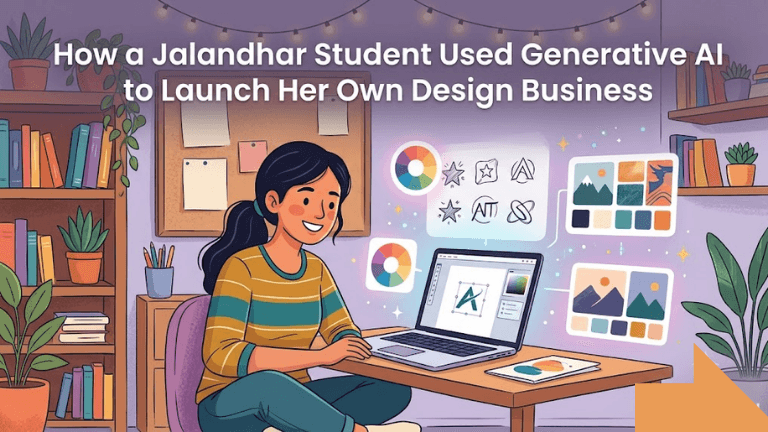
From Curious Beginner to Confident Designer
Meera was like most second-year design students in Jalandhar — sketchbooks full of ideas, a laptop full of half-finished projects, and a nagging feeling that she was falling behind. Everyone around her seemed to be talking about AI tools, but she didn't know where to start. Sound familiar?
It started with something small. A friend showed her how tools like Midjourney and Canva's AI features could turn a rough text description into a full visual concept in seconds. Meera was skeptical at first. Wouldn't this replace designers instead of helping them? But the more she experimented, the more she realized generative AI wasn't there to replace her creativity — it was there to speed it up.
She began using AI to generate quick mood boards for client pitches, something that used to take her hours of manual searching on Pinterest. Suddenly, she could show five different visual directions in the time it used to take to find one reference image. Her college projects started looking more polished, and her professors noticed.
That's when the idea hit her: if AI could help her work faster on assignments, it could help her work faster for actual paying clients too.
She started small. A logo here, a social media template there, mostly for local shop owners around Jalandhar who needed something quick and affordable. She used AI tools to draft initial concepts, then added her own design instincts to refine them — adjusting colors, spacing, and typography until each piece felt genuinely hers.
Within a few months, word spread. A boutique owner recommended her to another. A café asked her to redesign their menu. What began as a way to finish assignments faster had quietly turned into something bigger — a small but real design business, run entirely by a student who was still figuring things out.
What Beginners Get Wrong (And How to Avoid It)
Meera is quick to admit she made mistakes early on. The biggest one? Relying on AI-generated output without adding her own touch. "My first few pieces looked generic," she says. "They looked AI-made because they were AI-made — I hadn't added anything of my own yet." That's a trap a lot of beginners fall into. AI can give you a starting point, but it can't replace your eye for detail, your understanding of a client's brand, or your sense of what actually looks good.
Another mistake was pricing herself too low because she felt like "the AI did most of the work." Over time, she realized clients weren't paying for the tool — they were paying for her judgment, her taste, and her ability to turn a rough idea into something usable.
So, is this suitable for beginners? Yes, but with a mindset shift. You don't need years of experience to start experimenting with generative AI in design. What you need is patience to learn the tools, and enough design fundamentals to know when the AI's output needs fixing.
What can students in Jalandhar do next? Start by picking one AI tool and learning it properly instead of jumping between five. Practice on real briefs, even small ones for local businesses. Build a portfolio that shows the process — how you took an AI-generated concept and made it client-ready.
Meera's story isn't about AI making design easy. It's about a student using the right tools at the right time, staying curious, and not being afraid to turn a class project into something real. For students in Jalandhar wondering where to begin, her advice is simple: "Just start. You'll figure out the rest as you go."
Turning a Side Project Into a Sustainable Business
By her final year, Meera wasn't just doing occasional freelance work anymore — she had a small, steady stream of clients and a name people in her circle recognized. But getting there meant answering a question a lot of students ask themselves: will this skill actually help me in my career, or is it just a fun side hobby?
For Meera, the turning point came when she stopped treating her AI-assisted design work as "extra" and started treating it like an actual business. She set up a simple portfolio website, created a WhatsApp catalog of past projects, and started asking happy clients for reviews and referrals. Nothing fancy — just consistent, small steps that added up.
She also learned to be upfront with clients about her process. Instead of hiding the fact that AI was part of her workflow, she explained it as a strength: faster turnaround, more concept options, and more time spent on refining rather than starting from scratch. Most clients didn't care how the first draft was made — they cared about the final result and how quickly they got it.
What mistakes should you avoid if you're trying to do the same? Don't wait until you feel "ready" to take your first client. Don't undercharge just because part of your process involves AI tools. And don't skip the fundamentals — color theory, layout, typography — thinking AI will cover for gaps in your design knowledge. It won't.
Today, Meera balances coursework with a growing client base, all built from a Jalandhar hostel room and a laptop. Her story isn't unique because she used AI — plenty of students do. It's unique because she treated it as a tool to sharpen her own skills, not a shortcut to skip learning them. And that mindset is what turned a college experiment into a real, working business.
Filed under
Keep reading
- From Confusion to Confidence: One Boy's Journey Into Generative AI at techcadd, Jalandhar A relatable story of a confused beginner who found clarity in Generative AI through techcadd's Jalandhar training — real struggles, real breakthroughs, and a path any student can follow.
- How Generative AI Is Changing Local Search and Digital Marketing in JalandharGenerative AI is reshaping how Jalandhar businesses get found online. Here's how local search and digital marketing are evolving—and what it means for students learning digital marketing today.
- Excel + AI: The New Trend Reshaping Office Work — How techcadd Is Preparing StudentsExcerpt Discover how combining traditional Excel skills with AI tools is transforming modern office productivity. Learn how techcadd is equipping students with advanced, AI-powered spreadsheet techniques to succeed in today's evolving job market.
Comments
Loading…