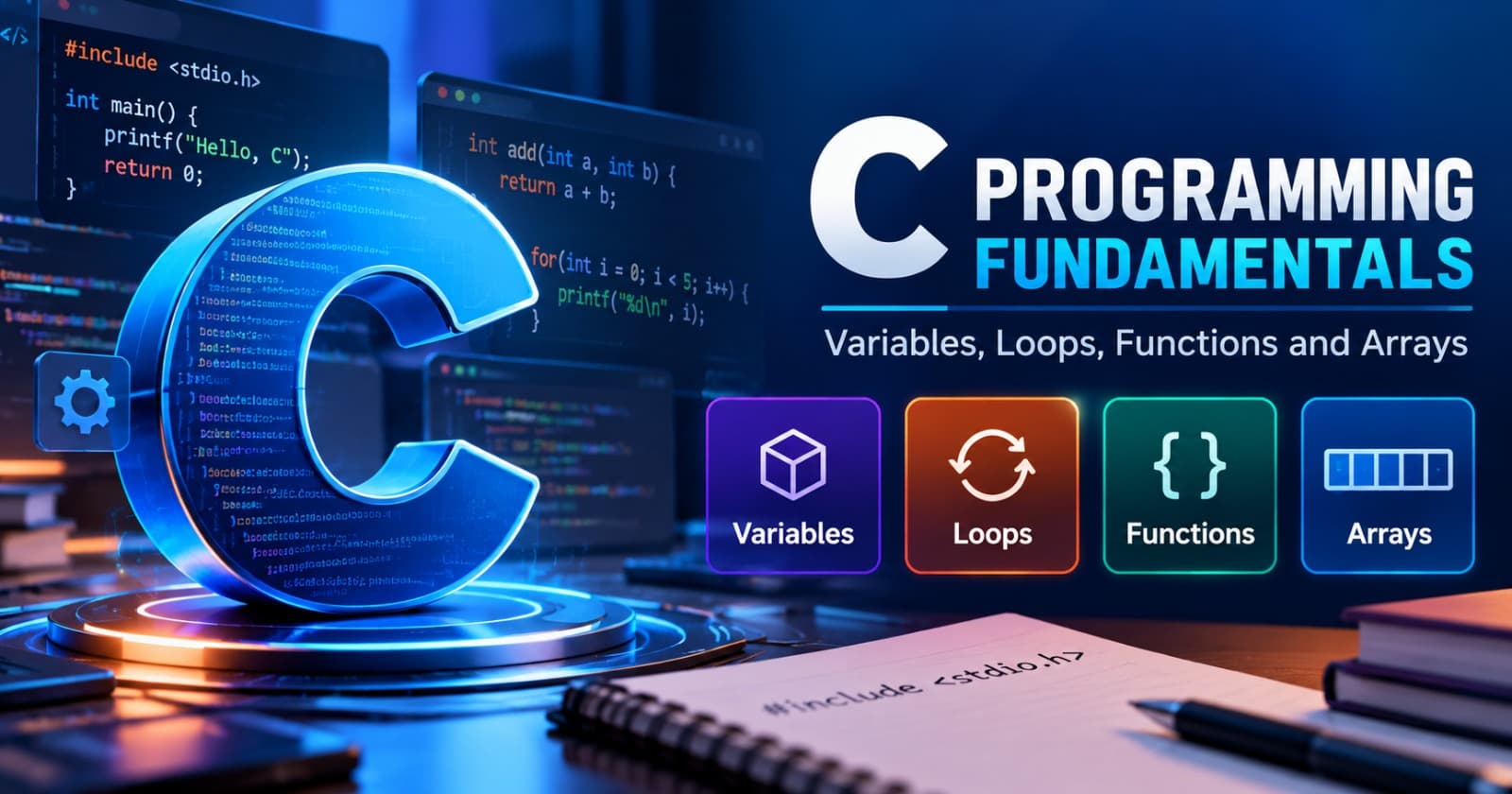
C Programming Fundamentals: Variables, Loops, Functions and Arrays
Learn C programming fundamentals with variables, loops, functions, arrays, conditions, and practical exercises for beginners.
C Programming Fundamentals: Variables, Loops, Functions and Arrays
C programming is a foundational language for students who want to develop strong programming and problem-solving skills. Its simple structure and close interaction with memory make it useful for understanding how programs work at a fundamental level.
For beginners, learning C step by step is important. The learning journey should begin with basic syntax and gradually move towards variables, data types, operators, conditional statements, loops, functions, arrays, strings, pointers, and structures.
What Is C Programming?
C is a general-purpose programming language widely used for system programming, embedded applications, operating systems, and software development. It is also commonly used to introduce students to fundamental programming concepts.
Learning C helps students understand how data is stored, how memory is managed, and how instructions are processed by a computer.
Understanding Variables and Data Types
Variables are used to store information that a program can use and modify. Beginners should understand how variables are declared, initialised, and used in calculations and logical operations.
Common C data types include int, float, char, and double. Students should also learn constants, type conversion, and basic input and output.
A strong understanding of variables and data types creates a foundation for learning more advanced programming concepts.
Using Operators and Conditions
C provides different types of operators for performing calculations, comparisons, and logical operations. Beginners should learn arithmetic, relational, logical, assignment, increment, and decrement operators.
Conditional statements allow a program to make decisions. Students can learn if, if-else, else-if, and switch statements through practical examples such as checking numbers, calculating grades, and creating menu-based programs.
Learning Loops
Loops allow a program to execute a set of instructions repeatedly. They are essential for handling repetitive tasks and processing collections of data.
Beginners should learn:
For loop
While loop
Do-while loop
Students can practise loops through problems involving number patterns, multiplication tables, counting, sums, factorials, and other programming exercises.
Understanding Functions
Functions help divide a program into smaller and reusable sections. Instead of writing the same logic repeatedly, programmers can create a function and call it whenever required.
Beginners should understand function declaration, definition, parameters, return values, and function calls.
Learning functions helps students write programs that are easier to read, test, maintain, and debug.
Working with Arrays
An array allows multiple values of the same data type to be stored under a single name. Arrays are important because they introduce students to organised data storage and prepare them for learning data structures.
Beginners can practise array operations such as:
Traversing an array
Finding maximum and minimum values
Searching for an element
Reversing an array
Sorting elements
Calculating sums and averages
Students can later progress to two-dimensional arrays and matrix-based problems.
Practical C Programming
The best way to learn C is through regular coding practice. Beginners can create small applications such as a calculator, student marks system, simple billing program, number guessing game, or menu-based application.
These projects help learners apply variables, conditions, loops, functions, and arrays together rather than studying each concept separately.
Why Learn C Programming?
C provides a strong foundation for understanding programming logic and computer fundamentals. It can also make it easier to learn languages such as C++, Java, and other programming technologies.
Students who develop strong C fundamentals can progress towards Data Structures and Algorithms (DSA) and explore concepts such as linked lists, stacks, queues, trees, and graphs.
Conclusion
Learning C programming fundamentals is an effective way for beginners to develop programming logic and understand how software works at a fundamental level. Starting with variables and data types, learners can gradually progress through operators, conditions, loops, functions, and arrays.
With consistent coding practice and practical projects, students can build a strong foundation for DSA, software development, and advanced programming concepts.
Learn C Programming Fundamentals
Build a strong programming foundation by learning essential C programming concepts such as variables, data types, operators, conditional statements, and basic input and output. These fundamentals help beginners develop logical thinking and understand how programs work.
Master Loops and Functions
Learn how loops can be used to perform repetitive tasks and how functions can divide programs into smaller, reusable sections. Practice with real programming problems involving calculations, patterns, numbers, and decision-making.
Understand Arrays
Learn how arrays are used to store and manage multiple values efficiently. Students can practise array traversal, searching, sorting, reversing, finding maximum and minimum values, and working with two-dimensional arrays.
Practise Through Programming Projects
Apply C programming concepts through beginner-friendly projects such as calculators, student marks systems, billing applications, number guessing games, and menu-based programs. Practical exercises help connect programming concepts with real problem-solving.
Have a questionabout this?
Leave your number and a counsellor will call you back — about batch timings, fees, EMI options, placement record, or which track fits your degree.
- Free career counselling, no registration fee
- Weekday, evening, weekend or 1-on-1 batches
- Internship letter and placement support
Ready to get started?
Start building yourcareer today.
Talk to a counsellor today. One call is usually enough to know which track fits your degree, your schedule and the job you want.
- Free career counselling
- No registration fee
- Placement support included