Complete SEO Overview
Learn SEO with this complete guide covering on-page, off-page, technical, local SEO, keyword research, link building, tools, and best practices.
On this page
- What is SEO?
- Why is SEO Important?
- How Does SEO Work?
- 1. Crawling
- 2. Indexing
- 3. Ranking
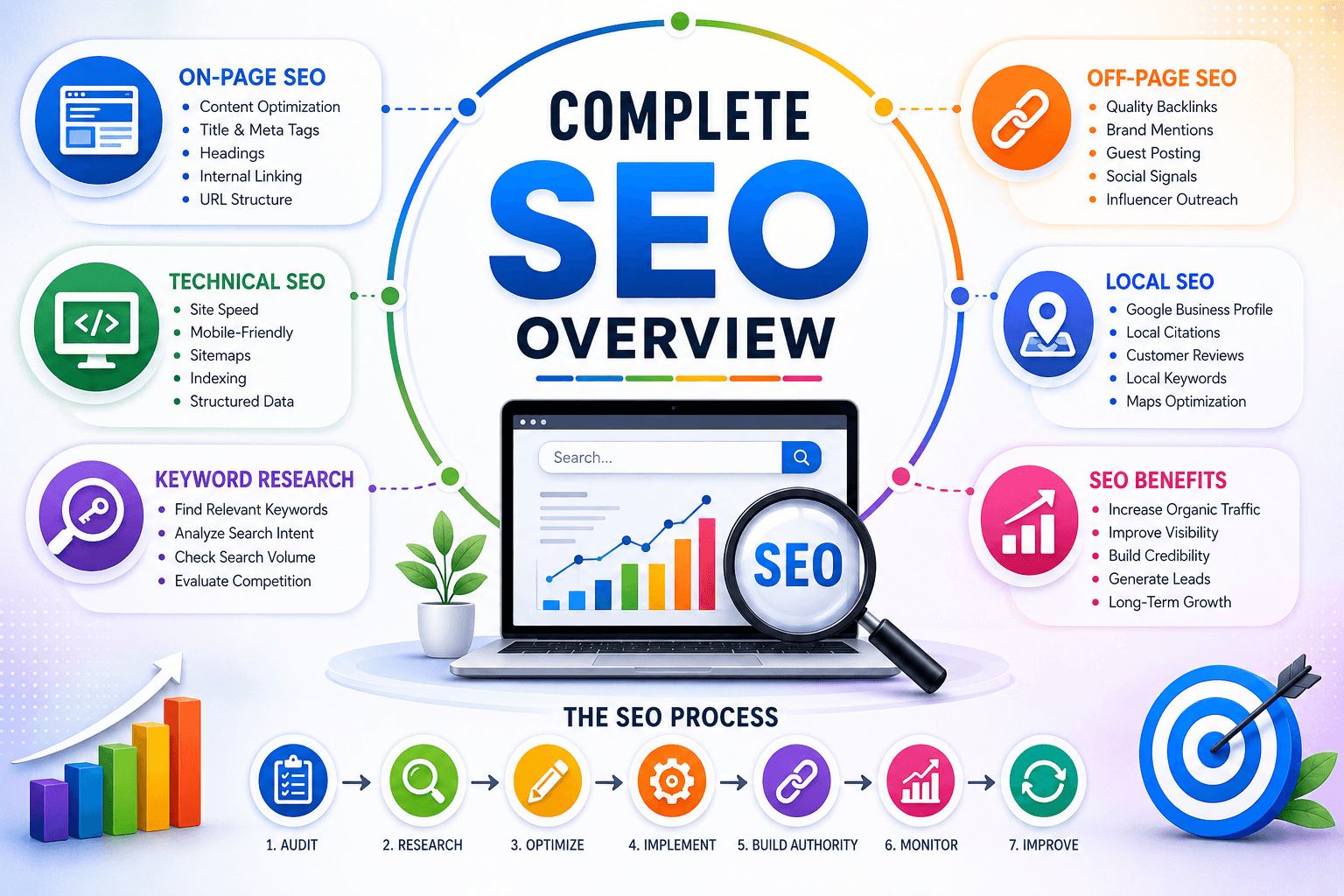
- On-Page SEO
- Technical SEO
- Off-Page SEO
- Local SEO
- E-commerce SEO
- Step 1: Website Audit
- Step 2: Keyword Research
- Step 3: Competitor Research
- Step 4: On-Page Optimization
- Step 5: Technical Optimization
- Step 6: Content Development
- Step 7: Authority Building
- Step 8: Monitor Performance
- Step 9: Improve and Update
What is SEO?
Search Engine Optimization (SEO) is the process of improving a website so that it can appear higher in search engine results for relevant searches. SEO helps search engines understand your website and helps users find useful, relevant content when they search online.
A strong SEO strategy focuses on website structure, content quality, keywords, technical performance, backlinks, user experience, and search intent. Unlike paid advertising, SEO focuses on earning organic visibility in search engine results.
Why is SEO Important?
Most people use search engines to discover products, services, businesses, information, and solutions. Ranking prominently for relevant searches can help a website attract qualified visitors without paying for every click.
The major benefits of SEO include:
Increase organic traffic: Bring more visitors through unpaid search results.
Improve online visibility: Help your website appear for relevant keywords.
Generate quality leads: Reach people who are actively searching for your products or services.
Build credibility: High search visibility can strengthen your online presence.
Improve user experience: SEO encourages faster, mobile-friendly, well-structured websites.
Support long-term growth: A well-optimized website can continue attracting organic traffic over time.
Increase conversions: Relevant traffic can lead to more enquiries, registrations, purchases, or other business goals.
How Does SEO Work?
Search engines such as Google use automated systems to discover, understand, organize, and rank web pages.
SEO generally works through three important stages:
1. Crawling
Search engine crawlers discover webpages by following links and accessing website content.
2. Indexing
After discovering a page, search engines analyze and store information about it in their index when the page is eligible to be indexed.
3. Ranking
When someone performs a search, search engines evaluate many signals to determine which pages are most relevant and useful for that query.
SEO helps make your website easier for search engines to understand while improving its usefulness for visitors.
Major Types of SEO
SEO consists of several areas that work together.
On-Page SEO
On-page SEO focuses on optimizing elements and content directly on your website.
Important areas include:
Keyword optimization
Search intent
Page titles
Meta descriptions
Headings
URL structure
Internal linking
Image optimization
Content quality
Content structure
The goal is to create pages that clearly answer what users are searching for.
Technical SEO
Technical SEO focuses on the technical aspects of a website that affect crawling, indexing, performance, and usability.
Common technical SEO activities include:
Improving website speed
Mobile optimization
Creating and managing XML sitemaps
Checking robots.txt
Fixing broken links
Managing redirects
Improving website architecture
Using HTTPS
Resolving indexing issues
Implementing structured data where appropriate
Off-Page SEO
Off-page SEO involves activities outside your website that can contribute to its authority, reputation, and visibility.
Common activities include:
Earning high-quality backlinks
Digital PR
Brand mentions
Content promotion
Relationship building
Relevant business listings
The focus should be on earning genuine, relevant signals rather than manipulating search rankings.
Local SEO
Local SEO helps businesses become more visible when people search for products or services in a specific geographic area.
Local SEO can include:
Optimizing a Google Business Profile
Maintaining consistent business information
Creating location-specific website content
Earning relevant local links and mentions
Managing customer reviews
Building local relevance
Local SEO is particularly useful for businesses that serve customers in specific cities or areas.
E-commerce SEO
E-commerce SEO focuses on improving the organic visibility of online stores.
It commonly involves optimizing:
Product pages
Category pages
Product titles and descriptions
Images
Internal links
Filters and navigation
Structured data
Technical performance
A good e-commerce SEO strategy can help potential customers discover products through search engines.
Keyword Research
Keyword research is one of the foundations of SEO. It involves identifying the words and phrases people use when searching for information, products, services, or solutions.
Effective keyword research considers:
Search intent
Relevance
Search demand
Competition
Business value
Long-tail keywords
Location-based searches
For example, instead of targeting only a broad term such as “SEO”, a business may also target more specific searches such as “SEO course in Phagwara”, “SEO training for beginners”, or “SEO services for small businesses.”
The best keyword strategy focuses on matching content with what users actually want to find.
SEO Content
Content is an important part of SEO because search engines need useful information to understand and rank pages.
Good SEO content should:
Answer the user's search intent
Provide accurate and useful information
Be easy to read
Use clear headings and structure
Naturally include relevant terms
Avoid unnecessary keyword repetition
Provide original value
Be regularly reviewed and updated when necessary
The objective should not be to write content only for search engines. Create content primarily for people while making it easy for search engines to understand.
Link Building
Links from other websites can help search engines discover pages and can contribute to a site's authority when they are earned naturally from relevant and trustworthy sources.
Effective link-building approaches can include:
Creating valuable resources
Publishing original research
Digital PR
Guest contributions where genuinely useful
Building relationships within your industry
Promoting useful content
Quality and relevance are generally more important than simply collecting a large number of backlinks.
SEO Tools
SEO professionals use different tools to research keywords, monitor performance, identify technical issues, and understand search visibility.
Popular categories of SEO tools include:
Keyword research tools
Website audit tools
Rank tracking tools
Backlink analysis tools
Analytics platforms
Search performance tools
Page-speed testing tools
Google Search Console and Google Analytics are commonly used to understand website performance and user behavior.
SEO Process
A typical SEO campaign can follow this process:
Step 1: Website Audit
Analyze the website's technical health, content, structure, and existing search visibility.
Step 2: Keyword Research
Identify relevant keywords and understand the search intent behind them.
Step 3: Competitor Research
Study competing websites to identify useful content, keyword, and optimization opportunities.
Step 4: On-Page Optimization
Improve titles, headings, content, URLs, internal links, images, and other page elements.
Step 5: Technical Optimization
Fix crawling, indexing, speed, mobile usability, and other technical issues.
Step 6: Content Development
Create useful pages, guides, landing pages, and other content that satisfy search intent.
Step 7: Authority Building
Promote valuable content and work toward earning relevant, high-quality links and mentions.
Step 8: Monitor Performance
Track organic traffic, search visibility, rankings, conversions, and technical health.
Step 9: Improve and Update
SEO is an ongoing process. Analyze results and continuously improve pages based on data and changing search behavior.
SEO vs Paid Advertising
SEO and paid advertising can both bring visitors to a website, but they work differently.
SEO focuses on organic search visibility and generally requires ongoing optimization and content development.
Paid advertising allows businesses to pay for placement and can generate traffic quickly while the campaigns are active.
Many businesses use both strategies to build short-term visibility while developing long-term organic search growth.
Common SEO Mistakes
Some common SEO mistakes include:
Keyword stuffing
Publishing low-quality or duplicate content
Ignoring search intent
Using misleading titles
Creating pages targeting the same intent unnecessarily
Ignoring mobile usability
Neglecting technical SEO
Buying low-quality backlinks
Having poor internal linking
Not monitoring indexing problems
Focusing only on rankings instead of business results
A successful SEO strategy should balance search visibility with user experience and business objectives.
How Long Does SEO Take?
SEO does not usually produce guaranteed or instant results. The time required to see meaningful improvements depends on factors such as website history, competition, industry, technical condition, content quality, authority, and the SEO strategy being implemented.
Some changes may produce improvements relatively quickly, while competitive keywords can require sustained work over a longer period.
SEO should therefore be viewed as a long-term digital marketing strategy rather than a quick fix.
SEO for Businesses
Businesses can use SEO to reach potential customers at different stages of the buying journey.
For example:
Awareness:
Users search for information about a problem or topic.
Consideration:
Users compare products, services, solutions, or providers.
Decision:
Users search for a specific product, service, brand, or local business.
Creating content for these different stages can help businesses attract relevant visitors and guide them toward conversion.
SEO Best Practices
For a strong SEO foundation:
Understand your target audience.
Research relevant keywords and search intent.
Create helpful, original content.
Build a logical website structure.
Optimize page titles and headings.
Use descriptive URLs.
Improve internal linking.
Make your website mobile-friendly.
Improve page performance.
Monitor crawling and indexing.
Earn relevant and trustworthy backlinks.
Track organic traffic and conversions.
Update important content when needed.
Follow search-engine guidelines.
Focus on providing real value to users.
Start Your SEO Journey
SEO combines technical optimization, content strategy, keyword research, website structure, authority building, and continuous analysis. Whether you are a business owner, marketer, student, freelancer, or website owner, understanding SEO can help you build stronger online visibility and attract more relevant organic traffic.
Explore the different areas of SEO to develop a complete understanding of how search optimization works and how it can support long-term website growth.
Have a questionabout this?
Leave your number and a counsellor will call you back — about batch timings, fees, EMI options, placement record, or which track fits your degree.
- Free career counselling, no registration fee
- Weekday, evening, weekend or 1-on-1 batches
- Internship letter and placement support
Ready to get started?
Start building yourcareer today.
Talk to a counsellor today. One call is usually enough to know which track fits your degree, your schedule and the job you want.
- Free career counselling
- No registration fee
- Placement support included