Data Structures and Algorithms: What Beginners Need to Learn First
Learn Data Structures and Algorithms from the basics with arrays, linked lists, stacks, queues, trees, graphs, searching and sorting.
Data Structures and Algorithms: What Beginners Need to Learn First
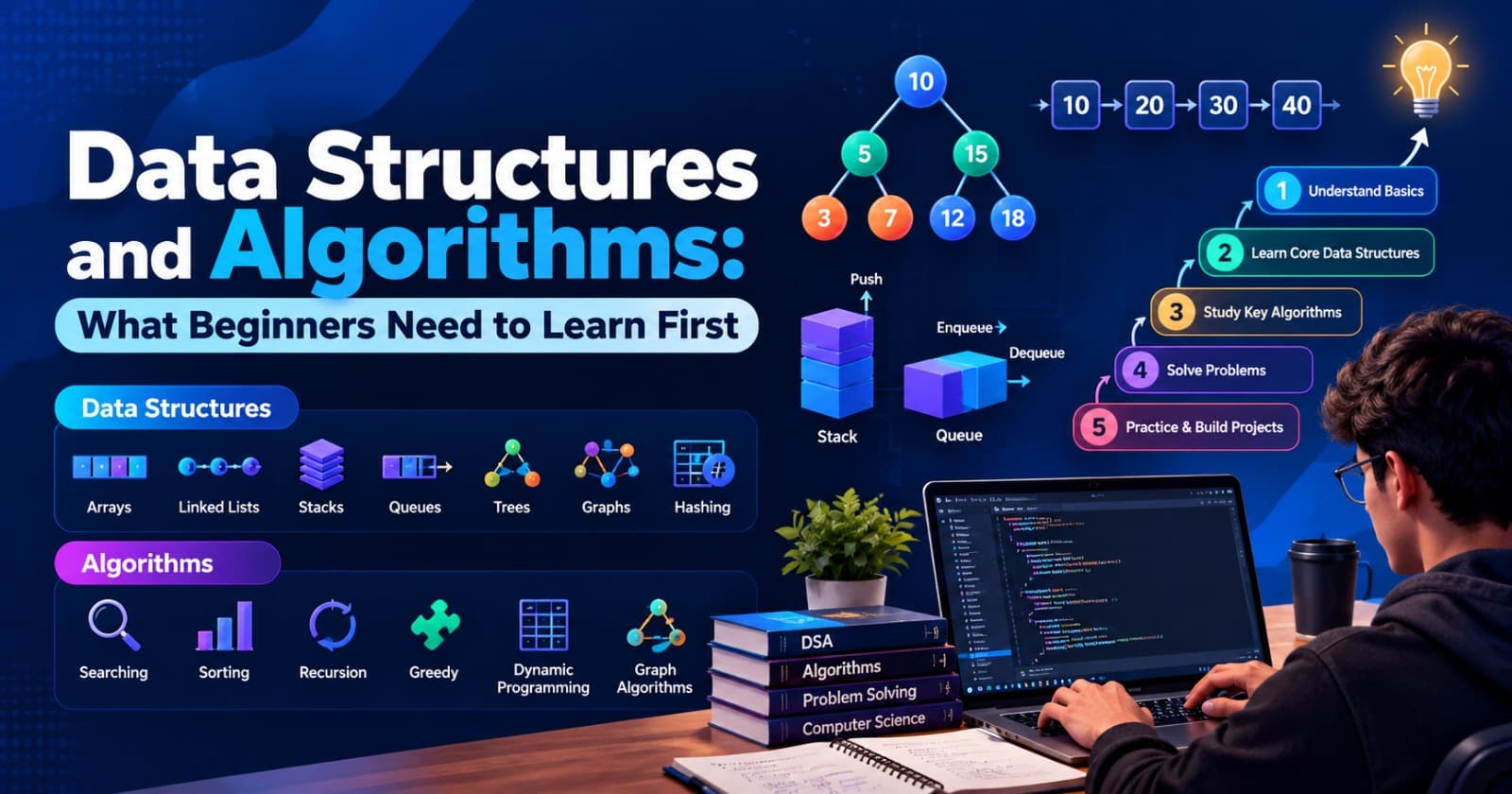
Data Structures and Algorithms (DSA) is one of the most important foundations for anyone learning programming or preparing for a career in software development. For beginners, DSA can seem difficult because it includes topics such as arrays, linked lists, stacks, queues, trees, graphs, searching, sorting, and recursion. The best approach is to learn these concepts step by step and understand how they are used to solve practical problems.
What Are Data Structures and Algorithms?
A data structure is a way of organising and storing data so that it can be accessed and managed efficiently. Common examples include arrays, linked lists, stacks, queues, trees, heaps, graphs, and hash tables.
An algorithm is a step-by-step method used to solve a particular problem. For example, searching for a particular value in a list can be done using Linear Search or Binary Search, depending on how the data is organised.
In simple terms, data structures help us understand how data is stored, while algorithms help us understand how a problem can be solved using that data.
Why Should Beginners Learn DSA?
Learning DSA for beginners helps develop logical thinking and problem-solving skills. It teaches students how to break a complex problem into smaller steps and choose an appropriate solution.
DSA is also important for technical interviews, coding assessments, and software development. Two programs may produce the same result, but one may use more time or memory than the other. Understanding DSA helps developers create more efficient solutions.
What Should Beginners Learn First?
Beginners should follow a structured learning path instead of trying to learn advanced topics immediately.
1. Programming Fundamentals
Before starting DSA, learners should understand basic programming concepts such as variables, data types, operators, conditions, loops, functions, and basic input and output.
A basic understanding of a programming language such as Java, Python, or C++ is recommended before starting DSA.
2. Time and Space Complexity
The next step is understanding time complexity and space complexity. These concepts help determine how efficiently an algorithm uses time and memory.
Beginners should become familiar with common complexities such as O(1), O(log n), O(n), O(n log n), and O(n²).
3. Arrays and Strings
Arrays are usually one of the first data structures beginners learn. Important topics include traversal, insertion, deletion, searching, updating, reversing, and sorting.
Students should also practise string manipulation, palindrome problems, character counting, and duplicate detection.
4. Linked Lists
After arrays, learners can move to linked lists. Important concepts include nodes, traversal, insertion, deletion, singly linked lists, doubly linked lists, and circular linked lists.
Problems such as reversing a linked list and finding its middle element help strengthen problem-solving skills.
5. Stacks and Queues
A stack follows the Last In, First Out principle, while a queue generally follows the First In, First Out principle.
Students should learn operations such as push, pop, enqueue, and dequeue. Practical applications include browser history, undo operations, scheduling, and expression evaluation.
6. Searching and Sorting
Searching and sorting are essential DSA concepts. Beginners should first learn Linear Search and Binary Search, followed by sorting techniques such as Bubble Sort, Selection Sort, and Insertion Sort.
Once the basics are clear, learners can progress to Merge Sort and Quick Sort.
7. Trees, Hashing, and Graphs
After learning the fundamental data structures, students can move to hashing, trees, heaps, and graphs.
Trees introduce concepts such as binary trees, tree traversals, and Binary Search Trees. Hashing helps with fast data lookup and frequency-based problems. Graphs are useful for representing relationships and networks and introduce techniques such as BFS and DFS.
Practical DSA Learning
The best way to learn data structures and algorithms is through regular coding practice. Students can work on projects such as a student ranking system using arrays and sorting, a browser history simulator using stacks, a task scheduler using priority queues, or a route-finding system using graphs.
These practical exercises help learners understand where different data structures and algorithms can be applied and improve their ability to solve programming problems.
Career Benefits of Learning DSA
Strong DSA knowledge can support preparation for roles such as Software Developer, Software Engineer, Backend Developer, Full Stack Developer, Java Developer, Python Developer, and C++ Developer.
However, DSA should be combined with other skills such as programming, databases, APIs, Git, frameworks, and real-world project development.
Why Learn DSA with techcadd?
A structured DSA course can help beginners learn concepts in the right sequence and practise them through coding problems. techcadd focuses on practical learning, concept explanation, problem-solving practice, projects, doubt support, and interview-oriented preparation.
The objective is not simply to memorise algorithms. Students should learn how to understand a problem, choose the right data structure, develop an algorithm, write the solution, and analyse its efficiency.
Conclusion
Data Structures and Algorithms provides a strong foundation for programming and software development. Beginners should start with programming fundamentals, complexity analysis, arrays, strings, linked lists, stacks, queues, searching, and sorting before moving towards trees, graphs, hashing, greedy algorithms, and dynamic programming.
With consistent practice and a step-by-step approach, DSA for beginners can become easier to understand and can significantly improve programming logic, problem-solving ability, and technical interview preparation.
What Is Data Structures and Algorithms?
Data Structures and Algorithms (DSA) are essential programming concepts that help learners organise data and solve problems efficiently. Data structures such as arrays, linked lists, stacks, queues, trees, and graphs provide different ways to store and manage information, while algorithms provide step-by-step approaches to solving problems.
Start Your DSA Learning Journey
Beginners can start with programming fundamentals and gradually learn arrays, strings, linked lists, stacks, queues, searching, sorting, trees, hashing, heaps, and graphs. Learning these concepts in the right order helps build strong programming logic and makes complex problems easier to approach.
Have a questionabout this?
Leave your number and a counsellor will call you back — about batch timings, fees, EMI options, placement record, or which track fits your degree.
- Free career counselling, no registration fee
- Weekday, evening, weekend or 1-on-1 batches
- Internship letter and placement support
Ready to get started?
Start building yourcareer today.
Talk to a counsellor today. One call is usually enough to know which track fits your degree, your schedule and the job you want.
- Free career counselling
- No registration fee
- Placement support included