How Affiliate Marketing Works: From Clicks to Commissions
On this page
- From Attention to Action: The Affiliate Marketing Journey
- Step 1: Choosing a Product or Affiliate Program
- Step 2: Understanding the Target Audience
- Step 3: Creating Valuable Content
- Step 4: Adding the Affiliate Link
- Step 5: The Click Happens
- Step 6: Tracking the Visitor
- Step 7: The Visitor Makes a Decision
- Step 8: The Conversion Happens
- Step 9: The Commission Is Recorded
- Step 10: Commission Approval and Payment
How Affiliate Marketing Works: From Clicks to Commissions
Affiliate marketing sounds simple on the surface: recommend a product, someone buys it, and you earn a commission. But behind that simple idea is a complete digital marketing system involving content, audience trust, tracking technology, brands, affiliate platforms, and consumer behaviour. When these elements work together, a simple click can become a measurable sale and, ultimately, a source of online income.
In a world where people discover products through Google searches, YouTube videos, Instagram posts, blogs, reviews, newsletters, and social media recommendations, affiliate marketing has become an important part of the digital economy. It gives creators, publishers, marketers, bloggers, influencers, and website owners an opportunity to monetize their audience without creating their own products.
The most interesting part is that affiliate marketing is not really about “selling” in the traditional sense. It is about connecting the right person with the right product at the right time. The affiliate creates useful content or recommendations, the audience clicks an affiliate link, the brand receives the visitor, and technology tracks what happens next. If the visitor completes a qualifying action, the affiliate receives a commission.
So, how exactly does this journey work? Let’s follow it from the very first impression to the final commission.
From Attention to Action: The Affiliate Marketing Journey
Every affiliate marketing journey begins with attention. Before someone clicks an affiliate link, they first need to discover the content containing that link. This could happen through a Google search, a social media post, a YouTube tutorial, an email newsletter, a comparison article, a product review, or even a recommendation from an online community.
For example, imagine someone wants to buy a new laptop for graphic design. Instead of immediately purchasing one, they may search for “best laptops for graphic designers,” watch comparison videos, read reviews, or look at buying guides. An affiliate marketer can create helpful content around that exact problem. Within the content, the marketer can recommend suitable laptops using affiliate links.
The visitor is not simply being shown an advertisement. They are receiving information that helps them make a decision. That difference is extremely important because modern consumers often research extensively before spending money.
Step 1: Choosing a Product or Affiliate Program
Before earning commissions, an affiliate needs something valuable to promote. This usually begins with selecting a product, service, company, or affiliate program that matches their audience.
Affiliate programs are offered by many types of businesses, including e-commerce companies, software providers, online learning platforms, hosting companies, financial services, travel businesses, and subscription-based services.
The smartest affiliates do not simply choose products because they offer high commissions. They consider whether the product is genuinely useful, reliable, relevant, and suitable for their audience.
For instance, if an affiliate creates content for beginner photographers, promoting photography equipment, editing software, online photography courses, or useful accessories would make more sense than promoting an unrelated product.
This is where relevance becomes powerful. When a recommendation naturally fits the audience's interests, it feels helpful rather than forced.
Step 2: Understanding the Target Audience
Successful affiliate marketing starts with understanding people, not links.
An affiliate needs to know what their audience wants, what problems they are facing, what questions they ask, and what prevents them from making a purchase.
Consider someone searching for “best budget website hosting for beginners.” They may not understand technical hosting terminology. If an affiliate simply lists ten hosting companies with complicated specifications, the visitor may leave confused.
But if the affiliate explains hosting in simple language, compares important features, discusses pricing, highlights advantages and disadvantages, and recommends suitable options for beginners, the content becomes genuinely useful.
This is why audience research is such an important part of affiliate marketing. The better you understand the audience's problem, the easier it becomes to create content that earns attention and trust.
Step 3: Creating Valuable Content
Once the product and audience are understood, the affiliate creates content.
This content can take many forms. A blogger might publish a detailed product review. A YouTuber might create a demonstration video. An Instagram creator might share a recommendation. A website owner might publish a comparison article. An email marketer might send subscribers a curated product guide.
The format can change, but the purpose remains similar: help the audience make a better decision.
High-quality affiliate content usually does more than say, “Buy this product.” It explains why the product may be useful, who should consider it, what its limitations are, and how it compares with alternatives.
For example, instead of writing “This camera is excellent,” an affiliate could explain its image quality, battery life, ease of use, strengths for beginners, limitations for professionals, and situations where another camera might be a better choice.
That kind of honest information builds credibility.
Step 4: Adding the Affiliate Link
This is where technology enters the picture.
The affiliate receives a unique tracking link from the affiliate program or network. This link identifies the affiliate who referred the visitor.
When the audience member clicks that link, the affiliate platform or merchant can associate the visit with the affiliate.
The link may contain tracking information that helps identify the referring affiliate and sometimes additional campaign information.
The visitor generally does not need to understand this technical process. From their perspective, they simply click a recommendation and visit the merchant's website.
Behind the scenes, however, that click creates a trackable journey.
Step 5: The Click Happens
The click is one of the most visible moments in affiliate marketing, but it is not the final goal.
A click simply means the audience member showed enough interest to explore the recommendation.
Suppose 10,000 people see an affiliate article and 500 click the product links. The affiliate has generated 500 referral visits.
But those 500 clicks do not automatically mean 500 commissions.
Some visitors may browse and leave. Others may compare prices. Some may return later. A smaller percentage may actually complete the required action.
This is why affiliate marketers should not focus only on clicks. Clicks create opportunities; conversions create revenue.
Step 6: Tracking the Visitor
After the visitor clicks the affiliate link, tracking technology helps connect the referral to the affiliate.
Depending on the program, tracking may involve cookies, tracking parameters, pixels, server-side methods, or other attribution technologies. The exact process varies between affiliate programs.
One common concept is the cookie window, which refers to the period during which a qualifying action may still be attributed to the affiliate after the initial referral.
For example, suppose a visitor clicks an affiliate link today but does not purchase immediately. If the program's attribution rules allow it, a later purchase within the applicable tracking period may still generate a commission for the affiliate.
However, attribution rules differ from one program to another, so affiliates should always understand the specific terms of the program they are using.
Step 7: The Visitor Makes a Decision
After clicking the affiliate link, the visitor arrives on the merchant's website.
At this point, the affiliate no longer controls the entire customer journey. The merchant's website, pricing, product quality, checkout experience, brand reputation, availability, and customer service can all influence whether the visitor converts.
This is an important lesson in affiliate marketing: you can create a fantastic recommendation and generate qualified traffic, but you cannot guarantee that every visitor will purchase.
That is why experienced affiliates carefully choose the brands they promote. A poor website or frustrating checkout experience can reduce conversions even when the affiliate's content is excellent.
Step 8: The Conversion Happens
A conversion occurs when the visitor completes the action defined by the affiliate program.
In many cases, that action is a purchase. However, conversions can take different forms.
Some affiliate programs pay for:
Completed purchases
Qualified leads
App installations
Free-trial registrations
Account sign-ups
Subscription activations
Bookings
Downloads
Other predefined actions
For example, an affiliate promoting an online software platform might earn a commission when someone subscribes to a paid plan. Another affiliate program might pay for a qualified customer enquiry rather than a sale.
Therefore, affiliates need to understand what their chosen program considers a successful conversion.
Step 9: The Commission Is Recorded
When the required action takes place, the affiliate platform records the conversion.
The system checks the referral and attribution information to determine which affiliate should receive credit.
The commission amount depends on the program.
Some programs offer a fixed amount per conversion, while others provide a percentage of the sale. Certain programs may also offer recurring commissions, meaning the affiliate can continue earning while a referred customer remains subscribed, depending on the program's terms.
For example, imagine an affiliate promotes a ₹10,000 product with a 5% commission. A qualifying sale could generate ₹500 in commission.
The numbers vary widely between industries and programs, but the fundamental model remains the same:
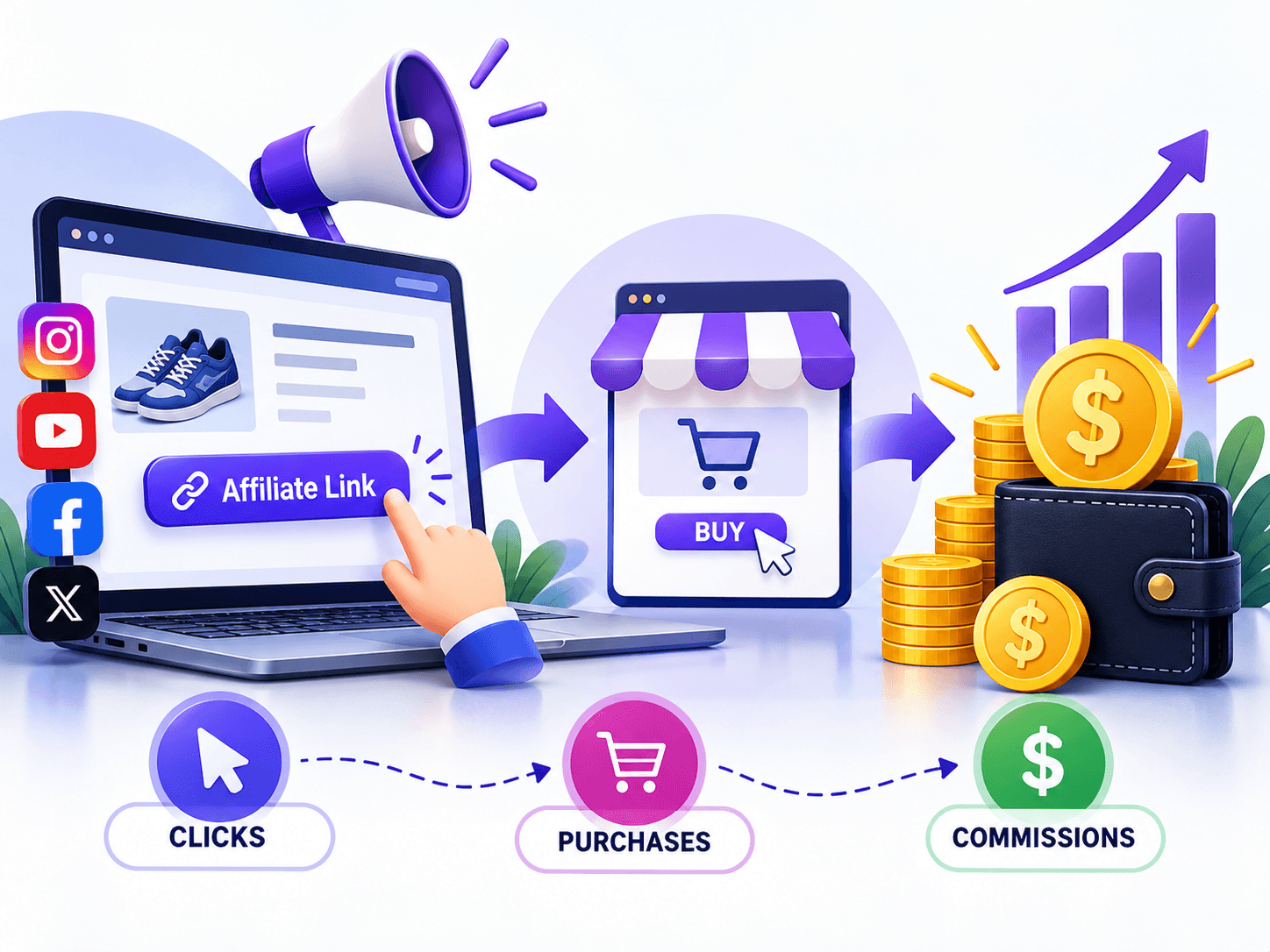
Audience → Click → Referral → Conversion → Commission
Step 10: Commission Approval and Payment
A recorded commission does not always mean immediate payment.
Many affiliate programs have a validation period. The merchant may need to confirm that the transaction was legitimate, was not cancelled or refunded, and met the program's terms.
After the applicable validation period, the commission may move from pending to approved.
Once the affiliate reaches the program's payment threshold and meets other requirements, the commission can be paid according to the program's payment schedule.
This is why affiliate marketing should not be viewed as instant money. There is usually a process between generating a conversion and receiving the actual payment.
Why Trust Is the Real Currency of Affiliate Marketing
Affiliate links and tracking technology are important, but trust is often what makes the entire system work.
People are more likely to act on recommendations from creators, publishers, or websites they consider credible.
Think about your own behaviour. If a friend recommends a useful tool and explains exactly why they like it, you may be more interested than if you see a random advertisement saying the same product is “the best.”
Affiliate marketing can work in a similar way.
The affiliate becomes a bridge between the customer and the brand. If that bridge is built on useful information and honesty, it can become extremely valuable.
On the other hand, constantly promoting low-quality products simply because they offer high commissions can damage audience trust. Once trust disappears, clicks and conversions can decline.
The best affiliate marketers therefore think beyond the immediate commission. They think about the long-term relationship with their audience.
Clicks Are Important, But Conversions Matter More
One of the biggest misconceptions about affiliate marketing is that getting lots of clicks automatically means earning lots of money.
It doesn't.
Imagine two affiliates.
Affiliate A generates 5,000 clicks but only 25 sales.
Affiliate B generates 1,500 clicks but produces 75 sales.
Affiliate B has fewer clicks but significantly more conversions.
This is why affiliates monitor metrics such as click-through rate, conversion rate, earnings per click, average order value, and overall revenue.
The goal is not simply to generate more traffic. It is to attract relevant traffic that has genuine purchase intent.
A smaller audience with strong trust and high buying intent can sometimes be more valuable than a massive audience with little interest in the promoted product.
The Role of SEO in Affiliate Marketing
Search engine optimization can be a powerful traffic source for affiliate marketers.
People frequently use search engines when they are researching products or trying to solve problems. Searches such as “best running shoes,” “best CRM for small businesses,” “laptop comparison,” or “best online accounting software” can indicate strong commercial intent.
An affiliate can create optimized content that answers these searches.
The key is not to fill an article with keywords. Modern affiliate content should genuinely answer the searcher's question.
Helpful comparisons, original insights, practical demonstrations, pros and cons, FAQs, and clear explanations can make content more useful to readers.
The ultimate objective is to attract visitors who are already interested in the topic and guide them toward an appropriate solution.
Social Media and Affiliate Marketing
Social media has opened another major opportunity for affiliate marketers.
Creators can introduce products through short videos, tutorials, reviews, demonstrations, stories, posts, and educational content.
A fitness creator might recommend workout equipment. A technology creator might review gadgets. A beauty creator might demonstrate skincare products. A business creator might recommend productivity software.
The strength of social affiliate marketing is its ability to combine content, personality, demonstration, and recommendation.
However, audiences are becoming increasingly aware of promotional content. Authenticity matters.
A creator who explains both the strengths and weaknesses of a product may appear more trustworthy than someone who describes every product as perfect.
Email Marketing: Turning One Click into a Relationship
Affiliate marketing does not always end when someone clicks a link.
Email marketing can help affiliates build longer-term relationships with their audience.
For example, someone might download a free guide and join an email list. Over time, the affiliate can provide useful tips, educational content, product comparisons, and carefully selected recommendations.
This creates multiple opportunities to provide value and, where appropriate, introduce relevant affiliate offers.
Instead of chasing a single transaction, the affiliate builds an audience they can communicate with repeatedly.
That is a major difference between short-term promotion and sustainable digital marketing.
Common Affiliate Marketing Mistakes
Affiliate marketing has plenty of opportunities, but success is not automatic.
One common mistake is promoting products without understanding them. If an affiliate has never used or properly researched a product, their recommendation may lack depth.
Another mistake is focusing too heavily on commissions. Choosing a product only because it pays well can result in irrelevant or low-quality recommendations.
Creating thin content is another problem. Simply rewriting product descriptions does not give audiences a strong reason to trust the affiliate.
Some marketers also become obsessed with traffic while ignoring conversion quality. Thousands of irrelevant visitors are not necessarily better than a smaller number of highly interested visitors.
Finally, affiliates should be transparent about their commercial relationships and follow applicable advertising, disclosure, platform, and affiliate-program requirements.
How Successful Affiliates Think Differently
Successful affiliate marketers usually stop thinking like traditional advertisers and start thinking like problem-solvers.
Instead of asking, “What product can I promote?” they ask:
“What problem is my audience trying to solve?”
Instead of asking, “How many clicks can I get?” they ask:
“Are these the right people clicking?”
Instead of asking, “How much commission does this product pay?” they ask:
“Would I genuinely recommend this product to someone I know?”
This change in mindset can completely transform an affiliate strategy.
When the focus moves from pushing products to helping people make better decisions, content becomes more valuable, trust becomes stronger, and conversions can become more natural.
The Future of Affiliate Marketing
Affiliate marketing continues to evolve alongside technology and consumer behaviour.
Artificial intelligence is helping marketers research topics, identify content opportunities, analyze performance, personalize communication, and improve workflows. Video content is becoming increasingly important, while creators are finding new ways to combine education and product recommendations.
At the same time, consumers are becoming more selective. They want authenticity, useful information, transparency, and genuine experiences.
This means the future of affiliate marketing is unlikely to belong simply to the person with the most links.
It will increasingly belong to those who can understand an audience, create useful content, build trust, and connect people with products that genuinely solve their problems.
From Clicks to Commissions: The Bigger Picture
Affiliate marketing is much more than placing links on a website.
It is a complete journey that starts with a customer's problem and ends with a measurable business outcome.
A person discovers useful content. They become curious. They click a recommendation. Tracking technology records the referral. The merchant receives the visitor. The visitor evaluates the offer. A qualifying action takes place. The affiliate platform attributes the conversion. The commission is recorded, approved, and eventually paid.
That entire journey can happen in seconds, days, or sometimes even longer, depending on the product, buying cycle, and attribution rules.
The beauty of affiliate marketing is that every stage can be improved.
Better audience research can create better content. Better content can generate more relevant clicks. Better recommendations can improve trust. Better landing pages can improve conversions. Better tracking and analytics can reveal what is working. And better optimization can turn a basic affiliate campaign into a scalable digital marketing channel.
Ultimately, affiliate marketing is about creating a win-win connection.
The customer discovers something useful. The merchant gains a customer. The affiliate earns a commission for generating the referral.
That is the real journey—from clicks to commissions.
And when the process is built around genuine value rather than aggressive selling, affiliate marketing becomes more than a way to earn online. It becomes a powerful example of how content, trust, technology, and consumer intent can work together to create measurable digital growth.
Have a questionabout this?
Leave your number and a counsellor will call you back — about batch timings, fees, EMI options, placement record, or which track fits your degree.
- Free career counselling, no registration fee
- Weekday, evening, weekend or 1-on-1 batches
- Internship letter and placement support
Ready to get started?
Start building yourcareer today.
Talk to a counsellor today. One call is usually enough to know which track fits your degree, your schedule and the job you want.
- Free career counselling
- No registration fee
- Placement support included