How Techcadd Jalandhar Helps Students Build Strong DSA Skills
Learn DSA in Jalandhar with techcadd through structured concepts, coding practice, problem solving, and technical interview preparation.
How techcadd Jalandhar Helps Students Build Strong DSA Skills
Data Structures and Algorithms (DSA) is an important part of programming and software development. Students who want to build a career in software development need more than basic programming knowledge. They need to understand how to organise data, solve problems logically, and develop efficient solutions.
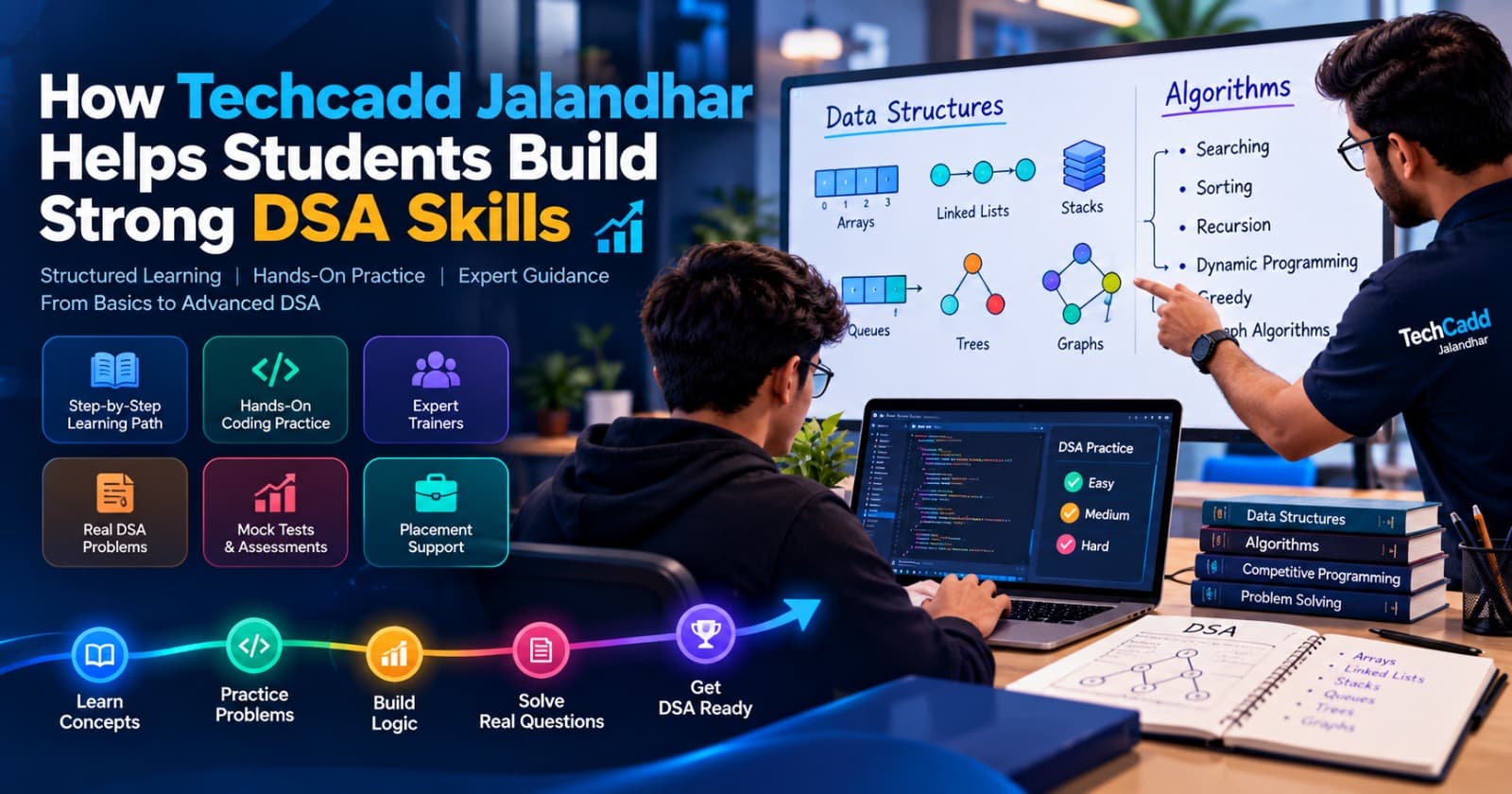
For many beginners, DSA can initially feel challenging because it includes concepts such as arrays, linked lists, stacks, queues, trees, graphs, searching, sorting, and recursion. A structured learning approach can make these concepts easier to understand and practise. techcadd Jalandhar focuses on helping students build their DSA knowledge through concept-based learning, coding practice, and problem-solving activities.
Building Strong Programming Fundamentals
A strong foundation is important before students begin advanced DSA concepts. Learners are introduced to programming fundamentals such as variables, conditions, loops, functions, arrays, and basic problem-solving.
Understanding these concepts first helps students approach DSA problems with greater confidence. Students can use programming languages such as Java, Python, or C++ depending on their learning requirements.
Learning DSA Step by Step
One of the most effective ways to learn DSA for beginners is to follow a structured sequence. Instead of starting directly with complex algorithms, students can begin with simpler data structures and gradually move towards advanced topics.
The learning journey can include arrays, strings, linked lists, stacks, queues, searching, sorting, recursion, hashing, trees, heaps, and graphs.
This step-by-step approach allows students to understand the purpose of each data structure before applying it to programming problems.
Practical Problem-Solving Approach
DSA is not only about understanding definitions or memorising algorithms. Students need regular practice to develop problem-solving skills.
At techcadd Jalandhar, learners can practise different types of programming problems based on the concepts they study. For example, after learning arrays, students can solve problems involving searching, sorting, duplicate values, and array manipulation.
Similarly, linked list practice can include insertion, deletion, traversal, reversing a list, and finding the middle element.
This type of practice helps students understand how theoretical concepts are applied to actual programming problems.
Understanding Time and Space Complexity
Learning an algorithm is only one part of DSA. Students also need to understand whether their solution is efficient.
Time complexity helps learners understand how the running time of an algorithm changes as the input size increases. Space complexity helps them understand the additional memory required by a solution.
Students can learn common complexity concepts such as O(1), O(log n), O(n), O(n log n), and O(n²). This knowledge helps them compare different solutions and select more efficient approaches.
Developing Coding and Logical Thinking Skills
Regular DSA practice helps students improve their ability to analyse a problem before writing code. Instead of immediately starting implementation, learners can first identify the input, expected output, constraints, and suitable data structure.
This process develops logical thinking, debugging skills, analytical ability, and structured problem solving.
With consistent practice, students can become more comfortable solving unfamiliar programming problems.
Preparing for Technical Interviews
DSA is commonly associated with technical interview preparation because coding assessments often test a candidate's ability to solve programming problems efficiently.
Students can use their DSA practice to prepare for questions related to arrays, strings, linked lists, stacks, queues, trees, graphs, searching, sorting, and other common programming concepts.
However, interview preparation should not focus only on memorising frequently asked questions. Understanding the underlying concepts helps students approach new problems more effectively.
Learning Through Projects and Applications
Practical projects can make DSA concepts easier to understand. Students can explore applications such as a student ranking system using sorting, a browser history system using stacks, a task scheduler using priority queues, or a route-finding system using graphs.
These projects demonstrate how different data structures and algorithms can be used to solve practical problems.
Why Choose techcadd Jalandhar for DSA Learning?
techcadd Jalandhar provides a structured environment where students can learn programming concepts, practise coding problems, clarify doubts, and work towards improving their technical skills.
The focus should be on understanding concepts rather than simply completing a syllabus. Students can gradually progress from basic data structures to more advanced topics while developing their problem-solving abilities.
Conclusion
Building strong DSA skills requires consistency, practice, and a clear learning path. Students should begin with programming fundamentals and gradually progress through arrays, linked lists, stacks, queues, searching, sorting, trees, graphs, and advanced problem-solving concepts.
With structured learning and regular coding practice, students at techcadd Jalandhar can develop stronger programming logic, problem-solving skills, algorithmic thinking, and technical interview readiness, giving them a stronger foundation for their software development journey.
Learn DSA from the Fundamentals
techcadd Jalandhar helps students build a strong foundation by starting with basic programming concepts before moving into advanced Data Structures and Algorithms. Students gradually learn arrays, strings, linked lists, stacks, queues, trees, graphs, searching, and sorting.
Practice Through Coding Problems
Regular coding practice helps students turn theoretical knowledge into practical problem-solving skills. Learners work on different programming problems to understand how DSA concepts can be applied to real situations and develop better logical thinking.
Understand Efficient Problem Solving
Students learn how to analyse different solutions using time complexity and space complexity. Understanding concepts such as O(1), O(n), O(log n), and O(n²) helps learners choose more efficient approaches to programming problems.
Prepare for Technical Interviews
Strong DSA knowledge can help students prepare for coding assessments and technical interviews. Practice with common problems involving arrays, strings, linked lists, stacks, queues, trees, and graphs helps learners become more confident when solving programming questions.
Have a questionabout this?
Leave your number and a counsellor will call you back — about batch timings, fees, EMI options, placement record, or which track fits your degree.
- Free career counselling, no registration fee
- Weekday, evening, weekend or 1-on-1 batches
- Internship letter and placement support
Ready to get started?
Start building yourcareer today.
Talk to a counsellor today. One call is usually enough to know which track fits your degree, your schedule and the job you want.
- Free career counselling
- No registration fee
- Placement support included