Java Programming Basics: A Complete Beginner’s Learning Guide
Learn Java programming basics with variables, loops, OOP, arrays, collections, exception handling, and practical projects for beginners.
On this page
- What Is Java Programming?
- Why Should Beginners Learn Java?
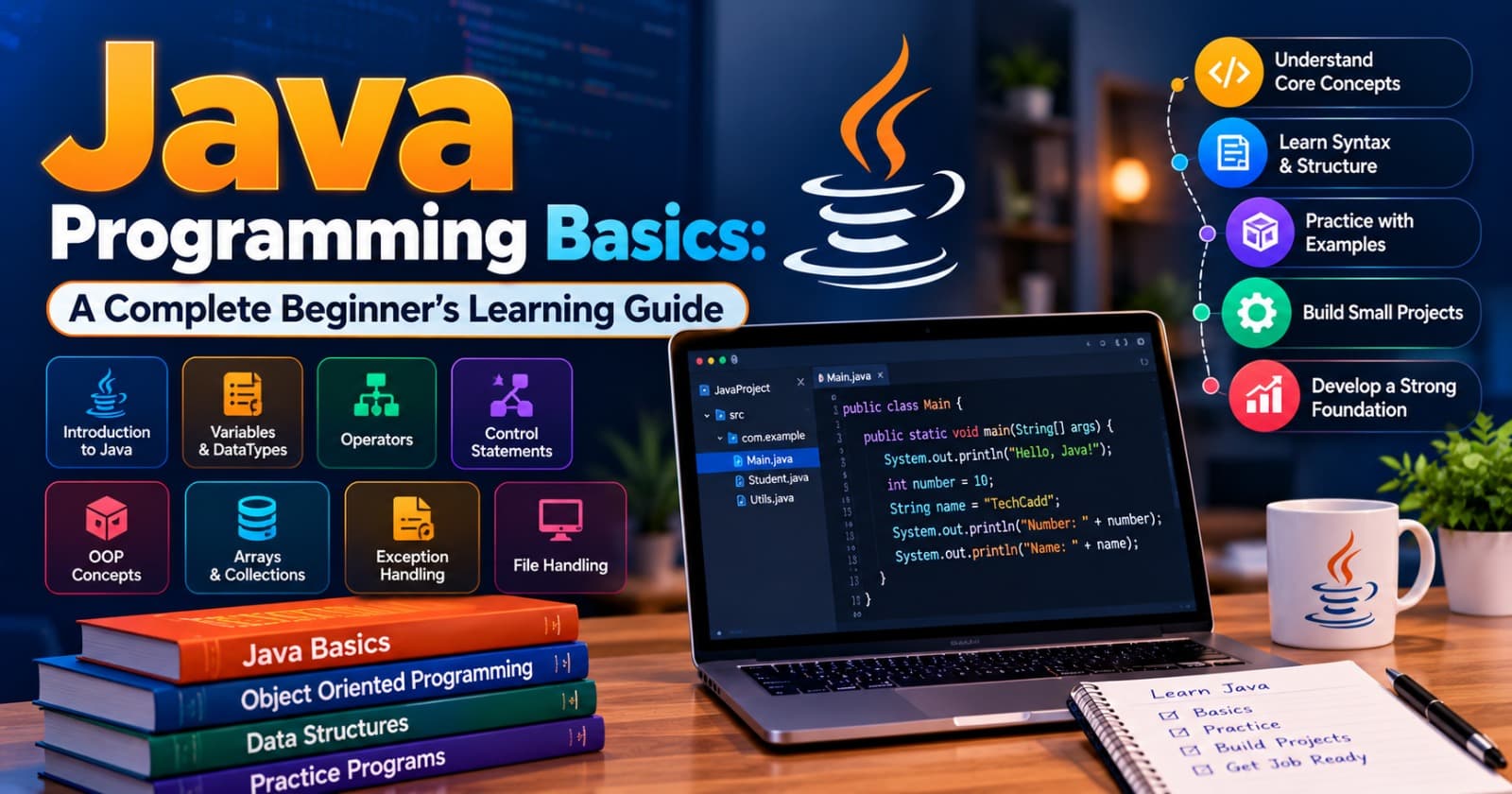
- Java Basics Beginners Should Learn First
- 1. Java Syntax and Program Structure
- 2. Variables and Data Types
- 3. Operators
- 4. Conditional Statements
- 5. Loops
- 6. Arrays and Strings
- Understanding Object-Oriented Programming
- Exception Handling
- Collections Framework
- Practical Java Learning
- Why Learn Java with techcadd?
- Career Opportunities
- Conclusion
Java Programming Basics: A Complete Beginner’s Learning Guide
Java programming is one of the most widely used programming technologies for learning software development and building different types of applications. Its structured syntax, object-oriented approach, and extensive ecosystem make Java a useful language for beginners who want to develop strong programming fundamentals.
For students who are new to programming, learning Java step by step is important. Instead of trying to learn advanced concepts immediately, beginners should first understand the basic syntax, variables, data types, conditions, loops, methods, and object-oriented programming concepts.
What Is Java Programming?
Java is a high-level, object-oriented programming language used to develop applications for different platforms. One of its well-known features is its ability to run Java applications across different systems through the Java Virtual Machine (JVM).
Java is used in areas such as web development, backend development, enterprise applications, Android development, and software engineering.
Its strong community and extensive collection of libraries and frameworks also make it a valuable language for students and aspiring developers.
Why Should Beginners Learn Java?
Java provides a structured way to learn programming concepts. Its syntax encourages students to understand how programs are organised and how different components work together.
Learning Java can help beginners develop:
Programming logic
Problem-solving skills
Object-oriented programming knowledge
Understanding of data structures
Debugging skills
Software development fundamentals
Java is also commonly used with Data Structures and Algorithms (DSA), making it useful for students preparing for coding assessments and technical interviews.
Java Basics Beginners Should Learn First
A beginner-friendly Java learning path should start with the fundamentals.
1. Java Syntax and Program Structure
Students should first understand how a basic Java program is structured. This includes classes, the main method, statements, comments, and how Java programs are compiled and executed.
2. Variables and Data Types
Variables are used to store information in a program. Beginners should learn data types such as int, float, double, char, boolean, and String.
Understanding variables and data types is essential before moving to more complex programming concepts.
3. Operators
Java provides different operators for performing calculations and comparisons.
Students should learn arithmetic, relational, logical, assignment, and increment/decrement operators and understand where each type is used.
4. Conditional Statements
Conditional statements allow programs to make decisions based on specific conditions.
Beginners should learn if, if-else, else-if, and switch statements and practise problems involving numbers, grades, eligibility checks, and other decision-making situations.
5. Loops
Loops are used when a particular block of code needs to execute repeatedly.
Students should learn for, while, and do-while loops and practise problems such as number patterns, multiplication tables, counting, and calculating sums.
6. Arrays and Strings
Once basic programming concepts are clear, learners can start working with arrays and strings.
Arrays allow multiple values to be stored in a single structure, while strings are used to work with text. Beginners can practise searching, sorting, reversing, and manipulating data.
Understanding Object-Oriented Programming
One of the most important parts of Java is Object-Oriented Programming (OOP).
Beginners should understand:
Classes and objects
Constructors
Encapsulation
Inheritance
Polymorphism
Abstraction
OOP helps developers organise large programs into reusable and manageable components.
Exception Handling
Programs may encounter errors during execution. Java provides exception handling to manage many runtime problems in a controlled way.
Students should learn concepts such as try, catch, finally, throw, and throws.
Understanding exception handling helps beginners write more reliable programs.
Collections Framework
After learning the fundamentals, students can explore Java's Collections Framework.
Important collections include:
ArrayList
LinkedList
HashSet
HashMap
Queue
Stack concepts
These structures are useful for storing and processing collections of data and are frequently used alongside DSA concepts.
Practical Java Learning
The best way to learn Java is through regular coding practice. Beginners can build simple projects such as a student management system, calculator, quiz application, banking system, or employee management application.
Practical projects help learners connect programming concepts with real application requirements.
Why Learn Java with techcadd?
A structured Java programming course can help beginners learn concepts in a logical sequence while getting opportunities to practise coding problems and application-based exercises.
techcadd focuses on concept-based learning, practical programming, problem-solving, project guidance, and support for students who want to strengthen their Java fundamentals.
The goal is to help learners understand how Java works rather than simply memorising syntax.
Career Opportunities
Java skills can support preparation for roles such as Java Developer, Backend Developer, Software Developer, Software Engineer, and Application Developer.
Students can further strengthen their career profile by learning DSA, SQL, databases, REST APIs, Git, Spring Boot, and other relevant development technologies.
Conclusion
Learning Java is a strong starting point for beginners who want to develop programming and software development skills. Start with syntax, variables, data types, operators, conditions, loops, arrays, and strings. Then progress to OOP, exception handling, collections, DSA, and practical projects.
With consistent practice and a structured learning approach, beginners can build a solid Java foundation and gradually progress towards developing real-world applications.
Start with Java Programming Fundamentals
Learn the basics of Java programming through a structured approach covering variables, data types, operators, conditions, loops, methods, arrays, and strings. A strong understanding of these fundamentals helps beginners develop better programming logic.
Understand Object-Oriented Programming
Java is based on Object-Oriented Programming (OOP) concepts. Students learn classes, objects, constructors, inheritance, encapsulation, polymorphism, and abstraction to understand how Java applications are structured and developed.
Practise Java Through Projects
Practical coding helps students apply Java concepts beyond theory. Beginners can work on projects such as student management systems, calculators, quiz applications, banking systems, and employee management applications to strengthen their programming skills.
Have a questionabout this?
Leave your number and a counsellor will call you back — about batch timings, fees, EMI options, placement record, or which track fits your degree.
- Free career counselling, no registration fee
- Weekday, evening, weekend or 1-on-1 batches
- Internship letter and placement support
Ready to get started?
Start building yourcareer today.
Talk to a counsellor today. One call is usually enough to know which track fits your degree, your schedule and the job you want.
- Free career counselling
- No registration fee
- Placement support included