Why Choose the Computer Vision Certificate Course?
Discover why to choose a Computer Vision course: explore key skills, career growth, target industries, and hands-on training with techcadd.
1. Certification
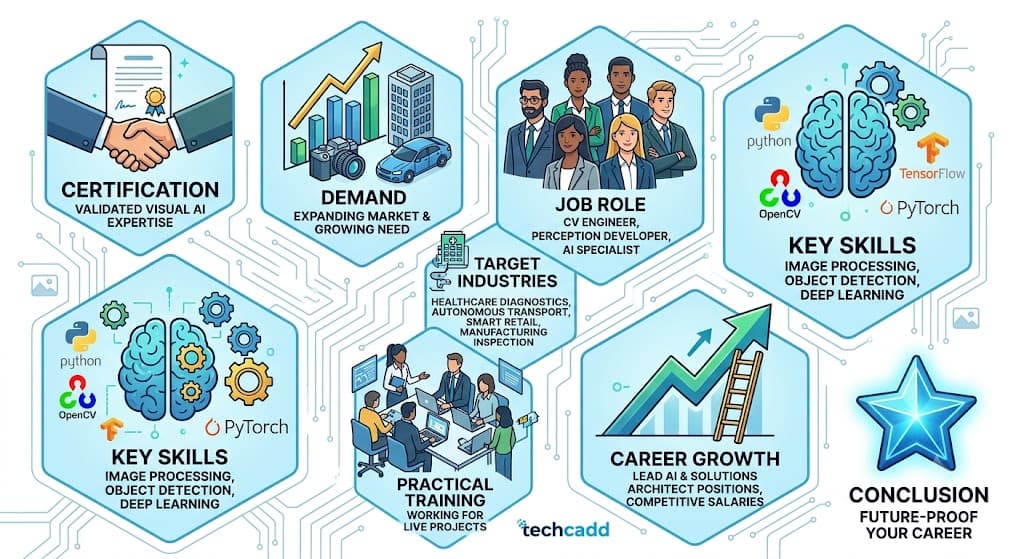
Earning a Computer Vision Certificate validates your expertise in image processing, deep learning, and visual AI architectures. It serves as proof to potential employers that you have hands-on experience with industry-standard frameworks and are capable of building real-world visual perception systems.
2. Demand
The global Computer Vision market is expanding rapidly across smart manufacturing, healthcare diagnostic tools, autonomous transport, and security systems. Companies are actively seeking skilled engineers who can process, analyze, and extract actionable insights from visual data like images and video streams.
3. Job Roles
Completing this certification prepares you for high-impact roles, including:
Computer Vision Engineer
AI/Machine Learning Engineer
Image Processing Specialist
Perception Software Engineer
Robotics Vision Developer
4. Key Skills
Through this program, you will develop proficiency in:
Core Tools & Frameworks: Python, OpenCV, TensorFlow, PyTorch
Techniques: Image Segmentation, Object Detection, Feature Extraction, Optical Character Recognition (OCR)
Neural Networks: Convolutional Neural Networks (CNNs), Vision Transformers (ViTs), YOLO architectures
Deployment: Edge AI integration and real-time video stream processing
5. Target Industries
Computer Vision technology powers innovation across diverse sectors:
Healthcare & Medical Imaging: Automated X-ray/MRI analysis and disease detection
Automotive & Autonomous Systems: Self-driving vehicles, driver monitoring, and robotics
Retail & E-commerce: Automated checkout systems, visual search, and inventory tracking
Security & Surveillance: Facial recognition, access control, and automated monitoring
Agriculture & Manufacturing: Crop monitoring, automated quality inspection, and defect detection
6. Career Growth
As visual AI becomes a core component of modern software solutions, professionals skilled in Computer Vision experience rapid career progression. Starting as a junior or mid-level vision developer, you can quickly advance to lead AI roles, solutions architect positions, or specialized research engineer roles with competitive salary growth.
7. Reality Check
While Computer Vision offers exciting opportunities, it comes with a learning curve:
Math & Fundamentals: Requires a solid grasp of linear algebra, calculus, and matrix operations.
Data Quality Challenges: Real-world visual data is often noisy, poorly lit, or unstructured, requiring significant pre-processing efforts.
Hardware Dependencies: Training deep vision models requires understanding GPU acceleration and optimization techniques.
8. Practical Training
Our program focuses on project-based learning rather than pure theory. You will work on real-world projects such as automated license plate recognition, real-time object tracking, medical image segmentation, and edge device deployment to build a portfolio that demonstrates your capabilities to recruiters.
Conclusion
Choosing a Computer Vision Certificate Course is a strategic step toward building a future-proof career in Artificial Intelligence. By mastering both the theoretical foundations and hands-on implementation of visual perception systems, you will position yourself at the forefront of one of technology's fastest-growing fields.
Have a questionabout this?
Leave your number and a counsellor will call you back — about batch timings, fees, EMI options, placement record, or which track fits your degree.
- Free career counselling, no registration fee
- Weekday, evening, weekend or 1-on-1 batches
- Internship letter and placement support
Ready to get started?
Start building yourcareer today.
Talk to a counsellor today. One call is usually enough to know which track fits your degree, your schedule and the job you want.
- Free career counselling
- No registration fee
- Placement support included